What Would Thoreau Do?

Yesterday, July 12th, was Henry David Thoreau’s 195th birthday, or 195th anniversary of his birth, or however that is best put when the person in question is no longer alive. In any case, Thoreau is best remembered for two things. The first is his experiment in living simply and in greater communion with nature in a cabin on the outskirts of Concord, Massachusetts. The cabin was situated on Walden Pond and Thoreau’s reflections on his “experiment” were later published as Walden.

Thoreau is also remembered for making a better pencil. It seems that Thoreau is actually not generally remembered for this, but it is nonetheless true. His family owned a pencil factory at which Thoreau worked on and off throughout his life. Thanks to his study of German pencil making techniques, Thoreau helped design the best American pencil of its day. Apparently, in the early 19th century, there remained significant technical challenges to the making of a durable pencil, mostly having to do with the sturdiness of the graphite shaft and fitting it into a casing. Among Thoreau’s many accomplishments was the development of a process of manufacturing the pencil that solved these engineering problems.

I thought of Thoreau yesterday not only because it was the anniversary of his birth, but also because I had come across an article titled, “Tweets From the Trail: Technology Can Enhance Your Wilderness Experiences” (h/t to Nathan Jurgenson). The author, novelist Walter Kirn of Montana, had the temerity to suggest that maybe there is something to be gained by brining your technology out into nature with you, rather than venturing into nature in order to escape technology. As you might imagine, many of Kirn’s Montana nature-enthusiast friends were less than pleased.

Now, we should note that these distinctions we make — nature/technology, for example — are a bit complicated. To illustrate here is the opening of a recent, relevant post by Nick Carr:

A couple of cavemen are walking through the woods. One sighs happily and says to the other, “I’m telling you, there’s nothing like being out in nature.” The other pauses and says, “What’s nature?”

It’s 1972. A pair of lovers go camping in a wilderness area in a national park. They’re sitting by a campfire, taking in the evening breezes. “Honey,” says the woman, “I have to confess I really love being offline.” The guy looks at her and says, “What’s offline?”

You see the point. Our idea of “nature” owes something to the advance of technology just as our idea of “offline” necessitates the emergence of online. But back to Kirn’s article. He discovered that his writing flourished when he set up a work station on an old wooden telephone wire spool under the big, blue Montana sky with badgers and gophers scampering all about. Subsequently he made a habit of screening movies on his iPad in “natural” settings such as the seaside or the shores of a river. Finally, he confesses to the manner in which being out in the wilderness inspires fits of creativity that he feels compelled to tweet and post. And here is his eloquent conclusion:

“To sever our experience of wilderness from our use of technology now seems to me an unnatural act, shortsighted and unimaginative. No one appreciates a ringing cell phone while they float on a muddy river through western badlands or stand in the saddle between two massive mountain ranges, but short of such rude interruptions of heavenly moments, technology has a mysterious way, at times, of providing the perfect contrast, the happy counterpoint to scenes and experiences and settings that are easy to take for granted or grow numb to. Along with harmony, contrast is one of the two great rules of art. It wakes the senses, jars the tired mind, breaks up routines that threaten to grow mechanical. If you don’t believe me, try it. Travel to that secluded spot you keep returning to, the one where you go to leave the world behind, and turn on some music, play a movie, capture a passing thought and send it onward, out of the forest, out into society, and then wait, while the wind blows and the treetops sway and the clouds pile up a mile above your head, for someone, some faraway stranger, to reply. Even when we’re alone, we’re not alone, this proves, and in the deepest heart of every wilderness lurks a miracle, often, the human mind.”

I can’t help but wonder, what would Thoreau think? I can’t pretend to know Thoreau well enough to answer that question. I suspect that present day technophile’s would suggest that Thoreau ought to approve, after all he took his pencil to Walden and that was a technology. Well, yes, but he didn’t string a telegraph wire to the cabin.

I wouldn’t discount the dynamic Kirn describes, particularly since it is measured (let’s do without the ringing cell phone) and it still recognizes the contrast. The juxtaposition of unlike things can be creatively stimulating, and if that is what you are after, then Kirn’s formula may indeed yield something for you.

But what if your aims are different? What if you’re seeking only to listen and not to speak? What if your goal is not to be inspired toward yet another act of self-expression? We may carry technology with us into nature, in fact, we may carry it within us. But this does not mean that we ought always to answer to its prerogatives. Nor does it mean that we should always assume the posture toward reality that technology enables and the frame of mind that it encourages. And, of course, different technologies enable and encourage differently. It is the difference between the pencil and the telegraph and the smartphone.

I am not against human civilization (which is a silly thing to have to say), and the human mind, as Kirn puts it, is a “miracle” indeed. But the miracle of the human mind lies not only in its ability to create and to build and to express itself and impose its own symbolic order on the world. The miracle lies also in its ability to listen and to receive and to contemplate and to be itself re-ordered; to be taken in by the world as well as to take the world in. Perceiving the value of such a stance draws us into an awareness of the various ethical or philosophical frames that inform our evaluations. I cannot sort all of those out, but I can acknowledge that for a wide array of people the point would not be to speak, but to be spoken to. Or perhaps, even to find that we are not addressed at all.

An even greater array of people would likely agree that our posture toward this world ought to be more than merely instrumental. Human civilization must advance, but it does so best when it abandons Promethean aspirations and acknowledges its finitude along with its power.

I suppose all of this is a way of saying that beauty resides not only in what we make and say, but also in what we find and encounter. But shouldn’t this found beauty be shared? Maybe. But perhaps not before it has done its work on us. Perhaps not before we have allowed it to speak to us and to transform us. The space in which beauty can do its work is precious, and it would seem that the logic of our technologies would have us collapse that space in the service of sharing, commodification, self-expression, capturing, publicizing, and the like.

I don’t want to speak for Thoreau, but I would venture to guess that he might have us preserve that precious space where beauty has its way.

Arts of Memory 2.0: The Sherlock Update

I’m a little behind the times, I know, but I just finished watching the second episode in the second season of Sherlock, “The Hounds of Baskerville.” If you’ve watched the episode, you’ll remember a scene in which Sherlock asks to be left alone so that he may enter his “Mind Palace.” (If you’ve not been watching Sherlock, you really ought to.) The “Mind Palace” in question turns out to be what has traditionally been called a memory palace or memory theater. It is the mental construct at the heart of the ancient ars memoria, or arts of memory.

Longtime (and long-suffering) readers will remember a handful of posts discussing this ancient art and also likening Facebook to something like a materialized memory palace (here, here, and here). To sum up:

“… the basic idea is that one constructs an imagined space in the mind (similar to the work of the Architect in the film Inception, only you’re awake) and then populates the space with images that stand in for certain ideas, people, words, or whatever else you want to remember.  The theory is that we remember images and places better than we do abstract ideas or concepts.”

And here is the story of origins:

“… the founding myth of what Frances Yates has called the “art of memory” as recounted by Cicero in his De oratore. According to the story, the poet Simonides of Ceos was contracted by Scopas, a Thessalian nobleman, to compose a poem in his honor.  To the nobleman’s chagrin, Simonides devoted half of his oration to the praise of the gods Castor and Pollux.  Feeling himself cheated out of half of the honor, Scopas brusquely paid Simonides only half the agreed upon fee and told him to seek the rest from the twin gods.  Not long afterward that same evening, Simonides was summoned from the banqueting table by news that two young men were calling for him at the door.  Simonides sought the two callers, but found no one.  While he was out of the house, however, the roof caved in killing all of those gathered around the table including Scopas. As Yates puts it, “The invisible callers, Castor and Pollux, had handsomely paid for their share in the panegyric by drawing Simonides away from the banquet just before the crash.

The bodies of the victims were so disfigured by the manner of death that they were rendered unidentifiable even by family and friends.  Simonides, however, found that he was able to recall where each person was seated around the table and in this way he identified each body.  This led Simonides to the realization that place and image were the keys to memory, and in this case, also a means of preserving identity through the calamity of death.”

The most interesting thing about the manner in which Sherlock presents the memory palace is that it has been conceived on the model of something like a touchscreen interface. You can watch the clip below to see what I mean. In explaining what Holmes is doing to a third party, Watson describes something like a traditional memory palace (not in the video clip). But what we see him doing is quite different. Rather than mentally walking through an architectural space, Holmes swipes at images (visualized for the audience) organized into something like an alphabetic multi-media database.

Surprisingly, though, this stripped down structure does have a precedent in the medieval practice of the arts of memory. Ivan Illich describes what 12th century scholar Hugh of St. Victor required of his pupils:

“… Hugh asks his pupils to acquire an imaginary inner space … and tells them how to proceed in its construction. He asks the pupil to imagine a  sequence of whole numbers, to step on the originating point of their run and let the row reach the horizon. Once these highways are well impressed upon the fantasy of the child, the exercise consists in mentally ‘visiting’ these numbers at random. In his imagination the student is to dart back and forth to each of the spots he has marked by a roman numeral.”

This flat and bare schematic was the foundation for more elaborate, three dimensional memory palaces to be built later.

The update to the memory theater is certainly not out of keeping with the spirit of the tradition which always looked to familiar spaces as a model. What more familiar space can we conceive of these days than the architecture of our databases. Thought experiment: Visualize your Facebook page. Can you do it? Can you scroll through it? Can you mentally click and visualize new pages? Can you scroll through your friends? Might you even be able to mentally scroll through your pictures? Well, there you have it; you have a memory palace and you didn’t even know it.

The Simple Life in the Digital Age

America has always been a land of contradictions. At the very least we could say the nation’s history has featured the sometimes creative, sometimes destructive interplay of certain tensions. At least one of these tensions can be traced right back to the earliest European settlers. In New England, Puritans established a “city on a hill,” a community ordered around the realization of a spiritual ideal.  Further south came adventurers, hustlers, and entrepreneurs looking to make their fortune. God and gold, to borrow the title of Walter R. Mead’s account of the Anglo-American contribution to the formation of the modern world, sums it up nicely.  Of course, this is also a rather ancient opposition. But perhaps we could say that never before had these two strands come together in quite the same way to form the double helix of a nation’s DNA.

This tension between spirituality and materialism also overlaps with at least two other tensions that have characterized American culture from its earliest days: The first of these, the tension between communitarianism and individualism, is easy to name. The other, though readily discernible, is a little harder to capture. For now I’m going to label this pair hustle and contemplation and hope that it conveys the dynamic well enough. Think Babbitt and Thoreau.

These pairs simplify a great deal of complexity, and of course they are merely abstractions. In reality, the oppositions are interwoven and mutually dependent. But thus qualified, they nonetheless point to recurring and influential types within American culture. These types, however, have not been balanced and equal. There has always seemed to be a dominant partner in each pairing: materialism, individualism, and hustle. But it would be a mistake to underestimate the influence of spirituality, communitarianism, and contemplation. Perhaps it is best to view them as the counterpoint to the main theme of American culture, together creating the harmony of the whole.

One way of nicely summing up all that is entailed by the counterpoints is to call it the pursuit of the simple life. The phrase sounds quaint, but it worked remarkably well in the hands of historian David E. Shi. In 1985, right in the middle of the decade that was to become synonymous with crass materialism – the same year Madonna released “Material Girl” – Shi published The Simple Life: Plain Living And High Thinking In American Culture. The audacity!

Shi weaves a variegated tapestry of individuals and groups that have advocated the simple life in one form or another throughout American history. Even though he purposely leaves out the Amish, Mennonites, and similar communities, he still is left with a long and diverse list of practitioners. Altogether they represent a wide array of motives animating the quest for the simple life. These include: “a hostility toward luxury and a suspicion of riches, a reverence for nature and a preference for rural over urban ways of life and work, a desire for personal self-reliance through frugality and diligence, a nostalgia for the past and a scepticism toward the claims of modernity, conscientious rather than conspicuous consumption, and an aesthetic taste for the plain and functional.”

This net gathers together Puritans and Quakers, Jeffersonians and Transcendentalists, Agrarians and Hippies, and many more. Perhaps if Shi were to update his work he might include hipsters in the mix. In any case, he would have no shortage of contemporary trends and movements to choose from. None of them dominant, of course, but recognizable and significant counterpoints still.

If I were tasked with updating Shi’s book, for example, I would certainly include a chapter on the critics of the digital age. Not all such critics would fit neatly into the simple life tradition, but I do think a good many would – particularly those who are concerned that the pace and rhythm of digitally augmented life crowds out solitude, silence, and reflection. Think, for example, of the many “slow” movements and advocates (myself included) of digital sabbaths. They would comfortably take their place alongside a many of the individuals and movements in Shi’s account who have taken the personal and social consequences of technological advance as their foil. Thoreau is only the most famous example.

Setting present day critics of digital life in the tradition identified by Shi has a few advantages. For one thing, it reminds us that the challenges posed by digital technologies, while having their particularities, are not entirely novel in character. Long before the dawn of the digital age, individuals struggled to find the right balance between their ideals for the good life and the possibilities and demands created by the emergence of new technologies.

Moreover, we may readily and fruitfully apply some of Shi’s conclusions about the simple life tradition to the contemporary criticisms of life in the digital age.

First, the simple life has always been a minority ethic. “Many Americans have not wanted to lead simple lives,” Shi observes, “and not wanting to is the best reason for not doing so.” But, in his view, this does not diminish the salutary leavening effect of the few on the culture at large.

Yet , Shi concedes, “Proponents of the simple life have frequently been overly nostalgic about the quality of life in olden times, narrowly anti-urban in outlook , and too disdainful of the benefits of prosperity and technology.” Better to embrace the wisdom of Lewis Mumford, “one of the sanest of all the simplifiers” in Shi’s estimation. According to Mumford,

“It is not enough to say, as Rousseau once did, that one has only to reverse all current practice to be right … If our new philosophy is well-grounded we shall not merely react against the ‘air-conditioned nightmare’ of our present culture; we shall also carry into the future many elements of quality that this culture actually embraces.”

Sound advice indeed.

If we are tempted to dismiss the critics for their inconsistencies, however, Shi would have us think again: “When sceptics have had their say, the fact remains that there have been many who have demonstrated that enlightened self-restraint can provide a sensible approach to living that can be fruitfully applied in any era.”

But it is important to remember that the simple life at its best, now as ever, requires a person “willing it for themselves.” Impositions of the simple life will not do. In fact, they are often counterproductive and even destructive. That said, I would add, though Shi does not make this point in his conclusion, that the simple life is perhaps best sustained within a community of practice.

Wisely, Shi also observes, “Simplicity is more aesthetic than ascetic in its approach to good living.” Consequently, it is difficult to lay down precise guidelines for the simple life, digital or otherwise. Moderation takes many forms. And so individuals must deliberately order their priorities “so as to distinguish between the necessary and superfluous, useful and wasteful, beautiful and vulgar,” but no one such ordering will be universally applicable.

Finally, Shi’s hopeful reading of the possibilities offered by the pursuit of the simple life remains resonant:

“And for those with the will to believe in the possibility of the simple life and act accordingly, the rewards can be great. Practitioners can gradually wrest control of their own lives from the manipulative demands of the marketplace and the workplace … Properly interpreted, such a modern simple life informed by its historical tradition can be both socially constructive and personally gratifying.”

Nathan Jurgenson has recently noted that criticisms of digital technologies are often built upon false dichotomies and a lack of historical perspective. In this respect they are no different than criticisms advanced by advocates of the simple life who were also tempted by similar errors. Ultimately, this will not do. Our thinking needs to be well-informed and clear-sighted, and the historical context Shi provides certainly moves us toward that end. At the very least, it reminds us that the quest for simplicity in the digital age had its analog precursors from which we stand to learn a few things.

Incommensurable Losses

Every so often I pop in my old audio tapes of Jacques Barzun’s From Dawn to Decadence and, at the expense of sounding hopelessly nostalgic, it leaves me thinking that scholarship is not what it used to be. It reminds me of a few lines from Edward Said that I first came across via Alan Jacobs some time ago, although I no longer remember where exactly. Said, thinking of the humanistic scholars of the mid-twentieth century wrote:

“This is not to say that we should return to traditional philological and scholarly approaches to literature. No one is really educated to do that honestly anymore, for if you use Erich Auerbach and Leo Spitzer as your models you had better be familiar with eight or nine languages and most of the literatures written in them, as well as archival, editorial, semantic, and stylistic skills that disappeared in Europe at least two generations ago.”

In any case, this meandering all leads to a passage from Barzun with which I will leave you. It is a moving estimation of the losses occasioned by the First World War, a war the consequences of which I tend to think we underestimate. Here is Barzun:

“Varying estimates have been made of the losses that must be credited to the great illusion. Some say 10 million lives were snuffed out in the 52 months and double that number wounded. Others propose higher or lower figures. The exercise is pointless, because loss is a far wider category than death alone. The maimed, the tubercular, the incurables, the shell-shocked, the sorrowing, the driven mad, the suicides, the broken spirits, the destroyed careers, the budding geniuses plowed under, the missing births were losses, and they are incommensurable … One cannot pour all human and material resources into a fiery cauldron year after year and expect to resume normal life at the end of the prodigal enterprise.”

And so, to varying degrees, it must be with any war.

The Architectural Legacy of Barcelona’s World’s Fairs

When world’s fairs close shop most of their buildings and structures are torn down and forgotten. This is as planned; most world’s fair architecture is designed to be temporary. Moreover, some world’s fair architecture was later destroyed by fire including London’s Crystal Palace and Chicago’s White City.  There are notable exceptions to this intended and unintended architectural ephemerality, of course. The Eiffel Tower is just the most famous instance of an enduring architectural legacy bequeathed to a city by a world’s fair. Seattle’s Space Needle would be another. We might also add a number of contemporary museums that are today housed in buildings first designed as world’s fair pavilions. Examples include the Queen’s Museum of Art in New York and The Museum of Science and Industry in Chicago.

Barcelona’s diverse architectural heritage which includes ancient Roman structures alongside bold modernist designs with medieval cathedrals between them also features a surprising number of prominent world’s fair contributions. A number of these are from the Exposición Universal de Barcelona held in 1888. But the most grand and impressive structures are gathered around the Plaça d’Espanya at the foot of Montjuïc and were built for the 1929 Barcelona International Exposition.

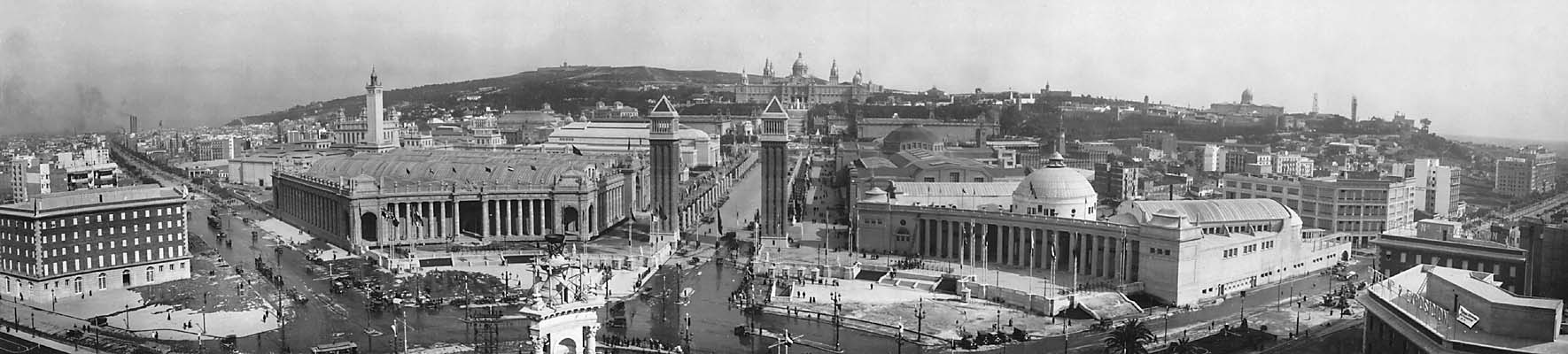
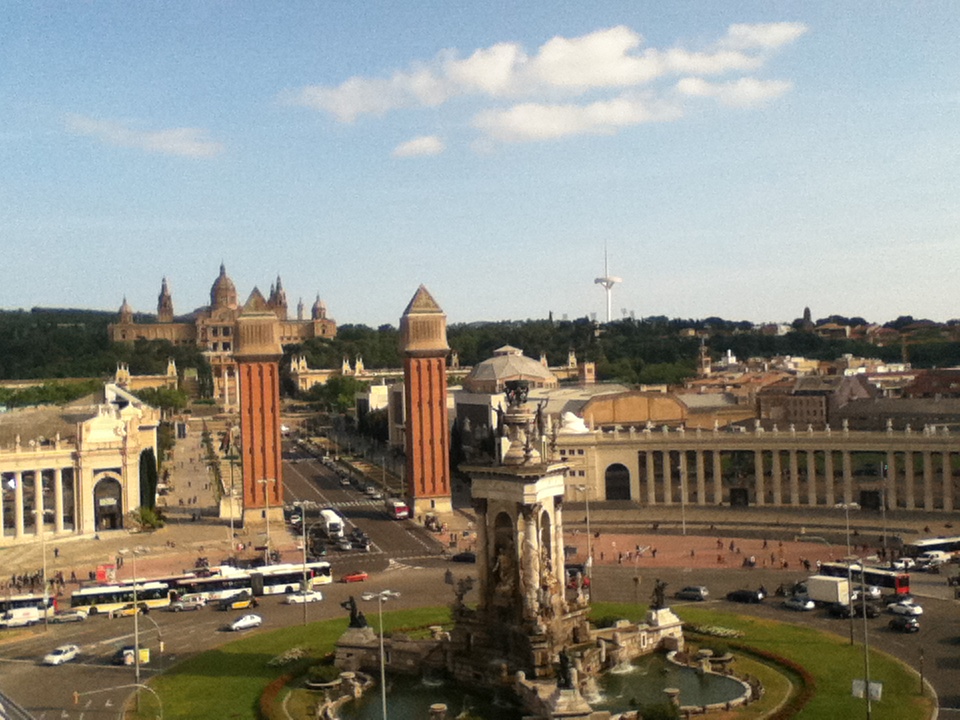
While in Barcelona two weeks ago I had the opportunity to take in some of these public spaces. Below are a few shots I gathered with a couple of additions for perspective, both temporal and spatial. To begin with, here is a shot taken from atop a former bull fighting arena now turned into a stylish shopping center. The shot was taken with my iPod so the quality is a bit lacking, but it shows a good bit of the roundabout that is Plaça d’Espanya along with several of the structures built for the 1929 Exposition. These include the Venetian inspired towers, the St. Peter’s inspired colonnades, and the Spanish Renaissance inspired palace in the background. Also visible is the Montjuïc Communications Tower built for the 1992 Olympics.

This panoramic black and white, which clearly I did not take, shows the same area and more as it appeared in 1929.

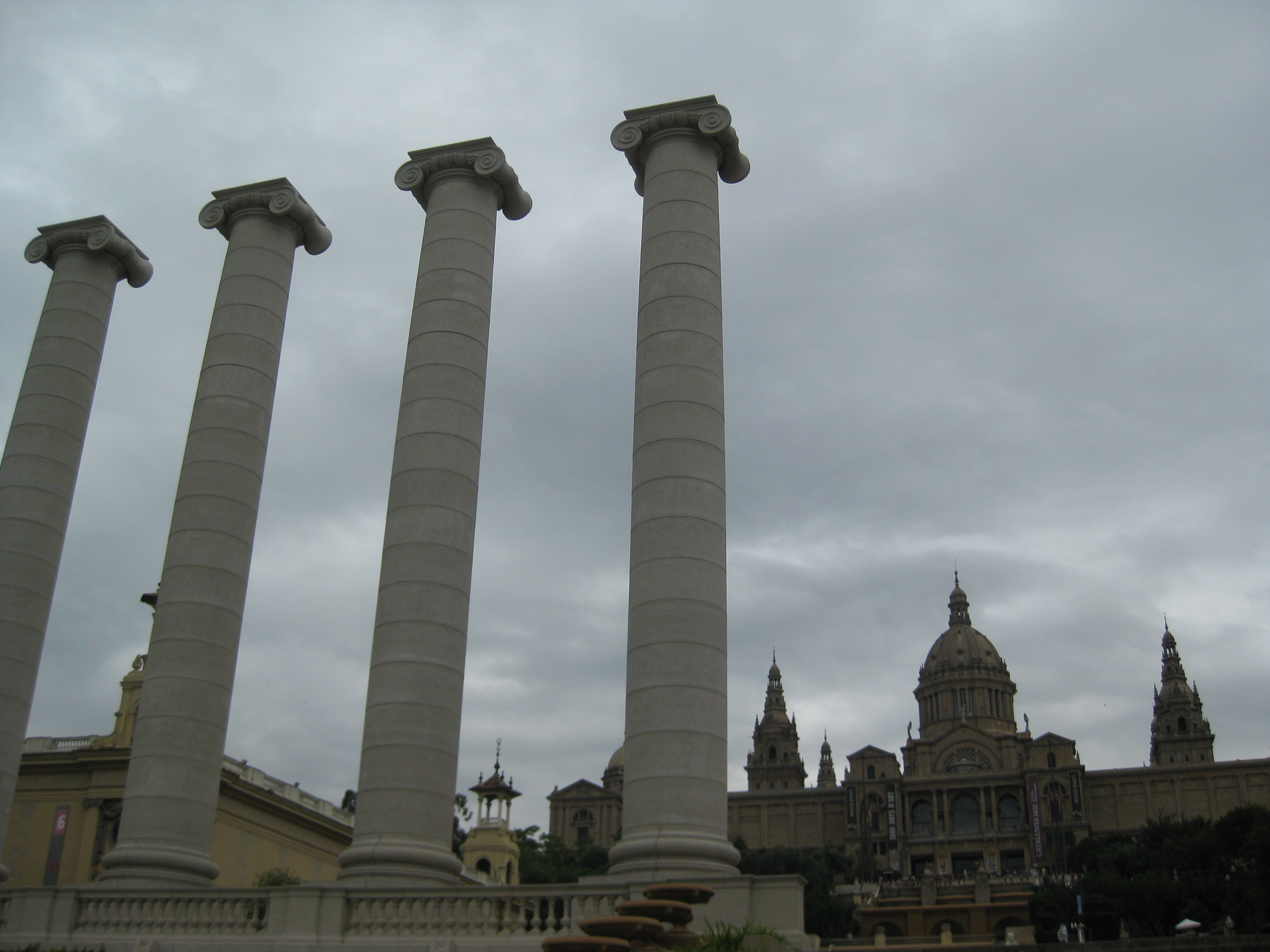
Here is another look at the Venetian towers, this time from Montjuïc toward Plaça d’Espanya. As you can tell, most of these shots were taken on a rather cloudy day which is unfortunate.

The four columns were intended to represent the four red bars of the Catalonian flag. Because of this the originals were torn down by then Spanish President Primo de Rivera. The columns visible today were reconstructed in 2010.

Below is a shot of what was for the fair the Palau Nacional and which now houses the Museu Nacional d’Art de Catalunya.

Once more looking out from the Museu Nacional toward Plaça d’Espanya. Visible to the right of the towers is the converted bull fighting arena.

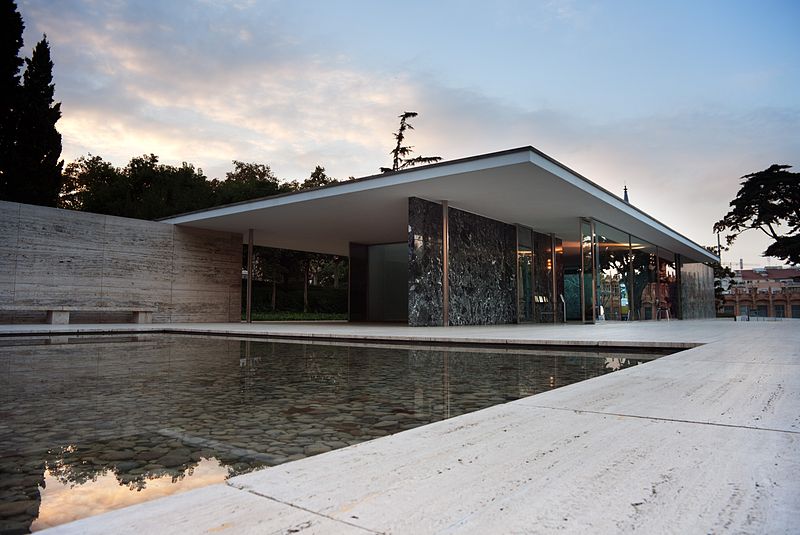
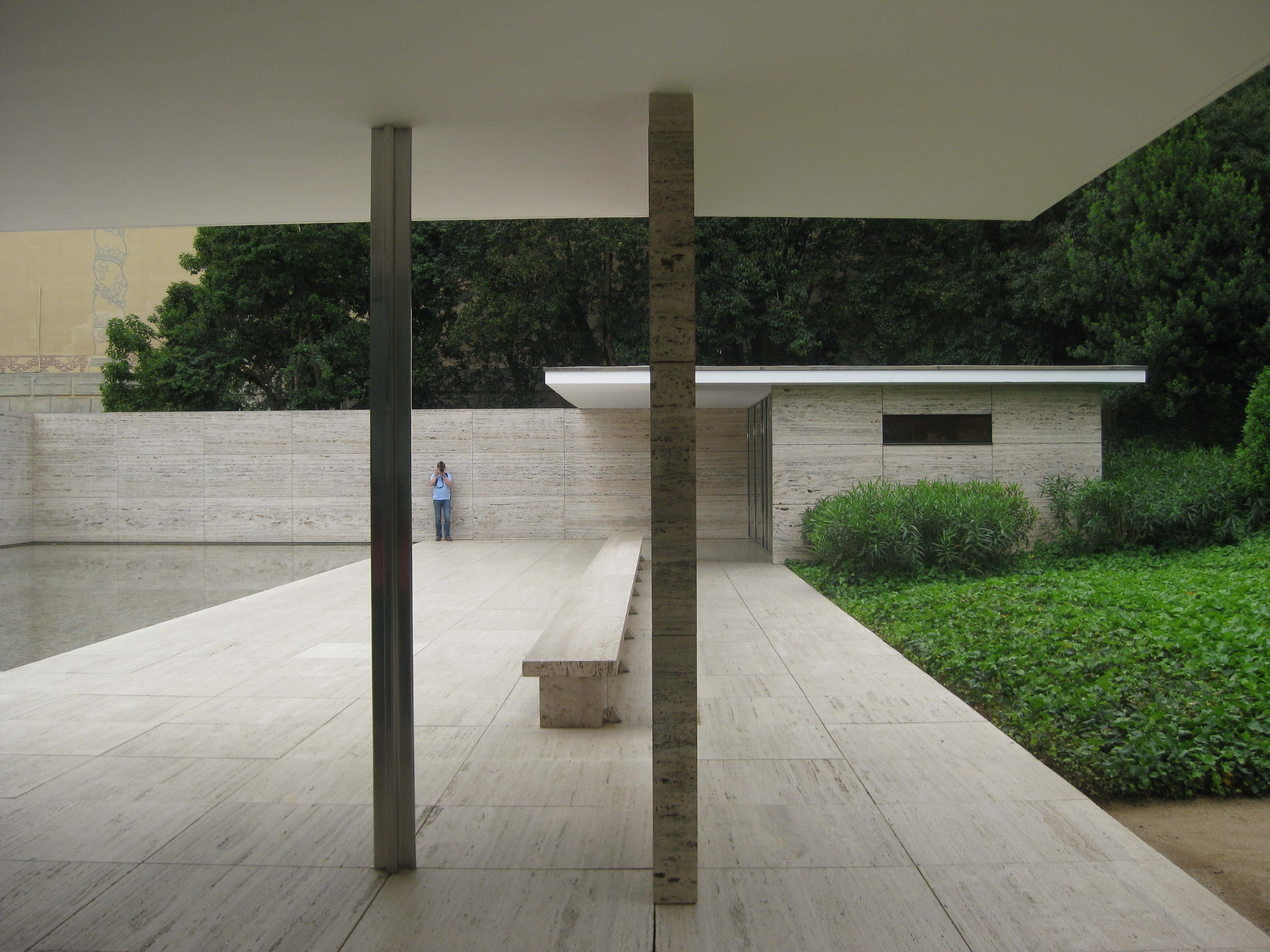
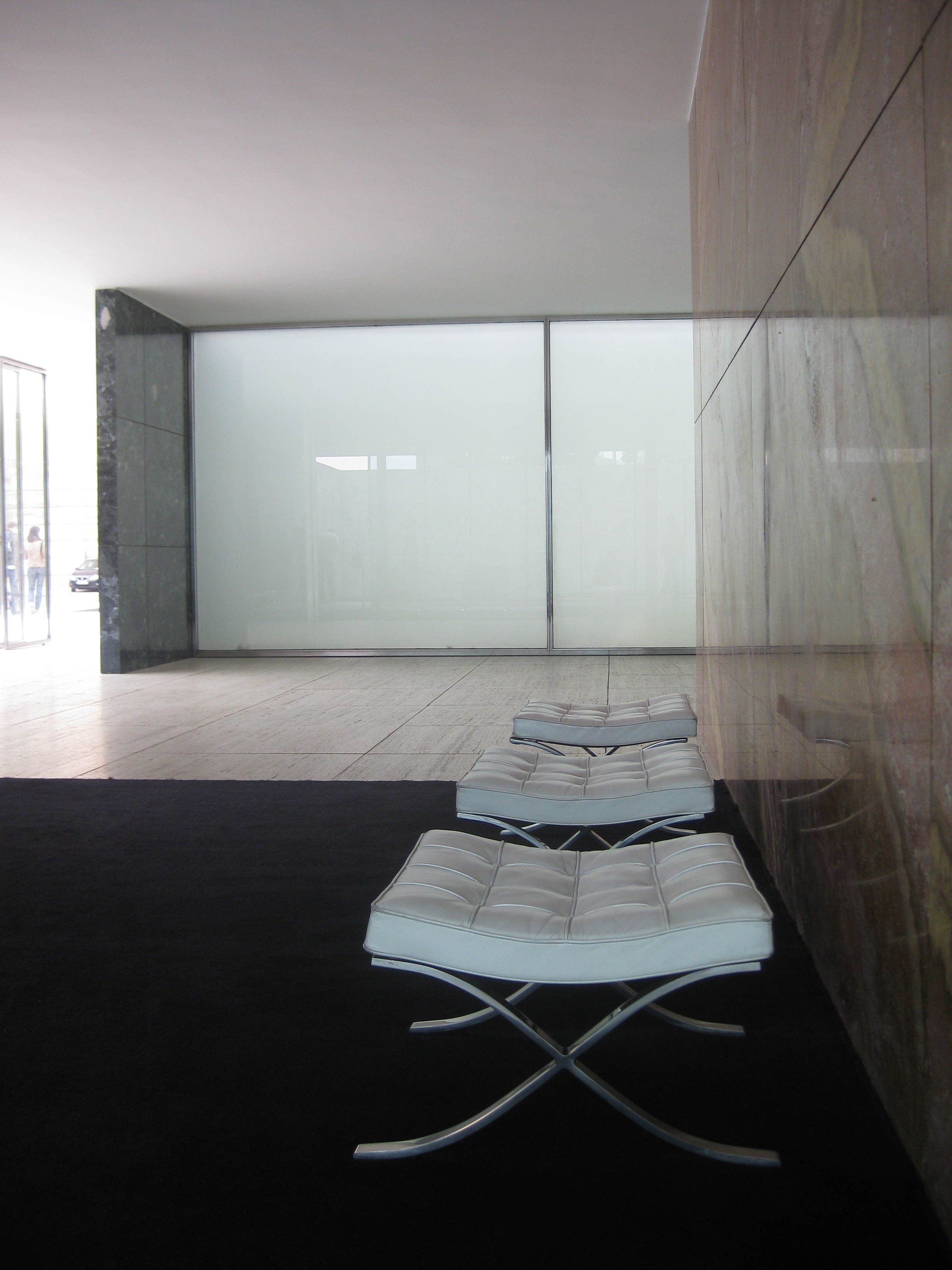
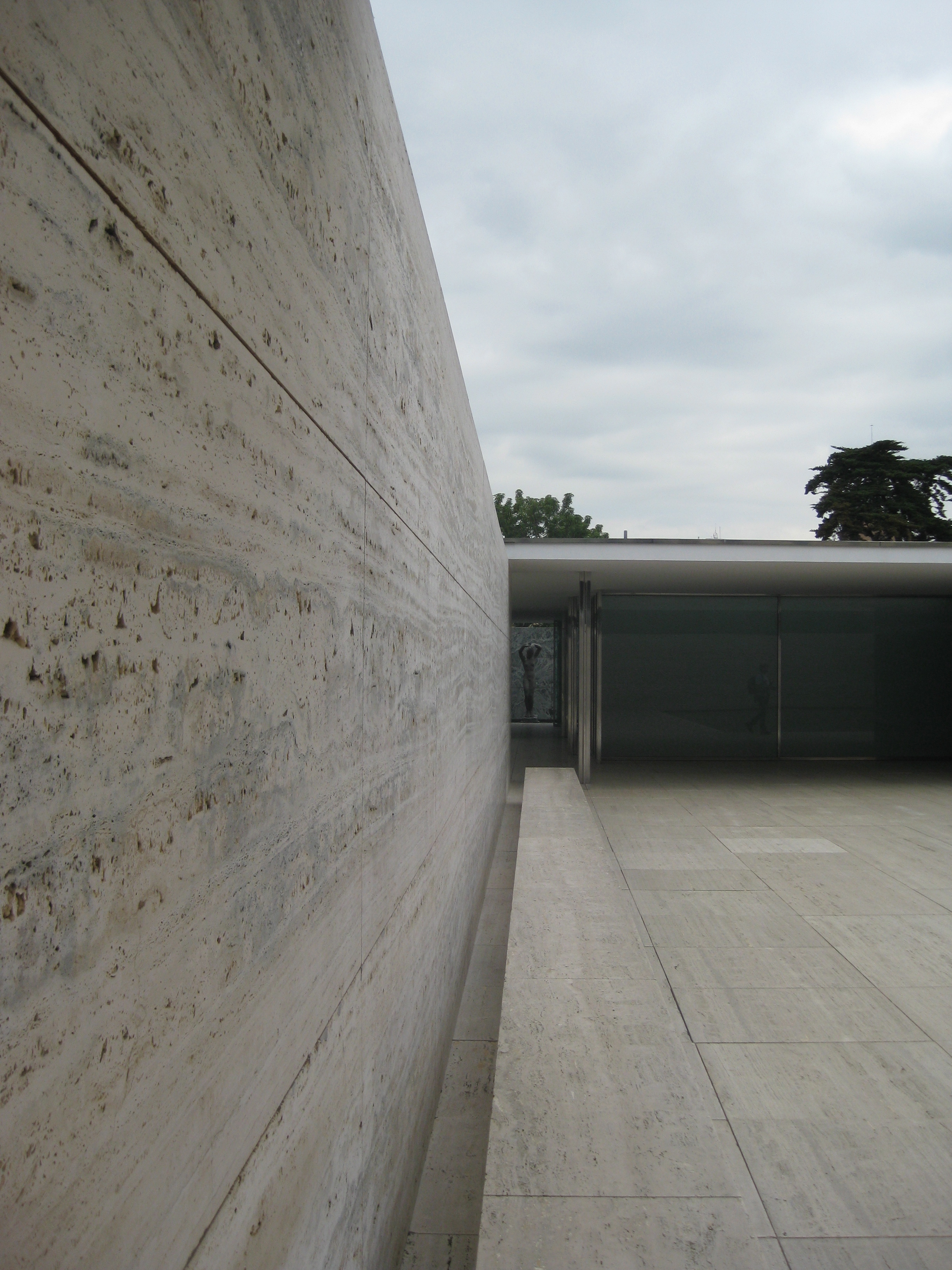
Remarkably, alongside these buildings that hearken back to the architectural past there was also built one of the early twentieth century’s most famous specimens of modernism, Ludwig Mies van der Rohe’s German Pavilion (today often referred to as the Barcelona Pavilion). As Paul Greenhalgh has put it referring to the German pavilion and the surrounding structures, “It is difficult to imagine these buildings being of the same century, and even more difficult to imagine them as part of the same event.”

Greenhalgh describes the juxtaposition as the “most dramatic example of contrast and competition between history and modernity at an exposition.” The Mies pavilion, he adds, “stunning in its opulent austerity, is an extraordinary essay on the potential of urban, domestic space to function as pure art.”

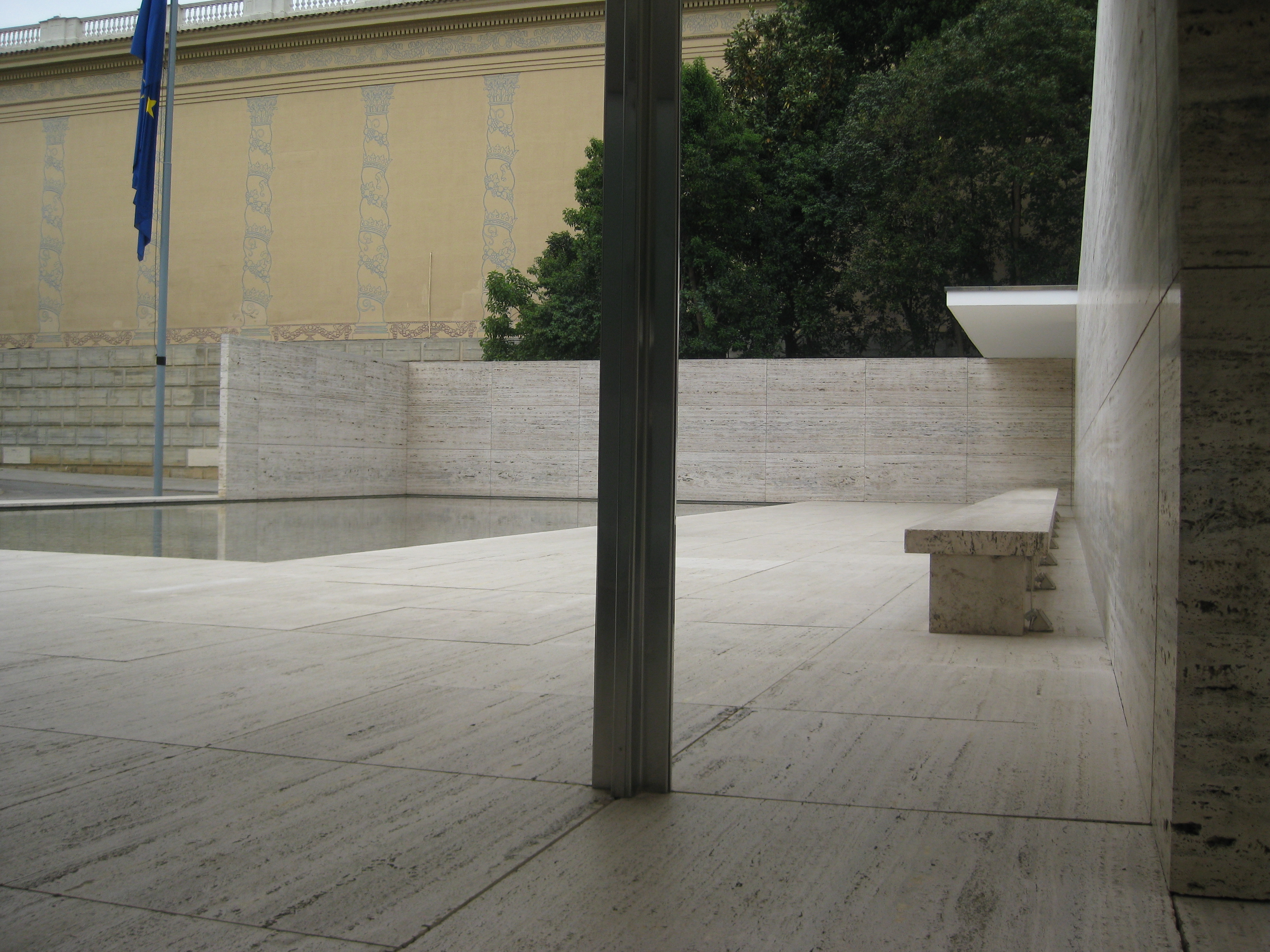
This first shot below is not my own, but taken from Wikipedia. It gives you a good look at the whole without any visitors present. Below are series of my own shots from inside the house. The original was torn down shortly after the fair in 1930. However, Spanish architects reconstructed the structure based on original plans and existing photographs between 1983 and 1986.

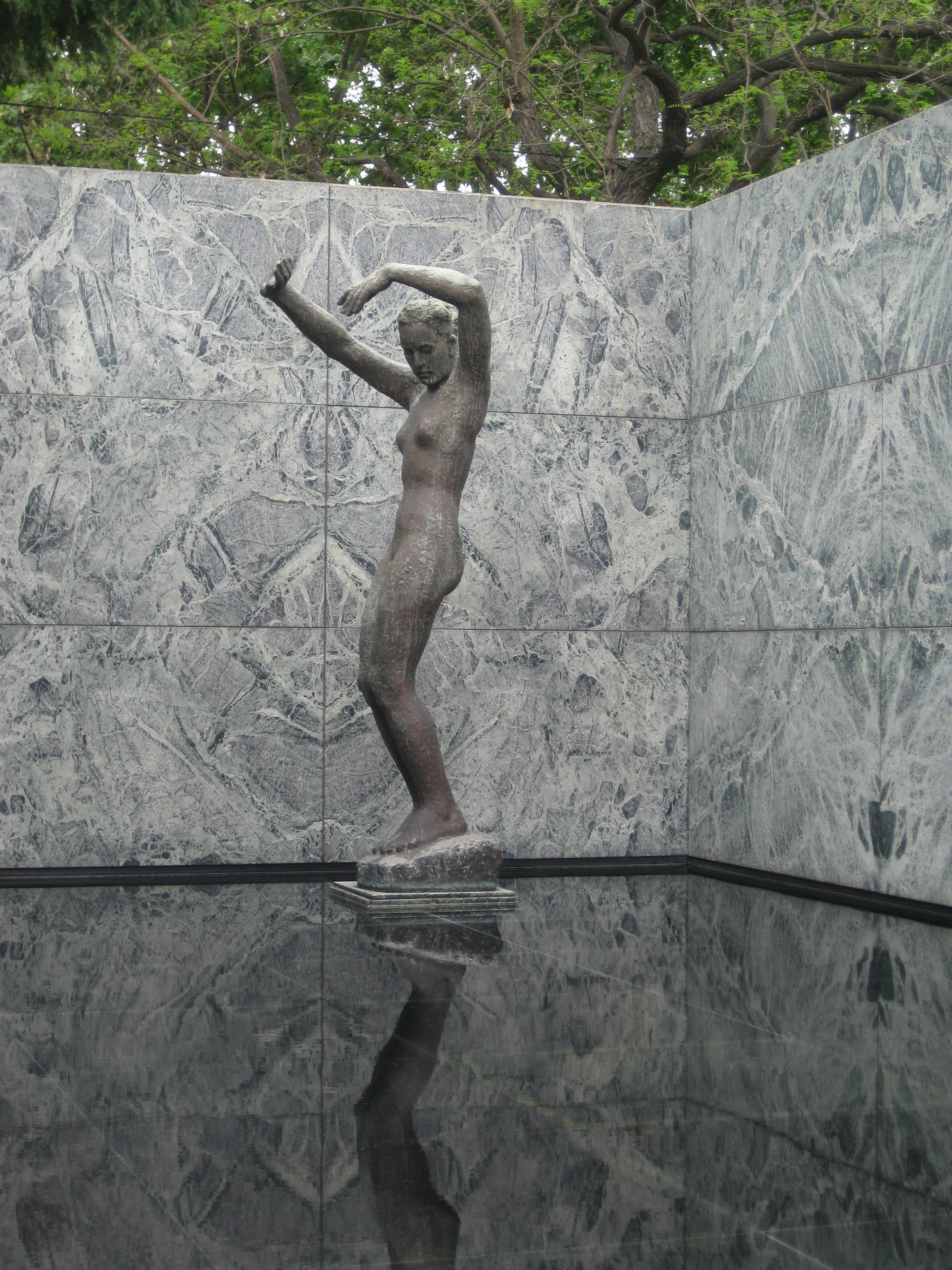
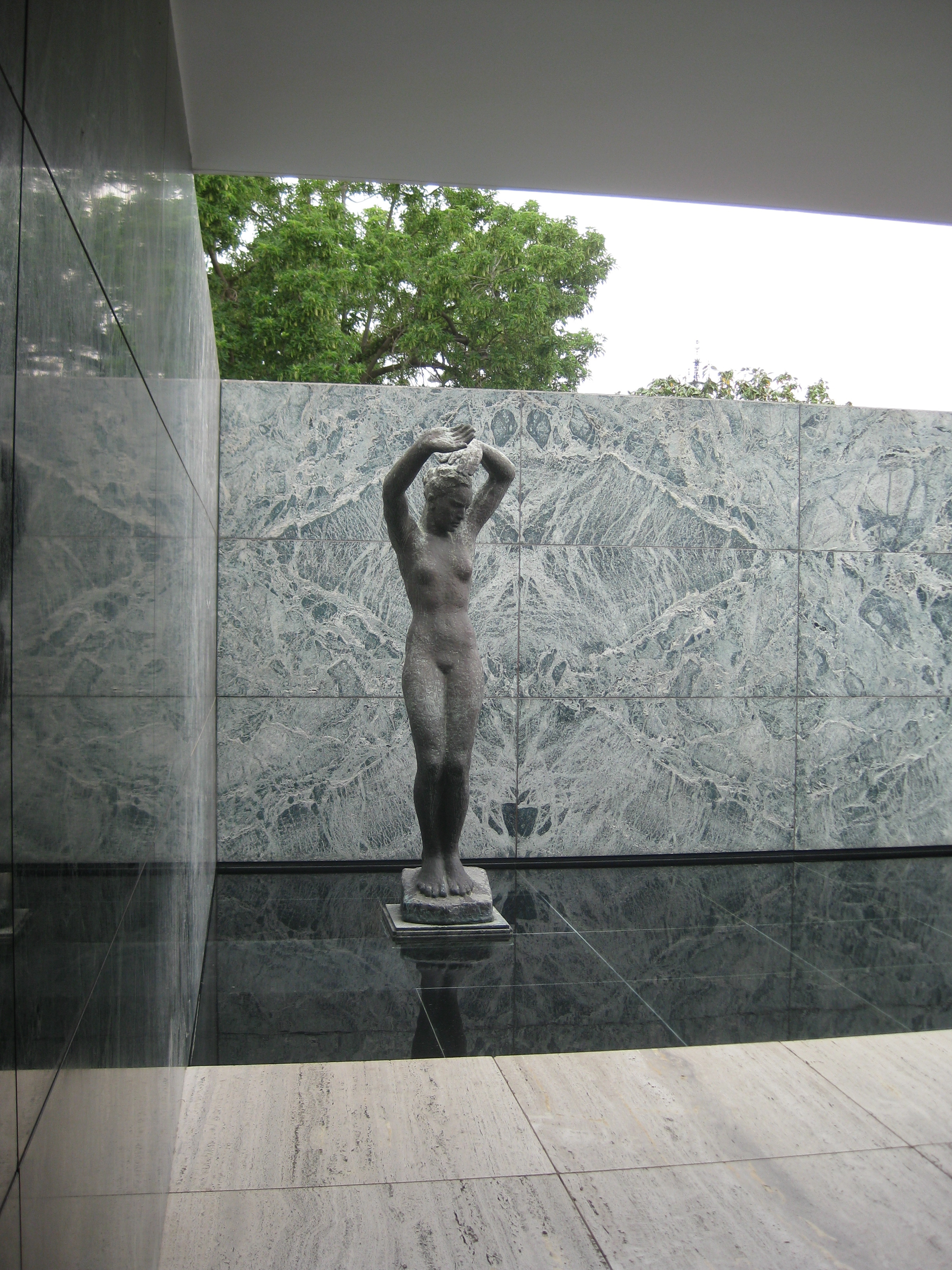
The pavilion also housed the sculpture below (seen from a distance above), Georg Kolbe’s Alba or Dawn. 

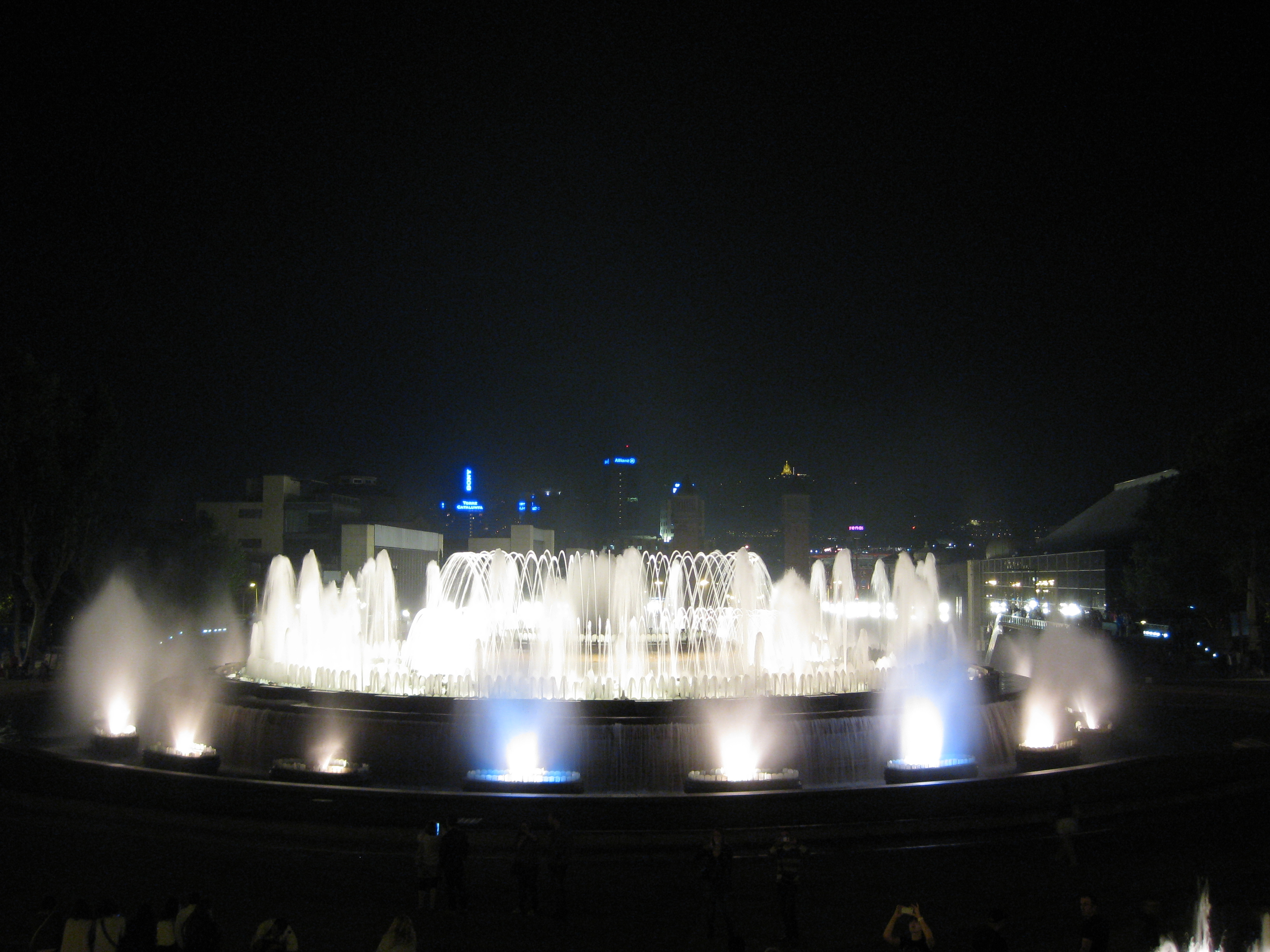
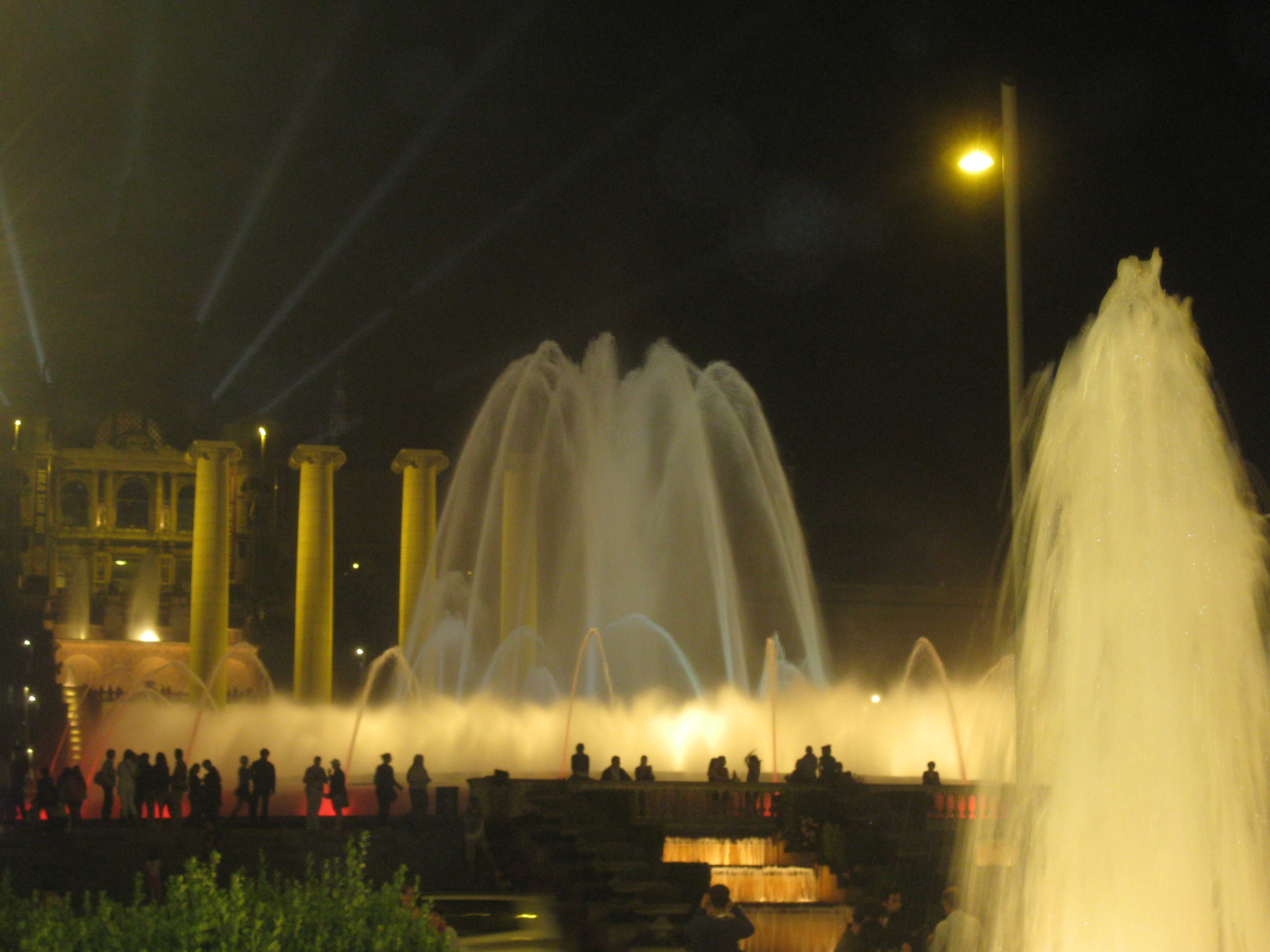
Finally, the fountains that line the avenue leading from Museu Nacional to Plaça d’Espanya including the massive fountain directly in front of the Museu Nacional, the Font màgica de Montjuïc, continue to put on a dazzling night time display as they were designed to do in 1929.