

Some Dim Dazzling Trick of Grace

Image: AFP

Unintentionally, yesterday’s post on sport as religion dovetailed suggestively with the preceding one, “Distracted from distraction by distraction.”  In that post I had continued a series of reflections on Nicholas Carr’s analysis of the Internet’s impact on our brains in his latest book, The Shallows combining a brief rejoinder to a strand of criticism frequently directed at Carr with strikingly apropos lines from T. S. Eliot’s “Four Quartets.”  Distraction was the recurring theme.  The Internet according to Carr habituates our mind to perpetual distraction, and in the long run our ability to think deeply and creatively suffers.  Eliot already laments a culture of distraction in the mid-20th century and seems to be describing us with eerie foresight.

Whether or not we finally judge sport to be a kind of religion, it is certainly a distraction; more precisely, it is a diversion.  As one comment noted, perhaps a bit harshly, it is escapist entertainment diverting us from ordinary life.  Sports may be more than this, and I will suggest that it is, but it is at least this.  And as our embrace of Internet-empowered distraction also demonstrates, we love to be distracted and we crave diversion.  We can hardly stand it if we are without either distraction or diversion for more than a few moments at a time.  We complain incessantly about our busyness, but were it all to stop we would hardly know what to do with ourselves.

This is not, however, a new problem.  Although the condition may now be intensified and heightened, it has been with us at least since the 17th century, and almost certainly before then.  It was in the 17th century that Blaise Pascal began assembling a series of notes on scraps of paper in preparation for a book he never wrote.  When he died at the age of 39 he left behind hundreds of barely organized notes which were later collected and published under the French title Pensees, or thoughts.  Pascal is today remembered, if at all, either for his law of fluid pressure or an argument for God’s existence known as Pascal’s Wager.  Neither quite does justice to the depth of his insight into what it is now unfashionable to call the human condition.

Pascal knew that we needed our diversions and distractions and that without them we would be miserable.  His description of the younger generation sounds wholly contemporary:

Anyone who does not see the vanity of the world is very vain himself.  So who does not see it, apart from young people whose lives are all noise, diversions, and thoughts for the future?  But take away their diversion and you will see them bored to extinction.  Then they feel their nullity without recognizing it, for nothing could be more wretched than to be intolerably depressed as soon as one is reduced to introspection with no means of diversion.

But Pascal is not merely an old crank berating a younger generation he fails to understand.  Pascal applies the same analysis indiscriminately.  Young or old, rich or poor, male or female — for Pascal it just comes with being human.  “If our condition were truly happy,” he explains, “we should not need to divert ourselves from thinking about it.”  As things stand, however,

Being unable to cure death, wretchedness, and ignorance, men have decided, in order to be happy, not to think about such things …. What people want is not the easy peaceful life that allows us to think of our unhappy condition, nor the dangers of war, nor the burdens of office, but the agitation that takes our mind off it and diverts us.  That is why we prefer the hunt to the capture.

We need distractions and diversions to keep us from contemplating our true condition, frail and mortal as it is.  For this reason we cannot stand to be alone with our own thoughts and seek to fill every moment with distraction.  Pascal’s view is admittedly rather grim even as it resonates with our experience.  Yet, Pascal knew there was more than this to the human condition.  There was also love and passion, knowledge and creativity, wonder and courage.  Pascal knew this and he insisted that we recognize both the glory and the misery of humanity:

Let man now judge his own worth, let him love himself, for there is within him a nature capable of good; but that is no reason for him to love the vileness within himself.  Let him despise himself because this capacity remains unfilled; but that is no reason for him to despise this natural capacity.  Let him both hate and love himself; he has within him the capacity for knowing truth and being happy, but he possesses no truth which is either abiding or satisfactory.

Pascal insists that we reckon with all that is good and all that is bad in us.  It is our awareness of the possibility of goodness, however, which heightens our misery.  And, yet again, it is our awareness of our misery that is part of our glory.  In the end Pascal believed that “God alone is man’s true good” and Christ the “via veritas.”  With St. Augustine, whose influence permeates Pascal’s thought, he would have prayed, “Our hearts are restless until they find their rest in Thee.”  Perhaps this is why at times spirituality and the language of worship suffuses our most prominent and powerful diversions.

Augustine and Pascal in turn both helped shape the thought of Walker Percy, a 20th century Roman Catholic novelist.  Percy blended Pascalian insight with a touch of existentialism in his best known novel The Moviegoer (1960) in which the main character, Binx Bolling, finds himself on a search.  “What is the nature of the search? you ask.”

Really it is very simple, at least for a fellow like me; so simple that it is easily overlooked.  The search is what anyone would undertake if he were not sunk in the everydayness of his own life …. To become aware of the possibility of the search is to be onto something.  Not to be onto something is to be in despair.

Near the middle of the novel throughout which Bolling has been amassing clues he thinks are somehow related to the search, he despairs:

… when I awake, I awake in the grip of everydayness.  Everydayness is the enemy.  No search is possible.  Perhaps there was a time when everydayness was not too strong and one could break its grip by brute strength.  Now nothing breaks it — but disaster.

However, through a rather tortured relationship with a very broken young woman named Kate whom he has come to love, Binx begins to see grace in the ordinary.  Near the very end of the novel, while he and Kate are sitting at a service station discussing marriage and the worries that still fill Kate’s mind, Binx notices a man coming out of a church.  It is Ash Wednesday.  Binx watches while the man sits in his car looking down at something on the seat beside him.  The man’s presence puzzles Binx:

It is impossible to say why he is here.  Is it part and parcel of the complex business of coming up in the world?  Or is it because he believes that God himself is present here at the corner of Elysian Fields and Bons Enfants?  Or is he here for both reasons:  through some dim dazzling trick of grace, coming for the one and receiving the other as God’s own importunate bonus?  It is impossible to say.

If sport diverts us from ordinary life, what do we make of it?  Is it as Pascal would have it a mere distraction which facilitates our unwillingness to acknowledge our true condition?  Or, taking a cue from Percy, might it be a rupture of the “everydayness,” the ordinariness of our lives that may awaken us to the possibility of the search?  My sense is that they are both right; each is a possibility.  Sports can be merely a distraction conducive to living in bad faith in denial of the truth of our situation.  It is odd, however, that something very much like a spiritual or religious aura so often surrounds sport.  Maybe it is because bursts of grace and beauty appear suddenly and unexpectedly even in the midst of our diversions to remind us that we ought to be searching for their source.  Maybe it is because “through some dim dazzling trick of grace, coming for the one” we receive “the other as God’s own importunate bonus?”

It is impossible to say.

Is Sport a Religion?

I can’t imagine that this is a new observation, but according to Nigel Barber at The Human Beast,

Psychologists are closing in on the conclusion that sport has many of the same effects on spectators as religion does. Here is Daniel Wann [2001], a leading sport psychologist at Murray State University, and his co-authors: “The similarities between sport fandom and organized religion are striking. Consider the vocabulary associated with both: faith, devotion, worship, ritual, dedication, sacrifice, commitment, spirit, prayer, suffering, festival, and celebration.”

So, is sport a religion?  The answer to that question could only be resolved, if at all, after some haggling over what one means by “sport” and “religion.”  In any case, there is something compelling about the comparison.  Myself, I’m inclined to think that there is something mystical and quasi-spiritual about baseball, but I can see how, especially this month, others might be more inclined to see adumbrations of the holy in World Cup Soccer (Football, Futbol, whatever).  As it turns out, meditations on the spirituality of soccer abound.

At the TimesOnline, Matthew Syed explores the psychological benefits of belief for players in “The Players with God on Their Side.” He concludes,

… if Ali [the boxer] is praying to Allah and Edwards [a triple jumper] to Jehovah, and if these two men believe in contradictory theologies, and if both are reaping benefits, it must be the belief itself, not its truth, that matters. These insights explain, I think, at least in part, the pervasiveness of religion at this World Cup. It is less a matter of theology than psychology. Belief in God can give an athlete, a team, a crucial edge in the cauldron of competition, where success and failure are measured in fractions.

Preston Davis at Religion Dispatches explores “Soccer and the Sublime in the Shadow of Apartheid” eloquently reflecting on the themes of grace, incarnation, beauty, and justice.  He soberly reflects on what the game can and cannot do, concluding that World Cup soccer,

like religion, possesses a beauty that humanizes. It does not whitewash tragedy but it does provide transcendence from it, and at its best meaning-making for it. It mysteriously wields us together and separates us all at once. We place our hopes in the efforts of 11 men on a pitch, competing against an opposing 11, and in the end we are thankful just to be a part of the experience.

If you’re interested in this sort of thing, each essay contains enough links to keep you busy for the better part of the morning.

Distracted from distraction by distraction

The title is taken from the first of T. S. Eliot’s” Four Quartets,” Burnt Norton.  Here is a bit more context:

Neither plenitude nor vacancy.  Only a flicker
Over the strained time-ridden faces
Distracted from distraction by distraction
Filled with fancies and empty of meaning
Tumid apathy with no concentration
Men and bits of paper, whirled by the cold wind
That blows before and after time,
Wind in and out of unwholesome lungs
Time before time and after.

Although these lines were first published near the middle of the last century, they unmistakably resonate with the present.  The problem of distraction facilitated and encouraged by Internet culture is among the chief targets of Nicholas Carr’s The Shallows, the public reception of which has been noted in some previous posts.  The reviews keep coming in.  Todd Gitlin’s review, “The Uses of Half-True Alarms,” appeared in The New Republic on June 7th.  Gitlin is clearly hesitant to embrace Carr’s claims in their fullness, but one is left with the sense that he is largely sympathetic to Carr’s argument.

I was especially pleased to see Gitlin express the obvious rejoinder to a frequent criticism directed toward Carr and others who raise questions about our too often uncritical embrace of all things technological.   This criticism is on display, for example, in the opening paragraphs of Steven Pinker’s recent op-ed in the NY Times.  Pinker never mentions Carr or his recent book, but they are clearly in view.  In its most basic form, the criticism runs something like this:  “moral panic” (to use Pinker’s phrase) is present whenever a new technology comes on the scene, society has obviously survived those past technological developments thus the panic was misguided,  and hence we should not pay too much attention to those who are raising questions about new technologies today.

There are a number of problems with this line of reasoning, but after offering his own version of the argument, Gitlin to his credit aptly stated perhaps the most obvious one:

Carr would no doubt respond that a repeated alarm is not necessarily a false alarm, and he would be right.

In his review, Gitlin cites Eliot’s lines which Carr employs in The Shallows.  Interestingly, last night I had been reading Paul Johnson’s chapter on Eliot in his 2006 book Creators:  From Chaucer and Durer to Picasso and Disney.  With all the recent attention drawn to our lack of attention in mind, I was struck by the following passage:

Eliot always worked hard at whatever he was doing, being conscientious, and consumed with guilt if he was “lazy” (a rare state), and having moreover the priceless gift of concentrating.  He could set to work immediately, first thing in the morning, without any time-consuming preliminary fiddling or rituals.  If interrupted, he could refocus immediately and resume work.  The intensity with which he worked was almost frightening.

Eliot, as Johnson describes him, appears to be the stark antithesis of the Internet Man.  The concern of some is that men and women of Eliot’s prodigious talent and skills will be increasingly rare in a culture dominated by the habits and priorities of the Internet.  Time will tell of course.  Needless to say, men and women of that caliber are rare in any age.  Will they become extinct?  In my more hopeful moments, I think not.  Unfortunately, this minimal optimism — surely a few men and women of genius will still emerge — is another frequent line of response to Carr’s thesis.  It is not as if before the Internet most of us were reading Proust and honing our cello skills.  More likely, so the argument goes, we were wasting our time with that last invention to a spark “moral panic,” the television.  (This is, I suspect, true enough.  However, one wonders how different things would be if a prior generation had heeded warnings about that screen and its dangers.)

But here again I find the argument misguided.  Of course, all of us have never been all that we could be.  The use of this argument against Carr and the like is rather depressing.  The assumption seems to be, “No worries, we’ve always been mediocre and always will be.”  This may be true, but it is a symptom of some kind of cultural anemia that we now embrace this line of thinking in defense of our gadgets and our toys.  The question is not whether we have in the past made any better use of our time, the question is whether our tools and our social climate in general are more or less conducive to the pursuit of some kind of excellence, however halting the pursuit.  Johnson noted a certain guilt that Eliot experienced when he perceived himself to have failed to use his time well.  It is perhaps the general absence of such guilt in the Wireless Age that is most telling of our present ills.


You can subscribe to my newsletter, The Convivial Society, here.

The Little Voice

Put a blank in place of “studied” and then fill in with whatever activity you’d like and see if this doesn’t describe your experience:

When he studied, “a little voice would be saying, ‘Look up’ at the computer, and I’d look up,” Connor said. “Normally, I’d say I want to only read for a few minutes, but I’d search every corner of Reddit and then check Facebook.”

This from “Hooked on Gadgets, and Paying a Mental Price” which appeared in yesterday’s NY Times.  And that is just one of three articles in the Times on the theme of “Your Brain on Computers.”  The other two are

An Ugly Toll of Technology – Impatience and Forgetfulness, by Tara Parker Pope, and

More Americans Sense a Downside to an Always Plugged-In Existence, by Marjorie Connelly.

The impact of internet use on the brain continues to get a lot of attention and while the news is not all bad, it doesn’t seem unreasonable to be more than a little concerned about much of it.

Nicholas Carr’s The Shallows: What the Internet Is Doing to Our Brains likewise continues to get a great deal of attention.  Jonah Lehrer’s review “Our Cluttered Minds,” also in the NY Times, takes issue with some of research Carr employs.  Here is Carr’s rejoinder.
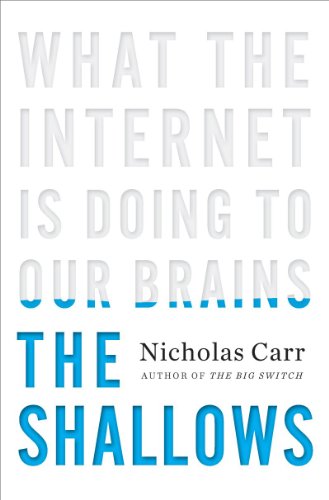
Nicholas Carr on the Internet and our Brains

“Is Google Making Us Stupid?” was my first introduction to Nicholas Carr.  It was a good first impression.  That essay published in The Atlantic during the summer of 2008 has led to a new book by Carr, The Shallows: What the Internet Is Doing to Our Brains.  Barely off the presses, it has already been making the rounds through media outlets and blogs.

Carr was interviewed on NPR and at ABC News.  The former is helpful and the latter is perhaps an unintended demonstration of Carr’s thesis by the interviewer who is trying too hard to be clever, but comes off only as rather shallow.

Adam Thierer’s review at The Technological Liberation Front also includes various links related to Carr and The Shallows including the official website for the book.

In Thierer’s helpful schema, Carr leans toward “pragmatic pessimism” in regards to the impact of the Internet on society.  Whether one is likewise inclined or not, it appears from all accounts that Carr has given us a lot to think about.  So on the summer reading list it goes.

UPDATE:  Another thoughtful review, this one by Russel Arben Fox, can be found at In Medias Res.