The Technological Sublime, Alive and Well

Natural wonders, lightning storms, tornadoes, sunsets — we sometimes describe the experience of these sorts of natural phenomenon as experiences of the sublime. They leave us in awe and render us speechless if only for a moment. There is a long tradition of reflection about the nature of the sublime experience going back at least to the eighteenth century. Kant and Burke in particular are often taken as starting points for the discussion. The sublime in Burke’s view was tinged with a certain terror, and for Kant the ability of human reason to take in and domesticate the sublime was a testament to its power.

More recently historian David Nye has argued that it is not only nature that inspires sublime experiences, our modern technologies also have the ability to elicit similar reactions of wonder, awe, and not a little trepidation. In American Technological Sublime, Nye argued that these experiences of the technological sublime have been especially characteristic of American society and have amounted to a kind of civil religion. They have at least been an integral part of the American civil religion. These experiences were more than moments of profound personal experience. They were moments that forged the collective national character. They were rituals of solidarity.

The first railroads, the first massive industrial factories, the electrified cityscapes, the Hoover Dam, the atomic bomb — all of these and more have inspired sublime experiences in those who first witnessed their appearance. One is reminded as well of Henry Adams’ famous account of the massive Corliss engine that powered the Philadelphia Centennial Exposition in 1876 and led Adams to compare the place of the dynamo in modern society to the place of the Virgin Mary in medieval society.

In more recent history the space program has supplied most instances of the technological sublime. Nye describes rocket launches at Cape Caneveral as quasi-religious events: “the event is less a matter of spectatorship than a pilgrimage to a shrine where a technological miracle is confidently expected.” In his account of the launch of Apollo 11, Nye describes Norman Mailer’s experience of the event. Mailer came as a skeptic, bent on resisting the allure of the event. He was determined not to be caught up in the fervor and devotion of the crowd of pilgrims. And yet … When the rocket launched and the earth began to rumble and the sound caught up with the sight, Mailer found himself saying over and over again, “Oh, my God! oh my God! oh, my God! oh my God!” That is the power of the technological sublime.

I write all of this today because yesterday Americans in Florida and the Washington D. C. area got an experience of the technological sublime. The space shuttle Discovery whose launches had been occasion for numerous pilgrimages to the Cape, especially as the shuttle program wound down, took her final voyage mounted on a specially fitted 747. If you were able to catch a glimpse of the spectacle, perhaps you know experientially what Nye theorized. If you were not able to see the sight in person, you have only to read the new stories, personal accounts, and, yes, tweets to conclude that the technological sublime is alive and well, if perhaps increasingly rare.

The technological marvel, the national pride, the sense of solidarity, the awe, the pride, the wave of emotion, the patriotic fervor abetted by the military jet accompanying the shuttle on its final voyage — you can read all of it on the faces of the spectators and in the nature of the pictures that made their way around the news outlets and blogs.

In the midst of it all, however, there was a sense of nostalgia as well. Of course, part of that nostalgia arises from the fact that this was a final voyage, and as such it recalled to mind all of the previous voyages, including those that ended in tragedy. But perhaps the nostalgia also arose from a tacit realization (if such a thing is possible) of the absence of such experiences from our more common and ordinary encounters with technology. In his final chapter, Nye describes the transition to what he calls the “consumer’s sublime” typified by Las Vegas and Disneyland. “The epiphany,” Nye writes, “has been reduced to a rush of simulations, in an escape from the very work, rationality, and domination that once were embodied in the American technological sublime.”

Put that way, one wonders whether it is not on the whole better that the American technological sublime is waning. And yet when one experiences its “melancholy, long withdrawing roar,” perhaps it is only natural to feel a tinge of sadness.

_________________________________________________________________________

My thanks to Christopher Friend for the excellent images posted below.

You can see additional photo-documentation of the technological sublime here, here, and here.

Image courtesy of Chris Friend
Image courtesy of Chris Friend.

Facebook and Loneliness: The Better Question

In 2008, Nick Carr’s article in The Atlantic, “Is Google Making Us Stupid?”, touched off a lively and still ongoing debate about the relative merits of the Internet.  Of course, the title was a provocation and perhaps played a role in generating initial interest in the piece. I’ve often wondered whether that was Carr’s own choice for a title or if an editor with the magazine slapped it on as link bait. In any case, I tend to think it does the essay as a whole a disservice. It suggested a straw man to readers before they read the first word of the article. Having used the piece in a variety of classes that I’ve taught, I’m struck by how often readers respond to the title rather than Carr’s argument in the body of the essay.

In this month’s issue, The Atlantic has once again published a cover story bearing a strikingly similar title — “Is Facebook Making Us Lonely?” by novelist Stephen Marche. I suppose it was too tempting to pass up.

This time around, however, the title is at best generically provocative and more like predictably lame. And, as with Carr’s piece, it threatens to obscure the argument.

Take, for example, the quite interesting response to Marche by sociologist Zeynep Tufekci. In a blog post, she takes on the article’s title more so than the contents of the article. Or so it seems to me. Tufekci emphasizes the need to rely on empirical research and she cites a number of studies that fail to find a causal correlation between social media and loneliness. In fact, studies suggest that on the whole social media users report lower rates of loneliness than non-users.

But as I read (and reread) Marche’s article, I failed to find Marche himself advocating such a causal connection. In fact, at several points Marche is quite clear in denying that social media (since Facebook, like Google in Carr’s article, stands in for a larger reality) causes loneliness. At the outset of the last main section of the article, Marche writes:

“Loneliness is certainly not something that Facebook or Twitter or any of the lesser forms of social media is doing to us. We are doing it to ourselves.”

That seems pretty straightforward to me.

In fact, Marche and Tufekci seem to be in broad agreement. Both agree that individuals have become more isolated over the course of the last few decades. Tufekci cites three studies to that effect:

“We are, on average, more isolated, at least in terms of strong ties. Three separate studies say so–and as we say in social sciences, once is a question, twice is a coincidence, thrice is a finding. (That is the General Social Survey with follow-up here, Pew Internet studieswritten up by Keith Hampton (with others) and a recent study by Matt Brashears).”

Marche makes the same point; in fact, I would suggest that Marche’s essay is really about this broad trend toward loneliness and isolation that predates the rise of social media. It is true that Marche clearly thinks Facebook is less than an ideal antidote to this loneliness and that it engenders certain problematic forms of socialization, but he does not claim that social media is making us lonely. It is the unfortunate title that suggests that.

The more interesting part of Tufekci’s response lies in her notion of cyberasociality which she defines as “the inability or unwillingness of some people to relate to others via social media as they do when physically-present.” Happily, Tufekci links to an unpublished paper in which she lays out her case for the existence of cyberasociality. She draws on an analogy to dyslexia to argue that some people may have an inherent inability to socialize via text based media. As she acknowledges, this is something she is still “working through empirically and conceptually,” but it is certainly an intriguing possibility.

Interestingly, at one point in Marche’s essay he himself appears to acknowledge as much. While discussing the work of Moira Burke — which (again) he himself notes “does not support the assertion that Facebook creates loneliness” — Marche ventures the following introspective confession: “Perhaps it says something about me that I think Facebook is primarily a platform for lonely skulking.” Perhaps. If so, Tufekci may already be working on the theory that explains why.

The real issue, it seems to me, is not whether Facebook makes us lonely, but whether Facebook is reconfiguring our notions of loneliness, sociability, and relationships. These are after all not exactly static concepts. Here is where I think Marche raises some substantial concerns that are unfortunately lost when the debate goes down the path of determining causality.

What Facebook offers is the dream of managing the social and curating the self, and we seem to obsessively take to the task. The asynchronicity of Facebook is rather safe, after all, when compared to the messy and risky dynamics of face-to-face interactions, and we naturally gravitate toward this sort of safety. I suspect this is in part also why we would sometimes rather text than call and, if we do call, why we hope to get sent to voicemail. It seems reasonable to ask whether we will be tempted to take the efficiency and smoothness of our social media interactions as the norm for all forms of social interaction.

One last thought. It seems to me that we should draw a distinction among desires that are bundled together under the notion of loneliness. There is, for example, a distinction between the desire for companionship (and distinctions among varieties of companionship) and the desire simply to be noticed or acknowledged. C. S. Lewis, eloquent as per usual, writes:

“We should hardly dare to ask that any notice be taken of ourselves. But we pine. The sense that in this universe we are treated as strangers, the longing to be acknowledged, to meet with some response, to bridge some chasm that yawns between us and reality, is part of our inconsolable secret.”

Among Facebook’s more problematic aspects, in my estimation, is the manner in which the platform exploits this desire with rather calculated ferocity. That little red notifications icon is our own version of Gatsby’s green light.

Facebook as Rear Window: What Hitchcock and Gadamer Can Teach Us About Online Profiles

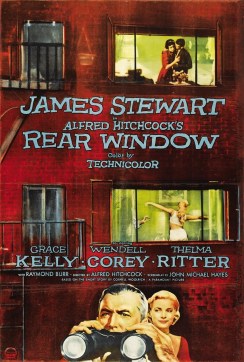
In Hitchcock’s 1954 classic, Rear Window, Jimmy Stewart plays a photojournalist named Jeff who is laid up with a broken leg and passes his time observing his neighbors through his apartment’s rear window. The window looks out on a courtyard onto which the rear windows of all the other apartments in the building also open up. It’s a multiscreen gallery for Stewart’s character who reclines in the shadows and becomes engrossed in the lives of his neighbors – the attractive dancer, the lonely woman, the young pianist, the newlyweds, and, most significantly, the unhappy married couple. Increasingly playing the part of the obsessive voyeur, he becomes convinced the disgruntled husband murdered his wife. The film’s plot is driven by Jeff’s determination to prove the man’s guilt.

The film came to my attention again when I received a link to the clip below, which impressively and artfully splices all of the scenes depicting what Jeff sees out of his window. [Update: The video is no longer available.] Serendipitously, I watched the clip not long after reading some comments on Hans-Georg Gadamer’s hermeneutical aesthetics developed in Truth and Method. Naturally, I then thought of Facebook … as one does after watching Hitchcock and reading Gadamer.

Let’s start with Hitchcock. Like the windows in Hitchcock’s film, Facebook profiles offer an opening into a life and one through which others can observe without the observed knowing it. This is classic Facebook behavior. The platform has always abetted and elicited stalker-ish activity from users. This is why one of the most popular of the many spam links that circulate on the social network purports to reveal who has been looking at your profile. If ever such a capability were enabled it would likely lead to a massive reduction in page views for Facebook.

Like Jeff’s character, Facebook users look through the profiles-as-windows at the lives of their virtual neighbors. And as with Jeff, it may begin in a relatively innocent curiosity born of boredom, or it may veer into the obsessive. There is, of course, one glaring difference between the rear windows and Facebook profiles: Stewart’s neighbors were presumably unaware that they were being watched. Facebook users are not only aware they are being watched – they are counting on it.

On Facebook we’re all flâneurs, simultaneously watching and being watched. But we don’t exactly know who is doing the watching and how much watching they’re doing or to what end. The uncanny moment in Rear Window comes when the watcher becomes the watched. Needless to say, such a moment would be equally uncanny where it to unfold online. Yet it is enough that we know we are being watched in general. This alone renders the profile something other than a representation of our life. It becomes itself a presentation. And that is were Gadamer first comes in.

As he develops his hermeneutical aesthetics, Gadamer challenges the representational view of the work of art that understands the work of art as a mere re-presentation of some real thing. On this view, whatever meaning the work of art holds is derivative of the thing it re-presents. Against this view, Gadamer contends that the appearing of the work of art before the participant (for the one who takes in a work of art is never merely a passive observer) constitutes an “event of being.” Meaning inheres in the work of art in itself. It is a presentation, not a re-presentation.

Now think again about a Facebook profile. It may be tempting to understand a profile as a representation of a life or of a personality whose meaning derives from the lived experience of the user who creates the profile. But is this entirely true? It is certainly the case that the online profile is, in a certain sense, grounded in the offline experience of the user. Also, we would do well to resist a digital dualism that abstracts the “real,” offline experience from “virtual,” online experience. Offline and online experience impinge upon one another; it would be misleading to compartmentalize the two.

Yet, there are multiple ways of construing the nature of their enmeshment. One way of resisting digital dualism is to note how the possibility of self-documentation asserts itself in lived experience. I’ve discussed this here on more than a few occasions and Nathan Jurgenson’s notion of “Facebook Eye” captures this dynamic neatly. On this view online profiles impinge upon offline experience by reordering our conscious intentionality – to the person with a social media profile, experience becomes a field of potential self-documentation to be publicized through social media. To the person with a hammer, everything looks like a nail. To the person with a Facebook profile, everything looks like a potential status update. Or alternatively, to the person with a Facebook profile, the question is always “How many ‘likes’ will this get?” But Gadamer offers another complimentary construal.

It begins by noting the presentational character of the online profile. It is not a mere copy of the original life; in its appearing before a profile viewer, it appears on its own terms. It’s meaning is not merely derived from the manner in which it copies life, rather it emerges out of the dynamics of the life as it is presented in the profile. And here is why, as I see it, this does not constitute a digital dualism. Gadamer’s discussion of the work of art as an “event of being” includes what Peter Leithart has called “retroactive ontological consequences” for the thing it refers to in the “real” world.

Leithart interprets Gadamer by reference to landscape painting. When a landscape is painted by Constable, its character has been altered, it is now a “landscape-that-inspires-painting.” When person maintains an online profile, they are now a person-with-a-profile. The landscape painting, Leithart continues, is an “event of being” because it is “an enhancement of the thing itself.” Likewise the online profile, although perhaps enhancement is not necessarily the best word to use here. Moreover Leithart concludes, “every encounter with the real landscape involves a moment of interpretation that is a ‘performance’ of the thing, and after Constable (even for many who are not directly aware of Constable) the interpretive performance is inflected by Constable’s work …” Translated: every encounter with a person-with-a-profile invites acts of interpretation that are inflected by Facebook. Now back to Rear Window to illustrate.

In the film, the windows presented a slice of a life. What Jeff saw was not something other than the lived experience of the people he watched, but the windows did the work of constituting those slices of their lives as something in themselves for Jeff inviting interpretation, not unlike the way a profile presents itself as something in itself for the viewer also inviting the viewer into a work of interpretation. And as we noted, via Gadamer, as a thing in itself the window-as-presentation gives off meaning that has retroactive ontological consequences. If Jeff were to meet any of the people he watched outside of their apartments, his interactions with them would be contoured by his interpretations of their fenestrated (when would I ever have another chance of using that word) presentations.

Likewise, when Facebook users encounter one another offline, their mutual interpretations of one another are loaded with whatever interpretations their profiles have already invited.

Now one final thought. Our presentations always produce more meaning than we intend. This is another way of saying that we are not entirely in control, despite our best efforts, of the manner in which our profile presentations are interpreted. Because they are always partial re-presentations (insofar as they are alluding back to lived experience), our profiles hide while they reveal and thus invite or even demand acts of creative interpretation. These interpretative surpluses, for better or worse, are those that are then brought to bear on our face-to-face encounters.

___________________________________________

An expanded and revised version of this post appeared at The Medias Res.

Tracking the Spread of Technology

The graph below which plots the diffusion of new technologies throughout the twentieth century came to my attention via Derek Thompson’s post at The Atlantic, “The 100 Year March of Technology in One Graph.”

Take a second and click to enlarge the graph. The lines trace the percentage of US households that adopted the technologies in question over time. There’s a lot of information condensed into this chart, and of course, there’s a lot that a chart can’t convey. Below the graph I’ll list a few of the things that caught my attention.

Grap by Visualizing Economics. Click to enlarge.

The first thing to note is that this chart gives us a glimpse at the social history of technology, a dimension of the story of technology that sometimes gets left out. Very often the focus is on the inventors and the process of invention or on the capabilities of a technology and its consequences. But behind each of these lines there is often a very interesting, and very human story. Naturally, this chart doesn’t quite give us those stories, but they do hint at them. (Many of these stories have been told in quite compelling fashion. America Calling by Claude Fischer, for instance, is a well regarded treatment of the social history of the telephone up to 1940.)

This particular chart, however, gives the impression that technologies always track toward almost full saturation of a society. Once invented, they inexorably trend upwards, some more quickly than others. But remember what this particular chart leaves out: the myriad of technologies that fail to achieve widespread adoption and those that are superseded and recede downward toward near extinction. So consider that this chart might also have included cassette players, laser discs, and typewriters.

That said, the far end of the chart does begin to show us a little of this kind of falling off. You’ll notice, for example, that the VCR adoption rate begins to tail off around the year 2000. So too does the telephone. This is not too surprising and we can readily guess at the causes: the appearance of the DVD player and cell phone respectively. Interestingly, the computer also shows a falling off which raises the question of how the “computer” is defined for the purposes of this chart.

As an aside, this reminds us that visual data, of which we are lately so fond, tends to present itself in rather objective, even clinical fashion, but interpretations are already built in to the data.

There are also instances of dips in adoption rates on the way to full saturation. Notably we see dips in the adoption of telephones, electricity, and automobiles. Not surprisingly, the most pronounced of these dips occurred in the early 1930s as the nation entered the Great Depression. This reminds us that economic conditions play an important role in the stories of technology adoption. It also prompts certain questions: why, for example, did telephone adoption dip while radio adoption continued to increase steadily?

The point of the chart — judging by its title, “Consumption Spreads Faster Today” — is to show that technologies are adopted more quickly today than in the past. There seems to be something to this claim; in fact, it feels intuitively commonsensical to us. But at second glance, it seems a bit more complicated than that.

Remember, for starters, the problem of interpretation that is buried below the apparent objectivity of the graph. It would seem, for instance, that the Internet began in the early 1990s, but arriving at this date involves defining out of existence the early history of the Internet which stretches back into the 1970s at least. Also, several earlier technologies — the radio, the refrigerator, the color TV —  appear to rise as precipitously in adoption rate as more recent technologies.

Interesting as well are the rather languid adoption rates for certain “time-saving” household technologies such as the  clothes washer (but not the clothes dryer) and the dishwasher. By contrast, the microwave enjoys a rather steep rate of adoption. This recalls Ruth Schwartz Cowan’s classic work in the social history of technology, More Work for Mother: The Ironies of Household Technology from the Open Hearth to the Microwave, in which she dismantled the assumption that the introduction of modern household technologies radically unburdened the average housewife.

This chart, then, is chiefly valuable for what it points to: the fascinating social history of technology. It’s a history that is often forgotten, but one whose consequences we all share in. In America Calling, Fischer sums up:

“Inventors, investors, competitors, organized customers, agencies of government, the media, and others conflict over how an innovation will develop. The outcome is a particular definition and a structure for the new technology, perhaps even a “reinvention” of the device. The story could always have been otherwise if the struggles had proceeded differently.”

Richard Wilbur on W. H. Auden

“The soul shrinks from all that it is about to remember.”

“… but for that look of rigorous content.”

“… the fountain-quieted square …”

“… gust of grace …”

” … having taught hell’s fire a singing way to burn …”

These are just a few of the many delightful and haunting lines from the poetry of Richard Wilbur, a former national poet laureate and two-time Pulitzer Prize  winner who turned 91 last month.

Those of you who have been reading for a while will have gathered that W. H. Auden is a poet I hold in high esteem. In light of that, here is Richard Wilbur’s “For W. H. Auden” which first appeared in The Atlantic in 1979:

   Now I am surer where they were going.
The brakie loping the tops of the moving freight,
The beautiful girls in their outboard, waving to someone
As the stern dug in and the wake pleated the water.

   The uniformed children led by a nun
Through the terminal’s uproar, the clew-drawn scholar descending
The cast-iron stair of the stacks, shuffling his papers,
The Indians, two to a blanket, passing in darkness,

   Also the German prisoner switching
His dusty neck as the truck backfired and started—
Of all these noted in stride and detained in memory
I now know better that they were going to die,

   Since you, who sustained the civil tongue
In a scattering time, and were poet of all our cities,
Have for all your clever difference quietly left us,
As we might have known that you would, by that common door.