Marcel Jousse: Forgotten Pioneer of Media Studies

Marcell Jousse was a pioneering scholar of gesture and orality. He was a younger contemporary and student of Marcel Mauss. During the inter-war years, he published a series of seminal studies on orality and gesture that garnered wide spread recognition. The publication of his first book in 1925, The Rhythmic and Mnemotechnical Oral Style of the Verbo-motors, caused an immediate sensation and earned him a series of prestigious posts in Paris, including a stint at the Sorbonne. However, shortly after his death in 1961, Jousse’s work fell into relative obscurity. Because his work is only recently finding its way into English translation, thanks largely to the efforts of Edgard Richard Sienaert, he is little known in the English-speaking world. (To get a feel for how little known, take a look at his Wikipedia page). But his work did not escape notice altogether. It features prominently in Walter Ong’s Orality and Literacy.

Ong advanced a simple, yet profound thesis: “writing restructures consciousness.” As Ong traced the antecedents of his thesis, which was largely the synthesis of a substantial body of existing work, he acknowledged a debt to Jousse’s distinction, based on his rural upbringing and extensive field work in the Middle East, between “oral composition” and “written composition.” Further on, Ong succinctly summarized Jousse’s larger theoretical framework:

“Protracted orally based thought, even when not in formal verse, tends to be highly rhythmic, for rhythm aids recall, even physiologically. Jousse has shown the intimate linkage between rhythmic oral patterns, the breathing process, gesture, and the bilateral symmetry of the human body in ancient Aramaic and Hellenic targums …”

Ong also deployed Jousse’s formulation, verbomotor, to designate cultures that “retain enough oral residue to remain significantly word-attentive in a person-interactive context (the oral type of context) rather than object-attentive.” It may not be entirey unreasonable to suggest that Ong’s work is in large part an elaboration of Jousse’s research. And, while I haven’t done the research to confirm this, I’m willing to bet that somewhere along the line he played part in the thought of Marshall McLuhan.

Not unlike McLuhan, Jousse’s method and writing was controversial, and in some respects ahead of his time. Here is Sienaert’s description of his fist book which was at the time was termed “The Jousse Bomb” (I’m not making that up):

“The Oral Style is a most unusual book. Jousse had read some five thousand books from a bewildering variety of disciplines. From these, he selected five hundred pertinent to his topic, and from them he chose extracts which reflected in some way his observations, which he linked by his own bracketed words, sentences and paragraphs. He thus recycled old materials, building a new house from old bricks, following his own research injunction: The aim of research is to quest for and discover fresh insights and under­standing. But how can we discover something fresh and new when it appears as if all has already been discovered? By the incessant, meticulous and de­tailed scrutiny of the Old.”

Ivan Illich also drew on Jousse in his study of medieval cultures of reading, In the Vineyard of the Text. Illich was particularly impressed by Jousse’s work on psychomotor reading techniques employed in Jewish, Christian, and Islamic settings. Memorization in these contexts was construed as a fully embodied rather than strictly mental activity. Illich noted that the content of sacred texts was memorized “through careful attention paid to the psychomotor nerve impulses which accompany the sentences being learned.” In Koranic and Jewish schools, students read aloud as they swayed and rocked back and forth and in this way were able to later “re-evoke” the text through the activation of those same body movements. In this analysis, Illich is explicitly drawing on research conducted by Jousse:

“Marcel Jousse has studied these psychomotor techniques of fixing a spoken sequence in the flesh. He has shown that for many people, remembrance means the triggering of a well-established sequence of muscular patterns to which the utterances are tied. When the child is rocked during a cradle song, when the reapers bow to the rhythm of a harvest song, when the rabbi shakes his head while he prays or searches for the right answer, or when the proverb comes to mind only upon tapping for a while — according to Jousse, these are just a few examples of a widespread linkage of utterance and gesture. Each culture has given its own form to this bilateral, dissymmetric complementarity by which sayings are graven right and left, forward and backward into trunk and limbs, rather than just into the ear and the eye.”

Ong’s and Illich’s concerns overlap with, but do not encompass the scope of Jousse’s ambitious anthropological project. Jousse developed a cosmological, mimetic theory of human communication. The universe, according to Jousse, impresses itself upon human beings. In fact, it impresses itself on all objects and organisms. The whole of reality is acting and acted upon. Human beings, however, not only receive this impression; they also act out the impression they have received, and this acting out is originally gestural. Sienaert summarizes:

“Man thus first relates to the world which imposes upon him the play of actual experiences. But this is not a passive process: on reception of reality, man is also animated by an energy that is released and that makes him react in the form of gestures.”

Moreover, human beings are uniquely capable of not only responding in their gestures to the impressions of reality, they are capable of re-playing or re-presenting those impressions. In other words, they can remember, they have memories. And before the advent of language, these memories were carried in the body. The transition from gestural to spoken language marks, in Jousse’s view, the transition from anthropology to ethnology. Generic humanity is particularized through the conventional language into which they are socialized.

Yet, even after this transition, the gestural foundations of communication and response to the universe remain embedded in the human being. These underlying structuring principles reveal themselves in what Jousse termed “the oral style.” The oral style is encapsulated in three laws summarized as follows by Sienaert:

1. Le rythmo-mimisme: the law of rhythmo-mimicry. Man is a mimic, he receives, registers, plays, and replays his actual experiences; as movement is possible in sequence only, mimicry is necessarily linked with rhythm.

2. Le bilatéralisme: the law of bilateralism. Man can only express himself in accordance with his physical structure which is bilateral—left and right, up and down, back and forth—and like his global and manual expression, his verbal expression will tend to be bilateral, to balance symmetrically, following a physical and physiological need for equilibrium …

3. Le formulisme: the law of formulism. The biological tendency towards the stereotyping of gestures creates habit, which ensures immediate, easy and sure replay; it is a facilitating psycho-physiological device as it organizes the intussusceptions and the mnesic replay in automatisms—acquired devices necessary to a firm basis for action …

In formulating these laws, based on his study of oral cultures, Jousse came strikingly close to the most prominent contours of the phenomenological account of the body’s role in human perception developed independently by the tradition of thought spanning Husserl and Merleau-Ponty. These laws, in other words, may be understood to govern not only verbal expression, but also embodied experience as a whole.

Revisiting “The Religion of Technology”

Several months ago I wrote a short post on David Noble’s The Religion of Technology. Having recently revisited the book I thought it would be worthwhile to post about Noble’s work once again, this time with a little more detail.

Noble’s thesis offers an intriguing perspective on the relationship between religion and technology. By tracing their historical entwinement, Noble claimed to expose more than “a merely metaphorical” relationship between the two. Noble intended the designation, religion of technology, “literally and historically, to indicate that modern technology and religion have evolved together and that, as a result, the technological enterprise has been and remains suffused with religious belief.”

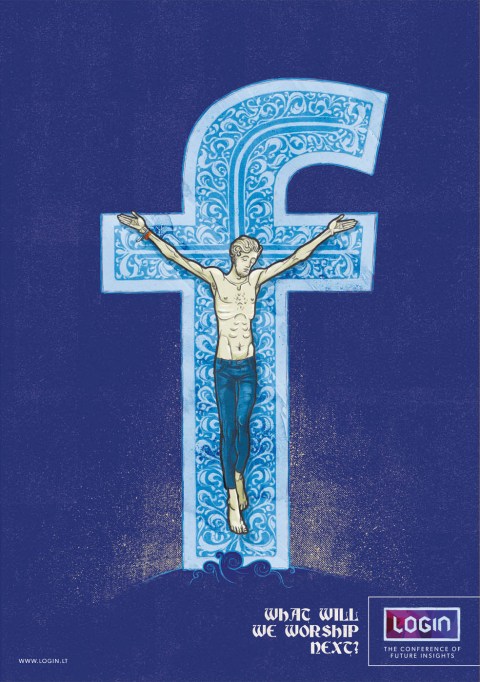
Noble is making an important distinction here. It is not uncommon to hear people talk metaphorically about technology in religiously inflected language or to draw analogies between religious practices and technology. As an example consider the poster below for “Login: The Conference of Future Insight” by the New! ad agency (h/t @troy_s). This poster analogically relates religion to technology by taking as its theme, “What will we worship next?” The question implies that we “worship” technology analogously to the worship of the religious believer, or that technology functions analogously to a deity in the life of the believer. This is a perfectly valid and suggestive angle of inquiry. However, it is not exactly what Noble has in mind. He unearths a concrete historical interrelationship between the Western technological project and the Christian tradition. A relationship, incidentally, which Noble hoped could be severed for the benefit of all involved.

By the New! ad agency

According to Noble, the religion of technology constitutes “an enduring ideological tradition that has defined the dynamic Western technological enterprise since its inception.” Consequently, it’s influence is evident not only upon “professed believers and those who employ explicitly religious language,” but also on many for “whom the religious compulsion is largely unconscious, obscured by a secularized vocabulary.” This influence manifests itself in the utopian hopes attached to the technological enterprise and can be traced back to the late Middle Ages. These utopian hopes include the expectation that technology would bring about the perfection of the individual and of society and serve as a vehicle of transcendence.

Statue of Roger Bacon in the Oxford University Museum of Natural History

The religion of technology emerges out of a worldview that posits an original state of perfection that, once lost, must be retrieved. Noble’s narrative traces the manner in which technology came to occupy a central place in this effort to regain the lost paradise. The medieval Christian worldview posited the requisite fallen condition: humanity had, by Adam’s sin, fallen from a state of spiritual and material perfection, and technology’s entanglement with the project of restoring the fallen order begins in an unlikely setting. Within the Benedictine monastic tradition, according to Noble’s interpretation*, work and its tools came to be seen as a means of grace enabling the recovery of mankind’s original perfection. At the dawning of the second millennium, this redemptive view of work and its tools was then joined to an eschatological fervor that anticipated the soon return of Christ and the renewal of the created order. In Noble’s narrative, this fusion was best exemplified by Roger Bacon:

“Having inherited the new medieval view of technology as a means of recovering mankind’s original perfection, Bacon now placed it in the context of millenarian prophecy, prediction, and promise. If Bacon, following Erigena and Hugh of St. Victor, perceived the advance of the arts as a means of restoring humanity’s lost divinity, he now saw it at the same time, following Joachim of Fiore, as a means of anticipating and preparing for the kingdom to come, and as a sure sign in and of itself that that kingdom was at hand.”

Noble goes on to describe the manner in which Christianity’s evangelical and missionary impulse “encouraged exploration, and thereby advanced the arts upon which such exploration depended, including geography, astronomy, and navigation, as well as shipbuilding, metallurgy, and, of course, weaponry.” Francis Bacon – who, Noble notes, “is typically revered as the greatest prophet of modern science” – is the next key figure in the evolution of the religion of technology. Noble, agrees with Lewis Mumford’s insistence that what Bacon advanced was “science as technology.” Bacon had little patience for science that did not issue in application and he suffused his advocacy of science as technology with a very specific theological aim: “the relief of man’s estate” understood as the amelioration of the material consequences of humanity’s fall. While the advent of Protestantism addressed the spiritual consequences of the fall, the scientific revolution underway in Europe was destined to address its material consequences. Both together would result in the re-establishment of the unfallen created order.

At the end of the nineteenth century, the religion of technology was alive and well in America, and it was best exemplified, according to Noble, by the techno-utopianism of Edward Bellamy whose writings “resound with the familiar refrains of redemption, of the divinely destined recovery of mankind’s lost perfection.” The historian Howard P. Segal, cited by Noble, summarizes Bellamy’s depiction of life in the year 2000 as follows:

The United States of the year 2000 is very much a technological utopia: an allegedly ideal society not simply dependent upon tools and machines, or even worshipful of them, but outright modeled after them. … The purposeful, positive use of technology – from improved factories and offices to new highways and electric lighting systems to innovative pneumatic tubes, electronic broadcasts, and credit cards – is, in fact, critical to the predicted transformation of the United States from living hell into a heaven on earth.

Following his survey of the historical origins of the religion of technology, Noble demonstrates its continuing vitality throughout the twentieth century in chapters exploring atomic weaponry, the space program, artificial intelligence, and genetic engineering. In each of these fields, Noble illustrates the enduring allure of the religiously inspired techno-utopian quest for perfection and transcendence.  In the end, Noble concludes that the religion of technology ultimately hinges on a hope of salvation that technology cannot finally provide.

_________________________________________________

*Noble’s interpretation of the Benedictine tradition should be qualified by George Ovitt’s work on the same.

Sex Sells the Future

The late nineteenth and early twentieth century world’s fairs were instrumental in transitioning America from an economy of production to one of consumption. Their role in bringing about this shift is fascinating. Here is but one of the more interesting dimensions of this role described by Robert Rydell in World of Fairs: The Century of Progress Expositions:

“Fundamental to this effort was an assault on remaining vestiges of values that were associated with what some historians have called a ‘culture of production.’ To hasten the dissolution of this older emphasis on restraint and inhibition, already under siege by world’s fairs at the beginning of the century and by the steady barrage of advertising that saturated the country during the 1920s, world’s fair builders injected their fantasies of progress with equally heavy doses of technological utopianism and erotic stimulation.”

We’re more familiar with the technological utopianism of the world’s fairs; the manner in which this technological utopianism was alloyed to erotic representations is less commonly noted. For example, Norman Bel Geddes, who famously designed Futurama, the fair’s most popular exhibit, also designed “Crystal Lassies,” “A Peep Show of Tomorrow.” Rydell continues:

“As if to liberate these fantasies from their Victorian moorings, exposition promoters gave increasing prominence to female striptease performances on exposition midways that, by the end of the decade, gave way to fully nude female performers in shows replete with world-of-tomorrow themes.”

Of course, this makes a great deal of sense. Chastity is to sexual desire what thrift is to economic desire. Rydell goes on:

“By suffusing the world of tomorrow with highly charged male sexual fantasies, the century-of-progress expositions not only reconfirmed the status of women as objects of desire, but represented their bodies as showcases that perfectly complemented displays of futuristic consumer durables everywhere on exhibit at the fairs.”

We know sex sells. This is a commonplace in our society. But we often think it operates by association. Pair the model with the car and somehow the attraction to the model will infuse the car. Perhaps. But some marketers appear to have understood the relationship somewhat differently. Eliminate restraint in one domain and you will eliminate it in the other as well.

E Simms Campbell in Esquire, 1939

“Sacred Industry” and Technology

From David Nye’s American Technological Sublime:

“Writing of the Philadelphia Exposition of 1876, Walt Whitman proclaimed:

Mightier than Egypt’s tombs,
Fairer than Grecia’s, Roma’s temples.
Prouder than Milan’s statued, spired cathedral,
More picturesque than Rhenish castle-keeps,
We plan even not to raise, beyond them all,
The great cathedral sacred industry, no tomb,
A keep for life of practical invention*.

‘Sacred industry’ rivaled the religious architecture of antiquity; in America technological achievements became measures of cultural value.”

______________________________________

* “Practical invention” was one of several phrases then commonly used to designate what we would today call “technology.”

The Centennial Tower, Philadelphia 1876

Looking Forward

Edward Bellamy in Equality, 1897 (cited by David Noble in The Religion of Technology):

“This craze for more and more and ever greater and wider inventions for economic purposes, coupled with apparent complete indifference as to whether mankind derived any ultimate benefit from them or not can only be understood by regarding it as one of those strange epidemics of insane excitement which have been known to affect whole populations at certain periods, especially of the middle ages. Rational explanation it has none.”