Ramblings Regarding Authenticity and Identity in an Age of Performance

What is authenticity? It is the holy grail of modern life.

Why?

Some thoughts.

Take One …

Because modernity is one long identity crisis.

In traditional societies, identity was given. It was grounded in the relative solidity of pre-modern life. Individuals inhabited an identity that was given by time, place, the structures and institutions of daily life.

In modernity, all that is solid melts … and choice is the solvent.

A multiplicity of choices arise were once there were few or none – choices regarding vocation, home, spouse, religion, and more. Consumer society is simply the apotheosis of a very long trajectory – Luther is her prophet.

Crisis of identity used to be the province of exiles and their children. Modernity generalizes the condition of exile.

Where there is choice there is freedom. There is also uncertainty, anxiety, regret, and self-consciousness.

Choice foregrounds the choosing self.

Freedom  and choice lead to performance. Choices, because they could have been otherwise, become signals to be read. They disclose and they reveal. When this dynamic is embraced, happily or despondently, identity becomes performance.

A performed identity – relative to an inhabited, given identity – feels inauthentic.

Take Two …

“The world of Homer is unbearably sad because it never transcends the immediate moment; one is happy, one is unhappy, one wins, one loses, finally one dies. That is all.” (W. H Auden)

Achilles is authentic. His identity is experienced as the fulfillment of a destiny. Further, there are no psychic gaps between circumstances and emotions and actions. Sorrow, tears, rage, murder – all follow immediately upon circumstances. Passionate intensity characterizes experience.

Self-consciousness lives in the gaps.

Once they open but a little, self-reflection and moderation emerge. Emotions are tempered and cooled.

Open them further and the space becomes a stage and performance ensues.

Performance is knowing, cool, detached, ironic. Performance feels inauthentic because it is rehearsed action.

Take Three …

“Writing heightens consciousness.” (Walter Ong)

Writing captures the mind. The diary is emblematic. Authentic self is the private self.

Images heighten self-consciousness.

Images of oneself capture the self as seen by others.

Images evoke performance.

“The medium is the message.” (Marshall McLuhan)

The medium is the message and we are both; it’s the ratio that matters.

Until recently the power to produce media has been in the hands of a relative few. Under these circumstances individuals were the medium and culture was the message. When the power to produce media is democratized the relationship is reversed. Culture becomes the medium and the self is the message.

“Any person today can lay claim to being filmed.” (Walter Benjamin)

Any person today can lay claim to being a filmmaker.

“The distinction between author and public is about to lose its axiomatic character … At any moment the reader is ready to become a writer.” (Walter Benjamin)

Digital media has democratized the production of media even further. We are not only actors, but also directors of our own lives as we perform them for an audience, imagined or real.

Authenticity, if it is taken to mean either non-performative action or immediate action that is not self-reflexive, is no longer an option. In the world created by the expansion of choices, we have no choice in the matter.
Hawthorne Against the Techno-Utopians

I’ve had occasion to mention Nathaniel Hawthorne’s writing a time or two in previous posts. In his journal, he noted the manner in which the train whistle broke into the natural idyll he was enjoying — “But, hark! there is the whistle of the locomotive” — inaugurating a long-standing literary convention which persists to this day (see Sherry Turkle).

Elsewhere, Hawthorne anticipated de Chardin and McLuhan’s metaphorical rendering of the electric age: “Is it a fact — or have I dreamt it — that, by means of electricity, the world of matter has become a great nerve, vibrating thousands of miles in a breathless point of time?”

Hawthorne and his generation were grappling with the consequences of industrialization. We are grappling with the consequences of digitization. These two are not necessarily analogous, but they share one variable: human nature. Hawthorne in particular had a keen sense of our faults and foibles. While his stories did not always dwell on technology explicitly, they imaginatively explored the darker proclivities that human beings bring to the techno-scientific project.

In the opening paragraph of The Scarlet Letter, Hawthorne writes,

“The founders of a new colony, whatever Utopia of human virtue and happiness they might originally project, have invariably recognized it among their earliest practical necessities to allot a portion of the virgin soil as a cemetery, and another portion as the site of a prison.”

This is a grim observation, but it seems incontrovertible; and it applies with equal force to all techno-utopian projects and hopes. Wherever we go, there we are and our imperfections with us.

Pascal observed that the error of Stoicism lay in believing that what can be done once can be done always. I would offer an analogous framing of the techno-utopian error: Believing the wonderful use to which a technology can be put, will be the use to which it is always put.

Better, it would seem, to go forward with a hopeful skepticism that avoids the cycloptic vision of either the techno-utopians or the techno-cynics. And reading a little Hawthorne might be a good way of nurturing that disposition.

_______________________________________________

Over the past couple of years, the folks at The New Atlantis have been publishing a series of reflections on a handful of Hawthorne’s short stories as they bear on Science, Progress, and Human Nature. These are each thoughtful and engaging essays.  

Mindfulness Is Not Merely Subtraction

Mindfulness is not merely negation, subtraction, or reduction.

This was the thought that occurred to me as I read Miranda Ward’s reflections on her inadvertent break from the Internet, which concluded with the following observation:

“Why can’t we at least acknowledge that, with or without the internet, we still have to work hard, fight distraction, fight depression, and succumb, every once in awhile, to paralysing self-doubt? So it was nice, while I was on holiday, not to have any mobile phone reception. It’s also nice to be able to video chat with my 86-year-old grandmother in California. Disconnected, connected, whatever: I’m still fallible.”

Indeed, we are all fallible. If we assume that merely withdrawing from certain facets of digital life will by itself render us supremely attentive and mindful individuals, then we are certainly in for a rather disheartening disappointment.

That said, I do think the little word merely is essential. Mindfulness is more, not less than what I’ve called attentional austerity. To put it otherwise, attentional austerity is a necessary, but not sufficient cause of mindfulness. It’s not a matter of starving attention, but training and directing it.

Ordinarily, mindfulness is a habituated response, not a spontaneous reaction. Habituated responses arise out of our practices. If our online practices undermine mindfulness, then moderating these practices becomes part of the solution.

Learning to establish and abide by certain limits is, after all, an indispensable discipline. But imposing limits for their own sake is at best unhelpful and at worst destructive. Limits, as Wendell Berry has written, are best understood as “inducements to formal elaboration and elegance, to fullness of relationship and meaning.” They are for something. 

Mindfulness must be for something. It is about fostering a certain kind of attention and learning to deploy it toward certain ends and not others. 

While doing whatever we call the Twitter equivalent of eavesdropping on an exchange centered on David Foster Wallace and the idea of mindfulness, I was reminded of Wallace’s Kenyon College commencement address in which he makes the following observation:

“The really important kind of freedom involves attention, and awareness, and discipline, and effort, and being able truly to care about other people and to sacrifice for them, over and over, in myriad petty little unsexy ways, every day. That is real freedom. The alternative is unconsciousness, the default-setting, the ‘rat race’ — the constant gnawing sense of having had and lost some infinite thing.”

Mindfulness, in Wallace’s view, is about redirecting our attention toward others; and not only toward others, but toward others as ends in themselves (to put a Kantian spin on it). This latter qualification is necessary because we very often direct our attention upon others, but only for the sake of having ourselves reflected back to us.

There are, of course, other legitimate ends toward which mindfulness may aspire. The point is this: We ought not to be for or against the Internet in itself. We ought to be for the kind of loving mindfulness Wallace advocates — to take one example — and then we ought to measure our practices, all of them, online or off, by how well they support such loving mindfulness.

The Road Makes All the Difference

“There is a subtle but fundamental difference between finding direction … and ambiently knowing direction.” This was Evgeny Morozov’s recent encapsulation of Tristan Gooley’s The Natural Navigator. According to Gooley, natural navigation, that is navigation by the signs nature yields, is a dying art, and its passing constitutes a genuine loss.

Even if you’ve not read The Natural Navigator, or Morozov’s review, your thoughts have probably already wandered toward the GPS devices we rely on to help us find direction. It’s a commonplace to note how GPS has changed our relationship to travel and place. In “GPS and the End of the Road,” Ari Schulman writes of the GPS user: “he checks first with the device to find out where he is, and only second with the place in front of him to find out what here is.” One may even be tempted to conclude that GPS has done to our awareness of place what cell phones did to our recall of phone numbers.

(Of course, this is not a brief against GPS, much less against maps and compasses and street signs. These have their place, of course. And there are a number of other qualifications which could be offered, but I’ll trust to your generosity as readers and assume that these are understood.)

From the perspective of natural navigation, however, GPS is just one of many technologies designed to help us find our way that simultaneously undermine the possibility that we might also come to know our way or, we might add, our place. Navigational devices, after all, enter into our phenomenological experience of place and do so in a way that is not without consequence.

When I plug an address into a GPS device, I expect one thing: an efficient and unambiguous set of directions to get me from where I am to where I want to go. My attention is distributed between the device and the features of the place. The journey is eclipsed, the places in between become merely space traversed. In this respect, GPS becomes a sign of the age in its struggle to consider anything but the accomplishment of ends with little regard for the means by which the ends are accomplished. We seem to forget, in other words, that there are goods attending the particular path by which a goal is pursued that are independent of the accomplishment of that goal.

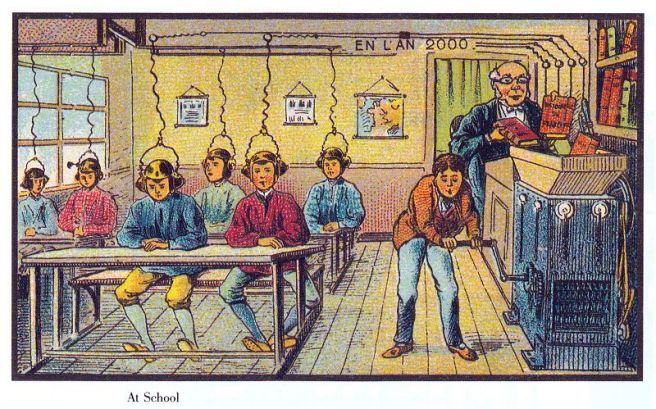
It’s a frame of mind demanded, or to put it in less tech-derministic terms, encouraged by myths of technological progress. If I am to enthusiastically embrace every new technology, I must first come to believe that means or media matter little so long as the end is accomplished. A letter is a call is an email is a text message. Consider this late nineteenth century French cartoon imagining the year 2000 (via Explore):

From our vantage point, of course, this seems silly … but only in execution, not intent. Our more sophisticated dream replaces the odd contraption with the Google chip. Both err in believing that education is reducible to the transfer of data. The means are inconsequential and interchangeable, the end is all that matters, and it is a vastly diminished end at that.

Natural navigation and GPS may both get us where we want to go, but how they accomplish this end makes all the difference. With the former, we come to know the place as place and are drawn into more intimate relationship with it. We become more attentive to the particulars of our environment. We might even find that a certain affection insinuates itself into our experience of the place. Affective aspects of our being are awakened in response. When a new technology promises to deliver greater efficiency by eliminating some heretofore essential element of human involvement, I would bet that it also effects an analogous alienation. In such cases, then, we have been carelessly trading away rich and rewarding aspects of human experience.

Sometimes it is the road itself that makes all the difference.

Why Did Curiosity’s Landing Generate So Much Attention?

Take a look at the image to the right. Care to guess what you’re looking at?

I might very well be wrong, but I imagine that more than a few people would guess that they are looking at an image of Curiosity during its descent stage onto the surface of Mars — there’s the chute and there’s the capsule. This would be a reasonable conjecture, but also an incorrect one.

The image is of another rover, Phoenix, making its final descent onto the surface of Mars on May 25, 2008. Remember that one? I didn’t. It was, as it turns out, the first time the landing of one spacecraft on the surface of a planet was photographed by another spacecraft.

Now, I don’t want to make too much of my own forgetfulness or inattentiveness, but I was surprised to learn that Curiosity’s successful landing was the sixth such success in NASA’s history.

Viking 1 and Viking 2 each landed on Mars in 1976. The Mars Pathfinder and its rover, Sojourner landed in 1997. Two rovers, Spirit and Opportunity, landed in 2004. And finally, Phoenix, landed in 2007. (Check out a great info graphic of missions to Mars here. H/T Jeremy Antley.)

I’ve been a low-level space geek since I was child, and so I wasn’t entirely oblivious to this history. But being reminded of it did make the publicity surrounding Curiosity, well, curious.

Why was it that Curiosity’s landing was received with such fanfare? And why was it that it evoked such a powerful emotional response when previous landings, recent and impressive, had not?

Naturally, I took to Twitter with my query. Now, I don’t have nearly enough followers to make this as fruitful a venture as it might be for others, but, thanks to some retweets, it did return a few interesting suggestions.

Here was my initial tweet:

My suggestions were arrived at as follows. Size? Curiosity was by far the largest such vehicle. Degree of difficulty? Given its size, landing the rover safely necessitated an ingenious and elaborate multi-stage landing system. Trailer? I was referring to the dramatically titled video produced by NASA, “Seven Minutes of Terror,” depicting Curiosity’s planned descent. Social media? Well, for starters, Curiosity has its own twitter feed: MarsCuriosity.

So what kind of responses did I get? A few suggested what one person neatly summed up as “Space shuttle ennui.” In other words, Curiosity stepped in to fill a gap created by the retirement of the space shuttles — the last voyage of which tapped the technological sublime.

Relatedly, it was suggested that Curiosity filled a void created by the absence of any inspiring visions for our future in relation to space, or perhaps for any future.

Others pointed to some variation of the suggestions I offered. The complexity of the skycrane, social media coverage of the landing, and NASA’s improved self-promotion.

All of these seem to have some role to play in creating the event that was Curiosity’s landing — the “Seven Minutes of Terror” video hooked me — but I’m not sure that any of these alone, or even all of them together satisfactorily explain the phenomenon.

Here’s my take as it stands: It mostly is a case of the distinctly American technological sublime. This actually draws both streams of responses together: those that focused on the filling up of some collectively felt absence and those that emphasized the sophistication of the technology involved. David Nye’s account of the American technological sublime included both the existential experience of a technology that left one in awe and a participation in what amounted to a (Durkheimian) civil religion.

As a civil religious experience, the technological sublime provided a sense of national identity, purpose, and destiny. Experiences of the technological sublime — whether seeing the first railroads or the first electrified cityscapes, standing before the Hoover Dam, or witnessing a Saturn V launch, to name a few instances — forged the collective national character. They were rituals of solidarity. They inspired confidence in what we could accomplish and, therefore, hope for the future.

It could be argued that we are a nation casting about for renewed unity and sense of purpose. There is a felt need for what the technological sublime had supplied earlier generations of Americans. The consumer technologies which surround us today, impressive as they are in many respects, don’t quite have the capacity to elicit the sublime experience. In part, because they merely (and “merely” is not  quite the right word there) enhance or repackage what earlier technologies had first accomplished long ago. The latest cell phone technology can never compete with the experience of hearing a voice over the telephone for the first time, for example.

Curiosity stepped into this fractured and disillusioned cultural milieu and it was dynamic and extraordinary enough to evoke the sublime response. Remember the tears that flowed at mission control. It was the right technology, at the right time. And social media supplied the sense of collective experience so critical to its civil religious function.

So now your thoughts. Did you tune in to the live feed from mission control? Did you give Curiosity more attention than you usually would to the space program? Were you moved by the whole thing? Did you notice that this was the case for others even if wasn’t quite your reaction? Pure media hype? Sheer awesomeness? To what does Curiosity owe its vaunted status?

Maybe its all just Curiosity’s WALL•E-esque anthropomorphic charm. Or, am I the only one that sees that?