In the last post, I cited a passage or two from Hannah Arendt in which she discusses “thinking without a bannister,” thinking that attempts to think “as though nobody had thought before.” I endorsed her challenge, but I hinted in passing at a certain unease with this formulation. This largely stemmed from my own sense that we must try to learn from the past. Arendt, however, does not mean to suggest that there is nothing at all that can be learned from the past. This is evident from the attentive care she gives to ancient sources in her efforts to illuminate the present state of things. Rather, she seems to believe that a coherent tradition of thought which we can trust to do our thinking for us, a tradition of thought that can set our intellectual defaults as it were–this kind of tradition is lost. The appearance of totalitarianism in the 20th century (and, I think, the scope and scale of modern technology) led Arendt to her conclusion that thinking must start over. But, again, not entirely without recourse to the tradition.
Here is Arendt expounding upon what she calls Walter Benjamin’s “gift of thinking poetically”:
“This thinking, fed by the present, works with the ‘thought fragments’ it can wrest from the past and gather about itself. Like a pearl diver who descends to the bottom of the sea, not to excavate the bottom and bring it to light but to pry loose the rich and the strange, the pearls and the coral in the depths of the past–but not in order to resuscitate it the way it was and to contribute to the renewal of the extinct ages. What guides this thinking is the conviction that although the living is subject to the ruin of the time, the process of decay is at the same time a process of crystallization, that in the depth of the sea, into which sinks and is dissolved what was once alive, some things suffer a ‘sea change’ and survive in new crystallized forms and shapes that remain immune from the elements, as though they waited only for the pearl diver who one day will come down to them and bring them up into the world of the living–as ‘thought fragments,’ as something ‘rich and strange,’ and perhaps even as everlasting Urphänomene [archetypal or pure phenomenon].”
As Richard Bernstein puts it in his essay, “Arendt on Thinking,” “what Arendt says in her eloquent essay on Walter Benjamin also might have been said about Arendt.” Bernstein goes on to explain that Arendt “links thinking together with remembrance and storytelling. Remembrance is one of the most important ‘modes of thought,’ and it requires story-telling in order to preserve those ‘small islands of freedom.'”
The tradition may have been broken, but it is not altogether lost to us. By the proper method, we may still pluck some pearls and repurpose them to help us make sense of the present.
In politics and religion, especially, moderates are in high demand, and understandably so. The demand for moderates reflects growing impatience with polarization, extremism, and vacuous partisan rancor. But perhaps these calls for moderation are misguided, or, at best, incomplete.
To be clear, I have no interest in defending extremism, political or otherwise. But having said that, we immediately hit on part of the problem as I see it. While there are some obvious cases of broad agreement about what constitutes extremism–beheadings, say–it seems pretty clear that, in the more prosaic realms of everyday life, one person’s extremism may very well be another’s principled stand. In such cases, genuine debate and deliberation should follow. But if the way of the moderate is valued as an end in itself, then debate and deliberation may very well be undermined.
I use the phrase “the way of the moderate” in order to avoid using the word moderation. The reason for this is that moderation, to my mind anyway, suggests something a bit different than what I have in view here in talking about the hankering for moderates. Moderation, for instance, may be associated with Aristotle’s approach to virtue, which I rather appreciate.
But moderation in that sense is not really what I have in mind here. I may agree with Aristotle, for instance, that courage is the mean between cowardice on the one hand and foolhardiness on the other. But I’m not sure that such a methodology, which may work rather well in helping us understand the virtues, can be usefully transferred into other realms of life. To be more specific, I do not think that you can approach, to put it quaintly, matters of truth in that fashion, at least not as a rule.
In other words, it does not follow that if two people are arguing about a complex political, social, or economic problem I can simply split the difference between the two and thereby arrive at the truth. It may be that both are desperately wrong and a compromise position between the two would be just as wrong. It may be that one of the two parties is, in fact, right and that a compromise between the two would, again, turn out to be wrong.
The way of the moderate, then, amounts to a kind of intellectual triangulation between two perceived extremes. One need not think about what might be right, true, or just; rather, one takes stock of the positions on the far right and the far left and aims for some sort of mean between the two, even if the position that results is incoherent or unworkable. This sort of intellectual triangulation is also a form of intellectual sloth.
Where the way of the moderate is reflexively favored, it would be enough to successfully frame an opponent as being either “far right” or “far left.” Further debate and deliberation would be superfluous and mere pretense. And, of course, that is exactly what we see in our political discourse.
Again, given our political culture, it is easy to see why the way of the moderate is appealing and tempting. But, sadly, the way of the moderate as I’ve described it does not escape the extremism and rancor that it bemoans. In fact, it is still controlled by it. If I seek to move forward by triangulating a position between two perceived extreme coordinates, I am allowing those extremes to determine my own path. We may very well need a third path, or even a fourth and fifth, but we should not assume that such a path can be found by passing through the middle of the extremes we seek to avoid. Such an assumption is the very opposite of the “independence” that is supposedly demonstrated by pursuing it.
Paradoxically, then, we might understand the way of the moderate as the flip side of the extremism and partisanship it seeks to counteract. What they both have in common is thoughtlessness. On the one hand you get the thoughtlessness of sheer conformity; the line is toed, platitudes are professed, and dissent is silenced. On the other, you sidestep the responsibility for independent thought by splitting the presumed difference between the two perceived extremes.
We do not need moderation of this sort; we need more thought.
In the conference transcripts I mentioned a few days ago, Hannah Arendt was asked about her political leanings and her position on capitalism. She responded this way: “So you ask me where I am. I am nowhere. I am really not in the mainstream of present or any other political thought. But not because I want to be so original–it so happens that I somehow don’t fit.”
A little further on she went on to discuss what she calls thinking without a bannister:
“You said ‘groundless thinking.’ I have a metaphor which is not quite that cruel, and which I have never published but kept for myself. I call it thinking without a bannister. In German, Denken ohne Geländer. That is, as you go up and down the stairs you can always hold onto the bannister so that you don’t fall down. But we have lost this bannister. That is the way I tell it to myself. And this is indeed what I try to do.”
And she added:
“This business that the tradition is broken and the Ariadne thread is lost. Well, that is not quite as new as I made it out to be. It was, after all, Tocqueville who said that ‘the past has ceased to throw its light onto the future, and the mind of man wanders in darkness.’ This is the situation since the middle of the last century, and, seen from the viewpoint of Tocqueville, entirely true. I always thought that one has got to start thinking as though nobody had thought before, and then start learning from everybody else.”
I’m not sure that I agree with Arendt in every respect, but I think we should take her call to start thinking as though nobody had thought before quite seriously.
I’ll leave you with one more encouragement in that general direction, this one from a recent piece by Alan Jacobs.
“I guess what I’m asking for is pretty simple: for writers of all kinds, journalists as well as fiction writers, and artists and academics, to strive to extricate themselves from an ‘artificial obvious’ that has been constructed for us by the dominant institutions of our culture. Simple; also probably impossible. But it’s worth trying. Few things are more worth trying.”
One step in this direction, I think, is to avoid the temptation presented to us by the way of the moderate as I’ve described it here. Very often what is needed is to, somehow, break altogether from the false dilemmas and binary oppositions presented to us.
You can subscribe to my newsletter on technology and society here: The Convivial Society.
There’s a well-known story about C.S. Lewis and J.R.R. Tolkien’s agreement to write stories about Space and Time. Dissatisfied with the state of Space/Time stories in the 1930s, the two decided to write the kind of stories they wanted to read. Lewis agreed to write a story focused on Space, and Tolkien agreed to write a story focused on Time. Ultimately, Lewis followed through and produced the three books popularly known as his Space Trilogy. Tolkien never quite got around to writing his story about Time, he was too busy finishing some business about a ring.
I relate that story because I was reminded of it as I read about SpaceX and Tesla founder, Elon Musk. I’ve written about Peter Thiel a time or two recently, but Thiel isn’t the only tech entrepreneur with an expansive vision for the future. Whereas Thiel’s interests seem to gravitate toward technologies associated with Transhumanism, however, fellow PayPal alum Elon Musk’s interests are interplanetary in scope. It is as if, not unlike Lewis and Tolkien, Musk and Thiel decided to split up Space and Time between them. They, of course, would do more than write–they would seek to conquer their respective fields. Thiel sets out to conquer Time through the radical human enhancement and Musk sets out to conquer Space through interplanetary colonization. Interestingly enough, the ultimate success of their wildest dreams rather depend on one another.
Musk was recently interviewed by Ross Anderson for Aeon. Anderson’s title for his nearly 7,000 word essay that resulted, “Exodus,” is apt on at least two counts. It encompasses both the central theme of the interview–interplanetary migration for the sake of species survival–and the religious themes evoked by Anderson.
It’s a long, interesting piece, but here are some of the highlights, particularly in light of recent posts considering technological innovation, culture, and the religion of technology.
First, a snapshot of Musk’s stated vision for space travel:
“I had come to SpaceX to talk to Musk about his vision for the future of space exploration, and I opened our conversation by asking him an old question: why do we spend so much money in space, when Earth is rife with misery, human and otherwise? It might seem like an unfair question. Musk is a private businessman, not a publicly funded space agency. But he is also a special case. His biggest customer is NASA and, more importantly, Musk is someone who says he wants to influence the future of humanity. He will tell you so at the slightest prompting, without so much as flinching at the grandiosity of it, or the track record of people who have used this language in the past. Musk enjoys making money, of course, and he seems to relish the billionaire lifestyle, but he is more than just a capitalist. Whatever else might be said about him, Musk has staked his fortune on businesses that address fundamental human concerns. And so I wondered, why space?
Musk did not give me the usual reasons. He did not claim that we need space to inspire people. He did not sell space as an R & D lab, a font for spin-off technologies like astronaut food and wilderness blankets. He did not say that space is the ultimate testing ground for the human intellect. Instead, he said that going to Mars is as urgent and crucial as lifting billions out of poverty, or eradicating deadly disease.
‘I think there is a strong humanitarian argument for making life multi-planetary,’ he told me, ‘in order to safeguard the existence of humanity in the event that something catastrophic were to happen, in which case being poor or having a disease would be irrelevant, because humanity would be extinct.”
While discussing our failure, thus far, to find intelligent life, Musk observed:
“At our current rate of technological growth, humanity is on a path to be godlike in its capabilities.”
He then went on to explain why he thinks we’ve not yet encountered intelligent life:
“Musk has a more sinister theory. ‘The absence of any noticeable life may be an argument in favour of us being in a simulation,’ he told me. ‘Like when you’re playing an adventure game, and you can see the stars in the background, but you can’t ever get there. If it’s not a simulation, then maybe we’re in a lab and there’s some advanced alien civilisation that’s just watching how we develop, out of curiosity, like mould in a petri dish.’ Musk flipped through a few more possibilities, each packing a deeper existential chill than the last, until finally he came around to the import of it all. ‘If you look at our current technology level, something strange has to happen to civilisations, and I mean strange in a bad way,’ he said. ‘And it could be that there are a whole lot of dead, one-planet civilisations.’”
A reminder dropped in by Anderson of the pedigree of Musk’s ambitions:
“In 1610, the astronomer Johannes Kepler wrote, in a letter to Galileo: ‘Let us create vessels and sails adjusted to the heavenly ether, and there will be plenty of people unafraid of the empty wastes. In the meantime, we shall prepare, for the brave sky-travellers, maps of the celestial bodies.'”
And then, toward the end of the piece, Anderson begins to play up the religion of technology jargon (emphasis mine):
“But a million people on Mars sounds like a techno-futurist fantasy, one that would make Ray Kurzweil blush. And yet, the very existence of SpaceX is fantasy. After talking with Musk, I took a stroll through his cathedral-like rocket factory.”
….
“This fear, that the sacred mission of SpaceX could be compromised, resurfaced when I asked Musk if he would one day go to Mars himself. ‘I’d like to go, but if there is a high risk of death, I wouldn’t want to put the company in jeopardy,’ he told me. ‘I only want to go when I could be confident that my death wouldn’t result in the primary mission of the company falling away.’ It’s possible to read Musk as a Noah figure, a man obsessed with building a great vessel, one that will safeguard humankind against global catastrophe. But he seems to see himself as a Moses, someone who makes it possible to pass through the wilderness – the ‘empty wastes,’ as Kepler put it to Galileo – but never sets foot in the Promised Land.”
….
You can see why NASA has given Musk a shot at human spaceflight. He makes a great rocket but, more than that, he has the old vision in him. He is a revivalist, for those of us who still buy into cosmic manifest destiny. And he can preach. He says we are doomed if we stay here. He says we will suffer fire and brimstone, and even extinction. He says we should go with him, to that darkest and most treacherous of shores. He promises a miracle.
In a 1979 collection of essays, Hannah Arendt: The Recovery of the Public World, edited by Melvyn Hill, I came across transcripts from a 1972 conference on Arendt’s work. I found the exchange below, between Arendt and the philosopher Hans Jonas, intriguing enough to type out here for your perusal. I believe this, then, is the only place on the web that you’ll find this little clip, an exclusive brought to you by The Frailest Thing! I found the opening and closing statements by Jonas especially interesting.
Hans Jonas: That there is at the bottom of all our being and of our action the desire to share the world with other men is incontestable, but we want to share a certain world with certain men. And if it is the task of politics to make the world a fitting home for man, that raises the question: “What is a fitting home for man?”
It can only be decided if we form some idea of what man is or ought to be. And that again cannot be determined, except arbitrarily, if we cannot make appeal to some truth about man which can validate judgement of this kind, and the derivative judgment of political taste that crops up in the concrete situations–and especially if it is a question of deciding how the future world should look–which we have to do all the time dealing with technological enterprises that are having an impact on the total dispensation of things.
Now it is not the case that Kant simply made appeal to judgment. He also made appeal to the concept of the good. There is such an idea as the supreme good however we define it. And perhaps it escapes definition. It cannot be an entirely empty concept and it is related to our conception of what man is. In other words, that which has by unanimous consensus here been declared dead and done with–namely, metaphysics–has to be called in at some place to give us a final directive.
Our powers of decision reach far beyond the handling of immediate situations and of the short-term future. Our powers of doing or acting now extend over such matters as really involve a judgment or an insight into or a faith in–I leave that open–some ultimates. For in ordinary politics as it has been understood until the twentieth century we could do with penultimates. It is not true that the condition of the commonwealth had to be decided by the really ultimate values or standards. When it is a matter, as it is under the conditions of modern technology, that willy-nilly we are embarking on courses which affect the total condition of things on earth and the total future condition of man, then I don’t think we can simply wash our hands and say Western metaphysics has got us into an impasse and we declare it bankrupt and we appeal now to shareable judgments–where, for God’s sake, we do not mean by shared judgments shared with a majority or shared with any defined group. We can share judgments to our perdition with many but we must make an appeal beyond that sphere!
Arendt: I am afraid that I will have to answer. I am not going to go into the question of Kant’s Critique of Judgment. Actually the question of the good doesn’t arise and the question of truth doesn’t arise. The whole book is actually concerned with the possible validity of these propositions.
Jonas: But it’s not political.
Arendt: No, but I said only of the validity: whether one can transfer it to the political sphere is also one of the very interesting, but at this moment side, issues. And this, of course, I have done, and I have done it by simply taking Kant’s late writing on politics. One of the main things here is a certain stand towards the French Revolution in Kant. But I am not going to go into that because it would lead us too far away from this question of ultimates.
Now if our future should depend on what you say now–namely that we will get an ultimate which from above will decide for us (and then the question is, of course, who is going to recognize this ultimate and which will be the rules for recognizing this ultimate–you have really an infinite regress here, but anyhow) I would be utterly pessimistic. If that is the case then we are lost. Because this actually demands that a new god will appear.
This word (God) was a Christian word in the Christian Middle Ages, and permitted very great skepticism, but one had it in the ultimate instance, because it was God. But because this [God] had disappeared Western humanity was back in the situation in which it had been before it was saved, or salvaged, or whatever, by the good news–since they didn’t believe in it any longer. That was the actual situation. And this situation sent them [i.e., the eighteenth century revolutionaries] back scrambling for antiquity. And not as in some cases because you are in love with Greek verse or Greek songs as may be the case in my case. But that was not their motivation.
That is, they were in all nakedness confronted with the fact that men exist in the plural. And no human being knows what is man in the singular. We know only “male and female created he them“–that is, from the beginning this plurality poses an enormous problem.
For instance, I am perfectly sure that this whole totalitarian catastrophe would not have happened if people still had believed in God, or in hell rather—that is, if there still were ultimates. There were no ultimates. And you know as well as I do that there were no ultimates which one could with validity appeal to. One couldn’t appeal to anybody.
And if you go through such a situation [as totalitarianism] the first thing you know is the following: you never know how somebody will act. You have the surprise of you life! This goes throughout all layers of society and it goes throughout various distinctions between men. And if you want to make a generalization then you could say that those who were still very firmly convinced of the so-called old values were the first to be ready to change their old values for a new set of values, provided they were given one. And I am afraid of this, because I think that the moment you give anybody a new set of values–or this famous “bannister” and a set of values, no matter. I do not believe that we can stabilize the situation in which we have been since the seventeenth century in any final way.
F.M. Barnard: Would you then agree with Voltaire? You raised this question of God and to some extent a metaphysic which one may question qua metaphysic but which one may regard as extremely useful socially.
Arendt: Entirely agree. We wouldn’t have to bother about this whole business if metaphysics and this whole value business hadn’t fallen down. We begin to question because of these events.
Jonas: I share with Hannah Arendt the position that we are not in possession of any ultimates, either by knowledge or by conviction or faith. And I also believe that we cannot have this as a command performance because “we need it so bitterly we therefore should have it.”
However, a part of wisdom is knowledge of ignorance. The Socratic attitude is to know that one does not know. And this realization of our ignorance can be of great practical importance in the exercise of the power of judgment, which is after all related to action in the political sphere, into future action, and far-reaching action.
Our enterprises have an eschatological tendency in them—a built in utopianism, namely, to move towards ultimate situation. Lacking the knowledge of ultimate values—or, of what is ultimately desirable—or, of what is man so that the world can be fitting for man, we should at least abstain from allowing eschatological situations to come about. This alone is a very important practical injunction that we can draw from the insight that only with some conception of ultimates are we entitled to embark on certain things. So that at least as a restraining force the point of view I brought in may be of some relevance.
Virginia Postrel thinks that Peter Thiel is wrong about the future. I think she is about half right, roughly.
If I read her correctly, Postrel’s thesis runs something like this: our lack of optimism about the future is not the consequence of fewer “moonshot” technological innovations, rather it stems from a failure to tell positive stories about the incremental improvements that have made the present better than the past.
In what follows, I want to take a close look at Postrel’s argument and some of its underlying assumptions because I think the piece reflects some interesting tensions in our thinking about technology and innovation.
Let’s start where Postrel does, with her examples of what I’m going to start calling Tech Stagnation Angst (TSA–sure there’s another TSA out there, but maybe the overlap is instructive).
Her points of departure are the science-fiction author Neal Stephenson and, big surprise, our would-be Francis Bacon, the tech-entrepreneur cum philosopher of innovation, Peter Thiel.
I’ve written enough about Thiel (e.g., here and here) to let mention of him go without further comment. Bottom line: yes, he’s is poster-boy for TSA. Now here’s Postrel quoting Stephenson on the worries that spurred him to write a series of positive stories about the future:
“’I worry that our inability to match the achievements of the 1960s space program might be symptomatic of a general failure of our society to get big things done,’ writes Stephenson in the preface to ‘Hieroglyph,’ a science-fiction anthology hoping ‘to rekindle grand technological ambitions through the power of storytelling.’”
Here’s the first point I want to register: stories alone will not shape our outlook about the future, especially not if they’re consciously designed to do so.
I’ve also recently written about pleas for more hopeful science-fiction writing, pleas which seem to be a symptom of TSA. Needless to say, Stephenson is not the only one who thinks that dystopian science-fiction is poisoning our imagination for the future. Witness, for instance, Kevin Kelly’s recent offer of cash for the best happy 100-word story about the next 100 years.
About these, Postrel is mostly right–writing happy stories will not change the spirit of the age. Stories are powerful, and they can shape our imagination. But compelling fiction tends to tap into some existing aspect of the zeitgeist rather than consciously setting out to change it. The artificiality of the latter enterprise dooms it. It’s that whole thing about how you can’t tell someone how to sublimate.
Postrel adds the following public comments by Stephenson:
“’There’s an automatic perception … that everything’s dangerous,’ Stephenson mused at a recent event in Los Angeles, citing the Stonehenge example, ‘and that there’s some cosmic balance at work–that if there’s an advance somewhere it must have a terrible cost. That’s a hard thing to fix, but I think that if we had some more interesting Apollo-like projects or big successes we could point to it might lift that burden that is on people’s minds.’”
Postrel comments: “He’s identified a real problem, but his remedy — ‘more interesting Apollo-like projects’ — won’t work.” Again, I think Postrel is right, but only to an extent.
She is, on the one hand, right to challenge the simplistic fix that Stephenson lays out. But there are at least two additional points that need to be made.
First, while I agree that “more moonshots”–which just now, in my own mental wunderkammer, echoed “more cowbell”—is not the right prescription for our time, I think Postrel ignores the degree to which “moonshots” fueled the public imagination for a very long time.
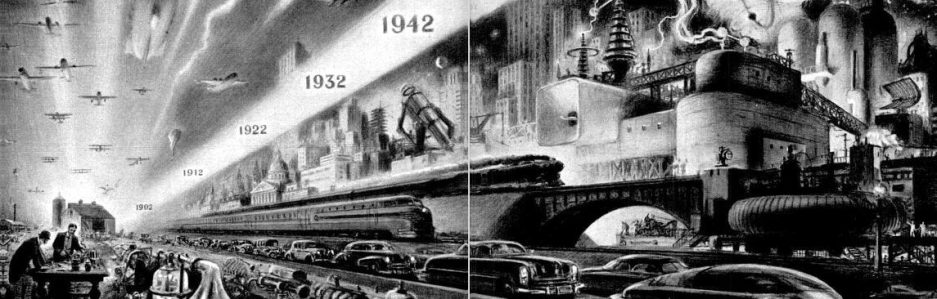
These “moonshots” we keep hearing about longingly might just be shorthand for the phenomena that David Nye labeled the American Technological Sublime. You can click that link to read more about it, but here is the short version: Nye documented responses to new technologies throughout the 19th and early to mid-20th century that verged on religious awe. These experiences were elicited by technologies of tremendous and hitherto unseen scale or dynamism (railroads, the Hoover Dam, skyscrapers, the electrified cityscape, atomic weapons, the Saturn V, etc.), and they were channeled into what amounted to a civil religion, public celebrations of national character and unity.
I would argue that Tech Stagnation Angst is, in fact, a response, wrong-headed perhaps, to the eclipse of the American Technological Sublime, which, as Nye himself explained, by the late 20th century had morphed into what he called the consumer sublime, a tacky simulated (!) version of the genuine experience.
Even if their response is misguided, Stephenson, Thiel, and all of those suffering from TSA are reacting to a real absence. While attitudes toward new technologies were often mixed, as Postrel points out, the popular response to new technologies of a grand scale in America has been overwhelmingly positive (with the exception of the atomic bomb). In fact, the response has been tinged with reverential awe, which functioned to sustain a powerful narrative about American exceptionalism grounded in our technological achievement.
It is only reasonable to expect that the eclipse of such a powerful cultural phenomena would yield a profoundly felt absence and not a little bit of anxiety. Again, I’m not endorsing the idea that we need only fabricate some more sublime experiences with moonshot-style projects and everything will be fine. On that score, I think Postrel is right. But in insisting that past optimism was chiefly grounded in relatively mundane accounts of how the present was incrementally better than the past, I think she misses other powerful forces at work in the complex way Americans came to think about technology in relation to the future.
In sum, technological projects of impressive scale and power have fueled America’s optimism about technology, thus their absence may very well account for tech stagnation angst.
Postrel seems to waver with respect to the power of stories to shape the future, and she does so in a way that reinforces my point about the collapse of the sublime. “Stephenson and Thiel are making a big mistake,” Postrel writes, “when they propose a vision of the good future that dismisses the everyday pleasures of ordinary people — that, in short, leaves out consumers.” She then adds that, “storytelling does have the potential to rekindle an ideal of progress.”
As I’ve argued elsewhere, and as Nye suggested, it is precisely the triumph of consumerism that, in part at least, accounts for the eclipse of the American Technological Sublime. To be clear, this is not a judgment call about the relative merits of consumer technology vs. moonshot/sublime technologies. It is simply a recognition of a historical feedback loop.
Innovation in a democratic, free-market society is driven by public sentiment; public sentiment is informed by our imaginative estimation of the good technology can achieve. In the American context at least, that imaginative estimation was shaped by the experience of the technological sublime. Once public sentiment became more narrowly consumeristic in the post-war period, technological innovation followed suit and, as a result, experience of the sublime faded. Fewer experiences of the sublime assured the ongoing collapse of innovation into consumer technology, narrowly conceived.
My second quibble with Postrel arises from her bristling at any criticisms of tech. Toward the end of her essay she calls for stories that do not “confuse pessimism with sophistication or, conversely, to demand that optimism be naive.” But she seemingly has very little patience with criticism of the sort that might temper naive optimism. In this respect, she is not unlike some of the tech-boosters she criticizes. It’s just that she would have us be happy with the technologies the industry has given us rather than pine for more grandiose varieties. Whatever we do, it seems we shouldn’t complain. Don’t complain about what you haven’t gotten, and don’t complain about what you have. Basically, just happily embrace whatever the tech industry feeds you.
She complains, for example, that it is “depressing to see just about any positive development — a dramatic decline in the need for blood transfusions, for instance — greeted with gloom.” Click on that story and you will find fairly even-keeled and reasonable reporting on the consequences of the decreased demand for blood, consequences having to do both with jobs and future preparedness. It’s hardly depressing or gloomy. Elsewhere, with respect to Stephenson’s complaints about the relative triviality of Internet-based technologies, she tells us there’s already plenty of negative press out there, no need for Stephenson to pile on.
Then she goes on to tell us, “The reason mid-20th-century Americans were optimistic about the future wasn’t that science-fiction writers told cool stories about space travel.” Rather, she explains, “People believed the future would be better than the present because they believed the present was better than the past. They constantly heard stories — not speculative, futuristic stories but news stories, fashion stories, real-estate stories, medical stories — that reinforced this belief.” In other words, stories did matter, but only certain kinds of stories–real-life stories about how life was getting better.
Unfortunately, these stories began to change. Postrel goes on to give a litany of reasons “good and bad” explaining the change in the character of stories. Read the grouping of reasons for yourself, but they seem to amount to a recognition of the costs that came along with the advent of certain technologies and innovations. And to give these reasonable concerns and legitimate observations the pallor of unhinged lunacy, she caps the litany off with reference to the unfortunate growing resistance to vaccinations. See what she did there?
Postrel is right to stress that how we feel about the future has something to do with how we understand the present in light of the past (even though that’s not the whole story), and she is right to ask for something other than fashionable pessimism and naive optimism. But on the whole she seems to miss this balance herself. As I read her, she is calling for a balanced presentation of the relative merits and costs of technology, so long as we keep quiet about those costs.
Clearly, I have some reservations about the manner in which Postrel has made her case. On the one hand, with respect to what shapes our view of the future, I think she’s missed some important elements. Of course, one can’t be expected to say everything in a short piece. More importantly, I find her bristling at the critics of technology disingenuous. How else are we to temper our utopian expectations and the misguided longing for “moonshot” technologies if we are to forego searching criticism?
I want to wrap up, though, by commending Postrel’s urging that we seek to move forward with a clear-eyed vision for the future that eschews both unbridled optimism and thoughtless pessimism, one that seeks to meet our real needs and enrich our lives in a responsible and ethical manner.
Simply saying so, of course, will not make it happen. But if we’ve lost our taste for escapist fantasies of transcendence about the future, perhaps we might then be better prepared to pursue a more humane vision for our future technologies.

 I relate that story because I was reminded of it as I read about SpaceX and Tesla founder, Elon Musk. I’ve written about Peter Thiel a time or two recently, but Thiel isn’t the only tech entrepreneur with an expansive vision for the future. Whereas Thiel’s interests seem to gravitate toward technologies associated with Transhumanism, however, fellow PayPal alum Elon Musk’s interests are interplanetary in scope. It is as if, not unlike Lewis and Tolkien, Musk and Thiel decided to split up Space and Time between them. They, of course, would do more than write–they would seek to conquer their respective fields. Thiel sets out to conquer Time through the radical human enhancement and Musk sets out to conquer Space through interplanetary colonization. Interestingly enough, the ultimate success of their wildest dreams rather depend on one another.
 L.M. Sacasas