To the Man With a Machete, or How Technology Mediates Perception

The most powerful and pervasive myth about technology is that a tool is fundamentally neutral; all that is of any consequence, according to this myth, is what one happens to do with that tool. This myth is powerful because it does contain an important truth: one and the same tool can be used for both morally good and bad ends. However, this is far from the whole story.

Technology, as Melvin Kranzberg has put it, is “neither good nor bad; nor is it neutral.” Furthermore, as McLuhan and a host of others have observed, media carry total effects that are independent of any particular uses to which they are put. One of the most consequential aspects of any given tool’s non-neutrality is the power of a tool to shape perception. The old well-worn line — to the person with a hammer everything looks like a nail — neatly captures the basic idea.

Today, I was once again reminded of technology’s power to shape our perception and experience. Irma spared my home but not the many trees around my house. So I’ve been working these past couple of weeks to clean up limbs and debris. Some of this work I’ve undertaken with the help of a machete. It’s an elegant and effective tool, and I’ve been grateful for it. And sure enough, machete in hand my immediate environment is transformed, I see and feel my way through it differently than I would otherwise. A limb or branch now presents itself as something that could be struck. And with machete in hand I feel encouraged to strike.

I was reminded of the historian David Nye’s discussion of the difference between reading a tool as a text and using it. Each yields a different kind of knowledge.

The slightly bent form of an American axe handle, when grasped, becomes an extension of the arms. To know such a tool it is not enough merely to look at it: one must sense its balance, swing it, and feel its blade sink into a log. Anyone who has used an axe retains a sense of its heft, the arc of its swing, and its sound. As with a baseball bat or an axe, every tool is known through the body. We develop a feel for it. In contrast, when one is only looking at an axe, it becomes a text that can be analyzed and placed in a cultural context. It can be a basis for verifiable statements about its size, shape, and uses, including its incorporation into literature and art. Based on such observations, one can construct a chronology of when it was invented, manufactured, and marketed, and of how people incorporated it into a particular time and place. But ‘reading’ the axe yields a different kind of knowledge than using it.

This is true not only of axes and machetes and other tools that are obviously and overtly taken up and used with the body. I’d suggest that it is true of just about every kind of tool and technology. Every technology somehow mediates our relationship with the world around us, and in doing so every technology shapes our perception of the world. One of the most important things, then, that we can know about any technology is how it shapes our perception.

Happily, this kind of knowledge is not limited to the experts and scholars, it is available to all of us if only we stop to think and reflect upon our experience. A measure of self-awareness and a willingness to contemplate what it feels like to use a tool or how it directs our attention or how it represents the world to us would be enough to achieve this kind of knowledge. It may take a little practice, but we’d be a little better positioned to use our tools wisely if we took the time.


What Do I See When I See My Child?

An entry in a series on the experience of being a parent in the digital age. 

At first glance, this may seem like a question with an obvious and straightforward answer, but it isn’t. Vision plays a trick on us all. It offers its findings to us as a plain representation of “what is there.” But things are not so simple. Most of us know this because at some point our eyes have deceived us. The thing we thought we saw was not at all what was, in fact, there. Even this cliche about our eyes deceiving us reveals something about the implicit trust we ordinarily place in what our eyes show to us. When it turns out that our trust has been betrayed we do not simply say that we were mistaken–we speak as if we have been wronged, as if our eyes have behaved immorally. We are not in the habit, I don’t think, of claiming that our ears deceived us or our nose.

What we ordinarily fail to take into account is that seeing is an act of perception and perception is a form of interpretation.

Seeing is selective. Upon glancing at a scene, I’m tempted to think that I’ve taken it all in. But, of course, nothing could be further from the truth. If I were to look again and look for a very long time, I would continue to see more and more details that I did not see at first, second, or third glance. Whatever it was that I perceived when I first looked is not what I will necessarily see if I continue to look; at the very least, it will not be all that I will see. So why did I see what I saw when first I looked?

Sometimes we see what we think we ought to see, what we expect to see. Sometimes we see what we want to see or that for which we are looking. Seeing is thus an act of both remembering and desiring. And this is not yet to say anything of the meaning of what we see, which is also intertwined with perception.

It is also the case that perception is often subject to mediation and this mediation is ordinarily technological in nature. Indeed, one of the most important consequences of any given technology is, in my view, how it shapes our perception of the world. But we are as tempted to assume that technology is neutral in its mediations and representations as we are to believe that vision simply shows us “what is there.” So when our vision is technologically mediated it is as if we were subject to a double spell.

The philosopher Peter-Paul Verbeek, building on the work of Don Ihde, has written at length about what he has called the ethics of technological mediation. Technologies bring about “specific relations between human beings and reality.” They do this by virtue of their role in mediating both our perception of the world and our action in the world.

According to Ihde, the mediating work of technology comes in the form of two relations of mediation: embodiment relations and hermeneutic relations. In the first, tools are incorporated by the user and the world is experienced through the tool. Consider the blind man’s stick an example of an embodiment relation; the stick is incorporated into the man’s body schema.

Verbeek explains hermeneutic relations in this way: “technologies provide access to reality not because they are ‘incorporated,’ but because they provide a representation of reality, which requires interpretation.” Moreover, “technologies, when mediating our sensory relationship with reality, transform what we perceive. According to Ihde, the transformation of perception always has the structure of amplification and reduction.”

We might also speak of how technological mediation focuses our perception. Perhaps this is implied in Ihde’s two categories, amplification and reduction, or the two together amount to a technology’s focusing effect. We might also speak of this focusing effect as a directing of our attention.

So, once again, what do I see when I see my child?

There are many technologies that mediate how I perceive my child. When my child is in another room, I perceive her through a video monitor. When my child is ill, I perceive her through a digital thermometer, some which now continuously monitor body temperature and visualize the data on an app. Before she was born, I perceived her through ultrasound technology. When I am away from home, I perceive her through Facetime. More examples, I’m sure, may come readily to your mind. Each of these merits some attention, but I set them aside to briefly consider what may be the most ubiquitous form of technological mediation through which I perceive my child–the digital camera.

Interestingly, it strikes me that the digital camera, in particular the camera with which our phones are equipped, effects both an embodiment relation and a hermeneutic relation. I fear that I may be stretching the former category to make this claim, but I am thinking of the smartphone as a device which, in many respects, functions as a prosthesis. I mean by this that it is ready-to-hand to such a degree that it is experienced as an appendage of the body and that, even when it is not in hand, the ubiquitous capacity to document has worked its way into our psyche as a frame of mind through which we experience the world. It is not only the case that we see a child represented in a digital image, our ordinary act of seeing itself becomes a seeing-in-search-of-an-image.

What does the mediation of the digital smartphone camera amplify? What does it reduce? How does it bring my child into focus? What does it encourage me to notice and what does it encourage me to ignore? What can it not account for?

What does it condition me to look for when I look at my child and, thus, how does it condition my perception of my child?

Is it my child that I see or a moment to be documented? Am I perceiving my child in herself or am I perceiving my child as a component of an image, a piece of the visual furniture?

What becomes of the integrity of the moment when seeing is mediated through an always-present digital camera?

How does the representation of my child in images that capture discreet moments impact my experience of time with my child? Do these images sustain or discourage the formation of a narrative within which the meaning of my relationship with my child emerges?

It is worth noting, as well, that the smartphone camera ordinarily exists as one component within a network of tools that includes the internet and social media tools. In other words, the image is not merely a record of a moment or an externalized memory. It is also always potentially an act of communication. An audience–on Facebook, Twitter, Instagram, Youtube, Snapchat, etc.–is everywhere with me as an ambient potentiality that conditions my perception of all that enters into my experience. Consequently, I may perceive my child not only as a potential image but as a potential image for an audience.

What is the nature of this audience? What images do I believe they care to see? What images do I want them to see? From where does my idea of the images they care to see arise? Do they arise from the images I see displayed for me as part of another’s audience? Or from professional media or commercial marketing campaigns? Are these the visual patterns I remember, half-consciously perhaps, when my perceiving takes the on the aspect of seeing-as-expectation? Do they form my perception-as-desire? For whom is my child under these circumstances?

I have raised many questions, which I have left unanswered. I leave these questions unanswered chiefly because whatever my answers may be, they are not likely to be your answers. And the value of these questions lies in the asking and not in the particular answers that I might give to them. Regardless of the answers we give, the questions are worth asking for what they may reveal as we contemplate them.


If you’ve appreciated what you’ve read, consider supporting the writer.
All That’s Wrong With Education In One Picture

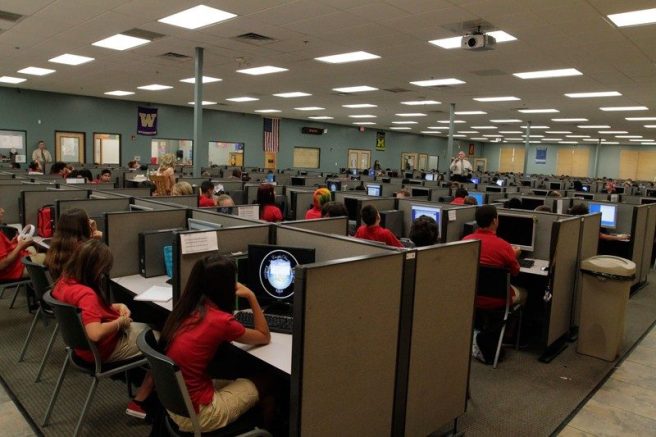
Okay, not “all,” but here is an image that captures much of what is wrong in the world of education.

You can read more about this school, called (without irony we are to assume) Carpe Diem, here.

When I first saw the image, I wondered, for a fleeting moment, if this were a parody or a fictional school set in some dreary, soul-numbing dystopian future. No such luck. Thinking beyond my initial visceral response, one question came to mind: What do you have to believe about the human person, knowledge, and education to think that this is a good model for how children should learn?

That question was followed by another, more cynical query: What business model do you have to buy into?

But let’s return to the first question for a moment. In numerous contexts, the philosopher James K.A. Smith has observed that every pedagogy assumes an anthropology. That is to say that every theory and practice of education assumes a certain view of the human person. Needless to say, this view is not always explicit, nor can it always be articulated by those who take it for granted. Nonetheless, when someone sets out to educate children they do so based on some understanding of what it means to flourish as a human being, the goal of education, what counts as knowledge, and how children learn.

So, again, what do you have to believe in order to conclude that this cubicle based model of education is the way to go? At the very least, I’d say that you’d have to discount both the embodied and social dimensions of learning. Hook your brain up to the screen, forget you have a body or that the body has much to do with how we come to learn about the world, and download the data. Never mind interpersonal relationships that fuel the desire to learn, never mind models and mentors, never mind the knowledge that can only be gained in conversation with peers and teachers.

You would also have to assume that education was merely a matter of transferring discreet bits of information from one receptacle, the computer, to another, the human mind. In other words, you would have to assume an impoverished account of both what it is to be a human being and of knowledge itself.

I would suggest that this impoverished view of the human person and of knowledge has become plausible because the computer has become a master metaphor ordering our thinking about knowledge and minds. Having understood the computer by analogy to the mind, we have now reversed the direction of the analogy and have come to understand the mind by analogy to the computer.

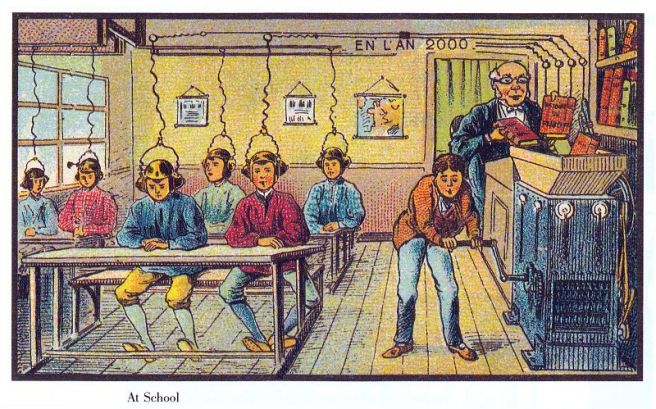
In fact, though, a similar trajectory was already discernible much earlier when “the machine” became our master metaphor. Consider this French cartoon from the late nineteenth century.

I’d suggest the image above finds its fulfillment in the image of the Carpe Diem school with which we began.

A few years ago, I touched on related matters from another angle. I wrote then of a similar “unspoken assumption” about learning: “that knowledge is merely aggregated data and its mode of acquisition does nothing to alter its status. But what if this were a rather blinkered view of knowledge? And what if the acquisition of knowledge, however understood, was itself only a means to other more important ends?

If the work of learning is ultimately subordinate to becoming a certain kind of person, then it matters very much how we go about learning. In some sense, it may matter more than what we learn. This is because  the manner in which we go about acquiring knowledge constitutes a kind of practice that over the long haul shapes our character and disposition in non-trivial ways. Acquiring knowledge through apprenticeship, for example, shapes people in a certain way, acquiring knowledge through extensive print reading in another, and through web based learning in still another. The practice which constitutes our learning, if we are to learn by it, will instill certain habits, virtues, and, potentially, vices — it will shape the kind of person we are becoming.”

If this is the case, then what sort of formation is taking place given the practice of learning embodied by the Carpe Diem school?

Let me reiterate, though: the Carpe Diem model is just a more extreme example of practices and assumptions that are widely distributed throughout the world of education, where, regrettably, the siren song of the next revolutionary educational technology often proves too hard to resist no matter how many times it has shipwrecked those who heed it.


Coda

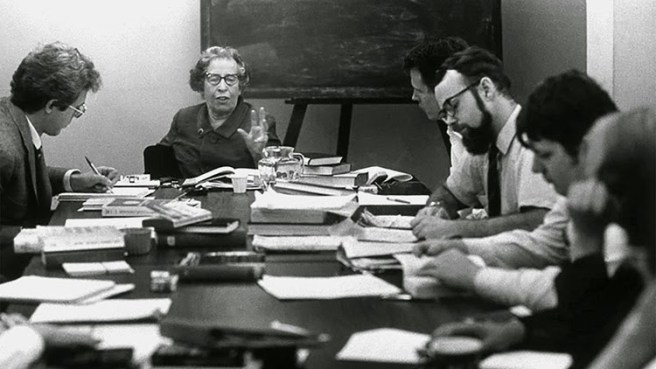
arendt seminar

Yes, I know we can’t all sit around the seminar table with the likes of Hannah Arendt. Nonetheless, in my view, there is an ideal to strive for here.

Notes Toward An Understanding of Our Technologically Enchanted World, 2

An entry in a series. The following excerpts are taken from the Introduction to Peter Dews 1995 collection of essays, The Limits of Disenchantment: Essays on Contemporary European Philosophy (Verso). 

Dews opens with a passage from Niezsche critiquing Wagner for his Hegelianism, for “inventing a style charged with ‘infinite meaning'” and rendering music as “idea.”

Nietzsche’s virtuoso attack on Wagner’s music for its portentous depths and sham reconciliations … marks the emergence of a distinctly modernist sensibility. For this new outlook, philosophical and aesthetic attempts to restore meaning to a disenchanted universe are in deep collusion with what they seem to oppose.

And:

Astutely, Nietzsche suggests that “transposed into hugeness, Wagner does not seem to have been interested in any problems except those which now occupy the little decadents in Paris. Always five steps from the hospital. All of them entirely modern, entirely metropolitan problems.”

Dews here describes trauma of disenchantment and its shock waves:

Since the time of Nietzsche’s polemics, this suspicion of depth and meaning–of any mode of significance which cannot be relativized to a specific practice, framework or perspective–has recurred throughout twentieth-century art and philosophy. One might have thought that the disenchantment of the world classically described by Max Weber, the collapse of belief in a cosmic order whose immanent meaning guides human endeavor, would constitute a cultural trauma of such magnitude that philosophy could do little other than struggle to come to terms with it–indeed, the shock waves of this collapse have reverberated throughout nineteenth- and twentieth-century thinking.

Further:

Other recent thinkers have been intolerant of even this residual soft-heartedness [speaking of Rorty’s assumption that we can “take seriously meanings which we know we have created”]. They have considered it their job to track down and eradicate those last traces of meaning which adhere to the human world, to dissolve any supposedly intrinsic significance of lived experience into an effect of impersonal structures and forces. The impulse here is still Promethean: for meaning, as Adorno emphasized, implies givenness–it is something we encounter and experience, not something we can arbitrarily posit, as Rorty and others too quickly assume. And this very givenness seems often to be regarded as an affront to human powers of self-assertion.”

This last point is worth considering at length. It speaks to the relationship between a distinctly modern understanding of the self–Promethean, autonomous, unbounded–and its relationship to disenchantment. As I’ve suggested elsewhere, technology, that is our tools of Promethean self-assertion, have more recently begun to appear as threats to the modern conception of the self as autonomous and unbounded, yielding a technologically induced post-modern condition.

Technological Enchantments and the End of Modernity

Dissatisfied with existing theories of secularization, Charles Taylor proposed his own account in his much-discussed 2007 book, A Secular Age. Taylor argued that traditional secularization stories were at best inadequate. They were in adequate because they were what Taylor called “subtraction stories.” According to such stories, secularization is what you get when belief in God goes away or when the Church loses its cultural power or when religious language is excised from the public square, etc. Taylor did not believe that secular society is simply what you have left when you slough off religious belief and institutions. Rather, he argued for the rise of something novel, exclusive humanism, which could fill the role that religious experience once served to provide “fullness” to people’s lives. Additionally, he argued that secularism as he understood it was not something that characterized only the unbelievers in a society. It was also the context for and conditions of belief and thus no one escaped its consequences.

I find Taylor’s work compelling and instructive, however, I bring it up only to make use of a small part of his multi-faceted and nuanced argument: his understanding of disenchantment.

The enchanted world was one of the features of pre-modern society which had to be overcome in order for a secular world, in Taylor’s sense, to emerge. The enchanted world as he describes it yields a particular experience of the self, what Taylor calls the “porous self” which later gives way to the modern “buffered self.”

Before moving on to explain what Taylor means by the porous self, I think it is useful to emphasize that Taylor is not after a theory of the self that pre-modern people may or not have held. Rather, he is after something more subjective, the background of lived experience or what was naively taken for granted. Taylor describes what he trying to get at as “the construal we just live in, without ever being aware of it as a construal, or–for the most of us–without ever even formulating it.”

This is a useful way of approaching these matters because rarely do we carry around with us a fully developed theory we could articulate to explain our beliefs and actions. Much of what we say and do arises from a tacit understanding of the world and our place in it, an understanding we might be hard pressed to put into words.

This is helpful because when I talk about technological re-enchantment, I don’t mean to suggest that anyone today would claim that there are spirits in the iPhone like a medieval peasant might have believed there were dryads in the forest. Nonetheless, we may experience our technology in a way that is functionally similar or analogous to the premodern experience of enchantment. And we may do so naively, that is without reflection and in a taken for granted manner.

Taylor’s discussion of enchantment unfolds as a theory of the self, and his understanding enchantment begins with the question of meaning. In a our modern disenchanted world, meaning arises only from mind, and the human mind is the only kind of mind there is. Nothing external to the human mind bears any meaning in itself. Moreover, there are no non-human agents in the world, either of matter or spirit.

By contrast, things (and spirits) in the enchanted world have the “power of exogenously inducing or imposing meaning,” a meaning that is independent of the perceiver. A meaning that someone may be forced to reckon with whether they would like to or not. Additionally, in the enchanted world objects can have a causal power. The “charged” objects, Taylor explains, “have what we usually call ‘magic’ powers.” Crucially, this power may be either benevolent or malevolent. The objects in question may bring blessing or trouble, cure or disease, rescue or danger.

“Thus in the enchanted world,” Taylor concludes, “charged things can impose meanings, and bring about physical outcomes proportionate to their meanings.” He calls these “influence” and ” causal power,” respectively.

The corresponding experience of the self that arises from this state of affairs is key for my purposes. Boundaries in the enchanted world are decidedly fuzzy. Taylor writes that the enchanted world “shows a perplexing absence of certain boundaries which seem to us essential.” In particular, “the boundary between mind and world is porous.” The porous self that corresponds to an enchanted world is “vulnerable, to spirits, demons, cosmic forces. And along with this go certain fears which can grip it in certain circumstances.”

The buffered self characteristic of the disenchanted world is, by contrast, “invulnerable” and “master of the meanings of things for it.” It is also immune to the fears that may grip the porous self. It is sealed off from the world, its boundaries are not at all fuzzy, meaning resides neatly within its own mind, it occupies a world of inert matter. It is autonomous and self-possessed. It is in other words, a thoroughly modern individual.

It would be fair to ask at this point, what any of this has to do with technology. My working hypothesis is something along these lines: contemporary technologies have taken on attributes that render their presence in our lived understanding of the world analogous to that of the “charged” objects of the enchanted world Taylor describes.

Two clarifications. First, I don’t mean to suggest that contemporary technology is in any literal sense magical. I am no more committed to that conclusion than a contemporary historian is committed to attributing real power to medieval relics when she describes them as enchanted.

Secondly, I don’t have in mind every kind of contemporary technology. Chiefly, I have in view technologies and objects that appear to be animated (as I’ve described elsewhere), and also processes, real or rhetorical, such as AI, automation, algorithms, and Big Data, which constitute something like an immaterial field of often inscrutable forces within which we conduct our lives.

In this technologically enchanted world we inhabit, then, we encounter objects and forces that, to borrow Taylor’s terminology, both influence us and exert causal power over our affairs. Some of these objects and forces appear also to have an agency independent of any human actor. I want to reiterate again that I am not talking about what some, including myself, would want to argue is actually the case: that technology is never wholly independent of human agency. Rather, like Taylor, I’m after what our unreflective experience of the world feels like.

Our technologically enchanted objects confront us with meaning that imposes itself on us and with which we must reckon. We turn to our technologies for help and invest our hope in their power. We also fear our technologies and see them as the cause of our troubles. The technological forces we encounter are sometimes benevolent but just as often malevolent forces undermining our efforts and derailing our projects.

It is not only that technological objects have the potential to empower us and sometimes even fill us with wonder. It is also that we experience these objects and forces as important determiners of our weal and woe and that they act upon us independently of our control and without our understanding. We are, in other words, vulnerable, and our autonomy is compromised by the lines of technologically distributed agency that intersect our will and desires.

This means, then, that the experience of the self that emerges out of this technologically enchanted milieu more resembles the porous self of the previously enchanted world than the buffered self that corresponded to disenchanted modernity. This is the key point at the end of this line of thought: a technologically enchanted world is inhospitable to the characteristically modern self. Postmodernity, then, at least the postmodern experience of the self, may be understood as an effect of our technological milieu.

“We are as gods,” Stewart Brand famously declared, “and might as well get good at it.” I suspect, though, that while the technologically enchanted world may tempt us with that possibility, most will experience it in a decidedly more creaturely and thus precarious mode. And not unlike the previous age of enchantment, our age will yield its own forms of serfdom, its own clerical class whose esoteric knowledge we turn to navigate the promise and perils of enchantment, and its own eschatological hope.


If you’ve appreciated what you’ve read, consider supporting the writer.