Christopher Hitchens passed away on Thursday evening from complications related to the cancer he had been fighting for many months. I received this news with a certain startled sadness, even though it was, of course, expected. I hope to post some reflections on Mr. Hitchens with regards to the quality of public discourse in the coming days. For now, I only want to draw attention to a portion of his brother Peter’s reflections published yesterday in the Daily Mail.
Peter Hitchens wrote of one of his last conversations with his brother in which Christopher hoped to return home from the hospital:
“There, he suggested, we could go through his bookshelves, as there were some books and other possessions he wanted me to have. I couldn’t have cared less about these things, but I had greatly hoped to have that conversation, which would have been a particularly good way of saying farewell.”
Admittedly, as Peter Hitchens notes, the objects are nothing compared to the person. But I would think, personally, that they are not therefore entirely insignificant. They are something. And the books especially, for what they meant to the giver, might be a particularly meaningful token.
All of this to say that no one will ever want to go through an e-reader in quite the same way. Only the particularity of the book as object can carry the fullness of meaning and significance that is entailed in passing a thing on to another in this way. It is an aspect of the culture of the book that takes shape around the older form.
This is, in itself, no argument against the utility of e-readers. It is only to note a subtle loss that attends this particular shift in our material culture. And I, for better or for worse, have a temperamental proclivity to register such losses.
Of course, it takes no particular predisposition to register and regret the loss of Mr. Hitchens.
As counterintuitive as it may now seem, there are links between the ethos and the history of technology and magic. A few weeks ago, I posted some observations by Lewis Mumford and C. S. Lewis to that effect (although Lewis speaks more generally of science rather than technology). In The Technological Society, Jacques Ellul makes a series of similar observations regarding magic and technique. Technique, for Ellul, encompasses not only material technology, but also the extension of machine logic into social and personal spheres. “Technique,” Ellul explains, “integrates the machine into society.” It amounts to the conditioning of man for a world of machines. More generally, it is a mentality that privileges efficiency and rationalization.
According to Ellul, “technique has evolved along two distinct paths.” The “concrete technique of homo faber [man the maker]” and “the technique, of a more or less spiritual order, which we call magic.”
Citing the work of sociologist Marcel Mauss, Ellul describes the affinities between magic and technique:
“Magic developed along with other techniques as an expression of man’s will to obtain certain results of a spiritual order. To attain them, man made use of an aggregate of rites, formulas, and procedures which, once established, do not vary. Strict adherence to form is one of he characteristics of magic: forms and rituals, masks whichever vary, the same kind of prayer wheels, the same ingredients for mystical drugs, for formulae for divination, and so on.”
And a little later on he writes,
“Every magical means, in the eyes of the person who uses it, is the most efficient one. In the spiritual realm, magic displays all the characteristics of a technique. It is a mediator between man and ‘the higher powers,’ just as other techniques mediate between man and matter. It leads to efficacy because it subordinates the power of the gods to men, and it secures a predetermined result. It affirms human power in that it seeks to subordinate the gods to men, just as technique serves to cause nature to obey.”
This latter observation also recalls Walter Benjamin’s observation that “technology is not the mastery of nature but of the relations between nature and man.”
Regarding magic’s relationship to technology, Mumford explained that “magic was the bridge that united fantasy with technology: the dream of power with the engines of fulfillment.”
What technology and magic, then, have in common is the effort to manipulate relationships through techniques that are an extension and empowerment of the human will. Manipulate tends to have rather pejorative connotations, but I use it nonetheless because of its suggestive etymology which is linked to a method for mining iron ore, a pharmacist’s measure, and, of course, the hand. This etymology felicitously evokes both technology and the body. The pejorative connotations, however, are not entirely misplaced.
Historians of science have linked the rise of modern science in the West with theological and philosophical developments in the late medieval period. During this time, Aristotelianism was displaced by a voluntarist account of God’s action. The voluntarists so emphasized God’s power and freedom, they concluded there was nothing at all necessary, and thus subject to rational deduction, about the world as it exists. It could have been otherwise in every detail. It would not do, then, to merely reason about the way the world must necessarily be assuming certain rational propositions, rather the world must be investigated in order to arrive at an accurate understanding of its nature.
Magic, science, and technology all initially flourished in this cultural climate oriented toward the will, and this orientation became a part of their DNA as it were. The freedom of the divine will imagined by the voluntarists appears eventually to have become the freedom of the human will. Unfettered from the constraints of either Aristotelian form or telos, and later from notions of a normative moral and natural order, the human will is liberated to manipulate reality as it sees fit.
Technology, in Western contexts, was anchored in this emphasis on the unfettered will and the activist vision of Francis Bacon, who did more than any other individual to shape Western attitudes toward technology in the early modern period. It is little wonder then that we are generally unwilling to abide non-technological constraints on technology. We are generally unwilling to abide such constraints on our own will and we have long since understood technology, as we once did magic, as an accouterment of the will.
Here is David Nyeagain, this time on the embodied character of our tool use and of our knowledge of technology:
“Tools are known through the body at least as much as they are understood through the mind. The proper use of kitchen utensils and other tools is handed down primarily through direct observation and imitation of others using them. Technologies are not just objects but also the skills needed to use them. Daily life is saturated with tacit knowledge of tools and machines. Coat hangers, water wheels, and baseball bats are solid and tangible, and we know them through physical experiences of texture, pressure, sight, smell, and sound during use more than through verbal descriptions. The slightly bent form of an American axe handle, when grasped, becomes an extension of the arms. To know such a tool it is not enough merely to look at it: one must sense its balance, swing it, and feel its blade sink into a log. Anyone who has used an axe retains a sense of its heft, the arc of its swing, and its sound. As with a baseball bat or an axe, every tool is known through the body. We develop a feel for it. In contrast, when one is only looking at an axe, it becomes a text that can be analyzed and placed in a cultural context. It can be a basis for verifiable statements about its size, shape, and uses, including its incorporation into literature and art. Based on such observations, one can construct a chronology of when it was invented, manufactured, and marketed, and of how people incorporated it into a particular time and place. But ‘reading’ the axe yields a different kind of knowledge than using it.”
This is a remarkably rich passage and not only because of its allusion to baseball. It makes an important point that tends to get lost in much of our talk about technology: technology use is an embodied practice. This point gets lost, in part, because the word technology, more often than not, brings to mind digital information technologies, and the rhetoric surrounding the use of these technologies evokes vague notions of participation in some sort of ethereal nexus of symbolic exchange.
On the one hand, we tend to forget about our more prosaic technologies — cars, refrigerators, eye glasses, drills, etc. — that are still very much a part of our lives, and, on the other, we forget that even our supposedly immaterial technologies have a very material base. We are not, as of yet, telepathically interacting the Internet after all. Having recently switched from a PC to a Mac, whenever I have occasion to use a PC again I am reminded of the embodied nature of our computer use. My fingers now want to make certain gestures or reach for certain keys on a PC that only work on the Mac. Or consider the proficient texters (or are they text messengers) who are able to key their messages without so much as glancing at their phones. Their fingers know where the keys are.
These sorts of observations resonate with the work of philosopher Hubert Dreyfus on knowledge and skill acquisition. You can read a very brief overview of Dreyfus’ position in this recent post on the body and online education. Simply put, Dreyfus, not unlike Merleau-Ponty, argues for the irreducibly embodied nature of our knowing and being in the world. Much of what we know, we know more with our bodies than with our minds. Or, perhaps better put, our mind’s engagement with reality is unavoidably embodied.
Likewise, our engagement with technology is unavoidably embodied and we would do well to focus our analysis of technology on the body as the intersection of our minds, our tools, and the world. The use a technology may ultimately have more in common with learning a skill, than with acquiring knowledge. There is, as Nye points out, some value in “reading” our tools is if they were a text, but a deeper understanding, at least a different sort of understanding can only be had by the use of the technology under consideration.
It is sometimes suggested that human beings may be characterized as tool-using animals. Some, for example Katherine Hayles, have alternatively ventured to define human beings as meaning-making animals:
“… the primary purpose of narrative is to search for meaning, making narrative an essential technology for human beings, who can arguably be defined as meaning-seeking animals …”
To put this point another way, we might say that human beings are story-telling animals.
Interestingly, Hayles suggests a link between technology and narrative by defining narrative as a kind of technology. In Technology Matters, historian David E. Nye also links narrative and technology in a slightly different, but likewise intriguing manner:
“Consider the similarity between what is involved in creating and using a tool and the sequence of a narrative …. Composing a narrative and using a tool are not identical processes, but they have affinities. Each requires the imagination of altered circumstances, and in each case beings must see themselves to be living in time. Making a tool immediately implies a succession of events in which one exercises some control over outcomes. Either to tell a story or to make a tool is to adopt an imaginary position outside immediate sensory experience. In each case, one imagines how present circumstances might be made different.”
A little later on Nye adds, “To improvise with tools or to tell stories requires the ability to imagine not just one outcome but several. To link technology and narrative does not yoke two disparate subjects; rather, it recalls an ancient relationship.”
And further on still, “A tool always implies at least one small story. There is a situation; something needs doing.”
All told, Nye is arguing that tools and narratives emerged symbiotically, seemingly as byproducts of a capacity to imagine that was not temporally encased in the present, and that human culture depended on their emergence. Nye is hesitant to enter into debates about the chronological priority or primacy of either tools or narrative and this strikes me as a rather sensible position to take.
It is interesting, however, to entertain the problem if just momentarily. In one respect, seeking to discern the primary partner in the relationship is a variation of the debate over technological determinism. Let us agree that we have, for all intents and purposes, always told stories and always made tools. But what frames what? This may be the critical question. Do our stories define our tools or do our tools shape our stories? (Of course, I admit at the outset that this is most likely a misleading question in that the best response is of a both/and rather than either/or nature.)
Narrative is essentially geared toward the production of meaning. We tell stories to make sense out of experience. To understand our relationship to technology, then, it is worth asking what stories we tell about our tools.
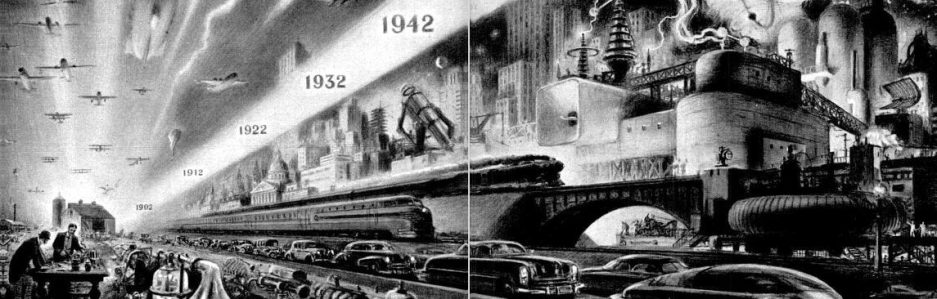
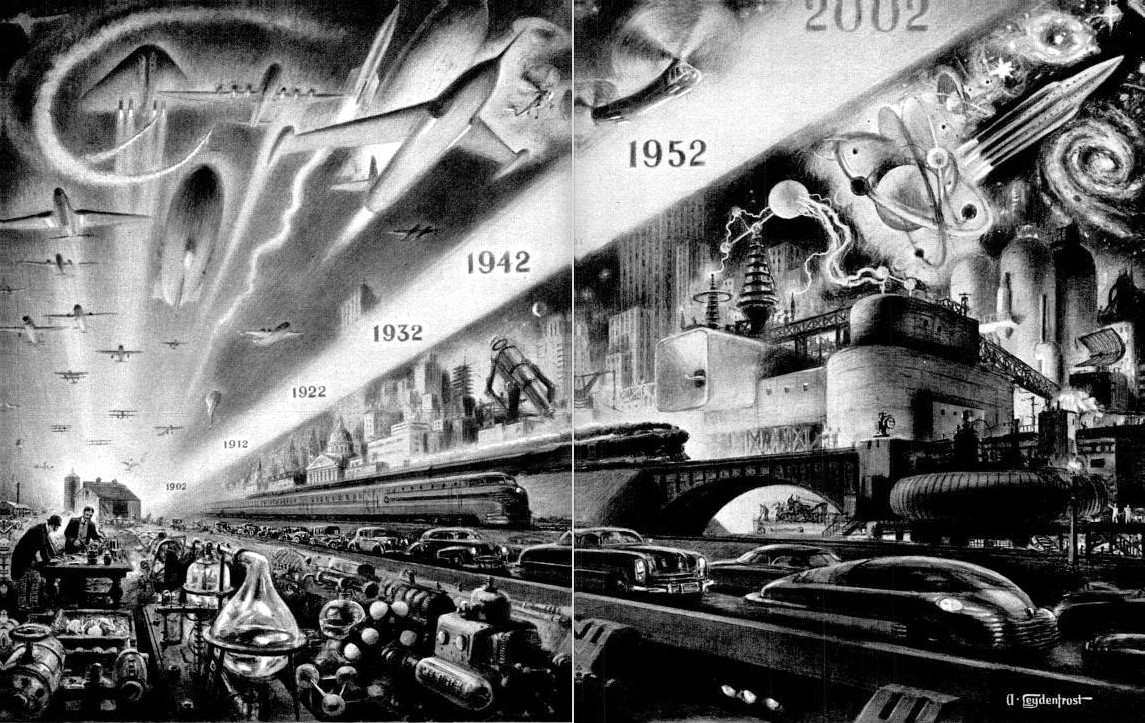
Immediately, I am reminded of the grand narratives of progress told by Western societies — and perhaps American society most enthusiastically — in which technology has been a central character, if not indeed, the central character. These stories have framed the place of technology within society; they have given a certain meaning to the presence and evolution of technology. As Leo Marx, among others, has noted, as the grand narrative of progress mutated over the course of the nineteenth century, technology assumed a dominant role, eventually making the story of progress coterminous with the story of technology. This was a powerful story and it influenced the nature of technology’s relationship to society as long as the story was widely affirmed.
The conventional wisdom is that postmodernity has fatally undermined all such grand (or, meta-) narratives. I’m not so sure. I think there is certainly something to the claim, no doubt. Certain kinds of totalizing grand narratives seem intuitively implausible, or what amount to the same thing, unpalatable. Yet, even though varieties of technological pessimism seem more widespread, the myth of the machine, to borrow Mumford’s phrasing, seems alive and well. The transhumanist project and its quite grand narrative is just one example. On a less grandiose scale we may perceive a survival of the grand narrative of progress in the popular insistence (or hope) that the answer to the problems introduced by technology is simply more technology. And, of course, the myth of the machine/progress still infuses a good bit of advertising.
Moreover, if we are indeed meaning-making, story-telling animals, then it is unlikely that the lure of grand narratives will ever permanently fade away. Certain types of grand narratives will undoubtedly pass from the scene, and all grand narratives may for a time leave a bad taste in our mouth, particularly if we have binged on one of them, but in time, I suspect, our taste for them will return and we’ll go looking once again to make sense of it all.
Returning specifically to the narrative of technological progress, it was undoubtedly challenged more recently by the dystopian stories of the twentieth century, particularly postwar science fiction, which framed technology within darker, more ambiguous narratives. These stories, many of which are quite popular, elicit a more reserved and chastened posture toward technology. But, more to the point, they are narratives and as narratives they frame technology in a meaningful way.
Along with these macro-narratives that order a society’s relationship to technology, we should also note the micro-narratives we weave around our own personal tools and devices. These micro-narratives may tell the story of how we came to possess the technology, they may instruct others in using the technology, they may explicitly tell of the technology’s significance to us; in all of these ways and more, they constitute our meaning making activity with regards to technology in our lives. These micro-narratives, in conversation with the macro-narratives, go a long way toward ordering our own personal relationship with technology, or at least they are symptoms of that ordering (or dis-ordering as the case may be).
Additionally, at a level between the micro- and the macro-, we might also consider the stories of particular technologies and the way these stories intersect with larger grand narratives and more personal accounts. One might take the story of the car, for example. The story of the automobile has a privileged place in narratives about the character of American society in the twentieth century. It is intimately woven into local histories such as that of Detroit, and it may even feature prominently in our personal histories. Who, after all, doesn’t remember their first car? The story of the automobile also attracts other prominent thematic elements that comprise the larger stories we tell about our culture including freedom, motion, autonomy, and restlessness. At this level we might also include the role accorded the printing press in the larger story of the Protestant Reformation or that accorded the cotton gin the story of the American Civil War. These stories may not always be entirely truthful, but they are believed and so secure their influence.
Altogether, we may distinguish at least the following kinds of technologically related stories:
a. Narratives about a particular technology
b. Small vignettes about our personal experience with technology
c. Large scale narratives in which technology figures prominently
d. Grand narratives that frames cultural attitudes toward technology
Technologies, we might then conclude, elicit a multiplicity of narratives. They invite meaning and encourage its construction.
Finally, I’m inclined to add that while it is true that narrative preceded literacy, literacy reshaped narrative. We have always told stories, but the shape and form of those stories have shifted in response to the appearance of new communication technologies, be it the stylus, the printing press, the radio, or the motion picture, to name but a few. And so again we are left with a reciprocal relationship. Narratives shape the way we use our tools and our tools shape the way we construct our narratives.
“You Say You Want a Devolution” by Kurt Anderson in Vanity Fair: “Or maybe, I worry some days, this is the way that Western civilization declines, not with a bang but with a long, nostalgic whimper.” Not as dramatic as all that, but an interesting look at the stagnation culture over the last twenty years.
“Hugo Addendum: The Film in Context” by Adam Batty at Hope Lies at 24 Frames per Second: Excellent post on the film history that forms the context of Hugo. H/T Mr. Gladding.
 L.M. Sacasas