The late French theorist, Michel de Certeau, offered this passing note of caution about the knowledge class in The Practice of Everyday Life. Read and heed:
“The ministers of knowledge have always assumed that the whole universe was threatened by the very changes that affected their ideologies and their positions. They transmute the misfortune of their theories into theories of misfortune. When they transform their bewilderment into ‘catastrophes,’ when they seek to enclose the people in the ‘panic’ of their discourses, are they once more necessarily right?”
“Is not the most appealing popular religious literature of the day that which presents religion, not in its timeless role of sharpening man’s awareness of the omnipresence of evil and the difficulties of salvation, but as a means of relief from anxiety and frustration? It enjoins not virtue but adjustment. Are not the popular areas of psychology and ethics those involving either the theoretical principles or the therapeutic techniques of status and adjustment for the disinherited and insecure? ‘In what other period of human existence,’ asks Isaiah Berlin, ‘has so much effort been devoted not to the painfully difficult task of looking for light, but to the protection … of individuals from the intellectual burden of facing problems that may be too deep or complex?’ Every age has its literature of regeneration. Our own, however, is directed not to the ancient desire of man of higher virtue but to the obsessive craving of men for tranquility and belonging.”
He goes on to link this craving for tranquility and belonging to the then current popular wave of nostalgia:
“Nostalgia has become almost a central state of mind. In mass advertising, the magazine story, and in popular music we cannot fail to see the commercial appeal that seems to lie in cultural themes drawn from the near past. It is plainly a nostalgia, not for the greater adventurousness of earlier times but for the assertedly greater community and moral certainty of the generations preceding ours. If the distinguishing mark of the late nineteenth and early twentieth century was transgression, that of the mid-twentieth century would appear to be the search for the road back.”
Knowing what lay ahead, remember Nisbet is writing in the early 1950s, it would seem that transgression had not yet exhausted itself as a cultural force and the road back would not be traveled for very long. In any case, Nisbet already recognized that the terms on which the journey was being undertaken would undermine its objective:
“Increasingly, individuals seek escape from the freedom of impersonality, secularism, and individualism. They look for community in marriage, thus putting, often, an intolerable strain upon a tie already grown institutionally fragile. They look for it in easy religion, which leads frequently to a vulgarization of Christianity the like of which the world has not seen before. They look for it in the psychiatrist’s office, in the cult, in functionless ritualizations of the past, and in all the other avocations of relief from nervous exhaustion.”
This recalls the following observations from James D. Hunter, a contemporary sociologist influenced by Rieff, in The Death of Character:
“We say we want the renewal of character in our day but we do not really know what to ask for. To have a renewal of character is to have a renewal of a creedal order that constrains, limits, binds, obligates, and compels. This price is too high for us to pay. We want character without conviction; we want strong morality but without the emotional burden of guilt or shame; we want virtue but without particular moral justifications that invariably offend; we want good without having to name evil; we want decency without the authority to insist upon it; we want moral community without any limitations to personal freedom. In short, we want what we cannot possibly have on the terms that we want it.”
“If the idea of progress has the curious effect of weakening the inclination to make intelligent provision for the future, nostalgia, its ideological twin, undermines the ability to make intelligent use of the past.” — Christopher Lasch, The True and Only Heaven
Memory and nostalgia have been twin recurring themes running through various posts this past year. Both of these words name ways of being with the past. Memory generally names what we take to be a healthy ordering of our relationship to the past, while nostalgia names whatever is generally taken to be a disordered form of relating to the past. I’ve long sensed, however, without necessarily having thought much about it, that some of what is casually and dismissively labeled nostalgia may in fact belong under the category of healthy remembering or, alternatively, that the nostalgic longings in question at the very least signaled a deeper disorder of which nostalgia is but a symptom.
If we step back and look at some of our behaviors and certain trends that animate popular culture, we might conclude that we are in the thralls of some sort of madness with regards to time and the past. We obsessively document ourselves, visually and textually, creating massive archives stuffed with memory, virtual theaters of memory for our own lives. Facebook’s evolving architecture reflects this obsession as it now aims to make it easier to chronologically and (geo)spatially order (a database gesture toward narrative) and access our stored memories. Simultaneously, vintage and retro remain the stylistic order of the day. Hyperrealistic period dramas populate our entertainment options. T-shirt design embraces the logos and artifacts of the pre-digital past. Social critics suggest that we are aesthetically stuck, like a vinyl record (which are incidentally quite hip again) skipping incessantly.
What do we make of it? How do we understand all of these gestures, some of them feverish, toward remembering and the past? How can we discern where memory ends and nostalgia begins? For that matter, how do we even define nostalgia?
Christopher Lasch, who raised many of these same sorts of questions throughout his career, particularly in The True and Only Heaven, provides some helpful insights and categories to help us along the path to understanding. But before considering Lasch’s perspective, let me take just one more pass at clarifying the main issues that interest me here.
Approaching nostalgia we need to distinguish between the semantic and the ontological dimensions of the issue. The semantic questions revolve around the use of the word nostalgia; the ontological questions revolve around the status of the sensibilities to which the word is applied as well as their sources and roots. It would seem that the semantic question has been more or less resolved so that the connotations of the word are uniformly negative (more on this later). Nostalgia, in other words, is typically a word of opprobrium. This being the case, then, the question becomes whether or not the word is justly applied and such judgments require us to define what constitutes healthy and unhealthy, ordered and disordered modes of relating to the past. Coming back to Lasch, we can see what help he offers in thinking through these questions.
First, for Lasch, nostalgia carries entirely negative connotations. He employs the term to name disordered relationships to the past. So, in his view, nostalgia prevents us from making intelligent use of the past because it is an ahistorical phenomenon.
“Strictly speaking, nostalgia, does not entail the exercise of memory at all, since the past it idealizes stands outside time, frozen in unchaining perfection. Memory too may idealize the past, but not in order to condemn the present. It draws hope and comfort from the past in order to enrich the present and to face what comes with good cheer. It sees past, present, and future as continuous. It is less concerned with loss than with our continuing indebtedness to a past the formative influence of which lives on in our patterns of speech, our gestures, our standards of honor, our expectations, our basic disposition toward the world around us.”
In this paragraph, by contrasting it with memory, Lasch lays out the contours of nostalgia as he understands it:
a. Nostalgia is primarily interested in condemning the present.
b. It fails to offer hope or otherwise enrich the present.
c. It sunders the continuity of past, present, and future.
d. It is focused on loss.
e. It fails to recognize the ongoing significance of the past in the present.
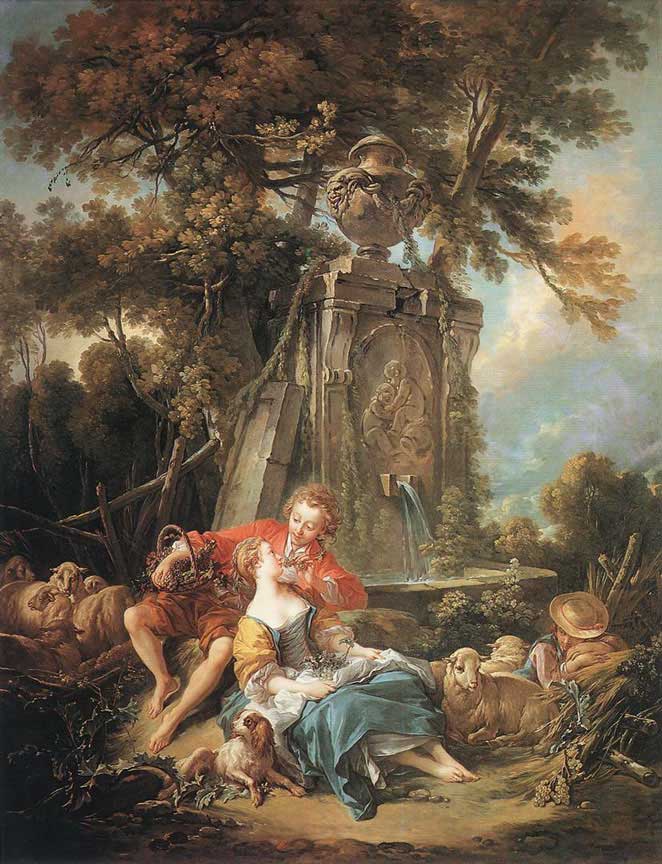
Boucher, An Autumn Pastoral, 1749
Lasch goes on to offer a genealogy of the various sources of contemporary nostalgia beginning with the historicizing of the pastoral sensibility and proceeding through the Romantic idealization of childhood, America’s romanticization of the West and later the small town, and finally nostalgia’s coming into self-awareness as such in the 1920s.
The recurring theme in these earlier iterations of the nostalgic sensibility is the manner in which, with the exception of childhood, an initially spatial displacement — of the countryside for example — becomes temporalized. So, for instance, the long standing contrast between town and country that animated pastoral poetry since the classical age became, in the eighteenth and nineteenth century with the advent of industrialization, a matter not of here and there, but then and now. The First World War had a similar effect on the trope of childhood’s lost innocence by marking off the whole of history before the war as a time of relative innocence compared with the generalized loss of innocence that characterized the time after the war.
The First World War, in Lasch’s telling of nostalgia’s history, also gave a specific form to a tendency that first appears in the early nineteenth century: “In an ‘age of change,’ as John Stuart Mill called it in his 1831 essay ‘The Spirit of the Age,’ the ‘idea of comparing one’s own age with former ages’ had for the first time become an inescapable mental habit; Mill referred to it as the ‘dominant idea’ of the nineteenth century.”
It would seem to me that this tendency is not entirely novel in Mill’s day, after all Renaissance culture made much of its contrast with the so-called Dark Ages and its recovery of classical civilization. But it seems safe to credit Mill’s estimation that in his day it becomes for the first time “an inescapable mental habit.” This would seem to correspond roughly with the emergence of historical consciousness and the discipline of history in its modern form — which is to say as a “science” of the past rather than as a branch of moral philosophy.
Following the First World War, this comparative impulse took on a specific form focused on the generation as the preferred unit of analysis. First, Lasch writes, “For those who lived through the cataclysm of the First World War, disillusionment was a collective experience — not just a function of the passage from youth to adulthood but of historical events that made the prewar world appear innocent and remote.” He then notes that it was no surprise that “the concept of the generation first began to influence historical and sociological consciousness in the same decade, the twenties, in which people began to speak so widely of nostalgia.”
It was in the 1920s, according to Lasch that nostalgia became aware of itself. In other words, it was not until the 1920s that the semantic problem we noted earlier appears since it was not until then that the term nostalgia gets applied widely to the varieties of responses to loss that had long been expressed in literature and the visual arts. Prior to the 1920s, nostalgia was mostly a medical term linked to the psychosomatic symptoms associated with severe, literal homesickness.
According to Lasch, by the mid-twentieth century, “History had come to be seen as a succession of decades and also as a succession of generations, each replacing the last at approximately ten year intervals. This way of thinking about the past had the effect of reducing history to fluctuations in public taste, to a progression of cultural fashions in which the daring advances achieved by one generation become the accepted norms of the next, only to be discarded in their turn by a new set of styles.”
This seems just about right. You can test it on yourself. First, consider our habit of talking about generations: baby-boomers, Y, X, millennials. Then, think back through the twentieth century. How is your memory of the period organized. I’m willing to bet that yours, as mine, is neatly divided up into decades even when the decades are little more than arbitrary with regards to historical development. And, further reinforcing Lasch’s point, what is the first decade for which you have a ready label and set of associations? I’m again willing to bet it is the 1920s, the “Roaring Twenties” of flappers, jazz, F. Scott Fitzgerald, and the stock market crash. Thirties: depression. Forties: World War II. Fifties: Ike and Beaver. Sixties: sex, drugs, and rock ‘n’ roll. Seventies: Nixon and disco. Eighties: big hair and yuppies. And so on.
(Interestingly, my sense is that after the 1990s we seem to have a harder time with the decade scheme, perhaps because we are still so very fresh. I wonder, though, if we will have as neat a caricature of the first and subsequent decades of the twenty-first century as we do for their immediate predecessors.)
But this manner of thinking evidences the chief problem Lasch identifies with nostalgia. It has the effect of hermetically sealing off the past from the present. It represents the past as a series of discreet eras that, once superseded inevitably and on schedule by the next, cease to effect the present. Moreover, “Once nostalgia became conscious of itself, the term rapidly entered the vocabulary of political abuse.” For a society still officially allied to a progressivist ideology (as in Progress, not necessarily progressive politics), the charge of nostalgia “had attained the status of a political offense of the first order.” And here again is the semantic problem. When a word becomes a lazy term of abuse, then it is in danger of swallowing up all sorts of realities that for whatever reason do not sit well with the person doing the labeling.
So as Lasch begins to draw his social history of nostalgia to a close with the 1960s, “denunciations of nostalgia had become a ritual, performed, like all rituals, with a minimum of critical reflection.” In his 1965 The Paranoid Style in American Politics, for example, Richard Hofstadter “referred repeatedly to the ‘nostalgia’ of the American right and the of the populist tradition from which it supposedly derived.” And yet, the “nostalgia wave of the seventies” was still ahead:
“Time, Newsweek, US News and World Report, Saturday Review, Cosmopolitan, Good Housekeeping, Ladies’ Home Journal, and the New Yorker all published reports on the ‘great nostalgia kick.’ ‘How much nostalgia can America take?’ asked Time in 1971. The British journalist Michael Wood, citing the revival of the popular music of the fifties, the commercial appeal of movies about World War II, and the saturation of the airwaves with historical dramas — ‘Upstairs, Downstairs,’ ‘The Pallisers,’ ‘The Forsyte Saga’ — declared, ‘The disease, if it is a disease, has suddenly become universal.'”
Maggie Smith in Downton Abbey
Note for just a moment how easy it would be to update the British journalist’s comments to fit contemporary circumstances. Just add Hipster Revivalism and replace the television dramas with Mad Men, Boardwalk Empire, Downton Abby, and Pan Am. (See also Chuck Klosterman and Kurt Anderson.) More on this in just a moment, but first back to Lasch.
Lasch concludes his analysis of memory and nostalgia by elaborating on the idea that “Nostalgia evokes the past only to bury it alive.” From this perspective, nostalgia and the ideology of Progress have a great deal in common. They both evince “an eagerness to proclaim the death of the past and to deny history’s hold over the present … Both find it difficult to believe that history still haunts our enlightened, disillusioned maturity.”
He goes on to add that the “nostalgic attitude” and belief in progress also share “a tendency to represent the past as static and unchaining, in contrast to the dynamism of modern life … Notwithstanding its insistence on unending change, the idea of progress makes rapid social change appear to be uniquely a feature of modern life. (The resulting dislocations are then cited as an explanation of modern nostalgia.)”
Regarding that last parenthetical statement, I plead guilty as charged. I’m not sure, however, that this is entirely off the mark, particularly when we distinguish between semantic (we might even say rhetorical) matters and the underlying phenomenon. Lasch himself points to the connections between industrialization, urbanization, and the First World War and the history of the nostalgic sensibility. The psychic consequences of these phenomena were not illusory. What Lasch is concerned about, however, is the manner in which these psychic consequences were ultimately interpreted and filtered through the language of nostalgia.
The danger, in his view, is that we fail to reckon with the persistence of history. By way of contrast, Lasch offers us Anthony Brandt’s comments on historical memory and nostalgia. Lasch summarizes Brandt’s reflections on Henry Ford’s Greenfield Village, colonial Williamsburg, and Disney’s “Main Street” this way: “the passion for ‘historical authenticity’ seeks to recapture everything except the one thing that matters, the influence of the past on the present.” Real knowledge of the past, in Brandt’s view, “requires something more than knowing how people used to make candles or what kind of bed they slept in. It requires a sense of the persistence of the past: the manifold ways in which it penetrates our lives.”
Disney’s Main Street
This is Lasch’s chief concern and he is certainly right about it. If we define nostalgia as a dehistoricizing impulse that undermines our ability to think about the past and its enduring consequences, then it is certainly to be resisted. Lasch is advocating a way of being with the past that takes it seriously by refusing to romanticize it and by recognizing its continuing influence on the present. In this sense, he is advancing a posture similar to that which I attempted stake out in a review of Woody Allen’s meditation on nostalgia, Midnight in Paris: we are not to live in the past, but we are to live with it. It is a position that is neatly summed up by Faulkner’s line, “The past is never dead. It’s not even past.”
But how does Lasch’s analysis help us understand the contemporary burst of nostalgia? For one thing, it reminds us that such bursts have a history. Ours is not necessarily novel. However, recognizing that a variety of sensibilities and responses are grouped, sometimes indiscriminately, under the heading of nostalgia, it is worth asking how our present fixations depart from their antecedents.
I’m going to venture this schema in response. There appear to be two prior large scale waves of sensibilities that have subsequently been identified as nostalgic, the first running throughout the middle part of the nineteenth century and another materializing subsequent to the First World War. These waves, at the expense of mixing metaphors, also yielded subsequent ripples of nostalgia that shared their essential orientation. The former wave and its ripples appears to have been generated by spatial or physical displacements related to industrialization and urbanization. The latter appears to have been generated by a temporal dislocation occasioned by the First World War that created a psychic chronological rupture. The semantic history of the nostalgia tracks with this two step generalization. Places were idealized, and then times.
So what are we idealizing today? I’m suggesting that it is neither a place nor a time (even though it is necessarily related to the chronological past). Contemporary nostalgia is fixated on the materiality of the past. Take Mad Men, for example, it’s not for the time period that we are nostalgic, the series after all gives us a rather bleak view of the era. No, it is for the stuff of the era that we are nostalgic — the fedoras, the martini glasses, the furniture, the typewriters, the ordinary accouterments of daily life. Consider all of those lingering close-ups on the objects of the past that are characteristic of the early seasons. Remember too how often such shows are praised for their “attention to detail” which is to say for the way they capture the material conditions of the era.
The same holds true for the hipster revivalism linked above. It is focused on the equipment of the past, not its values or its places. This is why Pottery Barn offers a faux rotary phone. It’s why vinyl records are now on sale again at big box retailers like Best Buy and Target. Our nostalgia is neither spatial nor temporal, it is tactile. And it is a response — conscious or not, ill-advised as it may be — to digital/virtual culture.
Taking one last cue from Lasch, nostalgia for the material risks missing the ways in which the material persists in its significance in much the same way that nostalgia for the past misses the way the past persists into the present. The danger is that we begin to think about life in terms of immaterial abstractions like “the cloud” and “Information” or false dichotomies such as the “online/offline” distinction while ignoring the underlying, persistently material realities. It also threatens to distract us from the persistence (and significance) of technologies that do not fit neatly in the digital category. This same material nostalgia which is blind to the materiality of the present is what leads us to myopically and misleadingly focus analysis of contemporary events on abstractions such as the “Twitter Revolution” or “social media campaigns.” It is not that these are insignificant, it is rather that the rhetoric obscures the ongoing significance of the material realities. It fashions a false dichotomy between the virtual present and the material past. And our thinking will be all the worse for it.
To rephrase Lasch, tactile nostalgia undermines our ability to make intelligent use of the material.
_________________________________________________
Update: Another instance of tactile nostalgia — The Book Club.
In the opening chapter of The True and Only Heaven: Progress and Its Critics, Christopher Lasch explains the premise that motivated its writing: “old political ideologies have exhausted their capacity either to explain events or to inspire men and women to constructive action.”
He goes on to add that the “ideological distinctions between liberalism and conservatism no longer stand for anything or define the lines of political debate.”
In his view, both the Left and the Right, for all the “shrill and acrimonious” debate, share an underlying “belief in the desirability and inevitability of technical and economic development.” Both sides resist any talk of “limits, so threatening to those who wish to appear optimistic at all times.”
Unfortunately, according to Lasch, this program fails on at least two counts. The first regards the political consequences of maintaining “our riotous standard of living”:
“This program is self-defeating, not only because it will produce environmental effects from which even the rich cannot escape but because it will widen the gap between rich and poor nations, generate more and more violent movements of insurrection and terrorism against the West, and bring about a deterioration of the world’s political climate as threatening as the deterioration of its physical climate.”
And that was Lasch’s view in the heady, halcyon days following the collapse of the Soviet Union. The True and Only Heaven was published in 1991. From where we stand, it would appear to be a rather prescient paragraph.
The other count on which the shared premise fails amounts to a misreading of the human condition. Historic liberalism, dating back to Adam Smith, presumed that “human wants, being insatiable, required an indefinite expansion of the productive forces necessary to satisfy them.”
Consequently, “Insatiable desire, formerly condemned as a source of frustration, unhappiness, and spiritual instability, came to be seen as a powerful stimulus to economic development.” (The reading of a few old books might have tempered this radical reconsideration of desire and its fulfillment.)
Lost in the ensuing evolution of culture was a certain “moral realism” with “its understanding that everything has its price, its respect for limits, its skepticism about progress.”
Lasch passed away prematurely shortly after the publication of The True and Only Heaven. Today he is best remembered for The Culture of Narcissism and his contrarian views do not sit comfortably with either the Left or the Right (in my view, all the more reason to take him seriously). I picked up his book to re-read his chapter on nostalgia and memory (more on that later), but as I flipped through the opening chapters I was struck by how viable Lasch’s critique remained.
Following on the Christmas holiday, here is a little something that is, given the book from which it is taken, tangentially related. Both of these paragraphs are from C. S. Lewis’ Introduction to an edition of Athanasius’ On the Incarnation. They each contain a great deal of wisdom about the reading of old books. First, on actually reading the old books:
“There is a strange idea abroad that in every subject the ancient books should be read only by the professionals, and that the amateur should content himself with the modern books. Thus I have found as a tutor in English Literature that if the average student wants to find out something about Platonism, the very last thing he thinks of doing is to take a translation of Plato off the library shelf and read the Symposium. He would rather read some dreary modern book ten times as long, all about “isms” and influences and only once in twelve pages telling him what Plato actually said. The error is rather an amiable one, for it springs from humility. The student is half afraid to meet one of the great philosophers face to face. He feels himself inadequate and thinks he will not understand him. But if he only knew, the great man, just because of his greatness, is much more intelligible than his modern commentator. The simplest student will be able to understand, if not all, yet a very great deal of what Plato said; but hardly anyone can understand some modern books on Platonism. It has always therefore been one of my main endeavours as a teacher to persuade the young that firsthand knowledge is not only more worth acquiring than secondhand knowledge, but is usually much easier and more delightful to acquire.”
And secondly, on the epistemological benefits of reading the old books:
“Every age has its own outlook. It is specially good at seeing certain truths and specially liable to make certain mistakes. We all, therefore, need the books that will correct the characteristic mistakes of our own period. And that means the old books. All contemporary writers share to some extent the contemporary outlook – even those, like myself, who seem most opposed to it. Nothing strikes me more when I read the controversies of past ages than the fact that both sides were usually assuming without question a good deal which we should now absolutely deny. They thought that they were as completely opposed as two sides could be, but in fact they were all the time secretly united – united with each other and against earlier and later ages – by a great mass of common assumptions. We may be sure that the characteristic blindness of the twentieth century – the blindness about which posterity will ask, “But how could they have thought that?” – lies where we have never suspected it, and concerns something about which there is untroubled agreement between Hitler and President Roosevelt or between Mr. H. G. Wells and Karl Barth. None of us can fully escape this blindness, but we shall certainly increase it, and weaken our guard against it, if we read only modern books. Where they are true they will give us truths which we half knew already. Where they are false they will aggravate the error with which we are already dangerously ill. The only palliative is to keep the clean sea breeze of the centuries blowing through our minds, and this can be done only by reading old books. Not, of course, that there is any magic about the past. People were no cleverer then than they are now; they made as many mistakes as we. But not the same mistakes. They will not flatter us in the errors we are already committing; and their own errors, being now open and palpable, will not endanger us. Two heads are better than one, not because either is infallible, but because they are unlikely to go wrong in the same direction. To be sure, the books of the future would be just as good a corrective as the books of the past, but unfortunately we cannot get at them.”
That said, then, to quote from one very old book, tolle lege.




 L.M. Sacasas