Oral Social Literacy, Past and Present

Ivan Illich’s In the Vineyard of the Text is an exploration of the evolution of reading and the book in Western Europe during the 13th century. It is focused on Hugh of St. Victor and a well-known work of his titled the Didascalicon, essentially the first guide to the art of reading.

Illich notes, “Before Hugh’s generation, the book is a record of the author’s speech or dictation. After Hugh, increasingly it becomes a repertory of the author’s thought, a screen onto which one projects still unvoiced intentions.”

Illich early on acknowledges his debt to Walter Ong who synthesized a great deal of research on the cultural consequences of the shift from orality to literacy (and later to what Ong called the secondary orality of electronic media).

What is sometimes lost in this schema is the persistence of orality after the emergence of literacy. And not only in the sense that oral cultures existed alongside literate ones, but also in the persistence of orality within literate societies.

A full 1500 years after literacy was effectively internalized into Western society (which is not the same thing as saying that all of those living in Western society were literate), reading remained a fundamentally oral activity. The quotation from Illich above is drawn from a chapter titled, “Recorded Speech to Record of Thought.” That title nicely captures the degree to which writing was understood as a record of oral communication rather than its own distinct medium prior to the period Illich examined.

Here is Illich again on the orality (and corporeality) of literacy through the late medieval period:

“In a tradition of one and a half millennia, the sounding pages are echoed by the resonance  of the moving lips and tongue.  The reader’s ears pay attention, and strain to catch what the reader’s mouth gives forth.  In this manner the sequence of letters translates directly into body movements and patterns nerve impulses.  The lines are a sound track picked up by the mouth and voiced by the reader for his own ear.  By reading, the page is literally embodied, incorporated.”

And here again on the oral and social nature of reading:

“The monastic reader — chanter or mumbler — picks the words from the lines and creates a public social auditory ambience. All those who, with the reader, are immersed in this hearing milieu are equals before the sound … Fifty years after Hugh, typically, this was no longer true. The technical activity of deciphering no longer creates an auditory and, therefore, a social space. The reader then flips through pages. His eyes mirror the two-dimensional page. Soon he will conceive of his own mind in analogy with a manuscript. Reading will become an individualistic activity, intercourse between a self and a page.”

As I read these passages again today, I was reminded of an essay that appeared not too long ago in the Wall Street Journal. In “Is This the Future of Punctuation?”, Henry Hitchings, the author of The Language Wars: A History of Proper English, makes the following observation about new proposed punctuations marks such as the  interrobang:

“Such marks are symptoms of an increasing tendency to punctuate for rhetorical rather than grammatical effect. Instead of presenting syntactical and logical relationships, punctuation reproduces the patterns of speech.”

The emergence of telephony, radio, and television marked the re-emergence of orality following the era of print literacy’s dominance. Ong called this secondary orality. Having appeared after literacy, it was not identical to primary orality, but it nonetheless represented a reemergence of orality and its habits which would now compete with literacy on the cultural stage.

Within the last twenty years, however, a funny thing has happened on the way to the world of secondary orality. Writing or text has reasserted itself. Text messaging, emails, online reading, e-reading, etc. — all of these together mean that most of us are deciphering of a lot of text each day. Even our television screens, depending on what we are watching, may be chock full of text, scrolling or otherwise.

But this reemergence of text is marked by orality, as the observation by Hitchings suggests. Can we call this secondary literacy? Is it still useful to speak in terms of literacy and orality?

It has always seemed to me that the orality/literacy distinction got at important historical developments in communication and consciousness. The bare dichotomy glossed over a good deal and it was always in need of qualification, but it was serviceable nonetheless. Secondary orality also pointed to important developments. But now what we appear to have, text having reasserted itself, is a thoroughly blended media environment.

It’s chief characteristic is neither its orality nor its literacy. Rather, it is the preponderance of both together — overlapping, interpenetrating, jostling, complementing, conflating.

Interestingly, there has also been, of course, a reemergence of social literacy, but it is not tied to the oral as it was in the circumstances described by Illich above. Rather than an orally constituted literate social anchored to physical presence, we have a diffused literacy based, image-inflected social often untethered from physical presence.

A social space was, then, constituted by an oral performance of the written text and gathered presences. We have, today, spaces constituted as social by silent reading and the presence of absences.

File all of this under “thinking aloud.” (Except, of course, that it wasn’t!)

Revisiting the Future

It is, I’m afraid, quite likely that the unusually light posting over the last couple of weeks will be the norm rather than the exception for the foreseeable future. Lots going on this semester to keep me busy. But perhaps that is for the better, maybe lighter posting means better writing and better reading.

In any case, one of the activities that is keeping me busy for the next few months is an internship with the Synthetic Reality Lab at the University of Central Florida’s Institute for Simulation and Training. Specifically, I’ll be conducting research for a rather cool project, a virtual recreation of the 1964-65 New York World’s Fair. Check out the website for more on the project: Come Back to the Fair.

I’m sure you’ve noticed that the World’s Fairs have been on my mind the past few months. As things stand right now, the ’39 New York Fair will serve as a case study of sorts for my dissertation. It is all still very much a work in progress, but my hope is to tie together some work on embodiment and spatial practices by Pierre Bourdieu, Henri Lefebvre, and Mark Johnson among others with a view to better understanding the social construction of technology.

I know, I know … I’ve got to figure out a way of talking about all of that so that it doesn’t sound dry as dirt. In fact, I’m quite excited about the whole thing. And, if you stick around, I’m sure you’ll get a feel for the whole project as it develops over the coming months. Stay tuned.

Panics, Recessions, Depressions, and Fairs

In a recent post I alluded to the interesting relationship between World’s Fairs/Expositions and economic downturns in American history. In that earlier post I suggested that perhaps the most peculiar thing about our present ongoing period of economic turmoil may be the absence of a World’s Fair. I thought I might provide a little support for that suggestion.

Of course, there is nothing like a 1:1 correlation between the many downturns and the numerous fairs and expositions that have been held in the United States over the last 150 years or so. There is nonetheless a very intriguing correlation between many of the more significant downturns and notable fairs. Here’s a sampling:

The Panic of 1873 triggered what is sometimes called Long Depression which lasted until 1896, a period which also included the Panic of 1893. This same period witnessed the Centennial Exposition of 1876 in Philadelphia which was held three years into the period of depression and the Columbian Exposition of 1893 in Chicago which was held in the same year as the second Panic that punctuated the Long Depression.

During the tail end of the recession of 1902-1904 the Louisiana Purchase Exposition of 1904 was held in New Orleans.

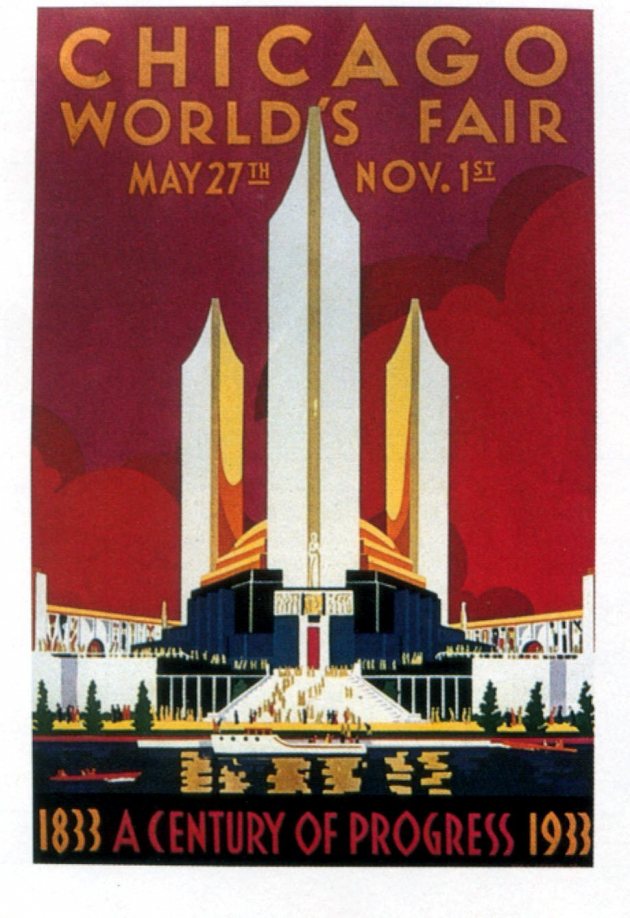
The decade of the Great Depression was also the decade when two major fairs were held, the Century of Progress Exposition of 1933 in Chicago and the New York World’s Fair of 1939. Incidentally, during this famously severe period of economic hardship seven minor fairs were also held throughout the United States.

More recently the period of recession that marked the early years of the 1980s  gave us the Knoxville World’s Fair of 1982 and 1984 Louisiana World Exposition.

“I Was Born To Stand Outside Myself”

Last summer I posted a few thoughts on Mark Helprin’s A Soldier of the Great War which I had then begun reading. As it turned out, I set the book aside for a few months for no particular reason, but I’ve recently returned to it and finished it. I stand by my initial characterization: the novel is a meditation on beauty, and a lovely one at that.

Near the end, the main character, Alessandro, meets up with a talented, intelligent, articulate man named Arturo who is nonetheless thoroughly unsuccessful and unaccomplished. In conversation with Alessandro, Arturo sums up his life thus: “I was born to stand outside myself.”

This struck me as a remarkably evocative line. Now I confess that I’m going to take this in a direction that Helprin neither intended nor imagined. That said, the line immediately suggested to me the manner in which we are made to virtually stand beside ourselves in our (social) media environment.

There are perhaps two senses in which this is true. I’m thinking of the way that our social media profiles stand beside us in a rather apprehensible manner. We can look at them, manipulate them, experience them; they are us but not us. In this sense, I’m still inclined to think of our social media profiles as virtual memory theaters, at least in part.

The other sense is the manner in which the presence of our second self impinges upon our lived experience. We not only stand beside our past self as it is represented online, we also stand beside our potential future self as it will be represented online. This other potential self haunts our present from the future. Several months ago I posted a synopsis of Michel de Certeau’s observations about the way the past layers over certain places and haunts them. Places capture memories and those places cannot be divorced from those memories in lived experience. Perhaps if he were alive today, de Certeau would suggest that the future as well as the past now haunts our present. We live with our virtual memory theaters and we live with future memories as well. We are born to stand beside ourselves, actual and potential. And, perhaps most significantly, the potential self we live with is imagined within the constraints of the platform through which it will represented.

On this latter point, I would also point you to Nathan Jurgenson’s fine essay reprinted in The Atlantic: “The Facebook Eye.”

It does occur to me that this standing beside ourselves did not itself emerge with the advent of social media. One could argue that it is a function of all representation. Certainly it is a feature of writing itself. Walter Ong made much of the way in which literacy alienates. Among the many separations effected by writing Ong includes the separation of the known from the knower, the past from the present, and being from time.

So we might conclude that social media only augments a long standing trajectory. But my sense, as it often is with efforts to situate present phenomena within a historical trajectory, is that this threatens to miss the significance of present developments. Changes of degree may amount to changes in kind. As I’ve heard it put somewhere or other, a hurricane is not merely an unusually strong breeze.

Social media, and the technological ecosystem on which it depends, radically augments the alienation of writing if only by its mere ubiquity. But perhaps more importantly, it does so by making our second self that stands beside us also a public self that presents itself to a myriad of others. It’s the difference between an old-school diary and your Facebook profile. It is no small difference and we are all in the process of sorting out the personal and social consequences.

De Certeau concluded that “haunted places are the only ones people can live in.” Walter Ong was also sanguine about the alienations wrought by writing:

“To say writing is artificial is not to condemn it but to praise it . . . By distancing thought, alienating it from its original habitat in sounded words, writing raises consciousness.  Alienation from a natural milieu can be good for us and indeed is in many ways essential for fuller human life.  To live and to understand fully, we need not only proximity but also distance.  This writing provides for, thereby accelerating the evolution of consciousness as nothing else before it does.”

Now the question is whether the standing beside ourselves effected by social media will carry similarly salubrious consequences. Discuss amongst yourselves. Here’s the prompt to get you going: Has social media continued to accelerate the evolution of consciousness or self-consciousness? Is there a difference?

Writing To An Imagined Audience … Suggestions Welcome

Audience, as the etymology suggests, originally involved hearing and, hence, speaking face-to-face; in which case you would know exactly who you were communicating to and, presumably, to what end. The paradox of referring to the “audience” of written communication reminds us of the more difficult task of communicating when the parties involved have been abstracted from one another in space and time.

So who’s my audience?

I know a few personally, I’ve come to know a few virtually through comments, but for the most part it is an invisible audience that I nonetheless find myself wanting to address in a meaningful manner.

Having said this, I’m curious to know why you take the time to read The Frailest Thing.

I was reminded by a comment today that most of the readers of this blog are “silent readers,” and that is fine of course. I’m not a very loud reader myself. But as I think about what to write, it couldn’t hurt to have some ideas of the kind of posts that readers find most helpful. What would you like to read more about? Which posts do you just skip over? What can I do to improve the quality of posts? Are there topics I don’t write enough about? Topics I write about too much? In short, what would make this a better blog? No need to pull punches.

If you have the time to spare, drop me a comment below or send me an email — LMSacasas at gmail dot com.

And of course, for whatever reason you do so, thanks for reading!