Ray Bradbury Goes to Disneyland: Automatons, Animatronics, and Robots

In October of 1965, Ray Bradbury wrote “The Machine-Tooled Happyland,” his reflections on Disneyland. He begins by recalling his delight as a child with all things Disney and then his dismay at an essay in The Nation that equated Disneyland with Las Vegas. Here is Bradbury:

“Vegas’s real people are brute robots, machine-tooled bums.

Disneyland’s robots are, on the other hand, people, loving, caring and eter­nally good.”

Here’s more:

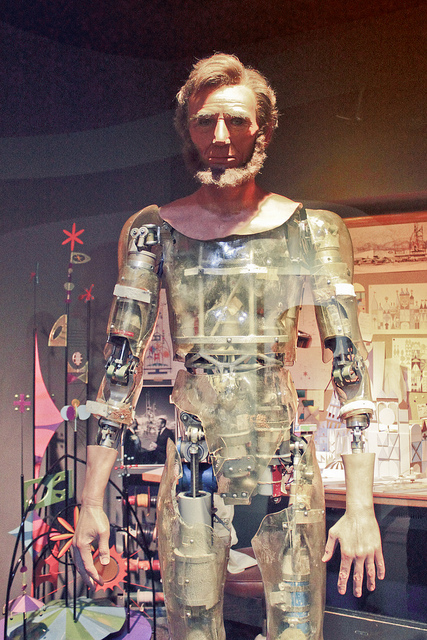
“Snobbery now could cripple our intellectual development. After I had heard too many people sneer at Disney and his audio-animatronic Abraham Lincoln in the Illinois exhibit at the New York World’s Fair, I went to the Disney robot factory in Glendale. I watched the finishing touches being put on a second computerized, electric- and air-pressure-driven humanoid that will “live” at Disneyland from this summer on. I saw this new effigy of Mr. Lincoln sit, stand, shift his arms, turn his wrists, twitch his fingers, put his hands behind his back, turn his head, look at me, blink and prepare to speak. In those fewmoments I was filled with an awe I have rarely felt in my life.

Only a few hundred years ago all this would have been considered blasphemous, I thought. To create man is not man’s business, but God’s, it would have been said. Disney and every technician with him would have been bundled and burned at the stake in 1600.”

Regarding that last thought, perhaps a bit of hyperbole. But there is something to it. Consider this recent fascinating Wilson Quarterly essay by Max Byrd, “Man as Machine.” Byrd discusses the popularity of automatons in Europe, particularly France, during the 18th and 19th centuries:

“Automates of various kinds have been around since antiquity, as toys or curiosities. But in the middle of the 19th century, in one of the odder artistic enthusiasms the French are famously prone to, a positive mania for automates like the dulcimer player swept the country. People flocked to see them in galleries, museums, touring exhibitions. Watchmakers and craftsmen competed to make more and still more impossibly complex clockwork figures, animals and dolls that would dance, caper, perform simple household tasks—in one case, even write a line or two with pen and ink. The magician Robert Houdin built them for his act. Philosophers and journalists applauded them as symbols of the mechanical genius of the age. Like so many such fads, however, the Golden Age of Automates lasted only a short time. By about 1890 it had yielded the stage to even newer technologies: Edison’s phonograph and the Lumière brothers’ amazing cinematograph.”

Back to Bradbury, the whole piece is a touching appreciation of Walt Disney (the man) and the possibilities of animatronics for the teaching of history:

“Emerging from the robot museums of tomorrow, your future student will say: I know, I believe in the history of the Egyptians, for this day I helped lay the cornerstone of the Great Pyramid.

Or, I believe Plato actually existed, for this afternoon under a laurel tree in a lovely country place I heard him discourse with friends, argue by the quiet hour; the building stones of a great Republic fell from his mouth.”

Read the whole thing. Together with Byrd’s piece it offers interesting background to questions such as those posed recently in an excerpt of Patrick Lin’s Robot Ethics in Slate: “The Big Robot Questions”. Read that too.

To Remember, Or To Forget …

Two (and a half) articles for your consideration today:

a. “Technologically Enhanced Memory” by Evan Selinger at Slate.

b. “The Forgetting Pill Erases Painful Memories” by Jonah Lehrer at Wired. See also Lehrer’s related blog post, “Learning to Forget”.

Selinger frames his essay as a discussion of the implications of transactive memory and extended cognition; in short, the ability to offload our memory and thinking onto our environment. That our environment serves as a “memory-prompting tool” is hardly controversial. That in this way it becomes part of our thinking process or an extended mind is a little more so.

Philosopher Andy Clark, a well-known advocate of the extended mind hypothesis, asks us to consider the hypothetical case of Otto and his notebook. Otto suffers from Alzheimer’s and uses a notebook to help him remember information, for example the address of the Museum of Art he wishes to visit. He consults his notebook and acts based on what he finds there in much the same way that someone without an impairment would consult their memory. In this way the notebook is incorporated into his thinking and acting and is thus an extension of his mind (although not, obviously, of his brain).

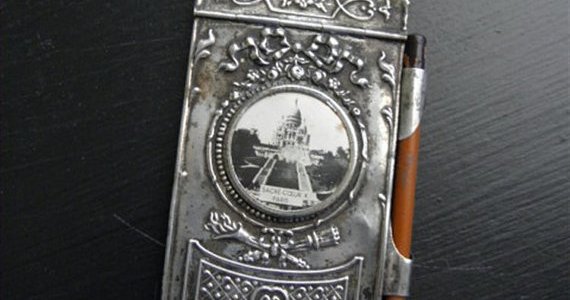
Notebooks such as Otto’s have a rather elegant history as it turns out. During the nineteenth century, the aide de memoir, a tiny notebook within decorative case on a chain, became a popular (and practical) fashion accessory. Today it seems they flourish mostly on Etsy. For our part, the smart phone has become our aide de memoir. Less elegant perhaps, but more powerful by many orders of magnitude. And it is these orders of magnitude that give Selinger pause. It is one thing to jot down a list of things to do today; it is quite another to have gigabytes of space dedicated to the storage of textual and audiovisual memories. It is quite another still to have the ability to curate those memories for public consumption.

With “Timehop, a lifelogging app that performs “memory engineering” in mind, he cites Elizabeth Lawley who wonders: “If we go through life aware we’re leaving behind a detailed digital archive that future generations can read, might we be inclined to behave inauthentically so that our digital breadcrumbs point back to idealized versions of ourselves?”

This is a dilemma not unlike the emergence of “Facebook Eye” described by Nathan Jurgenson. “Facebook Eye” describes the tendency to experience life with a view to its re-presenation on a social media site like Facebook and the responses that re-presentation is likely to draw.

Pointing to historical antecedents, in this case the aide de memoir, is helpful to a certain degree, but it also risks lulling us into a facile acceptance of a state of affairs that by its quantitative difference becomes also qualitatively (and consequentially) different.

In his Wired article, Lehrer explores the emerging possibility of pharmaceutical forgetting, pills that may be able to target specific and traumatic memories. As Lehrer notes, a more tactical and strategic realization of the capabilities that animate the plot of Eternal Sunshine of Spotless Mind. The premise of Lehrer’s article is that contrary to popular thinking, the best way to handle traumatic memories is not to air them or talk them through, but rather simply to forget them. And a pill that helped patients do just that would be markedly more successful (and efficient) than the talking cure.

Lehrer pays some attention to the ethical concerns, but you’ll have to go elsewhere to consider those more deeply. Analogously to the manner in which a discussion of historical antecedents tends to communicate “there’s nothing of consequence here”, Lehrer is fond of pointing to the natural fallibility of human memory as an antecedent to the pharmaceutically enabled forgetting that, he seems to suggest, renders it more or less unproblematic, at least not seriously so.

It seems odd, however, to point to the natural and inevitable distortions and deletions of memory in defense of drugs designed to help us forget traumatic memories we seem unable to shake.

It is also worth considering what role extended cognition plays in the remembering and forgetting explored by Lehrer. Leher is focused almost exclusively on neurological processes. Yet memory, as the extended mind theorists (among many others) have emphasized, is more than a neurological phenomenon. It is also an embodied, artifactual, spatial, social, and technological reality.

It would not be the first such irony, but perhaps in the future we will take pills to help us dissolve the memories that our technologically enhanced memories won’t let us forget.

“Liking” and Loving: Identity on Facebook

By one of those odd twists of associative memory, John Caputo’s little book, On Religion, came to mind today. Specifically, I recalled a particular question that he posed in the opening pages.

“So the question we need to ask ourselves is the one Augustine puts to himself in the Confessions, “what do I love when I love God?,” or “what do I love when I love You, my God?,” as he also puts it, or running these two Augustinian formulations together, “what do I love when I love my God?”.

I appreciate this formulation because it forces a certain self-critical introspection. It refuses us the comforts of thoughtlessness.

A little further on, Caputo takes the liberty of putting his words to the spirit of Augustine’s quest:

“… I am after something, driven to and fro by my restless search for something, by a deep desire, indeed by a desire beyond desire, beyond particular desires for particular things, by a desire for I-know-not-what, for something impossible. Still, even if we are lifted on the wings of such a love, the question remains, what do I love, what am I seeking?”

Then Caputo makes an important observation:

“When Augustine talks like this, we ought not to think of him as stricken by a great hole or lack or emptiness which he is seeking to fill up, but as someone overflowing with love who is seeking to know where to direct his love. He is not out to see what he can get, but out to see what he can give.”

Not too long ago I posted some thoughts on what I took to be the Augustinian notes sounded in Matt Honan’s account of his time at the Consumer Electronics Show in Las Vegas. In that post, “Hole In Our Hearts,” I employed the language Caputo cautioned against, but I’m now inclined to think that Caputo is on to something. His distinction is not merely academic.

Plummeting, perhaps, from the sublime to the … what to call it, let us just say the ordinary, this formulation somehow triggered the question, “what do I like when I “Like” on Facebook?” Putting it this way suggests that what I like may not, in fact, be what I “like”. The question pushes us to examine why it is that we do what we do in social media contexts (Facebook being here a synecdoche).

Very often what we do on social media platforms is analyzed as a performance or construction of the self. On this view, what we are doing is giving shape to our identity. What we like, if you will, is the projected identity, or better yet, the perception and affirmation of that identity by others. This, of course, does not exhaust what is done with social media, but it is a significant part of it.

There are, remembering Caputo’s distinction, two ways we might understand this. Caputo distinguished between love or desire understood as a lack seeking to be filled and love or desire understood as a surplus seeking to be expended. This distinction can be usefully mapped over the motivations driving our social media activity.

When we think about social media as a field for the construction and enactment of identities, we tend to think of it as the projection, authentic or inauthentic, of a fixed reality. Perhaps we would do well to consider the possibility that identity on social networks is not so much being performed as it is being sought, that behind the identity-work on social media platforms there is an inchoate and fluid reality seeking to take shape by expending itself.

The entanglement of our loves (or, likes) and our identity on social media has, it turns out, an antecedent in the Augustinian articulation of the human condition. Caputo went on to note that the question of what we love is also bound up with another Augustinian query:

“Augustine’s question — “what do I love when I love my God?” — persists as a life-long and irreducible question, a first, last, and constant question, which permanently pursues us down the corridors of our days and nights, giving salt to fire to our lives. That is because that question is entangled with the other persistent Augustinian question, “who am I?” …

What we love and desire and who we are — these two are bound up irrevocably with one another.

“I have been made a question to myself,” Augustine famously declared. And so it is with all of us. The problem with our talk about the performance of identity is that it tends to tacitly assume a fixed and knowing identity engaging in the performance. The reality, as Augustine understood, is more complex and whatever it is we are doing online is tied up with that complexity.

Ritual Fairs: Liminality and the World’s Fairs

In 1983, cultural historian Warren Susman wrote a brief but remarkably suggestive essay in the journal Chicago History. The essay, “Ritual Fairs,” evoked the categories of ritual studies and the sociology of religion to understand the significance of World’s Fairs to American culture.

Susman begins by discussing the World’s Fairs as instances of tourism, as the first modern media events, and as the paradigmatic generator of souvenirs. Susman then pivots to draw a comparison between the World’s Fairs of the 19th and 20th centuries and the fairs of medieval society.  According to Susman, “in our era pilgrimage becomes tourism, … souvenirs are a more modern form of relic, and … the iconographic function of some fair’s buildings can be related to the iconographic significance of Gothic cathedrals.”

Like the medieval fairs, World’s Fairs were “idealized towns, utopias, or as H. Bruce Franklin shrewdly suggests about New York’s 1939 fair, works of science fiction.” Consequently, Susman recommends that we understand the fairs in light of the liminal stage that Victory Turner assigned to pilgrimages. The fairs separated the “pilgrim” from their ordinary world and immersed them in another world “somewhere between past, present, and future.” From this vantage point fair goers were led to “an acceptance and participation in a new social order that is emerging technologically, socially, culturally, politically”.

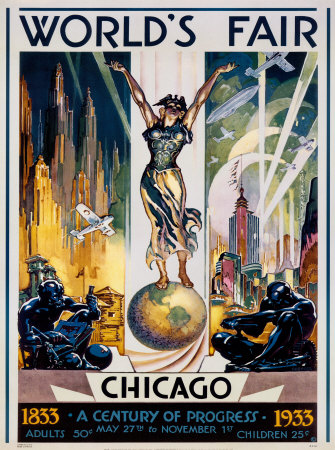
Consider the poster below, from the 1933 Century of Progress Fair in Chicago, a graphic representation of this idea of liminality. The fair’s icon stands posed between the world as it has been and the imagined world of the future.

Borrowing from Emile Durkheim’s notion that religion involves the worship of society, Susman also believes that the fair goers “went to worship or at least stayed to worship a vision of that society or social order.” Susman doesn’t use this language, but it is an eschatological vision that the fairs communicated and invited attendees to worship and participate in. It was not a vision of society as it was or had been, but as it could be. In this respect, the fairs traded in the cultivation of hope; thus their frequent appearance at times of economic or social upheaval.

The golden age of World’s Fairs in America, roughly the period between the 1870s and 1960s, witnessed the nation’s passage from an economy of scarcity and production to one of abundance and consumption. In Susman’s view, the World’s Fairs played an indispensable role in guiding American society through this transition: “… world’s fairs were rites of passage for American society which made possible the full acceptance of a new way of life, new values, and a new social organization.”

To wrap up with a question, is there anything comparable today? Do we have anything that serves a similar function in what is evidently our ongoing transition from one form of society to another?

Teachers, Resistance is Futile

Related to the last post, a friend passed along a link this afternoon to a story in the NY Times about a school district in North Carolina that is having notable success implementing technology in the classroom. Here’s a representative passage:

“Mooresville’s laptops perform the same tasks as those in hundreds of other districts: they correct worksheets, assemble progress data for teachers, allow for compelling multimedia lessons, and let students work at their own pace or in groups, rather than all listening to one teacher. The difference, teachers and administrators here said, is that they value computers not for the newest content they can deliver, but for how they tap into the oldest of student emotions — curiosity, boredom, embarrassment, angst — and help educators deliver what only people can.

Many classrooms have moved from lecture to lattice, where students collaborate in small groups with the teacher swooping in for consultation. Rather than tell her 11th-grade English students the definition of transcendentalism one recent day, Katheryn Higgins had them crowd-source their own — quite Thoreauly, it turned out — using Google Docs. Back in September, Ms. Higgins had the more outgoing students make presentations on the Declaration of Independence, while shy ones discussed it in an online chat room, which she monitored.”

Yes, you read that correctly. He did write “quite Thoreauly.” As unfortunate as that line may be, it’s not the most disturbing:

“Many students adapted to the overhaul more easily than their teachers, some of whom resented having beloved tools — scripted lectures, printed textbooks and a predictable flow through the curriculum — vanish. The layoffs in 2009 and 2010, of about 10 percent of the district’s teachers, helped weed out the most reluctant, Mr. Edwards said; others he was able to convince that the technology would actually allow for more personal and enjoyable interaction with students.”

Once more, the layoffs “helped weed out the most reluctant.”

I’m far from suggesting that there is never a time to let go of incompetent teachers, but it seems to me that this is a net that is just as likely to snare competent teachers as incompetent ones.

The message in this case seems clear: resistance is futile, I believe is the line. It rather reminds me of the motto of the 1933 Century of Progress World’s Fair which I stumbled upon recently — “Science Finds, Industry Applies, Man Conforms”.

So it would seem, at least as this writer presents the case.