Selling the Future

Again, from Laura Burd Schiavo’s “Modern Design Goes Public” in Designing Tomorrow: America’s World’s Fairs of the 1930s:

“From their start, expositions were meant to incite consumer desire.”

The evolution of display techniques:

“In pavillions dedicated to the display of goods, exhibits showcased row upon row of clocks, glassware, and, as industrial production heated up, pyramids of ketchup bottles and other mass produced goods, as well as the machines that made them possible.”

“By the late nineteenth and early twentieth century, displays had become more sophisticated, advancing from showcasing product to demonstrating production. The ultimate express of this trend came at the Panama Pacific International Exposition in 1915, where Henry Ford installed an assembly line that churned out as many as twenty-five Model Ts a day.”

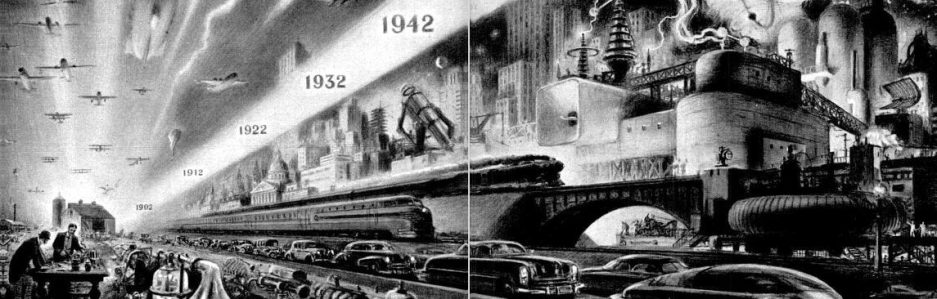
“During the 1920s and 1930s corporations were involved in the development of an increasingly sophisticated public relations strategy … World’s fairs became prime venues for designers to experiment with how design innovation could visually and viscerally dramatize the promise of industrial capitalism … they sought to provide innovative and engaging exhibits that shared a vision of the future, a sense of the power and promise of industry, and an image of the place of consumers in that world.”

Compare Walter Benjamin’s comments on the Paris expositions of the late nineteenth century:

“The world exhibitions glorified the exchange-value of commodities. They created a framework in which their use-value receded into the background. They opened up a phantasmagoria into which people entered in order to be distracted. The entertainment industry made that easier for them by lifting them to the level of the commodity. They yielded to its manipulations while savouring their alienation from themselves and from others.”

Test driving Fords on the "Road of Tomorrow" (NY 1939)

Corporate Modernism

From Laura Burd Schiavo’s “Modern Design Goes Public” in Designing Tomorrow: America’s World’s Fairs of the 1930s:

“[The world’s fairs of the 1930s] were decidedly public. They introduced modern design to the tens of millions who visited the fairs and those exposed to them through extensive coverage in popular periodicals, on the radio, and in newsreels. What might have been an aesthetic experiment or marketing ploy before 1929 soon became an urgent response to crisis. During the Great Depression, the spectacular demonstrations aligned modern design with a vision of a better future that celebrated consumer progress and trumpeted mass production and corporate leadership. The world’s fairs were popular interpretations of what it meant to be modern in the 1930s, lessons that could be taken home and applied to everyday lives.”

Historian David Nye dubbed this collusion of modernist aesthetics with corporate interests, “corporate modernism” (fittingly enough):

“The future that corporate planners imagined no longer had the neoclassical overtones expressed in the architecture at the pre-1915 fairs in Chicago, Buffalo, St. Louis, and San Francisco. The fairs of the 1930s adopted the geometrical forms and flat surfaces of the international style … Indeed the invention of ‘corporate modernism’ was one of the more remarkable adaptations of business to the 1930s. Part of the impulse came from increasing competition among manufacturers, whose products often performed equally well, and who therefore needed styles that set their products apart … To repackage products they turned to industrial designers to rework the appearance of objects, emphasizing sleekness, streamlined contours, and functional appearance. The demand for ‘the new’ beams incessant: last year’s style began to seem second-hand; and corporations increasingly advertised and packaged products as innovations recently arrived from the future.”

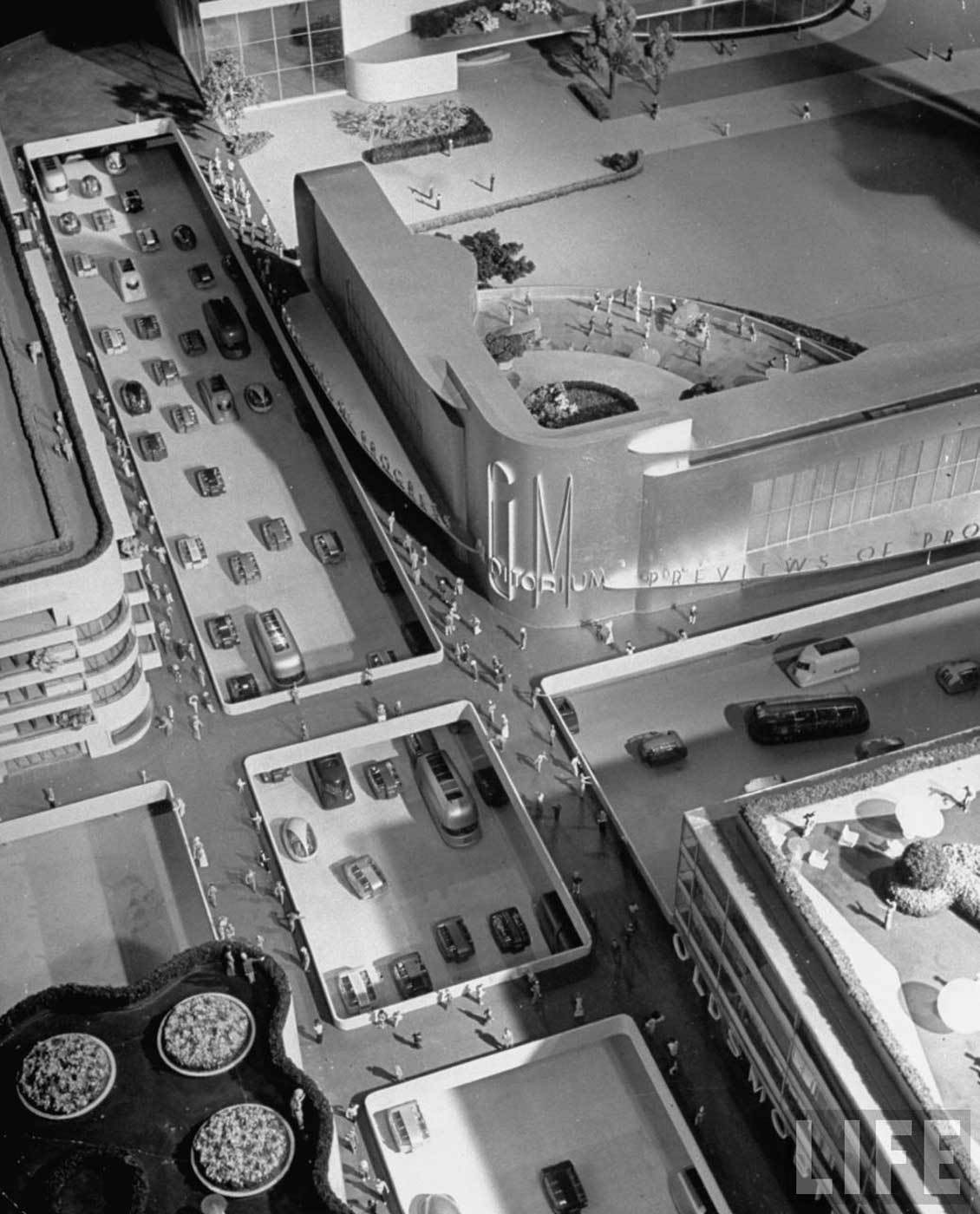
Intersection of Tomorrow, Futurama Exhibit
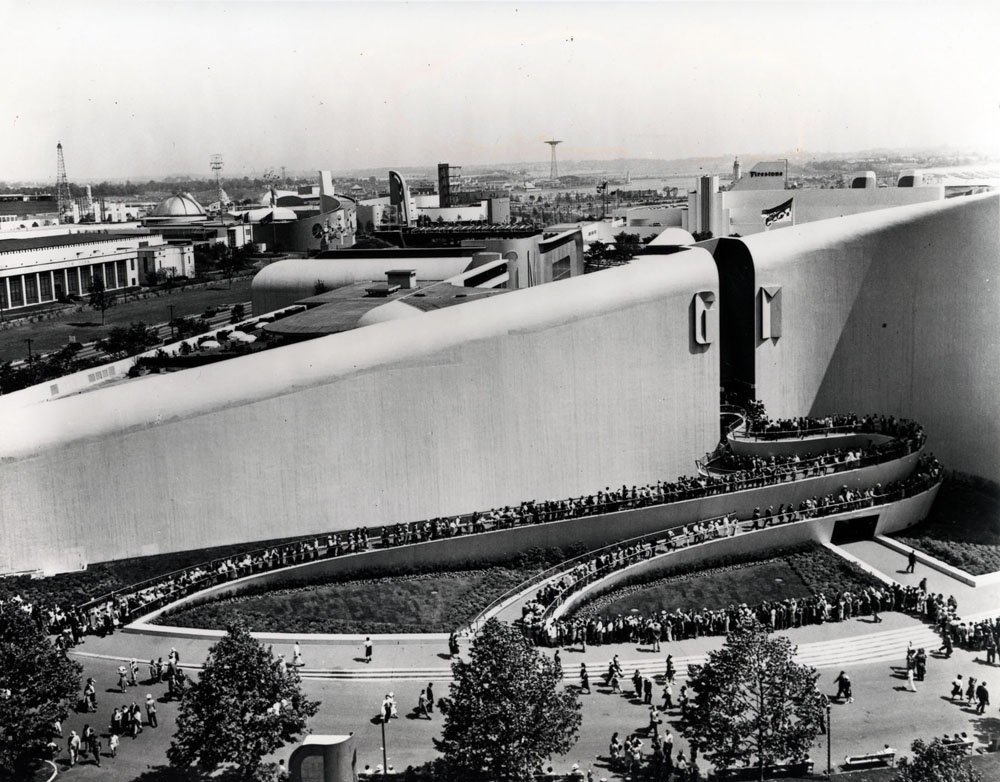
GM Building designed Albert Kahn and Norman Bel Geddes

Displacement and Nostalgia

Another tumblr-style post with excerpts from Casey’s Getting Back Into Place:

“… each of us is caught in the toils of displacement. As moderns and postmoderns in the Eurocentric West, we too are displaced persons … and inescapably so.”

The symptoms of this displacement, Casey claims, are “disruptive and destructive”:

“Among these symptoms, nostalgia is one of the most revealing. At the moment, our own culture suffers from acute nostalgia. Proust, living on the edge between the modern and the postmodern periods, described the drama of an entire life delivered over to nostalgia. But we do not need to turn to literature for evidence of the pervasive presence of nostalgia; we witness its cinematic expression in certain of Woody Allen’s films and its commercial exploitation in Disney World.”

This was, of course, before Midnight in Paris.

In Casey’s view, our displacement is in part a function of a faulty conceptualization. The triumph of abstraction over the particular:

“… the placeless is the thoughtless; and if we fail to honor and remember places, this is a direct reflection of our unthinking and increasingly ill condition. Another telling sign is the fact that ‘for the modern self, all places are essentially the same: in the uniform, homogeneous space of a Euclidean-Newtonian grid, all places are essentially interchangeable. Our places, even our places for homes, are defined by objective measures.'”

“The uniformity of space and the equability of time have replaced, or more exactly displaced, the priority of place. If nostalgia is a characteristically modern malaise, this may be due to its covert recognition that a time once existed when place was ‘the first of all things,’ when time and space in their modern (dis)guises were not yet fatally at work. For in the pathos of nostalgia, ‘space and time [are] not yet separable concepts, [they are] scarcely concepts at all.’ But in the modern era we have accepted and incorporated space and time in their objectivity and (in)difference … We calculate, and move at rapid speeds, in time and space. But we do not live in these abstract parameters; instead, we displaced in them and by them.”

For related musings see Fatal Nostalgia and Generalized Anxiety.

Encultured Place, Implaced Culture

Again, from Edward S. Casey’s Getting Back Into Place:

“Thus we are driven to acknowledge the truth of two related but distinct propositions: just as every place is encultured, so every culture is implaced.”

“Implacement is an ongoing cultural process with an experimental edge. It acculturates whatever ingredients it borrows from the natural world, whether these ingredients are bodies or landscapes or ordinary ‘things.’ Such acculturation is itself a social, even a communal, act. For the most part, we get into places together. We partake of places in common — and reshape them in common. The culture that characterizes and shapes a given place is a shared culture, not merely superimposed upon that place but part of its very facticity.”

“Place, already cultural as experienced, insinuates itself into a collectivity, altering as well as constituting that collectivity. Place becomes social because it is already cultural.”

“The cultural dimension of place — along with affiliated historical, social, and political aspects and avatars — adds something quite new to the earlier analysis … This dimension contributes to the felt density of a particular place, the sense that it has something lasting in it.”


Spatial Time

More from Edward S. Casey’s Getting Back Into Place:

“Following Bergson’s lead, we can note that many of the descriptive terms and phrases that we apply unthinkingly to time are spatial in character: a ‘stretch’ or ‘interval’ of time; indeed, a ‘space of time.’ Notice also that when we talk about being ‘before’ and ‘after’ in time, we are invoking a spatial distinction, as is evident when one object is said to be placed ‘before’ or ‘after’ another. Yet we can trace the distinction between before and after still further back — all the way back to place. ‘The before and after,’ avers Aristotle, are ‘in place (en topoi) primarily.’ The ultimate source of the distinction between before and after resides in the way that a given place disposes itself: as having both a ‘forward’ area that is accessible to and continuous with our own embodied stance and a ‘back’ region in which the same place eludes our grasp and view.”

And a little further on:

“Or take Saint Augustine’s offhand observation that ‘we speak of a ‘long time and a ‘short time,’ though only when we mean the past or the future.” But where do we first understand the sense of ‘long’ and ‘short’ themselves if not from our experiences of being in more or less accommodating or demanding, more or less extended or compressed, places?”