Tracking the Spread of Technology

The graph below which plots the diffusion of new technologies throughout the twentieth century came to my attention via Derek Thompson’s post at The Atlantic, “The 100 Year March of Technology in One Graph.”

Take a second and click to enlarge the graph. The lines trace the percentage of US households that adopted the technologies in question over time. There’s a lot of information condensed into this chart, and of course, there’s a lot that a chart can’t convey. Below the graph I’ll list a few of the things that caught my attention.

Grap by Visualizing Economics. Click to enlarge.

The first thing to note is that this chart gives us a glimpse at the social history of technology, a dimension of the story of technology that sometimes gets left out. Very often the focus is on the inventors and the process of invention or on the capabilities of a technology and its consequences. But behind each of these lines there is often a very interesting, and very human story. Naturally, this chart doesn’t quite give us those stories, but they do hint at them. (Many of these stories have been told in quite compelling fashion. America Calling by Claude Fischer, for instance, is a well regarded treatment of the social history of the telephone up to 1940.)

This particular chart, however, gives the impression that technologies always track toward almost full saturation of a society. Once invented, they inexorably trend upwards, some more quickly than others. But remember what this particular chart leaves out: the myriad of technologies that fail to achieve widespread adoption and those that are superseded and recede downward toward near extinction. So consider that this chart might also have included cassette players, laser discs, and typewriters.

That said, the far end of the chart does begin to show us a little of this kind of falling off. You’ll notice, for example, that the VCR adoption rate begins to tail off around the year 2000. So too does the telephone. This is not too surprising and we can readily guess at the causes: the appearance of the DVD player and cell phone respectively. Interestingly, the computer also shows a falling off which raises the question of how the “computer” is defined for the purposes of this chart.

As an aside, this reminds us that visual data, of which we are lately so fond, tends to present itself in rather objective, even clinical fashion, but interpretations are already built in to the data.

There are also instances of dips in adoption rates on the way to full saturation. Notably we see dips in the adoption of telephones, electricity, and automobiles. Not surprisingly, the most pronounced of these dips occurred in the early 1930s as the nation entered the Great Depression. This reminds us that economic conditions play an important role in the stories of technology adoption. It also prompts certain questions: why, for example, did telephone adoption dip while radio adoption continued to increase steadily?

The point of the chart — judging by its title, “Consumption Spreads Faster Today” — is to show that technologies are adopted more quickly today than in the past. There seems to be something to this claim; in fact, it feels intuitively commonsensical to us. But at second glance, it seems a bit more complicated than that.

Remember, for starters, the problem of interpretation that is buried below the apparent objectivity of the graph. It would seem, for instance, that the Internet began in the early 1990s, but arriving at this date involves defining out of existence the early history of the Internet which stretches back into the 1970s at least. Also, several earlier technologies — the radio, the refrigerator, the color TV —  appear to rise as precipitously in adoption rate as more recent technologies.

Interesting as well are the rather languid adoption rates for certain “time-saving” household technologies such as the  clothes washer (but not the clothes dryer) and the dishwasher. By contrast, the microwave enjoys a rather steep rate of adoption. This recalls Ruth Schwartz Cowan’s classic work in the social history of technology, More Work for Mother: The Ironies of Household Technology from the Open Hearth to the Microwave, in which she dismantled the assumption that the introduction of modern household technologies radically unburdened the average housewife.

This chart, then, is chiefly valuable for what it points to: the fascinating social history of technology. It’s a history that is often forgotten, but one whose consequences we all share in. In America Calling, Fischer sums up:

“Inventors, investors, competitors, organized customers, agencies of government, the media, and others conflict over how an innovation will develop. The outcome is a particular definition and a structure for the new technology, perhaps even a “reinvention” of the device. The story could always have been otherwise if the struggles had proceeded differently.”
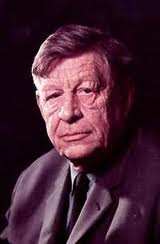
Richard Wilbur on W. H. Auden

“The soul shrinks from all that it is about to remember.”

“… but for that look of rigorous content.”

“… the fountain-quieted square …”

“… gust of grace …”

” … having taught hell’s fire a singing way to burn …”

These are just a few of the many delightful and haunting lines from the poetry of Richard Wilbur, a former national poet laureate and two-time Pulitzer Prize  winner who turned 91 last month.

Those of you who have been reading for a while will have gathered that W. H. Auden is a poet I hold in high esteem. In light of that, here is Richard Wilbur’s “For W. H. Auden” which first appeared in The Atlantic in 1979:

   Now I am surer where they were going.
The brakie loping the tops of the moving freight,
The beautiful girls in their outboard, waving to someone
As the stern dug in and the wake pleated the water.

   The uniformed children led by a nun
Through the terminal’s uproar, the clew-drawn scholar descending
The cast-iron stair of the stacks, shuffling his papers,
The Indians, two to a blanket, passing in darkness,

   Also the German prisoner switching
His dusty neck as the truck backfired and started—
Of all these noted in stride and detained in memory
I now know better that they were going to die,

   Since you, who sustained the civil tongue
In a scattering time, and were poet of all our cities,
Have for all your clever difference quietly left us,
As we might have known that you would, by that common door.

Ritual, Remembrance, and Communities of Memory

This week Jews celebrate Passover and Christians will celebrate Easter. In both cases the celebration will be anchored in the memory of an event upon which each community grounds its identity — the Exodus from Egypt and the death and resurrection of Christ.  And in both cases again, the celebration is not only anchored in the memory, it sustains the memory of the event in the present and for the future while also grounding the community’s identity in the founding memory.

The commemorative function of religious celebrations and rituals plays a critical role in Paul Connerton’s analysis in How Societies Remember.  Connerton’s thesis is simple and elegant:  whatever societies care to remember most, they entrust to embodied ritual and practice.  There are a variety of reasons for this which Connerton explores, but for brevity’s sake I’ll mention only one.  Remembrances carried by and enacted in the body  are more durable and less contingent than verbally articulated forms of remembrance precisely because they are less subject to verbal manipulation and critique.

Connerton begins by defining ritual as “rule-governed activity of a symbolic character which draws the attention of its participants to objects of thought and feeling which they hold to be of special significance.” He then elaborates this definition of ritual by proposing three things that rites or rituals are not.

  1. “Rites are not merely expressive … They are formalized acts and tend to be stylized, stereotyped and repetitive … They do discharge expressive feelings; but this is not their central point.”
  2. “Rites are not merely formal.  We commonly express our sense of their formalism by speaking of such acts as ‘merely’ ritual or as ’empty’ forms … But this is misleading. For rites are felt by those who observe them to be obligatory … and the interference with acts that are endowed with ritual value is always felt to be an intolerable injury inflicted by one person or group upon another … To make patriots insult their flag or to force pagans to receive baptism is to violate them.”
  3. Rites are not limited in their effect to the ritual occasion … [W]hatever is demonstrated in rites permeates also non-ritual behavior and mentality … Rites have the capacity to give value and meaning to the life of those who perform them.”

Each of these three elaborations by Connerton pose something of a challenge to conventional understandings of ritual and rites.  Contemporary culture, and large segments of the Christian community will take issue with the lack of expressivity and fail to recognize the formative power of ritual.  Connerton, however, is judicious in his formulations.  Rituals can be expressive, that is simply not their chief end which is, rather, remembrance.  Those who question the power of ritual should ask themselves if they would willing partake in the rituals of another religion not their own or salute the flag of a foreign country.  And finally, Connerton claims that rituals have the capacity to reorient the worshiper’s life, not that they will necessarily accomplish this.

Moving from what rituals are not to what they are, Connerton writes, “All rites are repetitive, and repetition automatically implies continuity with the past.”  In other words, by repeating you are automatically bringing into the present something that was done in the past.  But many rites not only imply continuity with the past, but explicitly claim such continuity and they “do so by ritually re-enacting a narrative of events held to have taken place at some past time … Nowhere is this explicit claim to be commemorating an earlier set of founding events in the form of a rite more abundantly expressed then in the great world religions …”

So for example Judaism:  “The core of Jewish identity is established by reference to a sequence of historical events.”  The social and cultic life of Israel is more or less geared toward remembrance.  And, according to Connerton,

“Nowhere is this theology of memory more pronounced than in Deuteronomy.  For the Deuteronomist the test of showing that the new generation of Israel remains linked to the tradition of Moses, that present Israel has not been severed from its redemptive history, is to be met by a form of life in which to remember is to make the past actual, to form a solidarity with the fathers.”

Christianity also “stands or falls with the tie that binds it to  its unique historical origin.”  Amid his discussion of the Christian liturgical calendar, Connerton fastens on the historical character of the Christian faith and the subsequent burden of remembering those events that is borne by Christian worship:

“The period of time evoked by the Gospels and recalled in the liturgy is not, as in archaic religions, a mythical time, and the events annually recapitulated in the sacred calendar are not to be thought of as events that occurred ‘in the beginning’, ‘in illo tempore‘.  The events took place in a datable history and at a clearly defined historical period, the period in which Pontius Pilate was a governor in Judea.  Those events and that period are commemorated annually in the Good Friday and Easter festivals.”

In support of Connerton’s thesis it should also be noted that the celebration of the Lord’s Supper, which historically has been the linchpin of Christian worship, is fundamentally an act of remembrance and re-enactment.  And while words are pronounced, and this is not insignificant, it is principally something that is done and not said.  What is more it is a robustly sensual act that incorporates vision, hearing, touch, smell, and taste, all in the service of engraving a memory on our bodies that it may then go with us and permeate our lives and shape our identity.

Auden on the Crucifixion

From W. H. Auden’s A Certain World: A Commonplace Book:

“Just as we are all, potentially, in Adam when he fell, so we were all, potentially, in Jerusalem on that first Good Friday before there was an Easter, a Pentecost, a Christian, or a Church. It seems to me worthwhile asking ourselves who we should have been and what we should have been doing. None of us, I’m certain, will imagine himself as one of the Disciples, cowering in agony of spiritual despair and physical terror. Very few of us are big wheels enough to see ourselves as Pilate, or good churchmen enough to see ourselves as a member of the Sanhedrin. In my most optimistic mood I see myself as a Hellenized Jew from Alexandria visiting an intellectual friend. We are walking along, engaged in philosophical argument. Our path takes us past the base of Golgotha. Looking up, we see an all too familiar sight – three crosses surrounded by a jeering crowd. Frowning with prim distaste, I say, ‘It’s disgusting the way the mob enjoy such things. Why can’t the authorities execute people humanely and in private by giving them hemlock to drink, as they did with Socrates?’ Then, averting my eyes from the disagreeable spectacle, I resume our fascinating discussion about the True, the Good and the Beautiful.”

Agency and Embodiment

If you’ve been following this blog over the last few months, you may justly be wondering if there is any unifying thread to what I post. The answer is: sort of. Clearly the vast majority involves “technology” in the broadest sense, but I would say that there are a few more specific unifying threads (in my mind at least). One of those threads will (hopefully) tie together the posts on embodiment, place, and the worlds’ fairs. How neatly I’m able to tie that thread remains to be seen.

My reading of Carrie Noland’s Agency and Embodiment contributes to this particular thread and I’ll be posting a few excerpts with minimal comment in the coming days (tumblr style). In this post, I’m picking out some portions from the Introduction that will give you a feel for her project and the approach she takes to it. I’m particularly sympathetic to the manner in which she forges a third way through certain perennially intractable oppositions.

One last note before the excerpts. There is also significant rhetorical variety among the sources that I cite on this blog. They range from straightforward, clear journalistic prose to more obscure, academic theoretical writing. Noland’s text veers toward the latter, but for someone dealing with theory in the French phenomenological tradition, she writes with surprising clarity. That said, this will not be everyone’s cup of tea, of course.

Here’s Noland’s statement of her thesis:

“If bodily motility is, as Henri Bergson once claimed, the single most important filtering device in the subject’s negotiations with the external world, then a theory of agency that places movement center stage is essential to understanding how human beings are embodied within — and impress themselves on — their worlds.

The hypothesis I advance in this book is that kinesthetic experience, produced by acts of embodied gesturing, places pressure on the conditioning a body receives, encouraging variations in performance that account for larger innovations in cultural practice that cannot otherwise be explained.”

She adds:

“In these pages I will speak of ‘variations in performance’ and not only instances of ‘resistance,’ in order to avoid the agonistic overtones of Michel Foucault’s highly influential but largely binary account of power, which reduces the field of cultural practices to techniques of ‘strict subjection.'”

In other words, the experience of having, or perhaps better, being a body creates the conditions for the possibility of agency within the fields that operate to constrain and form our subjectivity.

More from Noland:

“Kinesthetic sensations are a particular kind of affect belonging both to the body that precedes our subjectivity (narrowly construed) and the contingent, cumulative subjectivity our body allows us to build over time. Because these sensations are also preserved as memories, they help constitute the ’embodied history of the subject,’ a history stored in gestural ‘I can’s’ that determines in large part how that embodiment will continue to unfold. Kinesthesia allows us to correct recursively, refine, and experiment with the practices we have learned. The knowledge obtained through kinesthesia is thus constitutive of — not tangential to — the process of individuation.”