Rethinking My Online Presence for 2014

A couple of weeks ago, more or less, I stumbled on a post by Matt Mullenweg in which he discussed the seemingly arbitrary logic governing what gets a lot of attention online. Work really hard on a piece that wrestles with something you think is important, he notes, and you may end up getting a trickle of attention. Post something offhand on a whim, and it may get a ton of exposure.

In his view, there are two unhealthy responses to this state of affairs. One is to despair and stop writing. The other is “to deconstruct the elements of what makes something sharable and attempt to artificially construct these information carbohydrates over and over.”

The third way that Mullenweg offers is to write for two people. Write for yourself and write for “a single person who you have in mind as the perfect person to read what you write.”

That’s not bad advice.

Around the same time I read another post that, together with Mullenweg’s, got me thinking about this blog. I lost track of that post, but happily Alan Jacobs recently linked to it. It was a post by Frank Chimero that concluded in this way:

“So, I’m doubling down on my personal site in 2014. In light of the noisy, fragmented internet, I want a unified place for myself—the internet version of a quiet, cluttered cottage in the country.”

That closing metaphor makes more sense if you read the whole post, which I would recommend. You get the idea, though. Jacob’s own post also helped clarify some of the thoughts I’d been having about my online presence.

So what, then?

Like Chimero, I’m doubling down on this site in 2014.

Some of you may remember that a few months ago I commented on the relatively light posting on here throughout most of 2013. Circumstances haven’t changed all that much. I’m still too busy with a number of commitments. That said, I’m thinking of how I can weave some of that work into the life of this site, something that was only possible when I started thinking along the lines suggested by Chimero and Mullenweg.

So here is a rundown of how I’m thinking about my online presence in 2014.

A while ago I created a Facebook page for this site. There I provided links to posts, but I also linked to other articles I thought worth passing along and wrote an occasional Note. Given the way Facebook seems to be handling Pages–limiting reach to encourage people to pay to promote posts–I’m thinking of pulling the Page altogether. If it stays up, I will use it strictly to publish posts from this site for the convenience of those for whom Facebook is primary newsfeed.

My presence on Twitter is pretty low-key, and it will stay that way. While I know many smart, articulate folks that thrive on Twitter, I’ve concluded that I am not one of those people. I’ll mainly use it to provide links to posts that appear on this site and to pass on links of interest. I’m sure I’ll occasionally have a few exchanges with the aforementioned smart, articulate folks too. 

I will in all likelihood use my personal tumblr only to peruse content–mainly design, typography, art, and the like. The tumblr I created to catalog the Borg Complex will probably stay active. I have no particular problem with tumblr, except that it does encourage the tendency to be little more than a relay in the network. Other than that, dropping off of tumblr is mostly driven by the desire to consolidate my online presence.

And that is a good segue to talking about this site. In the admittedly selfish spirit of using this site in the way that most benefits me, I’m going to start including tumblr-style posts alongside the more typical posts. While the focus here will definitely remain on technology, you may start to see some other aspects of my interests and personality work their way in. You might also notice a few design tweaks to make this feel more like a personal website.

I should also take a moment to say that I’ve not done a very good job of responding to comments over the last couple of months. My apologies to those who have left comments and have not gotten a reply. I read them all, but regrettably I don’t always have time to reply. I hope that doesn’t discourage future comments, as I truly do appreciate the usually very thoughtful replies I get.

I hope all of this amounts to something that you too find useful, and if you’ve got any ideas related to any of this, I’d love to hear them.

Cheers!

Technoscientific Angst

“The anguish of artists and poets is celebrated by societies that expect justice and happiness in the future regardless of their current conditions. Anguish is accepted and endorsed not so much as a judgment about the present but as a means to envision and usher in a different future. Oddly enough, those who are members of the technoscientific community are discouraged from playing the same social role as do artists and poets; their anguish is neither acknowledged nor displayed. On the rare occasions when they express professional anxiety, personal anguish, or cultural angst, they are invited to leave the technoscientific community. I find this situation unfortunate, disturbing, and socially harmful. It is reasonable to believe that if members of the technoscientific community were encouraged to display their concerns publicly and thereby enhance the critical involvement of society as a whole (as did, for example, Joseph Rotblat, the 1995 Nobel Peace Prize laureate), we might be spared in the future the horrors of the past, like those of Auschwitz and Hiroshima.”

From the Preface of Raphael Sassower’s Technoscientific Angst: Ethics And Responsibility (1997). Compare Don Ihde’s remarks discussed here.
Self-Defeating Technological Projects

In Technoculture and Critical Theory, Simon Cooper seeks a third way to understand technology that avoids the pitfalls of technological determinism on the one hand and instrumental accounts of technology on the other. According to Cooper, an instrumental approach to technology which treats technologies as neutral tools enabling human beings to do better (or worse) what they already do in any case fails to ask whether “the meanings of these human capacities are reconstituted through the operation of a technological framework.” Cooper thinks that is the crucial question.

“Understanding technology’s capacity to reconstitute human meanings and activities within different constitutive frameworks,” Cooper believes, “provides the condition for determining whether we might say ‘yes’ or ‘no’ to technology.”

Cooper goes on to argue that “technology enables a more constitutively abstract mode of engagement with the world.” The levels of abstraction, which may be either intellectual or material, effect both “modes of social integration” and “ontological categories of existence.” The ontological categories of existence include space and time as well as subjectivity and embodiment. Following Paul James, Cooper suggests three levels of social integration: the face-to-face, the agency-extended, and the disembodied (Cooper is quick to point out that these do not exist in pure form).

These concepts are crucial to Cooper’s argument. In his view, desires and meanings that are constituted at the face-to-face level of social integration, are re-constituted when their fulfillment is pursued through technologies that shift the interactions to the higher levels of abstraction. This leads Cooper to ask,

“If technology allows for a more abstract mode of engagement with the world, if it reconstitutes social and cultural settings, in effect creating a new constitutive framework through which to operate, then how ought we to negotiate the relationship between this emergent level and prior levels of engagement and association?”

Ultimately, Cooper wants to recognize “the benefits of technological reconstitution while setting limits to the extent of its operations.” He offers two reasons why such limits are worth pursuing. “The first,” Cooper explains, “concerns the degree to which the abstract reconstitution of social and cultural meanings is easily harnessed to the commodity relation.”

The second revolves around what Cooper calls ontological contradiction, “the process whereby desires and practices contained within one constitutive layer contradict those carried within another.” Cooper explains further: “Insofar as human needs and desires are carried within specific historical and cultural frameworks, it is necessary to consider whether technology is able to consummate these needs, or whether the reconstituting process it enables works to undermine the ground which historically sustained them.” In other words, it’s worth considering if the pursuit of certain ends through certain technological means does not ultimately undermine the end being pursued.

Cooper goes on to give a handful of examples of such self-defeating operations from the theorists he has chosen as his conversation partners:

“Heidegger’s technologised subject, whose power to objectify the world through a process of abstraction only comes at the coast of objectifying the self, is a classical formulation. Paul Virilio’s claim that technological ‘speed’ ultimately leads to inertia has a similar tenor, in that both theorists describe a situation in which technological mediation extends previous capacities only to undermine the ground on which such extension would have any meaning. The Futurists desire for a more powerful and regenerated nation-state was attempted within a theory that worshipped technology for its transgressive and universalising character. Yet the nation-state was invoked at the very same time that emerging technologies allowed for the easy transcendence of any physical and cultural boundary and hence threatened to undermine the meaning of the nation.”

Promethean Shocks

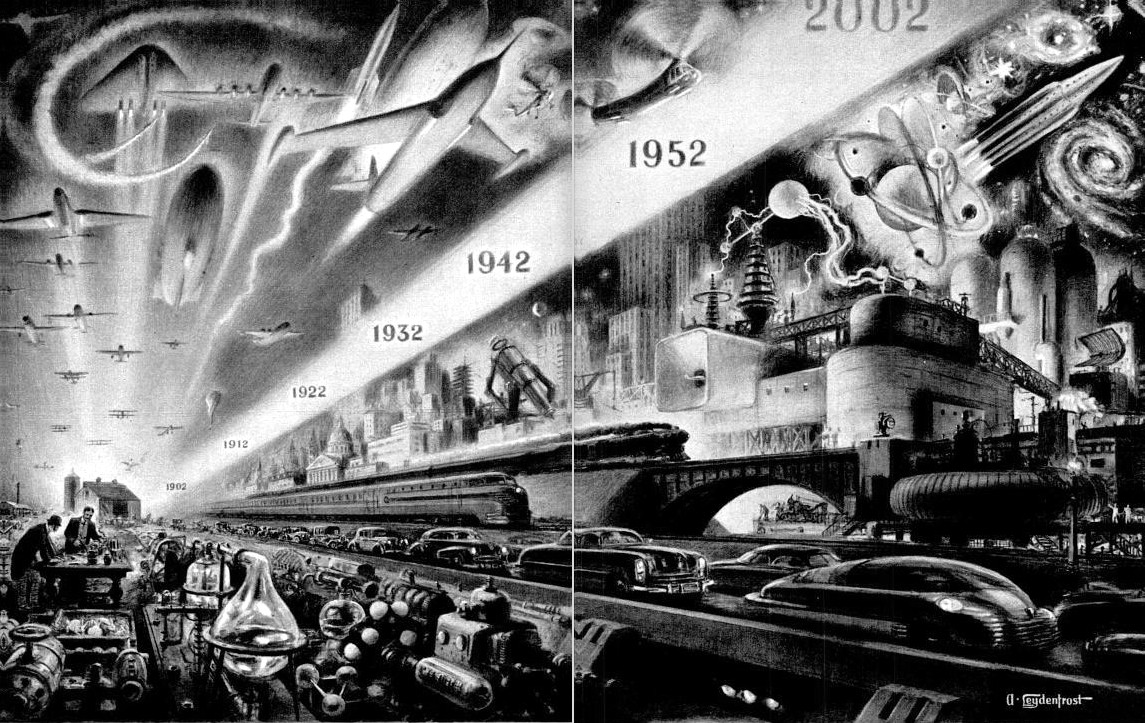
Consider the image below. It was created in 1952 by Alexander Leydenfrost for the 50th anniversary issue of Popular Mechanics.

Alexander Leydenfrost - March of Science 3WifC

I thought of this image as I read Thomas Misa’s brief discussion of the wide-spread perception that the pace of technological change is ever-quickening. “At least since Alvin Toffler’s best-selling Future Shock (1970),” Misa writes, “pundits perennially declare that the pace of technology is somehow quickening and that technology is forcing cultural changes in its wake, that our plunge into the future is driven by technology gone out of control.”

Misa, a historian of technology, is not altogether certain that the pace of technological change has in fact quickened. He is certainly opposed to the “crude technological determinism” inherent in the idea that technology is forcing cultural changes. He does, however, give merit to the experience that is often described using this language. He attributes the perception of quickening to “a split between our normative expectations for technology and what we observe in the world around us.” “It is not so much that our technologies are changing especially quickly,” he explains, “but that our sense of what is ‘normal,’ about technology and society, cannot keep pace.”

According to Misa, developments in cloning, biotechnology, surveillance technologies, and nanotechnology are outstripping regulatory laws and ethical norms. This seems true enough. We might even describe the condition of modernity (and/or post-modernity, or hyper-modernity, or reflexive modernity, or whatever) as one of perpetual Promethean shock. This way of putting it seems more apt than “future shock.” One way of telling the story of modernity, after all, is to order it as a series of startling realizations of what we suddenly acquired the power to do. As Auden wrote of the modern Mind,

“Though instruments at Its command
Make wish and counterwish come true,
It clearly cannot understand
What It can clearly do.”

Clearly certain technological innovations yield this dizzying experience of Promethean shock more than others. The advent of human flight, the atomic bomb, and putting a man on the moon are just some of the more simultaneously startling, awe-inspiring, disconcerting examples. When these technologies arrived, in rather quick succession, they rattled and unsettled reigning cultural and moral frameworks, tacit as they may have been, for incorporating new technologies into existing society.

These normative cultural expectations for technology were set, Misa suggests, during the “longer-duration ‘eras'” of technology which he identifies in his history of the relationship between technology and culture. These eras included, for example, the age of the Renaissance, when the demands of Renaissance court culture set the agenda for technological change, and the age of imperialism, when the imperatives of empire dictated the dominant agenda. The former era, in Misa’s analysis, spanned nearly two centuries, and the latter the better part of one; but the 20th century is home to at least four different eras, which Misa labels the eras of systems, modernism, war, and global culture respectively.

Misa is on to something here, but he seems to push the question back rather than answering it directly. Why then are these eras, tentative and suggestive as he acknowledges them to be, getting progressively shorter? He is closer to the mark, I think, when he also suggests that the sense of quickening is linked to another “quickening” in  the “self-awareness of societies,” which he further defines as “our capacities to recognize and comprehend change.”

His brief illustration of this development is initially compelling. Two centuries elapsed before the Renaissance was named. Within 50 years of the appearance of factories in Manchester, the phrase industrial revolution was in usage. Just four years after the telephone arrived in Moscow, Chekhov published a short story, “On the Telephone,” about the travails of an early adopter trying to make a restaurant reservation over the phone (fodder for a Seinfeld plot, if you ask me). Most recently, William Gibson gives us the term cyberspace “almost before the fact of cyberspace.” This sequences suggests to Misa that Western society has become increasingly self-aware of technological change and its consequences.

I think this claim has merit. The Modern mind that, according to Auden “cannot understand/what it can clearly do” he described as the “self-observed, observing Mind.”  But, again, we might be tempted to ask why our “self-awareness” is accelerating in this way. Might it not be attributed, at least in part, to an increase in the rapidity of technological development? The two seem inseparable. I’m reminded of Walter Ong’s dictum about writing: “Writing heightens consciousness.” In a slightly different way, might we not argue that technological change heightens societal self-awareness?

Consider again that Leydenfrost image above. It captures an important aspect of how we’ve come to understand our world: we have aligned our reckoning of the passage of time with the development of technology. We have technologies that mark time, but in another sense the advent of new technologies mark time by their appearance, iteration, and obsolescence.

Human beings have long sought markers to organize the experience of time, of course. For a day sunrise and sunset served just fine. The seasons, too, helped order the experience of a year. For longer periods, however, cultural rather than natural markers were needed. Consider, for instance, the common practice in the ancient world of reckoning time by the reigns of monarchs. “In the x year of so-and-so’s reign” is a recurring temporal formula.

Without achieving that sort of verbal formality or precision, I’d suggest that the development of technology–the reign, if you will, of certain technologies and artifacts–now does similar work for modern societies. Records, 8-tracks, tapes, CDs, MP3s. Desktops, laptops, tablets. Landline, portable landline, cellphone, smartphone. Black and white TV, color TV, projection TV, flatscreen TV. Pre-Internet/post-Internet. Dial-up/broadband/wireless. I suspect you can supply similar artifactual chronologies that have structured our recollection of the past. We seem to have synchronized our perception and experience of time to the cycles of technological innovation.

The Leydenfrost image also reminds us that insofar as the notion of progress exists at all today, it is clearly bound up with the advance of technology. All other forms of progress that we might imagine  or aspire to– moral, economic, social–these are subsumed under the notion of technological progress. For that reason, rumors or suggestions that technological innovation might be slowing down unnerve us. We need the next big thing  to keep coming on schedule, however trivial that next big thing might be, to distract us from our economic, political, and personal woes.

This was illustrated nicely by the minor tech-media freakout occasioned recently by a Christopher Mims’ piece at Quartz arguing that 2013 was a lost year for tech. It was received as a heretical claim, and it was promptly and roundly condemned. “I, too, constantly yearn for mind-blowing new tech,” Farhad Manjoo tells us in his reply to Mims before re-assuring us: “I think we’re witnessing the dawn of a new paradigm in machine-human cooperation: Combining machine intelligence with biological intelligence will always trump one or the other. Machines make us better, and we make machines better. There’s still hope for us. Welcome to the bionic future.”

The world may be falling apart around us, but we can bear it so long as we can project our hopes on the amorphous promise of technological advance. The prospect of a host of Promethean shocks that we seemed poised to receive–from drones, robotics, AI, bioengineer, geo-engineering, nanotechnology–makes us nervous, they unsettle our moral frameworks; but their absence would worry us more, I suspect.


The Intellectual Virtues

I commend to you Alan Jacobs’ recent musings on thinking, or more precisely on “having ideas worth expressing.” Jacobs encourages us to seek out intellectual encounters with the best and most serious proponents of traditions of thought other than our own. Such encounters will have several salubrious, although potentially uncomfortable consequences. For instance:

“If you seek out what’s strange to you in its better expressions, several things will happen. First of all, you’ll court being changed by the encounter, having your views altered, perhaps in significant ways. You’ll learn that the people who disagree with you are almost certainly, taken as a whole, morally and intellectually the equal of the people you agree with.”

That last lesson is crucial. The failure of public discourse is ultimately a moral failure. It is not, so far as I can tell, primarily a failure of reason, intellect, or logic (although, certainly, such failures also abound). It is a failure of humility, patience, and imagination. A failure, in other words, to recognize our own ignorance, to persevere in the pursuit of understanding one another, and to imagine a different way of looking at the world.

Jacobs closed his post with a lovely line from the philosopher and novelist Iris Murdoch:  “Love is the extremely difficult realization that something other than oneself is real.”

I’ll add to that this complimentary passage from Murdoch’s, The Sovereignty of the Good, which I stumbled upon some time ago:

“I am confronted by an authoritative structure which commands my respect. The task is difficult and the goal is distant and perhaps never entirely attainable. My work is a progressive revelation of something which exists independently of me…. Love of Russian leads me away from myself towards something alien to me, something which my consciousness cannot take over, swallow up, deny or make unreal. The honesty and humility required of the student — not to pretend to know what one does not know — is the preparation for the honesty and humility of the scholar who does not even feel tempted to suppress the fact which damns his theory.”

Murdoch is here reflecting on the task of learning a foreign language, but what she has to teach us in this passage applies just as well to learning from others more generally. Central to the passage is that same notion of love as that which leads us out of ourselves. Notice as well what is required of the student: honesty and humility. The life of the mind, especially when it concerns itself with our common experience — which is to say with our life together, with our political life — depends on virtue for its success.

But it is, as Jacobs points out, a risky business to humbly and honestly seek out such encounters with those who do not agree with us. We risk a discomforting and disorienting loss of certainty. We risk a challenge to beliefs and convictions that we’ve long held dear. And so it is not just a matter of humility and honesty, but also of courage.

Of course, there is an even greater risk involved. James Schall put it this way:

“Chesterton once said, in a memorable phrase of which I am inordinately fond, that there is no such thing as an uninteresting subject, only uninterested people. Nothing is so unimportant that it is not worth knowing. Everything reveals something. Our minds cannot fully exhaust the reality contained in even the smallest existing thing. The condition of our being human, then, is the risk of not knowing something worth knowing.”