If Nostalgia Is a Desire, What Does It Long For?

When we’re not using nostalgia as a term of derision, we use it to name a twinge in the gut that somehow blends melancholic longing with happy recollection. When this experience becomes acute it may best be described, pardon the unseemly melodrama, as an ache in the soul, but one that is not without its consolations.

But first, about that derisiveness. Nostalgia is a fighting word. For instance, one of the easiest ways to dismiss a claim is to label it nostalgic. This is why, in fact, I’m thinking of adding “knee-jerk recourse to nostalgia as a term of derision” to the list of Borg Complex symptoms. No doubt, much of what gets labeled nostalgic should be dismissed, although perhaps not simply by attaching a label to it. At best, then, we allow ourselves to indulge in the distractions of nostalgia–a little Mad Men, a little Downton–so long as we maintain the appropriate degree of ironic detachment.

I remain curious, though, about the feeling itself and what evokes it. It is one thing to critically analyze the commodification of nostalgia and its deployment as a marketing tool, for example, and it is another thing to contemplate that moment when we experience the feeling we label nostalgia, particularly in its more acute manifestations, and seek its sources.
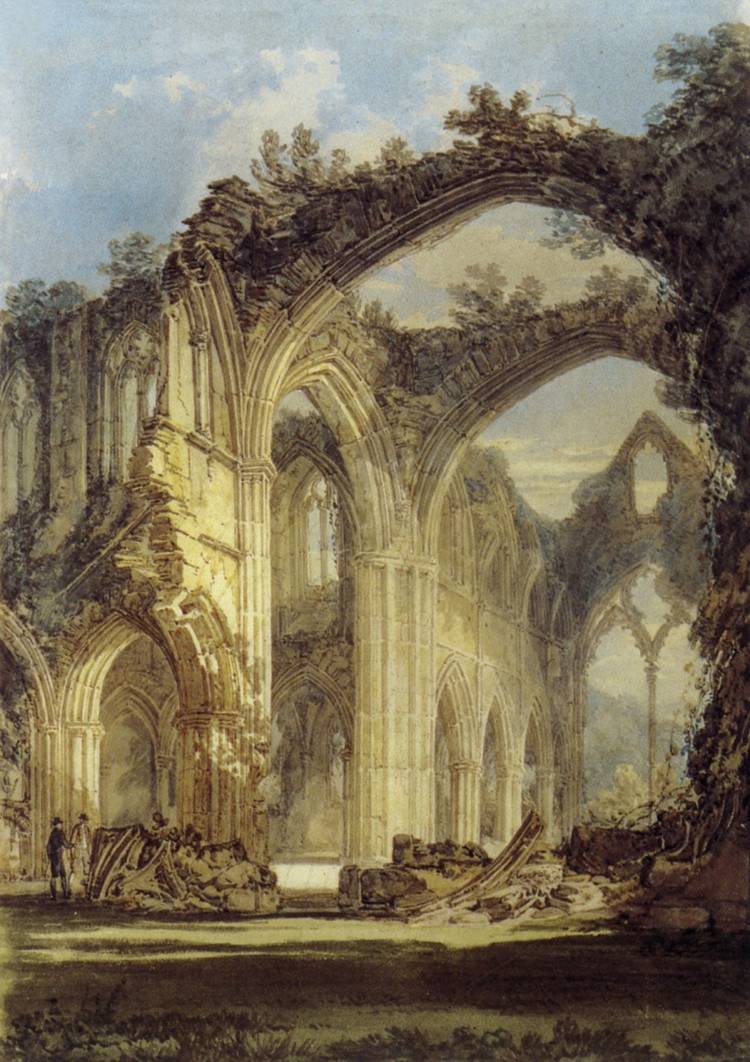
Tintern Abbey, JMW Turner, 1794. Wikimedia Commons.

Part of what puzzles me about such experiences is how difficult it is , for me at least, to define what exactly one is feeling. But before I go any further, it might be useful for you to recall for yourself a time when you experienced nostalgia. I don’t assume that everyone has had such an experience, but, if you have, try to hold that moment in mind and think with me about how we might understand it. Here are a few lightly structured thoughts toward that end.

The thing that arouses nostalgia is a synecdoche for the past and a signal of our dislocation; it is a reminder of our finitude, for we cannot horde time.

But is nostalgia for the past? We know that nostalgia was originally a word that described intense homesickness, but today we think of it more as a longing for a time rather than a place. So which is it? Is it really or always “pastness” that evokes the feeling we call nostalgia? I wonder, too, if these are not always present together. I think of Wordsworth’s “Lines Written a Few Miles above Tintern Abbey,” which begins with

“Five years have past; five summers, with the length
Of five long winters!”

and continues by describing the place around the abbey. It would be hard to abstract, in more than a theoretical way, the aspects of time and place from Wordsworth’s nostalgic meditations.

Maybe it is really neither place nor time that is the essence of the experience of nostalgia. Maybe place and time have been proxies for some other object of desire whose presence radiates from  them and through our memory to us.

Nostalgia, then, is just another word for desire, or, perhaps better, it is one of the shapes desire takes. That’s what gives it its ache-in-the-soul quality. But what is it a longing for, if not for a time or for a place?

Wordsworth gives us a hint when he notes that he was

“changed, no doubt, from what I was when first
I came among these hills.”

I am scattered through time, as are you. One way of thinking about the divided, de-centered, shattered self is to see it as a temporal phenomenon, as a function of our time-stretched nature. I have been; I am; I will be. The self may feel most coherent in the present moment, on the leading edge of time, but it is scattered throughout the past.

We can imagine it as a boat and its wake. Seen from above, the wake is widest, and most diffuse, at its farthest from the boat. We are that boat making its way inexorably onward on the sea of time, but we are also the wake with the detritus of the self strewn upon it.

Nostalgia, from this perspective, is a desire for the self, for self-possession, for all of the selves we have been. The desire is kindled when our present self tunes in to traces of our past self. That tuning might be occasioned by an object, an image, a melody, a smell, and, yes, a place. But it is not any of those things which we desire, it is that part of our self that existed with them. The objects and experiences that evoke nostalgia are synecdoches not for a time but for the self.

Nostalgia then is ultimately a desire for wholeness. It is a desire to horde, not time, but rather the fullness of our self, scattered across time; a desire to lose nothing of our selves, to hold, at once, all that we have been. That, of course, is an impossible object of desire, which is why nostalgia vocalized is a sigh.

But Wordsworth once more:

“That time is past,
And all its aching joys are now no more,
And all its dizzy raptures. Not for this
Faint I, nor mourn nor murmur; other gifts
Have followed; for such loss, I would believe,
Abundant recompense.”

______________________________

Further reading:

Consuming Traditions: Modernity, Modernism, and the Commodified Authentic 

The True and Only Heaven: Progress and Its Critics

Walter Ong on Romanticism and Technology

The following excerpts are taken from an article by Walter Ong titled, “Romantic Difference and Technology.” The essay can be found in Ong’s Rhetoric, Romance, and Technology: Studies in the Interaction of Expression and Culture.

Ong opens by highlighting the lasting significance of the Romantic movement:

“Romanticism has not been a transient phenomenon. Most and perhaps even all literary and artistic, not to mention scientific, movements since the romantic movement appear to have been only further varieties of romanticism, each in its own way.”

He follows by characterizing subsequent literary and cultural movements as variations of romanticism:

“Early Victorian is attenuated romantic, late Victorian is recuperated romantic, fed on Darwin, Marx, and Comte, the American frontier and the American Adam are primitivist romantic, imagism and much other modern poetry is symbolist romantic, existentialism is super-charged or all-out romantic, programmatic black literature is alien-selfhood romantic, and beatnik and hippie performance is disenfranchized [sic] romantic. Insofar as it is an art form or a substitute for literature, and in other guises, too, activism is most certainly idealist romantic.”

Here is how Ong construes the link between Romanticism and technology, specifically technologies of the word:

“Romanticism and technology, as we shall be suggesting, are mirror images of each other, both being products of man’s dominance over nature and of the noetic abundance which had been created by chirographic and typographic techniques of storing and retrieving knowledge and which had made this dominance over nature possible.”

In other words, print acted as a kind of safety-net that encouraged intellectual daring, both technologically and literarily. This hypothesis depends upon Ong’s understanding of thought and knowledge in oral cultures. The first sentence is about as close to Ong in a nutshell as you’re going to get:

“Any culture knows only what it can recall. An oral culture, by and large, could recall only what was held in mnemonically serviceable formulas. In formulas thought lived and moved and had its being. This is true not only of the thought in the spectacularly formulary Homeric poems but also of the thought in the oratorically skilled leader or ordinarily articulate warrior or householder of Homeric Greece. In an oral culture, if you cannot think in formulas you cannot think effectively. Thought totally oral in implementation has specifically limited, however beautiful, configurations. A totally oral folk can think some thoughts and not others. It is impossible in an oral culture to produce, for example, the kind of thought pattern in Aristotle’s Art of Rhetoric or in any comparable methodical treatises….”

Here are some highlights of what follows for Ong:

“A typical manifestation of romanticism on which we have focused is interest in the remote, the mysterious, the inaccessible, the ineffable, the unknown. The romantic likes to remind us of how little we know. If we view romanticism in terms of the development of knowledge as we are beginning to understand this development, it is little wonder that as a major movement romanticism appeared so late. From man’s beginnings perhaps well over 500,000 years ago until recent times […] knowledge had been in short supply. To keep up his courage, man had continually to remind himself of how much he knew, to flaunt the rational, the certain, the definite and clear and distinct.”

Further:

“Until print had its effect, man still necessarily carried a heavy load of detail in his mind [….] With knowledge fastened down in visually processed space, man acquired an intellectual security never known before [….] It was precisely at this point that romanticism could and did take hold. For man could face into the unknown with courage or at least equanimity as never before.”

Finally:

“[…] romanticism and technology can be seen to grow out of the same ground, even though at first blush the two appear diametrically opposed, the one, technology, programmatically rational, the other, romanticism, concerned with transrational or arational if not irrational reality [….] romanticism and technology appear at the same time because each grows in its own way out of a noetic abundance such as man had never known before. Technology uses the abundance for practical purposes. Romanticism uses it for assurance and as a springboard to another world.”

This strikes me as a bold and elegant thesis. Does it hold up? Ong paints with some broad strokes, and particularly where he discusses what oral culture could and could not have thought we may want to consider how sure we could ever be of such a claim. That said, Ong’s thesis naturally encourages us to explore what transformations of thought and culture are encouraged by digital archives, databases, and artificial memories.

More on Ong: “Memory, Writing, Alienation.”


You can subscribe to The Convivial Society, my newsletter about technology and society,  here.

Feenberg’s Rational Critique of Rationality

In his attempt to work out a “rational critique of rationality,” philosopher Andrew Feenberg blends Frankfurt School critical theory with science and technology studies and a sprinkling of Weberian rationalization theory. The result is the articulation of a framework for understanding structural similarities among the development of technology, technological systems, and systems of rationality.

The concept of instrumentalization plays a crucial role in Feenberg’s critique. Here Feenberg describes the initial stage of instrumentalization:

“The initial insight that opens up an object to incorporation into a rational system presupposes two conceptual operations. First the object must be decontextualized, split off from its original environment. And second, it must be reduced or simplified to bring to prominence just those aspects that can be functionalized in terms of a goal. These operations describe the original imaginative relation to the world in which affordances are identified that expose objects and persons to technization, commodification, and bureaucratic control. This vision plays out in actions that exhibit a decontextualizing and reductive aspect. For example, a tree in the forest is situated in a specific place and an ecological niche but to become lumber it must be removed and stripped of its complex connections to other living things and the earth. A person enters the purview of a bureaucracy as a ‘case,’ abstracted from the totality of a life process and simplified of extraneous elements. Goods become commodities through an interpretation which strips them bare of human connections and throws them into circulation. ‘In short, rationalization might be defined as the destruction or ignoring of information in order to facilitate its processing’ (Benziger, 1986: 15).”

What has been abstracted and decontextualized must then be reintegrated:

“Before it can be developed as a working artifact, the decontextualized object must be placed in the context of pre-existing devices and systems. ‘Systematization,’ as I call this process, links the artifact or system to its technical and natural environment, for example, to the prevailing electrical voltage and weather conditions. In addition, the reductions it has undergone must be compensated by new mediations drawn from the ethical and aesthetic registers of the society in which it is to function. Legal, moral, and aesthetic constraints intervene in the design and production process, determining an artifact capable of entering a specific social world.”

Feenberg describes these two stages as primary and secondary instrumentalization. You can read the whole article here: “From Critical Theory of Technology to the Rational Critique of Rationality.”

Two Introverts On The Internet

Paul Fidalgo wonders about the relationship between extroversion and the disconnectionists, the label he borrows from Nathan Jurgenson for those who advocate periods of disconnection from the Internet. Like Jurgenson, Fidalgo is annoyed by what he takes to be the self-righteous tone of the disconnectionists, but he also links his complaint to the opportunities for expression the Internet offers introverts like himself:

Online I’ve found a taste of liberation. Not only do I feel more free to expound upon all manner of subjects, to make dumb jokes, and to promote myself with a sincerity I could never muster in meatspace, but perhaps more importantly, I more often feel at ease in simply explaining things about myself as a person, to talk about my kids and my day-to-day life, to unpack some of the mundane stuff as well as the heavier things. Behind the screen, at the keyboard, at the flick of the scrolling display, even in the midst of the cacophony of the Internet, I can communicate without so much of the same noise within my own mind, where each synapse second-guesses the next.

I can relate to Fidalgo’s introversion, and I can understand where Fidalgo’s is coming from when he raises the following possibility in his conclusion:

I’d be curious to know whether many or most of the folks who espouse disconnection are extroverts, if they are biased by their own inclination toward revitalization through in-person human contact, all within a “real world” already largely constructed around extroverted predilections. If I’m on to something, well then of course they see the online life as valueless, or as phony. It doesn’t serve their own needs. But for me, and I suspect for my kind, the Web is the means of expression, the gateway into general society, that we’ve been waiting for. We’re damn lucky it came about it our lifetimes, and you better believe that for us, it’s real life.

Well, I can offer myself to Fidalgo as one point of anecdotal evidence: I espouse certain forms of disconnection, and I am decidedly not an extrovert. Without calling Fidalgo’s experience into question, I’ve sometimes felt that my disconnectionist impulses stemmed in part from my own introversion. I’ve also linked my inability to be at ease on Twitter directly to my introversion. That is to say, I sometimes find using Twitter to be as draining an experience as navigating a crowded and unfamiliar social setting.

Again, this is not to discount or challenge Fidalgo’s experience; it’s only to offer a contrasting one.

Perhaps talk of introversion and extroversion, conceptually fuzzy categories to begin with is not the only or best way of describing whatever dynamic is at play here. Zeynep Tufekci , for instance, invites us to consider the possibility of a condition she calls cyberasociality:

It remains a possibility that there are people for whom text is unable to evoke the same deep reaction embodied physically co-present interaction arouses. Such an inability, or an unwillingness, could be seen akin to another modern ailment, that of dyslexia (Wolf, 2007). The ability to convert alphabetical symbols to words, and then to seamlessly convert those words into meanings, is one of the more remarkable feats of the human brain and is mastered by most who are given persistent and competent instruction. However, for some segment of the population, this leap may remain unattainable and pose great difficulty even though the person in question may not suffer from any other disadvantage such as technological incompetence or inability or fear of using computers for instrumental purposes.

Whatever causes dyslexia, it would not have been detectable in a pre-literate population as among such people, words are always and only just sounds. In fact, linguists often caution against our tendency to equate words with letters and remind us that language is primarily aural and the transition to visual language is a late development. (Ong, 2004). Dyslexia emerges as a disadvantage only as a society incorporates the ease of use of the written word into the expected competencies into its portfolio, similarly, the increasing incorporation of online-sociality may expose a segment of the population that is similarly disadvantaged from being able to use these technologies as effectively as others.

Thus, conceptually, I propose a modern condition, named cyberasociality, which represents the possibility that some segment of the population remain unable or unwilling to relate to others via social media as they do when physically-present; and that this is not necessarily related to their general levels of sociality or to their competence with or use of computers or similar digital devices.

It seems to me that Tufekci is on to something important. In any case, I’m not sure why we would privilege either connection or disconnection in abstraction. Decisions about Internet use should be responsive to any number of shifting internal and external variables. While negotiating digital culture, it seems best to keep all options on the table, including the practice of disconnection … sans self-righteousness, of course.

“Of course” It Rarely Is

We half-consciously navigate our way through life by the light of what we take for granted, by beliefs that, if articulated, would be prefaced with “of course.”

“Of course, the world is this way.”

“Of course, people are this way.”

“Of course, I am this way.”

But where do these “of course” assumptions come from? Their force, their compelling “of course” status, is proportionally related to the difficulty of answering this question. Actually, their force derives from the unlikelihood of our ever even formulating the question in the first place. We do not ordinarily think about these assumptions, we think with them. 

These “of course” assumptions are rooted in the shadowy borderland between conscious and unconscious thought. They were, for the most part, formed in childhood and we were unaware that they were taking shape.They envelop us. 

Occasionally though, their contours appear to us fleetingly, like the outlines of a cloud that becomes visible at night when it is shot through with lightning. That flash of insight may be just enough to quicken our imagination, weaken the hold of the “of course,” and illuminate new possibilities. Such intellectual flashes are among the great pleasures of the life of the mind, even though they may sometimes mingle terror with their beauty. 

We cannot do without the assumptions that structure thought. We cannot, in other words, imagine the world anew each time that we try to think at all. But it is good to remember, for humility’s sake, that our assumptions are there, like the unseen cloud against the night sky, unseen yet shaping what we see. And we should welcome the lightning when it strikes.