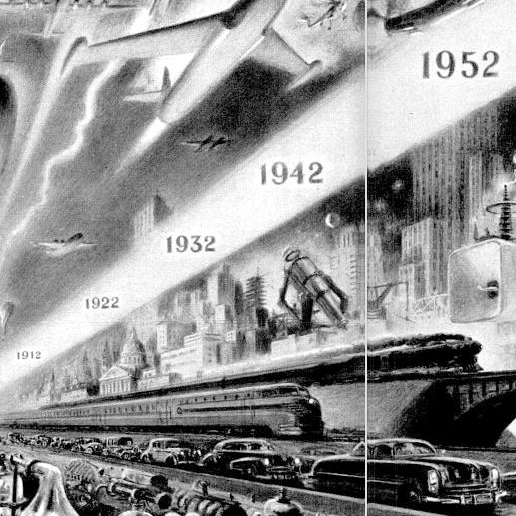
Choice and the Machine

“Choice manifests itself in society in small increments and moment-to-moment decisions as well as in loud dramatic struggles; and he who does not see choice in the development of the machine merely betrays his incapacity to observe cumulative effects until they are bunched together so closely that they seem completely external and impersonal. No matter how completely technics relies upon the objective procedures of the sciences, it does no form an independent system, like the universe: it exists as an element in human culture and it promises well or ill as the social groups that exploit it promise well or ill. The machine itself makes no demands and holds out no promises: it is the human spirit that makes demands and keeps promises. In order to reconquer the machine and subdue it to human purposes, one must first understand it and assimilate it. So far, we have embraced the machine without fully understanding it, or, like the weaker romantics, we have rejected the machine without first seeing how much of it we could intelligently assimilate.

The machine itself, however, is a product of human ingenuity and effort: hence to understand the machine is not merely a first step toward re-orienting our civilization: it is also a means toward understanding society and toward knowing ourselves.”

Lewis Mumford in the introduction to Technics and Civilization (1934).

Love’s Labor Outsourced

On Valentine’s Day, The Atlantic’s tech site ran a characteristically thoughtful piece by Evan Selinger examining a new app called Romantimatic. From the app’s website:

Even with the amazing technology we have in our pockets, we can fly through the day without remembering to send a simple “I love you” to the most important person in our lives.

Romantimatic can help.

It can help by automatically reminding you to contact the one you love and providing some helpful pre-set messages to save you the trouble of actually coming up with something to say.

Selinger has his reservations about this sort of “outsourced sentiment,” and he irenically considers the case Romantimatic’s creator makes for his app while exploring the difference between the legitimate use “social training wheels” and the outsourcing of moral and emotional responsibility. I encourage you to read the whole thing.

“What’s really weird,” Selinger concludes, “is that Romantimatic style romance may be a small sign of more ambitious digital outsourcing to come.”

That is exactly right. Increasingly, we are able to outsource what we might think of as ethical and emotional labor to our devices and apps. But should we? I’m sure there are many for whom the answer is a resounding Yes. Why not? To be human is to make use of technological enhancements. Much of our emotional life is already technologically mediated anyway. And so on.

Others, however, might instinctively sense that the answer, at least sometimes, is No. But why exactly? Formulating a cogent and compelling response to that question might take a little work. Here, at least, is a start.

The problem, I think, involves a conflation of intellectual labor with ethical/emotional labor. For better and for worse, we’ve gotten used to the idea of outsourcing intellectual labor to our devices. Take memory, for instance. We’ve long since ceased memorizing phone numbers. Why bother when our phones can store those numbers for us? On a rather narrow and instrumental view of intellectual labor, I can see why few would take issue with it. As long as we find the solution or solve the problem, it seems not to matter how the labor is allocated between minds and machines. To borrow an old distinction, the labor itself seems accidental rather than essential to the goods sought by intellectual labor.

When it comes to our emotional and ethical lives, however, that seems not to be the case. When we think of ethical and emotional labor, it’s harder to separate the labor itself from the good that is sought or the end that is pursued.

For example, someone who pays another person to perform acts of charity on their behalf has undermined part of what might make such acts virtuous. An objective outcome may have been achieved, but at the expense of the subjective experience that would constitute the action as ethically virtuous. In fact, subjective experience, generally speaking, is what we seem to be increasingly tempted to outsource  When it comes to our ethical and emotional lives, however, the labor is essential rather than accidental; it cannot be outsourced without undermining the whole project. The value is in the labor, and so is our humanity.

____________________________________________

Further Reading

Selinger has been covering this field for awhile; here is a related essay.

I touched on some of these issues here.

Where Have All The Public Intellectuals Gone

“Professors, we need you!” announces the title of a Nicholas Kristof op-ed in the NY Times. Kristof goes on to lament the dearth of public intellectuals actively informing American culture regarding “today’s great debates.” Kristof blames this regrettable state of affairs on a series of predictable culprits: tedious academic writing, pressure to publish arcane scholarship in obscure journals, and hyper-specialized areas of research with little bearing on public life.

The responses I’ve read to Kristof’s column tend to grant that Kristof, almost despite himself, has put his finger on something, but go on to explain why his analysis is mostly flawed. Take as one example Corey Robin’s lengthy response: “Look Who Nick Kristof’s Saving Now.”

Part, but only part, of Robin’s response is to point to a host of intellectuals that would very much like to be public intellectuals and certainly have what it takes to fill that role admirably. He even speaks highly of grad students that are already making a name for themselves with timely, intelligent, well-written pieces on matters of public consequence.

And, indeed, many of us I’m sure could supplement Robin’s list of publicly engaged intellectuals. The problem as I see it is not a lack of intellectuals, it is the absence of a public.

To be clear, I don’t mean to suggest that there is not an intelligent reading public that craves informed, well-crafted pieces that bear on matters of public consequence. That may also be true, but I only believe it on my more cynical days. Of course, I won’t tell you what percentage of my days those cynical ones take up.

What I do mean by saying that there is no public may be better put by saying that there is no public sphere, and I mean this from a media ecological perspective. Our media ecosystem makes it easier than ever for intellectuals to make their work public, but harder than ever to achieve the status of public intellectual, i.e. someone who is both widely known and widely respected.

Kristof may or may not have had this in mind, but we might think of a public intellectual as someone who specializes in intellectual labor and makes that labor publicly accessible. If this is what we mean by public intellectuals, then, as Robins and other have pointed out, we’re surrounded by public intellectuals. The Internet is crawling with them. We might even say of public intellectuals what Jack says of clever people in “The Importance of Being Earnest”:

“I am sick to death of cleverness. Everybody is clever nowadays. You can’t go anywhere without meeting clever people. The thing has become an absolute public nuisance. I wish to goodness we had a few fools left.”

But 1,000 intellectuals writing publicly may not amount to a single public intellectual in the more traditional sense that Kristof has a hankering for. The more traditional sort of public intellectual, the one who is widely known, widely respected, and influential may simply have been a function of late print culture, a techno-cultural moment when the last ripples of Enlightenment ideals of rational and civil democratic discourse reached the public through newly-minted mass media. The proliferation of media outlets–the 400+ television stations, the countless forums and blogs and Internet magazines, Twitter, etc.–spawns niche markets and this makes it quite hard for someone to get the kind of audience and across-the-board respect that the title of public intellectual seems to suggest. When there were fewer gatekeepers of public opinion, and the remnants of a cultural consensus to work with, it would’ve been easier to achieve the status of public intellectual.

I realize that last paragraph trades in big generalizations and leaves out a whole host of factors. Feel free to pick it apart. I’ll leave aside all of the Postman-esque arguments you might imagine for yourself about our entertaining ourselves to death, etc. I’ll also leave aside the fact that a good deal of academic work in a variety of disciplines has been devoted to the critique of a universal public reason that the possibility of a public intellectual assumes.

One last thought: It may be that the craving for public intellectuals is a kind of nostalgic longing for a time when we could reasonably imagine that even though we ourselves couldn’t get an intellectual grip on the complexities of modern society, out there, somewhere, there were smart people at the controls. These mythical public intellectuals we long for were those whose cultural function was to reassure us with their calm, accessible, and smart talk that people who knew what they were doing were steering the ship.[1] I suspect the unnerving truth is that the trade-off for the benefits of an unfathomably complex technological society is the disquieting reality that understanding is now beyond the reach of any intellectual, public or otherwise. 

______________________________________

[1] The same function is served by the cabals of conspiracy theory dreams.

Traditions of Technological Criticism

Given how the word technology gets used and abused, we might sometimes be tempted to respond this way.

In fact, technology is a word we use all of the time, and ordinarily it seems to work well enough as a shorthand, catch-all sort of word. That same sometimes useful quality, however, makes it inadequate and counter-productive in situations that call for more precise terminology. See yesterday’s post for more on that.

The challenge lies in the difficulty of precisely defining what we mean by technology, but this wasn’t always the case. In fact, the word wasn’t commonly used at all until roughly the mid-20th century. See, for example, this Google ngram charting the use of the word technology from 1800 – 2000:

Google_Ngram technology

Ngrams aren’t perfect, for one thing they are limited to the books Google has managed to scan, but in this case I think it may give us a pretty good picture of what was actually the case. It certainly supports Langdon Winner’s claim that by the late ’70s “technology” had become a ubiquitous concern in a way it had not been before, say, World War II. Of course, this doesn’t mean that no one was talking about technology until roughly 1920 or so. There were other words or phrases that named the sort of stuff we would just dump in the category of technology. If you’re interested, Leo Marx’s article on the word technology gives a helpful summary of the semantic history of the concept.

Long before the word got both popular and complicated, though, it had a fairly straightforward sense. You can probably guess it by thinking of some similar words that we use with less ambiguity, words like biology, geology, and theology. The words are derived from Greek roots suggesting the study of a field or subject. In these three cases, the study of life, the earth, and God respectively.

Likewise, the word technology, derived from the Greek root techne meaning “craft” or “art,” originally suggested not the technical or mechanical artifacts themselves, but rather their study or the knowledge involved in their making. Winner, for example, cites Webster’s Second International dictionary published in 1909, which defines technology as “industrial science, the science of systematic knowledge of the industrial arts, especially of the more important manufactures.”

By 1961, however, Webster’s was defining technology as “the totality of means employed by a people to provide itself with the objects of material culture.”

One of the most comprehensive definitions I’ve seen lately comes from David Kaplan and runs to paragraph length:

“Technologies are best seen as systems that combine technique and activities with implements and artifacts, within a social context of organization in which the technologies are developed, employed, and administered. They alter patterns of human activity and institutions by making worlds that shape our culture and our environment. If technology consists of not only tools, implements, and artifacts, but also whole networks of social relations that structure, limit, and enable social life, then we can say that a circle exists between humanity and technology, each shaping and affecting the other. Technologies are fashioned to reflect and extend human interests, activities, and social arrangements, which are, in turn, conditioned, structured, and transformed by technological systems.”

This definitional bloat is a symptom of the technological complexity of modern societies. It is also a consequence of our growing awareness of the significance of what we make.

One interesting, somewhat whimsical way at getting at this complexity and at the pervasive place that technology occupies in modern societies might be to imagine that the earliest sense of the word technology persisted and that their existed a disciplined called Technology.

It would, I suggest, occupy the same place in our universities that Theology occupied in the medieval schools. It might even give substance to the claim implicit in the etymology of the word university by unifying the disparate disciplines and organizing the human experience around what we make rather than what we know, driven by material rather spiritual aims.

If we imagine that medieval society envisioned Theology as the pinnacle of a pyramid of human knowledge, unifying human experience by providing a transcendental goal from above, we might consider Technology instead as the base of the pyramid, the foundation upon which all else rested, providing unity from below.

Theology took as its object of study an unseen reality that permeated and ordered human experience and yet could never be fully understood. Analogously, Technology would take as its object of study a mostly seen reality that permeates and orders our experience which also resists our understanding. As St. Paul said of God, so we might say of technology: in it we move and breathe and have our being.

In fact, there is no one master discipline called Technology. While matters technological are threaded through every discipline to greater and lesser extents, these are never woven into any coherent theoretical fabric. Approaches to the study of technology also mirror the diversity of disciplines: historical, sociological, philosophical, economic, etc.

I’ve been thinking lately of laying out a taxonomy of sorts for the many approaches to technology, or the question concerning technology if you like. This would be mostly for my benefit, although I imagine others might find it useful. Consider it a heuristic that might introduce one to the field of technology studies (not that there is something quite so coherent that encompasses all of the theorists/thinkers/writers I have in mind).

I’m struggling to find the best organizational schema. Academic disciplines or fields of study might work, but I’m leaning toward loosely defined schools or traditions of thought that may not necessarily overlap with disciplinary boundaries. The richest explorations of technology, after all, tend not to abide traditional disciplinary boundaries. Take someone like N. Katherine Hayles, for example, who’s background includes both computer science and literary studies and ranges in her work from deep readings of cyberpunk fiction to in-depth discussions of mid-20th century cybernetic theory.

Eventually, I’d like to identify the leading representatives of these schools of tech criticism, along with their key ideas and concepts, a history of their development, etc., but to wrap up this meandering post I’m going to list a few of the schools of tech criticism that I’ve been toying around with and leave it to you, if you are so inclined, to help me refine my categories, fill in my blind spots, and otherwise improve my organizational schema.

Again, the object here is to find a useful way of grouping, for purely heuristic purposes, a diverse field of scholars and writers that includes Martin Heidegger, Albert Borgmann, Langdon Winner, Jacques Ellul, Walter Ong, David Nye, Karl Marx, Michel Foucault,  Walter Benjamin, Neil Postman, Katherine Hayles, Lewis Mumford, Leo Marx, Donna Haraway, Marshall McLuhan, Herbert Marcuse, Carl Mitcham, Don Ihde, Bruno Latour, Andrew Feenberg, David Noble, and the list could go on. It is, to say the least, an eclectic field.

So here is my first attempt with a few examples to give you an idea of what I’m thinking with each grouping:

Media-critical tradition including Ong, Postman, and McLuhan.

Critical-theoretical tradition including Frankfurt Schoolers (better than Frankfurters, no?) and their heirs such as Benjamin, Adorno, Marcuse, Habermas, and Feenberg.

Phenomenological tradition including Heidegger, Borgmann, and Ihde.

Autonomous Technology tradition including Winner and Ellul.

Posthumanist tradition including Hayles and Haraway.

Social Constructivist tradition including Nye and Thomas Hughes.

I can see a lot of problems with this first offering, but it’s a start. Here are some questions to consider for take two: Does Actor-Network Theory get its own category? What about the journalistic critics (and I don’t mean that disparagingly) such as Nicholas Carr or Alexis Madrigal? What about someone like Sherry Turkle? Is there grounds for a psycho-analytic tradition? Where does someone like Mumford fit in? Or Leo Marx? Could there be a French tradition that might include both Foucault and Ellul? What about a literary-poetic tradition?

Suggestions welcome.

What Are We Talking About When We Talk About Technology?

I’ve been of two minds with regards to the usefulness of the word technology. One of those two minds has been more or less persuaded that the term is of limited value and, worse still, that it is positively detrimental to our understanding of the reality it ostensibly labels. The most thorough case for this position is laid out in a 2010 article by the historian of technology Leo Marx, “Technology: The Emergence of a Hazardous Concept.

Marx worried that the term technology was “peculiarly susceptible to reification.” The problem with reified phenomenon is that it acquires “a ‘phantom-objectivity,’ an autonomy that seems so strictly rational and all-embracing as to conceal every trace of its fundamental nature: the relation between people.” This false aura of autonomy leads in turn to “hackneyed vignettes of technologically activated social change—pithy accounts of ‘the direction technology is taking us’ or ‘changing our lives.’” According to Marx, such accounts are not only misleading, they are also irresponsible. By investing “technology” with causal power, they distract us from “the human (especially socioeconomic and political) relations responsible for precipitating this social upheaval.” It is these relations, after all, that “largely determine who uses [technologies] and for what purposes.” And, it is the human use of technology that makes all the difference, because, as Marx puts it, “Technology, as such, makes nothing happen.”[1]

As you might imagine, I find that Marx’ point compliments a critique of what I’ve called Borg Complex rhetoric. It’s easier to refuse responsibility for technological change when we can attribute it to some fuzzy, incohate idea of technology, or worse, what technology wants. That latter phrase is the title of a book by Kevin Kelly, and it may be the best example on offer of the problem Marx was combatting in his article.

But … I don’t necessarily find that term altogether useless or hazardous. For instance, some time ago I wrote the following:

“Speaking of online and offline and also the Internet or technology – definitions can be elusive. A lot of time and effort has been and continues to be spent trying to delineate the precise referent for these terms. But what if we took a lesson from Wittgenstein? Crudely speaking, Wittgenstein came to believe that meaning was a function of use (in many, but not all cases). Instead of trying to fix an external referent for these terms and then call out those who do not use the term as we have decided it must be used or not used, perhaps we should, as Wittgenstein put it, ‘look and see’ the diversity of uses to which the words are meaningfully put in ordinary conversation. I understand the impulse to demystify terms, such as technology, whose elasticity allows for a great deal of confusion and obfuscation. But perhaps we ought also to allow that even when these terms are being used without analytic precision, they are still conveying sense.”

As you know from previous posts, I’ve been working through Langdon Winner’s Autonomous Technology (1977). It was with a modicum of smug satisfaction, because I’m not above such things, that I read the following in Winner’s Introduction:

“There is, of course, nothing unusual in the discovery that an important term is ambiguous or imprecise or that it covers a wide diversity of situation. Wittgenstein’s discussion of ‘language games’ and ‘family resemblances’ in Philosophical Investigations illustrates how frequently this occurs in ordinary language. For many of our most important concepts, it is futile to look for a common element in the phenomena to which the concept refers. ‘Look and see and whether there is anything common to all.–For if you look at them you will not see something that is common to all, but similarities, relationships, and a whole series of them at that.'”

Writing in the late ’70s, Winner claimed, “Technology is a word whose time has come.” After a period of relative neglect or disinterest, “Social scientists, politicians, bureaucrats, corporate managers, radical students, as well as natural scientists and engineers, are now united in the conclusion that something we call ‘technology’ lies at the core of what is most troublesome in the condition of our world.”

To illustrate, Winner cites Allen Ginsburg — “Ourselves caught in the giant machine are conditioned to its terms, only holy vision or technological catastrophe or revolution break ‘the mind-forg’d manacles.'” — and the Black Panthers: “The spirit of the people is greater than the man’s technology.”

For starters, this is a good reminder to us that we are not the first generation to wrestle with the place of technology in our personal lives and in society at large. Winner was writing almost forty years ago, after all. And Winner rightly points out that his generation was not the first to worry about such matters either: “We are now faced with an odd situation in which one observer after another ‘discovers’ technology and announces it to the world as something new. The fact is, of course, that there is nothing novel about technics, technological change, or advanced technological societies.”

While he thinks that technology is a word “whose time has come,” he is not unaware of the sorts of criticisms articulated by Leo Marx. These criticisms had then been made of the manner in which Jacques Ellul defined technology, or, more precisely, la technique: “the totality of methods rationally arrived at and having absolute efficiency (for a given stage of development) in every field of human activity.”

Against Ellul’s critics, Winner writes, “While Ellul’s addition of ‘absolute efficiency’ may cause us difficulties, his notion of technique as the totality of rational methods closely corresponds to the term technology as now used in everyday English. Ellul’s la technique and our technology both point to a vast, diverse, ubiquitous totality that stands at the center of modern culture.”

It is at this point that Winner references Wittgenstein in the paragraph cited above. He then acknowledges that the way in which technology tends to be used leads to the conclusion that “technology is everything and everything is technology.” In other words, it “threatens to mean nothing.”

But Winner sees in this situation something of interest, and here is where I’m particularly inclined to agree with him against critics like Leo Marx. Rather than seek to impose a fixed definition or banish the term altogether, we should see in this situation “an interesting sign.” It should lead us to ask, “What does the chaotic use of the term technology indicate to us?”

Here is how Winner answers that question: “[…] the confusion surrounding the concept ‘technology’ is an indication of a kind of lag in public language, that is, a failure of both ordinary speech and social scientific discourse to keep pace with the reality that needs to be discussed.”There may be a better way, but “at present our concepts fail us.”

Winner follows with a brief discussion of the unthinking polarity into which discussions of technology consequently fall: “discussion of the political implications of advanced technology have a tendency to slide into a polarity of good versus evil.” We might add that this is not only a problem with discussion of the political implications of advanced technology, it is also a problem with discussions of the personal implications of advanced technology.

Winner adds that there “is no middle ground to discuss such things,” we encounter either “total affirmation” or “total denial.” In Winner’s experience, ambiguity and nuance are hard to come by and any criticism, that is anything short of total embrace, meets with predictable responses: “You’re just using technology as a whipping boy,” or “You just want to stop progress and send us back to the Middle Ages with peasants dancing on the green.”[2]

While it may not be as difficult to find more nuanced positions today, in part because of the sheer quantity of easily accessible commentary, it still seems generally true that most popular discussions of technology tend to fall into either the “love it” or “hate it” category.

In the end, it may be that Winner and Marx are not so far apart after all. While Winner is more tolerant of the use of technology and finds that, in fact, its use tells us something important about the not un-reasonable anxieties of modern society, he also concludes that we need a better vocabulary with which to discuss all that gets lumped under the idea of technology.

I’m reminded of Alan Jacobs’ oft-repeated invocation of Bernard Williams’s adage, “We suffer from a poverty of concepts.” Indeed, indeed. It is this poverty of concepts that, in part, explains the ease with which discussions of technology become mired in volatile love it or hate it exchanges. A poverty of concepts short circuits more reasonable discussion. Debate quickly morphs into acrimony because in the absence of categories that might give reason a modest grip on the realities under consideration the competing positions resolve into seemingly subjective expressions of personal preference and, thus, criticism becomes offensive.[3]

So where does this leave us? For my part, I’m not quite prepared to abandon the word technology. If nothing else it serves as a potentially useful Socratic point of entry: “So, what exactly do you mean by technology?” It does, to be sure, possess a hazardous tendency. But let’s be honest, what alternatives do we have left to us? Are we to name every leaf because speaking of leaves obscures the multiplicity and complexity of the phenomena?

That said, we cannot make do with technology alone. We should seek to remedy that poverty of our concepts. Much depends on it.

Of course, the same conditions that led to the emergence of the more recent expansive and sometimes hazardous use of the word technology are those that make it so difficult to arrive at a richer more useful vocabulary. Those conditions include but are not limited to the ever expanding ubiquity and complexity of our material apparatus and of the technological systems and networks in which we are enmeshed. The force of these conditions was first felt in the wake of the industrial revolution and in the ensuing 200 years it has only intensified.

To the scale and complexity of steam-powered industrial machinery was added the scale and complexity of electrical systems, global networks of transportation, nuclear power, computers, digital devices, the Internet, global financial markets, etc. To borrow a concept from political science, technical innovation functions like a sort of ratchet effect. Scale and complexity are always torqued up, never released or diminished. And this makes it hard to understand this pervasive thing that we call technology.

For some time, through the early to mid-twentieth century we outsourced this sort of understanding to the expert and managerial class. The post-war period witnessed a loss of confidence in the experts and managers, hence it yielded the heightened anxiety about technology that Winner registers in the ’70s. Three decades later, we are still waiting for new and better forms of understanding.

______________________________________

[1] I’m borrowing the bulk of this paragraph from an earlier post.

[2] Here again I found an echo in Winner of some of what I had also concluded.

[3] We suffer not only from a poverty of concepts, but also, I would add, from a poverty of narratives that might frame our concepts. See the end of this post.

Tip the Writer

$1.00