Deformance, Materiality, Theory

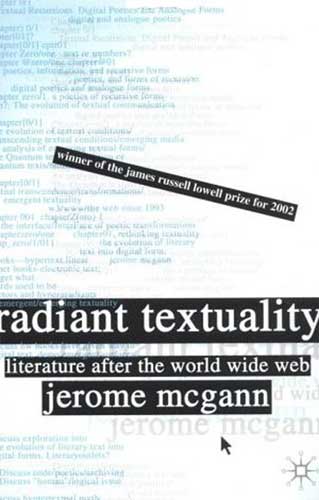
In radiant textuality, Mcgann introduces the practice of deformance by suggesting that it will help “break beyond conceptual analysis into the kinds of knowledge involved in performative operations.” (106)  As I understand him, Mcgann is reminding us that there is a kind of knowledge that cannot be “cast in thematic form.”  (106)  Interpretation that seeks to extract a meaning in thematic form assumes that meaning is something contained by the work of literature, let us say a poem for example, which can be sucked out and recast otherwise.  There is a place for such interpretative strategies, but they tend to ignore the knowledge embedded in the textuality/materiality of the poem that is acquired not by ratiocination but by performance.  This knowledge by its nature is difficult to articulate, but it is the kind of knowledge that deformance seeks to tap and the language of “intimacy” with a text gets at the sensuality of this knowledge.  This knowledge arises from the forming of the words with our mouths, the seeing of the words on the printed page (a seeing that is sharpened by distortion), the hearing of sounds made by the words (again sharpened by distortion), and even feeling the weight of the book in the hand.  To read the works backward or to displace or isolate elements of the text is a way of helping us see what ordinarily “escapes our scrutiny” (116) because with most interpreters we locate meaning not in the documentary features of the text but in a linguistic event. (115)  Mcgann’s dedication to John Unsworth, Deo Gratias, invites me to understand this almost as a kind of liturgical knowledge.

Referring to Dickinson’s backward reading as an example of the kind of performance that elicits this intimate knowledge, Mcgann suggests that this model is in a sense “antitheoretical: not because it is opposed to theory (i.e., speculative thought) but because it places theory in a subordinated relation to practice.”  (109)  This connects back to his earlier discussion of the “pragmatics of theory.”  (83)  There rather than equating theory with speculative thought, theory is distinguished from “hypothesis or speculation.”  Theory in this earlier case then is not what is being opposed by deformance when it is labeled antitheoretical.  Theory here is aligned with the kinds of knowledge that arise from performance/deformance because Mcgann envisions it as poiesis rather than gnosis.  This embodied knowledge that arises from making or performing “makes possible the imagination of what you don’t know” because it elicits knowledge from failure and also from serendipity.  (83)

My sense is that Mcgann sees this kind of knowledge that emerges out of the work of building something like the Rossetti Archive as a critical step toward envisioning what the digital humanities can be, but that he also is concerned that digitized texts will not be able to attain the capabilities of critical interaction with the materiality of our texts.  Or perhaps to put it differently, he is most concerned that forgetting what we have learned over centuries of interaction with material texts, we will fail to incorporate that knowledge into our emerging digital tools.
Escapes

C. S. Lewis was fond of saying that the only people opposed to escapes were jailers. In his classic essay, “On Fairy Stories,” Tolkien made the same point at greater length:

“Why should a man be scorned if, when finding himself in prison, he tries to get out and go home? Or, if when he cannot do so, he thinks and talks about other topics than jailers and prison walls? The world outside has not become less real because the prisoner cannot see it. In using Escape in this way the critics have chosen the wrong word, and, what is more, they are confusing … the Escape of the Prisoner with the flight of the Deserter.”

Why indeed?

Lewis and Tolkien, both best remembered for their works of fantasy, were each responding to the charge of writing escapist literature. But, what counts as escapism is a matter of perspective. From what is the escape? Lewis and Tolkien constructed their fantasy to offer an escape into the deepest reality. Is it possible that the structures and pace of our world chain us up in a kind of Platonic cave of ignorance, detached from what is true, good, and beautiful? If so, then escape is the very thing we should be hell-bent on achieving.

In “The Weight of Glory” Lewis evocatively describes the alluring and haunting appeal of beauty, but he is quick to remind us that beauty is not found in the moments, experiences, and objects that captivate us and fill us with wonder.

“These things—the beauty, the memory of our own past—are good images of what we really desire; but if they are mistaken for the thing itself they turn into dumb idols, breaking the hearts of their worshippers. For they are not the thing itself; they are only the scent of a flower we have not found, the echo of a tune we have not heard, news from a country we have never yet visited.”

The odd thing about beauty is that it is so often mixed with longing. Instead of leaving us satisfied, profound experiences of beauty can instead create a deep ache in our hearts. These encounters with beauty that momentarily overwhelm us are glimpses of life beyond the walls of the prison. But they are just that, glimpses. In Lewis’ view, and that of many others before him, beauty itself flows from God’s being through the created order. What we perceive then is a profound signal of God’s being beyond the created order and our taste of beauty beckons us to the source.

Lewis went on to observe that, “Almost our whole education has been directed to silencing this shy, persistent, inner voice; almost all our modem philosophies have been devised to convince us that the good of man is to be found on this earth.” And thus his efforts to remind us through the beauty of his art, that there is more; that the deep longing we feel for something we have never yet experienced is not a cruel trick played by impersonal cosmic forces, but the “truest index of our real situation.”

So perhaps art, literature, poetry, and films that offer us an escape from the ordinary and mundane are not so much pulling us out of the world, but rather helping us to see the world and our place in it more truly, more fully.

Manovich, Technology, and Culture

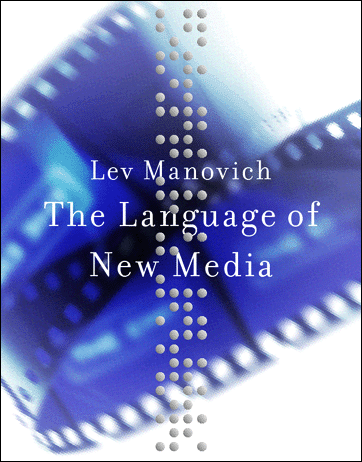
We are all of us immersed in a dense cultural web of which our identity is a reflection, and technology is an integral and formative component of this cultural web. In The Language of New Media, Lev Manovich signals as much when he reminds us that, “New media objects are cultural objects; thus, any new media object … can be said to represent, as well as help construct, some outside referent.” (15) The relationship is symbiotic – technology is a product of culture and at the same time it forms culture. It does this by influencing the way human beings interpret, or is it process, reality.

One place where culture and technology intersect quite significantly is in the metaphors we use to speak of the human mind or the human body. Notice, for example, that we are less likely to say that we “ran out of steam” (a decidedly industrial metaphor) than we are to say that we “crashed” (unless you are an Apple user in which case the “crash” metaphor is lost). We are also likely to speak of ourselves as having been “hardwired” or “programmed” for certain activities or tendencies. And we are more likely to say that we are “processing” an idea than we are to speak of “our wheels turning.” You can find a substantial database of metaphors for the mind drawn from the literary, philosophical and theological sources of the Western tradition at The Mind is a Metaphor.  These metaphors encourage us to understand ourselves in certain ways and not others. They influence the contours of our imagination. They may even lock us into certain patterns of thought and action – for example the algorithm as pattern for thought. What difference will it make, hypothetically, if the algorithm rather than the narrative is the patter of human thought? (225)

Manovich’s discussion of transcoding also explores this same interaction between culture and technology by pointing to two distinct layers of new media – the cultural layer and the computer layer. These two layers “influence each other,” or better yet, are “composited together.” The more cultural artifacts are transcoded into forms of new media and processed through computers, the more far-reaching the interaction of technology and culture. (46-47) In some respects I see this as an extension of Ong’s project. Ong sought to understand the way writing (and later its extension in print) shaped human consciousness and culture. Manovich is doing the same with new media.

At the macro level, Manovich tied the transition to new media with the move from an industrial to a post-industrial society. But what is the nature of the interaction? When, for example, “a computer – and computer culture in its wake – substitutes every constant with a variable” is this because postindustrial society has already encouraged every citizen to “construct her own custom lifestyle” or do these kinds of citizens arise from the programmability of new media?

More provocatively still, we can wrestle with Manovich’s question: “Do we want, or need, such freedom?”

Walter Ong on Orality and Literacy

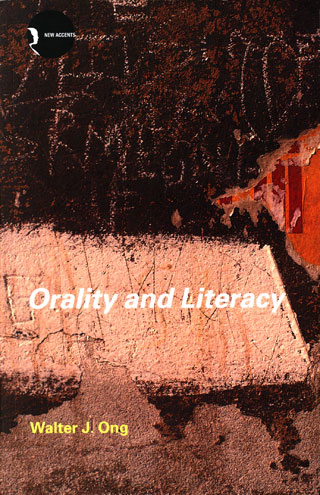
Walter Ong’s Orality and Literacy is something of a classic. It explores the changes in consciousness that have been wrought by the introduction of literacy and then print into human culture. The changes, according to Ong, have been momentous.

As I read Ong, I kept having what I will call Ong-moments. These are moments when one of his observations or arguments appears immediately useful in making sense of some phenomenon or is otherwise existentially reinforced by a certain experience.

In conversation with my wife a thought crystallizes; I quickly reach for something to write a quick summary of my thought before it evaporates, possibly never to be recaptured (31). How many thoughts and ideas are lost in oral cultures because there is no effective way of recording them?

Just now, I switch out a second use of “immediately” in favor of “quickly” in order to avoid redundancy (40). Redundancy was an accepted feature of oral cultures because there were simply fewer available words. Oral cultures operate with a vocabulary of roughly a few thousand words, while written English features well over a million words. Redundancy also functioned as an aide to memory in the absence of writing.

With each line I sense the agonizing quality of writing with no “real” audience (102). Oral discourse is always in the context of some real audience (notice how even the word audience is rooted in hearing). Writing is always for an absent audience (etymologically the word no longer works), and perhaps even an unknown audience. Furthermore, writing is deprived of all of the contextual aides to meaning provided by nonverbal communication and thus must develop an extreme precision to achieve clarity of meaning apart from these aides.

While reading Orality and Literacy I was struck by the concept of secondary orality (11, 136-138). Secondary orality describes a return to orality brought about primarily by the advent of radio and television. Because I am a teacher, my first thoughts turned to the question of how useful this category may be for understanding or contextualizing much of what teachers struggle against in their classrooms — shrinking vocabularies, choppy grammar, a seeming inability to reason through a problem, agonistic relationships, difficulty expressing thoughts and emotions, and the struggle to sustain attention, to name just a few. At some level, these seem to be characteristics of secondary orality. They are not necessarily the result of some innate deficiency in the students, nor are they necessarily the manifestations of laziness or apathy; rather they are the marks of those who have been shaped more by secondary orality than by print literacy. Too many of my students unashamedly report never having read a book.  They read other sorts of texts, but many are not at all familiar with the experience of sustained, solitary, silent reading.

On a slightly different but related note, if privacy is a concept or habit that flows out of a print culture and the isolation of private reading (among other factors), then does the distinction between the private and public necessarily evaporate in a society that has transitioned into secondary orality (130-131)? Is secondary orality behind the transition from diaries kept under lock and key to blogs published for the world to read? Critics point to blogs and social networking sites as products of narcissistic and self-absorbed selves. Perhaps so, but are they also features of selves no longer operating with the private/public categories fostered by print literacy?

You can read more about Ong at the Walter J. Ong Archive maintained by St. Louis University where Ong taught for over 3o years.