“Spiritual but not religious”

The Immanent Frame is hosting a discussion of Courtney Bender’s new book, The New Metaphysicals: Spirituality and the American Religious Imagination.  The book examines the belief and practices of a set of individuals living in Cambridge, Massachusetts who would classify as “spiritual but not religious,” an increasingly popular self-designation in the Western religious landscape.  Today’s post, “Working on individualism” by Joel Robbins, highlights perhaps the key theme of Bender’s book:

… the lack of sociological awareness these metaphysicals display does not mean that their beliefs and practices do not have histories, are not housed within institutions, and are not profoundly shaped by cultural patterns of thought and action that present-day practitioners did not in fact make up. Bender teaches us how to identify the hard social skeleton that makes possible even the very amorphous-seeming spirituality that the metaphysicals promote. She shows how their religious endeavors depend on various religious, medical, and arts organizations to give them space; on more or less established cultural models of phenomena such as past lives and subtle bodies to teach them what is possible by way of spiritual encounters; and on the shared narrative structures they use to make sense of their experiences to themselves and to one another. By rendering visible the social machinery of metaphysical spiritual lives, Bender makes those she studies finally social scientifically tractable. In doing so, she also manages to trouble the distinction between religion and spirituality that currently shapes so much of popular and sociological discourse alike. If the spiritual is just as socially embedded as the religious, she points out, the usual distinction that makes religion a matter of institutions and the spiritual one of personal experience turns out to need rethinking.

In other words, their dismissal of tradition is itself a tradition, and antipathy to history and institutions has a history and has yielded institutions.  Herein lies the significance of Cambridge as the site for her ethnographic analysis.  Fringe and individualistic spiritualities have long flourished in Cambridge.  However, Robbins goes on to make an important qualification that he finds implicit in Benders work:

… the seeking after individualism that the metaphysicals Bender writes about display in their pursuit of self-development also raises a final point: many Americans want to live as individuals, and they want their religion to help them pull this off. Social scientists tend to imagine that Americans don’t really want this. They suspect that bowling alone and Sheilaism are bad things that happen to otherwise good (read: “social”) people. But the spiritual practitioners that populate this book don’t help us make that argument. Instead, they remind us that many times, those who live very individualistic lives are getting just what they want and what they work toward. We might wish this were not so, or even seek for ways to change it, but it is important to recognize how well the goals of these practitioners line up with the religious formations through which they have tried to pursue them. For me, that is one of the most arresting conclusions of Bender’s important social scientific reckoning with a kind of faith that our disciplines so often fail to comprehend.

His post also contains some revealing reflections on the values and assumptions that guide sociological research.

Consumer Citizenship

“Seldom can we re-create a moment in history in such a dramatic and living way,” Library of Congress preservation director Dianne van der Reyden said at Friday’s announcement of the discovery.

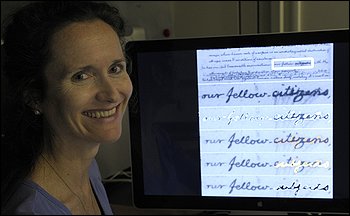
The discovery, as you may have heard over the weekend, was of a word beneath a smudge in an early draft of the Declaration of Independence.  The Library of Congress announced the discovery on Friday, July 2nd ahead of the July 4th weekend and you can read the Washington Post’s coverage here.  The smudge had long puzzled historians and the application of some high tech wizardry finally allowed them to uncover what lay beneath.  Unlike other revisions in the early drafts of the Declaration this word was not merely crossed out, it was painstakingly erased.  What’s more, Thomas Jefferson seems to have gone out of his way to make sure the word would never be read.  He carefully wrote the letters of the new word, “citizens,” so that they would overlap wherever possible with the letters of the earlier word.

His efforts had succeeded in obscuring his first choice until now.  Using “a modified version of the kind of spectral imaging technology developed for the military and for monitoring agriculture” research scientist Fenella France reconstructed the original word.  And what was this mystery word?  “Subjects.”  In a sentence that didn’t even make it into the final draft from the section of the Declaration enumerating the offenses of George III, Jefferson referred to the colonists first as “subjects” of the king and then, apparently realizing the sudden incongruity of the term, opted for the more democratic “citizens.”  The significance seems to have been such for Jefferson that he attempted to physically erase every trace of his first infelicitous choice, as if by abjuring the term he would reconstitute the political situation.

Perhaps the designation meant something to Jefferson because he recognized that our own self-understanding would go a long way in shaping our actions.  (A recognition, comrade, not lost on subsequent revolutions.)  To refer to themselves as subjects in some sense already gave up the cause; to refer to themselves as citizens was as much an act of revolution as were the first shots at Lexington.  Now here is the question of the day:  By what word do we most frequently refer to ourselves?  My vote, and this is not an original observation, is for “consumers.”  Try it out.  Listen for how often the word “consumers” is used to designate Americans.  I suspect “citizen” still makes an appearance in certain obligatory contexts, but “consumers” seems the dominant self-designation.

Jefferson was on to something significant and the recent shift in terminology reveals a great deal about our political and moral environment.  Being a consumer implies a wholly different set of associations than being a citizen.  Citizenship entails an array of privileges and responsibilities wholly absent from the image of the consumer.  The consumer has but one relationship to the world — consumption.  The citizen participates, upholds, defends, sacrifices, invests, honors.  Perhaps this is why we hardly mind the label, it asks so much less of us.  Remember the weeks following 9/11.  There was no call to arms, no push to enlist volunteers, and certainly no talk of a draft.  The government, however, did urge us to continue buying and spending.  This is the whole duty of person as consumer.  Buy, spend, purchase — it is your patriotic duty. It’s not hard to see the appeal.

I may yet prefer subject to consumer.

The Bookshelf as Memory Theater

Nathan Schneider’s “In Defense of the Memory Theater” begins thus:

What concerns me about the literary apocalypse that everybody now expects—the at least partial elimination of paper books in favor of digital alternatives—is not chiefly the books themselves, but the bookshelf. My fear is for the eclectic, personal collections that we bookish people assemble over the course of our lives, as well as for their grander, public step-siblings. I fear for our memory theaters.

And concludes as follows:

As the business of reading technology continues along its trajectory, whether apocalyptic or utopian or both, perhaps those of us who continue to fancy ourselves concerned readers—however much we give in to the new and shiny—might turn our attention anew to what one might call “inner work.” In the part of ourselves which is not technological, we could rediscover the tautology that what makes knowledge so precious is its precariousness, not the surety of our control over it. We’ll need to cultivate the arts of memory and forgetting alluded to in these lines by William Blake, which came to me in a letter from a friend, a librarian who, for years now, has been slowly dying in a monastery:

He who binds to himself a joy
Doth the winged life destroy.
He who kisses the joy as it flies,
Lives in eternity’s sunrise.

Even among these wonders now available to us and still to come, all having remains no less a preparation for loss.

Ready? Because that’s what is at stake.

Read everything in between at Open Letters Monthly.

In case you don’t, here is at least one more dose:

Modern life, if we can still call it that, occurs as a sequence of gleeful apocalypses. One world constantly gives way to another. If it doesn’t, “consumers”—as people now call themselves—get anxious. We’re familiar with the drill: new audio/video formats arrive every decade; a new “generation” of cell phone every couple years; and, on a rolling basis, there’s the expectation that several totally unexpected paradigm shifts are in the works—the internet, global climate change, a new fundamental particle, and that sort of thing.

Augustine’s Secret

James K. A. Smith on marketing, desire, and the erotic:

“In a culture whose civic religion prizes consumption as the height of human flourishing, marketing taps into our erotic religious nature and seeks to shape us in such a way that this passion and desire is directed to strange gods, alternative worship, and another kingdom.  And it does so by triggering and tapping into our erotic core — the heart.  Thus in marketing one finds the promise of a kind of transcendence that is linked to a certain bastardization of the erotic.  Certain modes of advertising appeal more directly to eros, to sexual desire and romantic love, and then in a  move of substitution, channel our desire into a product — or at least associate the product with that desire and promise a kind of fulfillment ….

… I think we should first recognize and admit that the marketing industry — which promises an erotically charged transcendence through media that connects to our heart and imagination — is operating with a better, more creational, more incarnational, more holistic anthropology than much of the (evangelical) church.  In other words, I think we must admit that the marketing industry is able to capture, form, and direct our desires precisely because it has rightly discerned that we are embodied, desiring creatures whose being-in-the-world is governed by the imagination.  Marketers have figured out the way to our heart because they ‘get it’:  they rightly understand that, at root, we are erotic creatures — creatures who are oriented primarily by love and passion and desire.  In sum, I think Victoria is in on Augustine’s secret.”    (Desiring the Kingdom, 76)

The Victoria in question is, of course, the purveyor of a certain line of woman’s attire.  Augustine’s secret, as Smith puts it, is the recognition that human beings are embodied, desiring animals before they are thinking, rational beings.  We aim at life with our heart, not with our mind — the heart here standing for all the emotional, affective, visceral and bodily dimensions of the human person.