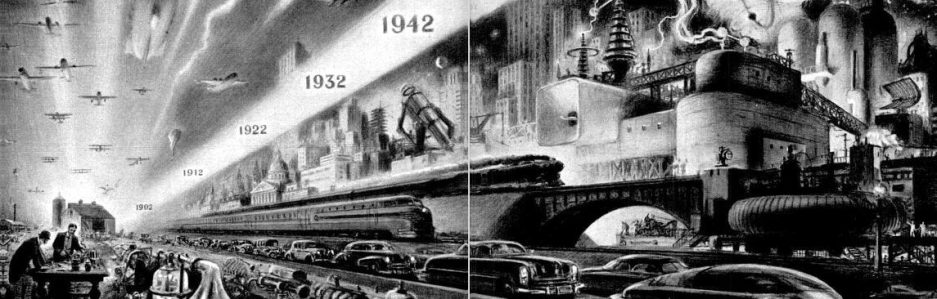
 Well, right here actually. Unfortunately, in case you hadn’t noticed, they’re not zipping through some highway in the sky. This despite the hopes fanned by science fiction, cartoons, and science magazines from an earlier generation. The flying car has become the emblem of a future that never was, one that actually seems quite silly now.
As a kid the future fascinated me, I just had no idea it was an already dated image of the future that took me in. My favorite ride at Disney World was The Carousel of Progress (say that with a straight face) and later its sequel at Epcot, Horizons. Both gave us a sense of steady, inexorable movement towards … underwater cities and farms in the desert, and sitting around watching … television.
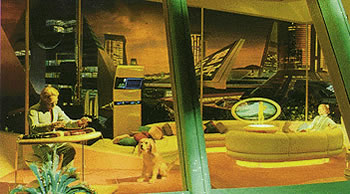 It wasn’t just Disney either. I am just old enough to have had libraries rather than media centers in school as I was growing up. In these libraries with actual books and magazines, I would pull out back issues of Popular Science and Popular Mechanics scouring them for even more images of a future that would never quite materialize. Of course, its not just a matter of not having the know-how, looking back one wonders why some of this stuff was attractive to begin with. Again, underwater cities?
All of this to say that it is hard work imagining the future (although Star Trek had better luck than Disney). William Halal should know,
Forecasting anything is an enormous challenge, much less “predicting” the state of the world decades from now. My TechCast project is in the business of forecasting, but we make a point of avoiding the word “prediction” for that very reason.
According to Halal,
For more than a decade, TechCast has scanned the literature and surveyed 100 experts worldwide to forecast technology breakthroughs and their social impact. We identify trends driving a forecast and obstacles opposing it, summarize other forecasts made by other sources, and have our experts review all this background data to reach their best estimates. Although I think this approach provides the best possible answers to tough questions, we miss the mark by about plus or minus three years for forecasts a decade out, and sometimes a lot more. For anything beyond two decades out, the sources of error mount dramatically, especially because the world is changing so quickly that present assumptions will soon prove invalid.
So what is Halal betting on these days,
Our forecasts suggest that most of the big breakthroughs now anticipated—green technologies, alternative energy, artificial intelligence, biogenetic medical care—are likely to arrive well before 2050. In fact, exploding information technology and knowledge are likely to unify the globe into some type of coherent world system between 2020 and 2030 out of sheer necessity. The mounting threats of climate change, energy shortages, environmental collapse, WMDs, terrorism, and other elements of the “Global Megacrisis” are forcing this historic transition, and global gross domestic product will double about 2020, making the present global order unsustainable and demanding a form of “global consciousness.” Our surveys of the megacrisis show that the next decade or two will either see a crucial turning point to a “mature” global society or we are likely to witness the collapse of civilization in major parts of the world.
So basically we are heading toward a “mature” global society (exciting!) or the end of the world as we know it.
Funny, I feel fine.


 . She is addressing “the advent of automation, which in a few decades [she is writing in the late 1950’s] probably will empty the factories and liberate mankind from its oldest and most natural burden, the burden of labouring and the bondage to necessity.” This development, however, will not yield what it seems to promise. Arendt continues:
 L.M. Sacasas