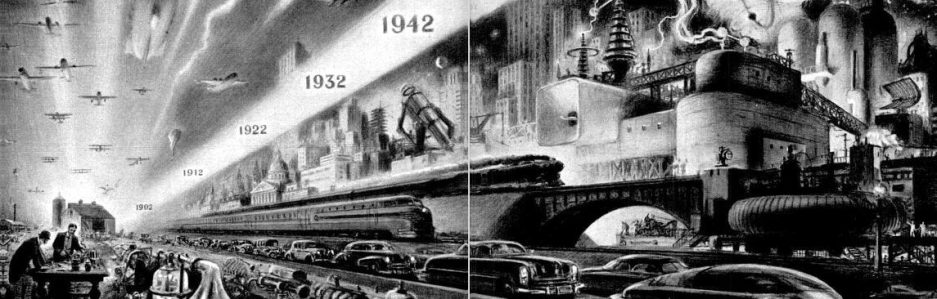
 The ability to attract the attention, sustain the interest, and even earn the admiration of readers from diverse and even antithetical intellectual and moral traditions is surely suggestive of an impressive mind and a generous personality. That G. K. Chesterton can count the radical, critical theorist Slavoj Zizek and the traditionalist Catholic Marshall McLuhan among those who have engaged his work with penetrating insight tells us a great deal about Chesterton, who also happens to be the source of this blog’s tag line.
After posting a link to Nicholas Carr’s review of Douglas Coupland’s new biography of McLuhan, I decided to pull out my copy of an older, well regarded biography by W. Terrence Gordon, Marshall McLuhan: Escape into Understanding
Nearly forty years later [from his time in Cambridge], McLuhan said: “I know every word of [Chesterton]: he’s responsible for bringing me into the church. He writes by paradox — that makes him hard to read (or hard on the reader).” Chesterton and St. Thomas Aquinas, he said, were his two biggest influences. He loved Chesterton’s rhetorical flourishes, imbibed his playfulness, turned his impulse to try out new combinations of ideas into the hallmark of the McLuhan method. (54)
No doubt many have said the same about McLuhan’s paradoxical and gnomic style as well as the relative (un)ease McLuhan presents for the reader.
The significance McLuhan gives to Aquinas parallels his estimation of Plato and Aristotle. Speaking of an influential Cambridge professor, McLuhan wrote:
Lodge is a decided Platonist, and I learned [to think] that way as long as I was trying to interpret Christianity in terms of comparative religion. Having perceived the sterility of that process, I now realize that Aristotle is the soundest basis for Christian doctrine. (53)
Aristotle, of course, is the philosopher whose thought Aquinas brought into synthesis with Christian doctrine, and among Chesterton’s expansive corpus is a short, insightful biography of Aquinas, Saint Thomas Aquinas: The Dumb Ox.

Demonstrating early on his characteristically wide-ranging and, in Gordon’s words, “synthesizing impulses,” McLuhan links Platonism with Protestantism:
Plato was, of course, a Puritan in his artistic views, and his philosophy when fully developed as by the 15th century Augustinian monks (of whom Luther was one) leads definitely to the Calvinist position. (51)
And while Aristotle, Thomas, and Chesterton receive high marks from McLuhan, Protestants get a lashing:
Catholic culture produced Don Quixote and St. Francis and Rabelais . . . Everything that is especially hateful and devilish and inhuman about the conditions and strains of modern industrial society is not only Protestant in origin, but it is their boast (!) to have originated it. (55)
These insights and formulations from McLuhan give us a sense that in his religious thought and cultural criticism he is after something we might simply call joy. The link between his cultural criticism and religious thought is explicit and centered on Chesterton:
He opened my eyes to European culture and encouraged me to know it more closely. He taught me the reasons for all that in me was blind anger and misery . . . . (56)
He goes on to write,
You see my ‘religion-hunting’ began with a rather priggish ‘culture-hunting.’ I simply couldn’t believe that men had to live in the mean, mechanical, joyless, rootless fashion that I saw in Winnipeg . . . . It was a long time before I finally perceived that the character of every society, its food, clothing, arts, and amusements are ultimately determined by its religion — It was longer still before I could believe that religion was as great and joyful as these things which it creates — or destroys. (56)
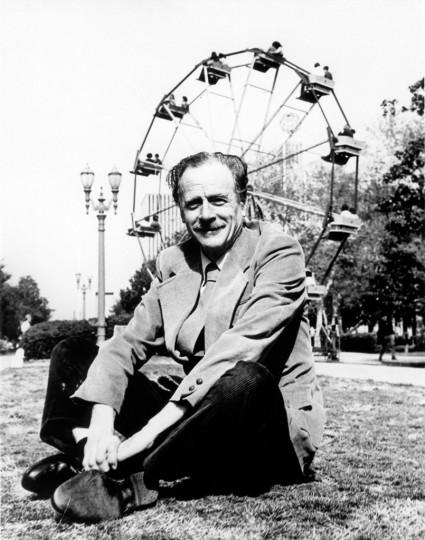 His criticisms of Protestantism and its consequences also circle around the affective sensibilities he perceives it to engender. In a letter McLuhan writes of “the dull dead daylight of Protestant rationalism which ruinously bathes every object from a beer parlour to a gasoline station . . . ” (56)
In all of this, the appeal of Chesterton who appears continuously mesmerized by the sheer gratuity and giftedness of existence becomes apparent. Borrowing Chesterton’s own words and re-applying them to Chesterton himself, McLuhan noted that he “had somehow made a giant stride from babyhood to manhood, and missed that crisis in youth when most of us grow old.” (59) Likewise, Gordon is correct in reapplying McLuhan’s words regarding Chesterton to McLuhan himself,
There is no hue of meaning amidst the dizziest crags of thought that is safe from his swift, darting pursuit. (60)
And ultimately, it appears that it was the pursuit of joy.
 in which he argues that transitions from oral to literate to secondary oral cultures (marked respectively by the development of alphabetic technology and electronic communication) have effected transformations in human consciousness. It is something of a testament to Ong’s enduring influence, he passed away in 2003, that I’ve been assigned his work in three separate graduate courses.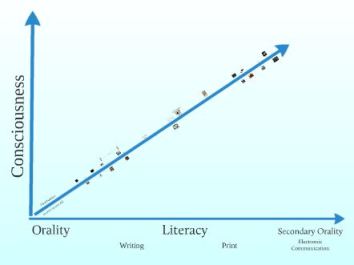

 . In the review, Carr makes the following observation:
 , Lakoff and Johnson drew attention to the significant and often unnoticed work metaphors perform in our everyday use of language. Once you start paying attention you realize that metaphors (and figurative language in general) are not merely the ornaments of speech employed by poets and other creative types; they are an indispensable element of our most basic attempts to represent our experience of the world with words. Lakoff and Johnson also suggested that many of our most basic metaphors (up is good/down is bad; heavy is serious, light is not) are grounded in our embodied experience of reality. Did we not stand erect, for example, we’d have a very different set of metaphors.
 L.M. Sacasas