Giving Them the Thumbs

So I was at the dentist’s office this morning and the dental hygienist asked me what I did for a living as one customarily does to make small talk. I was a teacher and graduate student I replied. She asked what I was studying. I told her that I was working on a PhD in a program titled Texts & Technology. This usually elicits a slight pause of unfamiliarity, so I quickly glossed the program by explaining that it explores the intersections of technology and culture. Usually this works just fine and typically intrigues people. What it doesn’t usually trigger, as it did this morning, is a soap-box rant. It was a polite and subdued rant, but a rant no less. I do believe the phrase “these kids” was used at some point.

My dental hygienist proceeded to inform me that she did not own a cell phone and was mildly disgusted by public texting, particularly texting while driving and while having x-rays (not sure if there was an implied correlation between those two).

Most of all, she was dismayed by the readiness to disregard personal presence inherent in the act of texting while ostensibly interacting with another. This is by now a commonplace complaint, and while no less valid for being so, not by itself worthy of comment. It was how she described the offense and captured its feel that caught my attention. While miming the standard tw0-handed, thumbs twirling texting gesture with a slight thrust of both hands in my direction, she declared that it is as if she were being given the finger.

Well, they’re thumbs technically, but point taken.

Nostalgia as Active Memory and Index of Our Desires

Below is an excerpt of an email exchange between myself and Mark Garcia, my very thoughtful friend who generously reads what I write on here. The exchange was occasioned by my earlier thoughts on nostalgia in Woody Allen’s Midnight in Paris. It was, I thought, worth posting here for a (slightly) wider audience. My thanks to Mark for pushing these reflections further along.

Collaboration in action, although you’ll see the real insights are not mine:

MG:  … is romanticized nostalgia for the ahistorical past itself a signal of transcendence, pace Berger, but not only of a heavenly and ‘other’ present or purely vertical, up-there, or beyond reality, but a reach for a certain kind of heavenly future?

MS: Yes, and few have captured that better than C. S. Lewis in The Weight of Glory in which he remarks that we take our revenge on what amounts to a longing for transcendence by, among other things, labeling it nostalgia and being done with it.

MG: Nostalgia as revenge is fascinating. Is it possibly, then, a form of memory in action, the action being the pursuit of some perceived form of justice? Is nostalgia at heart a longing for a certain form of “putting things right” and thus, in that way, a longing for an order of perfect justice and goodness?

MS: Yes, absolutely, memory in action. Memory, insofar as it is a search and not spontaneous, is in an index of desire. Nostalgia in this sense names the desire not only for justice, but also peace, joy, belonging, settledness, wholeness — shalom, shall we say?

MG: So whatever adjustments, reconfigurations, and manipulations of history nostalgia introduces are themselves the index to the desire nostalgia acts upon, e.g., nostalgic reconfigurations of one’s painful past reflects a desire for justice, reconfigurations of a lonely past along more satisfying lines reflects the desire for belonging, etc. This could take positive or negative forms, too: a positive or upward reconfiguration of a painful history might make things seem better than they were in order to aid present coping with it, whereas a negative or downward reconfiguration of that same past might make things seem worse than they were in order to aid present justifications of felt bitterness, injustice, or whatever. How varied are our grasping at shalom! As varied as we are, inside and out.

MS: Just so.

I also find it worthwhile to quote at some length from the essay by Lewis I referenced in the exchange. It is one of the most enchanting passages in the whole of Lewis’ oeuvre:

In speaking of this desire for our own far- off country, which we find in ourselves even now, I feel a certain shyness. I am almost committing an indecency. I am trying to rip open the inconsolable secret in each one of you—the secret which hurts so much that you take your revenge on it by calling it names like Nostalgia and Romanticism and Adolescence; the secret also which pierces with such sweetness that when, in very intimate conversation, the mention of it becomes imminent, we grow awkward and affect to laugh at ourselves; the secret we cannot hide and cannot tell, though we desire to do both. We cannot tell it because it is a desire for something that has never actually appeared in our experience. We cannot hide it because our experience is constantly suggesting it, and we betray ourselves like lovers at the mention of a name. Our commonest expedient is to call it beauty and behave as if that had settled the matter. Wordsworth’s expedient was to identify it with certain moments in his own past. But all this is a cheat. If Wordsworth had gone back to those moments in the past, he would not have found the thing itself, but only the reminder of it; what he remembered would turn out to be itself a remembering. The books or the music in which we thought the beauty was located will betray us if we trust to them; it was not in them, it only came through them, and what came through them was longing. These things—the beauty, the memory of our own past—are good images of what we really desire; but if they are mistaken for the thing itself they turn into dumb idols, breaking the hearts of their worshippers. For they are not the thing itself; they are only the scent of a flower we have not found, the echo of a tune we have not heard, news from a country we have never yet visited.

He later adds:

Apparently, then, our lifelong nostalgia, our longing to be reunited with something in the universe from which we now feel cut off, to be on the inside of some door which we have always seen from the outside, is no mere neurotic fancy, but the truest index of our real situation.

Midnight in Paris: Learning to Live With the Past

The past may be a foreign country where they do things differently as the L. P. Hartley line has it, but it is one to which many would readily immigrate given the opportunity. If you are among them, Woody Allen’s Midnight in Paris will likely enchant and delight you. (Warning: some spoilers ahead.) Gil, the main character played charmingly by Owen Wilson, and his fiancée tag along with her parents who have come to Paris on a business trip. She and her parents are crassly materialistic, he is a romantic — a romantic in love with the city, particularly its Jazz Age past. Having been a successful, but disenchanted Hollywood film writer he is determined to write real literature, even if it means surrendering the upscale lifestyle his fiancée craves. While they shop for chairs that cost as much as a moderately priced four-door sedan, he frequents outdoor shops that sell vintage vinyl records and works on his novel about a man who owns a nostalgia shop. The theme of his would-be novel tracks closely with Gil’s own sensibilities. He obsesses over the past and its artifacts, and his obsession is an index of his dissatisfaction with the present.

Without even a gesture toward explantation, and all the better for it, a vintage Peugeot filled with revelers stops to pick up Gil just after a clock has struck midnight. Gil, with some hesitation, joins the merry crowd and finds himself transported back to the 1920’s and the Paris of his dreams. Endearingly awestruck throughout the experience, he meets the Fitzgeralds, Hemingway, Gertrude Stein, T. S. Eliot, Picasso, Dali, Cole Porter, and a host of other luminaries just entering into the fullness of their legend. Each night he rides into the past, and each morning he finds himself again in the present, a progressively unfulfilling present.

When he is in the past, Gil comes alive. The characters are inspired: Adrien Brody plays a delightfully quirky Salvador Dali and Corey Stoll is almost absurdly intense as Hemingway. Kathy Bates’ Gertrude Stein provides Gil with straightforward counsel regarding life and writing. Gil, as he becomes increasingly at ease in the past, offers Luis Buñuel a suggestion for a film in which guests find themselves unable to leave a room. Buñuel, perplexed, wonders why they cannot simply walk out.  He also finds in Picasso’s lover Adriana, a woman who stirs his heart and a kindred spirit. Simply put, the past rekindles Gil’s passion.

Yet, Allen finally wants to critique nostalgia and reaffirm the present. The film builds up to an overly didactic moment when Gil, realizing that he cannot remain in the past indefinitely, launches into a not quite moving appreciation of the present. Allen foreshadows the moment throughout the film. While delivering one of his impromptu lectures, Paul, a pedantic intellectual and friend of Gil’s fiancee, pontificates about the “Golden Age Fallacy,” the unsubstantiated belief that the greatness  of some prior historical era eclipses the present, a chronological version of the grass is always greener. The character of Adriana is herself unimpressed with the ’20s and nostalgic for 1890s Paris, La Belle Époque. When Gil and Adriana, Inception-like, delve even further into the past via horse-drawn carriage they meet up with Degas, Gauguin, and Toulouse-Lautrec just as La Belle Époque commences.  But we find those  artists similarly dismissive of their own age believing it pales in comparison with the Renaissance. And it is then that Gil realizes the futility of inordinately longing for another age.

He returns to the present, reorders his life, and walks off happily ever after in the Paris rain. And we, likewise, leave the theater, returning to our own present, cured of our nostalgic longings, and determined to seize the moment. Yet, the film lingers in our minds and as we revisit it, we find ourselves charmed. It works its magic as we turn it over in our memory. Wasn’t the “Golden Age Fallacy” introduced by the most unlikeable, pompous character in the film? Wasn’t the past portrayed in delightful, vivacious, enchanting fashion? Wasn’t Gil, in fact, nourished and invigorated by his dalliances with the past? While Gil chose to return to his present, did not Adriana choose to stay in La Belle Époque? Finally, wasn’t Gil’s other climatic epiphany (that I will not spoil) revealed in the past?

Certainly, the past is shown to be complex and disordered in its own way. In one of the few more sober scenes, Gil and Adriana, on a moonlit stroll through the city, come upon Zelda Fitzgerald very near to taking her own life. Yet, even here there is ambiguity. Gil offers Zelda Valium which we learn he has been taking to cope with the anxieties of an impending wedding. Are we to conclude that while the past bequeaths great art and literature to the present, the best the present can offer the past is Valium? Not quite I suppose, I do recall penicillin also being mentioned at some point.

Midnight in Paris takes nostalgia as its theme, but the difficulty with any exploration of nostalgia is that in common usage the word indiscriminately names too many sensibilities, unfortunately dismissing appropriate and enriching ways of being with the past. Altogether, the film helpfully suggests that there is more than one way to have a disordered relationship to the past. We may succumb to the “Golden Age” fallacy and refuse the present, or we might also reject the past altogether uprooting ourselves from that which gives depth of field to lived experience. While Gil chooses the present, it is clear that the past nourished and educated him. While he has chosen not to live in the past, he has not abandoned it either. He will not live in it, but he will live with it.

It was Buñuel who wrote in his autobiography,

You have to begin to lose your memory, if only in bits and pieces, to realize that memory is what makes our lives.  Life without memory is no life at all …  Our memory is our coherence, our reason, our feeling, even our action.  Without it, we are nothing.

Thus we may turn the commonplace on its head and suggest that the past is the only place we can live.

John Mayer and John Piper: Twitter Case Studies

I’ve never read the tweets of John Mayer, but I suspect they are an improvement on the tweets of Kanye West. In any case, Mayer apparently tweeted a lot, in fact, he recently owned up to a case of Twitter addiction. At a Berklee Performance Center Clinic for aspiring musicians, he had this to say:

“The tweets are getting shorter, but the songs are still 4 minutes long. You’re coming up with 140-character zingers, and the song is still 4 minutes long…I realized about a year ago that I couldn’t have a complete thought anymore. And I was a tweetaholic. I had four million twitter followers, and I was always writing on it. And I stopped using twitter as an outlet and I started using twitter as the instrument to riff on, and it started to make my mind smaller and smaller and smaller. And I couldn’t write a song.”

Mayer’s comments came to the attention of John Piper, a prominent Christian pastor with his own not insignificant Twitter following.  In a blog post, Piper offered his own experience as an alternative to Mayer’s:

My experience of publishing three Tweets a day (usually written and scheduled a week or two ahead of time) is different. Mayer said, “I couldn’t have a complete thought anymore.” To me this is almost the opposite of what happens. But that may depend on what we aim to do with Twitter.

Piper goes on to add, in what amounts to his philosophy of tweeting, that he aims to be capacious, concise, and compelling when he composes his tweets (preachers seem to have a hard time resisting alliteration). Along the way he likens tweets to proverbs and explains that, “Tweets for me are a kind of poetry.” This is all very nicely put, and I suspect it makes for pretty decent tweets.

Two users, admittedly two very different users, and two quite different experiences. Of course, there is nothing particularly surprising about this.  We shouldn’t necessarily expect any two users to have the same experience with any technology. Yet, I couldn’t help but wonder what might account for the difference, or if one were more typical.

We get a hint at what the difference might be when Piper writes, “My experience of publishing three Tweets a day (usually written and scheduled a week or two ahead of time) is different.”

That parenthetical statement suggests to me that Piper is not really tweeting. Obviously, he is composing words that are eventually shared via Twitter, but he is doing so in a manner that almost renders the platform irrelevant from the standpoint of personal experience. I would even bet that Piper is not the one interacting with the Twitter interface, in other words I wonder if he passes his composed tweets on to a third party who then types them in and publishes them. (There wouldn’t be a thing wrong with this, of course.) A quick look at Piper’s Twitter feed confirms the suspicion that his use of the interface is minimal since we find only the carefully composed statements and occasional links, but no interaction with other Twitter users. He has 185,000+ followers, and follows only 66. There are no @s0andso, no signs of conversation.

So let me suggest that Piper might as well be composing fortune cookie messages. Piper’s experience and habits are solidly in the world of old media. Piper’s thinking is not being influenced by Twitter because he is not using Twitter. In other words, Piper’s experience tells us nothing about the consequences of Twitter for someone who is actually robustly engaged with the interface, like John Mayer for example.

Piper’s closing paragraph further suggests that he is not exactly experiencing Twitter:

I don’t ask that others Tweet the way I try to. I only write this blog post to explain why I don’t experience Twitter the way John Mayer did, and why you don’t have to either. If your goal is to spread capaciousconcisecompelling truth about God and his ways, the Tweet is a fruitfully demanding form.

To describe a Tweet as a “fruitfully demanding form” is to view Twitter through the lens of the literary. Piper is measuring Twitter strictly in light of its verbal qualities, in the same way he might view a sonnet or a haiku. This a valid level of engagement and analysis, but has little to do with the way Twitter is experienced by most of its users. Moreover, it misses the significant points of contrast between print and digital media environments.

I hope it is clear that I’m certainly not criticizing Piper. My point is to understand the influence of technology, and I suspect that it is found in part in the habits formed by use of technology, or the practice of an interface. Piper has not experienced the effects of Twitter because he has not entered into the practice of Twitter defined as a robust and sustained engagement with the interface. I suspect that his Twitter account isn’t open on his desktop or smartphone. He probably is not emerged in the flow of TwitterTime. This is probably a good thing. By not really using the medium, he is not being used by it either. In any case, I would suggest that a tool’s influence will not really be felt until its use becomes a practice integrated into our form of life.

________________________________________________________

H/T: Mr. Greenwald for pointing me to Piper post.

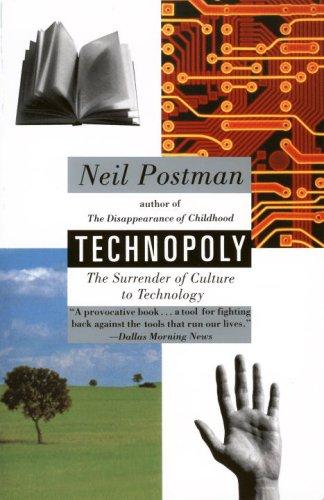
Neil Postman, Technopoly, and Technological Theology

Early in his book Technopoly, Neil Postman presents a helpful summary of the variety of schema or classifications offered by historians for the history of the relationship of technology to culture:

We think at once of the best-known classification:  the Stone Age, the Bronze Age, the Iron Age, the Steel Age.  We speak easily of the Industrial Revolution, a term popularized by Arnold Toynbee, and, more recently, of the Post-Industrial Revolution, so named by Daniel bell.  Oswald Spengler wrote of the Age of Machine Technics, and C. S. Peirce called the nineteenth century the Railway Age.  Lewis Mumford, looking at matters from a longer perspective, gave us the Eotechnic, the Paleotechnic, and Neotechnic Ages.  With equally telescopic perspective, Jose Ortega y Gasset wrote of three stages in the development of technology:  the age of technology of chance, the age of technology of the artisan, the age of technology of the technician.  Walter Ong has written about Oral cultures, Chirographic cultures, Typographic cultures, and Electronic cultures.  McLuhan himself introduced the phrase “the Age of Gutenberg” (which, he believed, is now replaced by the Age of Electronic Communication).

A lot is packed into that paragraph, and if we were to go on and read each of these scholars in order to understand their classifications we would end up with an impressive grasp on the relationship of technology to culture. To these Postman adds his own schema.  He divides cultures into three types:  tool-using cultures, technocracies, and technopolies. Here is a quick overview for your consideration:

In a tool-using culture according to Postman, tools were “largely invented to do two things”:  “solve specific and urgent problems of physical life” and “serve the symbolic world of art, politics, myth, ritual, and religion …” Additionally, “in a tool-using culture technology is not seen as autonomous, and is subject to the jurisdiction of some binding social or religious system.”

In a technocracy, society is “only loosely controlled by social custom and religious tradition” and it is “driven by the impulse to invent.” A technocracy, however, “does not have as its aim a grand reductionism in which human life must find its meaning in machinery and technique.  Technopoly does.”

Technopoly, in Postman’s most succinct formulation, features “the submission of all forms of cultural life to the sovereignty of technique and technology.”  Postman took the assumptions informing Frederick Taylor’s The Principles of Scientific Management to be more less the assumptions of the “thought-world of Technopoly.” These included the following beliefs:

  • “the primary, if not the only, goal of human labor and thought is efficiency”
  • “technical calculation is in all respects superior to human judgment”
  • “human judgment cannot be trusted because it is plagued by laxity, ambiguity, and unnecessary complexity”
  • “subjectivity is an obstacle to clear thinking”
  • “what cannot be measured either does not exist or is of no value”
  • “the affairs of citizens are best guided and conducted by experts.”

Ironically, in Postman’s view, these assumptions amount to a “technological theology.”  In other words, while traditional theologies which governed tool-using cultures are displaced in a technocracy, in a  Technolopy a governing ideology in the mode of theology is reintroduced to order society. The function of theology has not been eradicated, it has just been reconfigured, which rather reminds me of a Dylan tune:

But you’re gonna have to serve somebody, yes indeed
You’re gonna have to serve somebody
Well, it may be the devil or it may be the Lord
But you’re gonna have to serve somebody.

I’ll leave the applications to you.