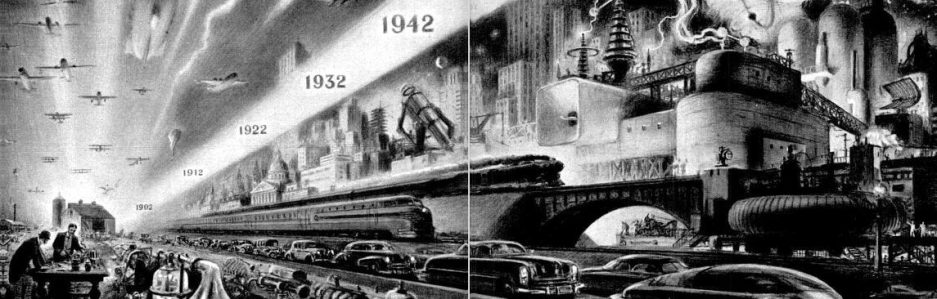
Capitalism, Magic, and Technology

In his chapter on the “cultural preparation” for the age of the machine in Technics and Civilization, Lewis Mumford cites, among other phenomenon, capitalism and magic. Here’s the abridged version:

“Thus although capitalism and technics must be clearly distinguished at every stage, one conditioned the other and reacted upon it.”

“It was because of certain traits in private capitalism that the machine — which was a neutral agent — has often seemed, and in fact has sometimes been, a malicious element in society, careless of human life, indifferent to human interests.  The machine has suffered for the sins of capitalism; contrariwise, capitalism has often taken credit for the virtues of the machine.”

“… indeed, the necessity to promote continual changes and improvements, which has been characteristic of capitalism, introduced an element of instability into technics and kept society from assimilating its mechanical improvements and integrating them in an appropriate social pattern.”

“Between fantasy and exact knowledge, between drama and technology, there is an intermediate station: that of magic. It was in magic that the general conquest of the external environment was decisively instituted.”

“In sum, magic turned men’s minds to the external world: it suggested the need of manipulating it: it helped create the tools for successfully achieving this, and it sharpened observation as to the results.”

“As children’s play anticipates crudely adult life, so did magic anticipate modern science and technology …”

“… magic was the bridge that united fantasy with technology: the dream of power with the engines of fulfillment.”

Capitalism, magic, and technology — an odd grouping at first blush, but less so upon further reflection. The common denominator? Human desire — its generation, manipulation, and satisfaction.

Interestingly, this was a confluence of influences (sans capitalism) also eloquently articulated by C. S. Lewis, a scholar of Medieval and Renaissance literature, in The Abolition of Man:

I have described as a `magician’s bargain’ that process whereby man surrenders object after object, and finally himself, to Nature in return for power. And I meant what I said. The fact that the scientist has succeeded where the magician failed has put such a wide contrast between them in popular thought that the real story of the birth of Science is misunderstood. You will even find people who write about the sixteenth century as if Magic were a medieval survival and Science the new thing that came in to sweep it away. Those who have studied the period know better. There was very little magic in the Middle Ages: the sixteenth and seventeenth centuries are the high noon of magic. The serious magical endeavour and the serious scientific endeavour are twins: one was sickly and died, the other strong and throve. But they were twins. They were born of the same impulse. I allow that some (certainly not all) of the early scientists were actuated by a pure love of knowledge. But if we consider the temper of that age as a whole we can discern the impulse of which I speak.

There is something which unites magic and applied science while separating both from the wisdom of earlier ages. For the wise men of old the cardinal problem had been how to conform the soul to reality, and the solution had been knowledge, self-discipline, and virtue. For magic and applied science alike the problem is how to subdue reality to the wishes of men: the solution is a technique ….
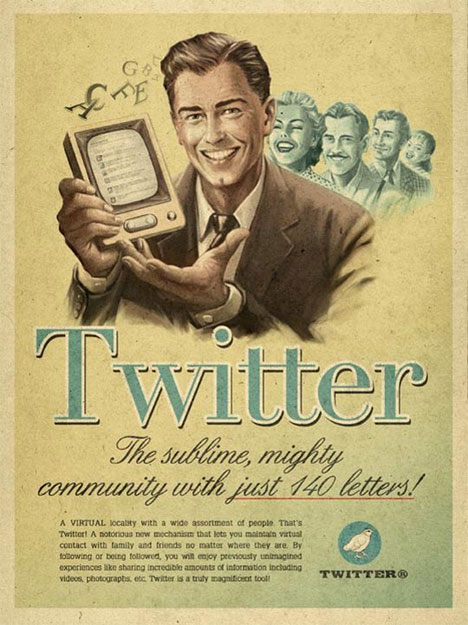
Fatal Nostalgia and Generalized Anxiety: Signs of the Times

“At the end of the eighteenth century people began to be fearful of extended sojourns away from home because they had become conscious of the threat posed by nostalgia. People even died of nostalgia after having read in books that nostalgia is a disease which is frequently mortal.”  — Jean Starobinski, “The Idea of Nostalgia”

No need to read that again, you read it correctly the first time.

Whatever else we may say, this is clearly something very different than what you felt when you recently learned that MTV turned 30 (and didn’t tell anybody) or when you watch Mad Men. It is also different than the nostalgia which infuses the Pottery Barn catalogue, drives popular segments of “contemporary” music, and inspires playful design concepts. It is also quite different from nostalgia animating the handle-bar mustached mixologists populating trendy urban bars. In fact, it is very different from most of what we tend to label nostalgic. And as you may have noted yourself, there is quite a bit that we might label nostalgic all about us. This is not exactly a sudden development, the “vintage” turn has been around for a decade or two at least, but it certainly does seem to be permeating experience to ever greater degrees lately.

And yet the burgeoning nostalgia industry is only distantly related to the reportedly fatal nostalgia described in the opening lines and which Richard Terdiman, in his study of the nineteenth century memory crisis, labeled, with a dash of hyperbole perhaps, a “dangerous epidemic.” This earlier, acute nostalgia occasioned by  prolonged journeys away from one’s home was, owing to its physiological symptoms, treated as a medical condition. This may at first seem quaint and evoke the image of Victorian fainting couches, but let’s not rush to judgment without asking some questions. Why an outbreak of nostalgia, and why then? Why the severity? And how is it that “nostalgia” was subsequently domesticated and even commodified?

As per usual, I’m thinking out loud here, and raising questions to offer what are at best only suggestive responses. It would seem that any response to the first and second questions would take into consideration the ongoing and multiple disruptions of settled agrarian life which characterized the long nineteenth century. What is interesting about nostalgia, then, is that it appears as a symptom of sociological change. It registers the psychic consequences of the onset of modernity and the subsequent disorder introduced into the human experience of time and place. Eventually, what is initially experienced as an acute disorder becomes generalized and to some extent domesticated. That it is later commodified should be of little surprise; there is nothing the market can’t and won’t price. So the “vintage” turn in contemporary society might be understood as a distant ripple  of an original, profound disturbance in the experience of time and place occasioned by rapid social, economic, technological, and political transformations.

I suggested earlier that we not too quickly dismiss the epidemic of nostalgia. Here’s why. Nostalgia was then a psychological condition with physiological consequences brought about by the rapid disintegration of the social order. This led me to wonder if we might find anything analogous in our own experience. With all of the provisionality a blog post entails, perhaps we need look no further than the epidemic of anxiety. Anxiety too is a psychological condition with physiological consequences and, it could be argued, is also generated by sudden social shifts and disruptions. Anxiety is to the late twentieth and early twenty-first century what nostalgia was to the long nineteenth century — a symptom of social change.

My sense is that anxiety is well on the way to generalization and commodification. But will it ever be chic?

“Archival Consciousness”

From Richard Terdiman’s Present Past: Modernity and the Memory Crisis:

“[Walter Benjamin] argued that the nineteenth-century city produced a particularly acute experience of disconnection and abstraction. Such abstraction defeats the associative structure of natural memory and induces in its place a different form of the habitus or technology of recollection that we could call ‘archival consciousness.’ Its principle would be the increasingly randomized isolation of the individual item of information, to the detriment of its relation to any whole, and the consignment of such information to what earlier I called ‘extrindividual’ mnemonic mechanisms. Such abstraction has been increasingly programmed by the practices of modern socio-economies since the industrial revolution.”

Is the structure of this 19th century “memory crisis”  recapitulated within the further abstractions of memory within 21st century digital culture?

The View from 1907: Begging for an Update

Leo Marx, a distinguished historian of technology with no relation to Karl or the brothers as far as I know, writes the following in a 2010 article* exploring the history “technology” as a concept:

Henry Adams gives a particularly vivid, telling account of this sudden, unprecedented acceleration of the rate of change—and its consequences—in The Education of Henry Adams (which he first published privately in 1907). Here he announces the appearance of what he takes to be a uniquely empowered human being, an American “born since 1900”:

the child of incalculable coal-power, chemical power, electric power, and radiating energy, as well as new forces yet undetermined—[and who] must be a sort of God compared with any other former creation of nature. At the rate of progress since 1800, every American who lived to the year 2000 would know how to control unlimited power. He would think in complexities unimaginable to an earlier mind.

This begs to be evaluated in light of how the 20th century played out, and it also invites us to imagine an updated version for the American “born since 2000.”

Any takers?

_________________________________________________________________

*I can email a PDF of the article if anyone is interested.

Resisting Disposable Reality, II: The Pen

Consumerism, together with the technology it drives, generates disposable reality. That was my conclusion in a post a few months back that synthesized some insights drawn from William Cavanaugh and Albert Borgmann. In that same post I suggested that the book was an instance of resistance to disposable reality as it is very often purchased and kept, sometimes for a lifetime. This is one important way in which e-books differ from traditional print books.

Since then I’ve had the lingering idea of documenting similar instances of resistance to disposable reality, and this past Sunday morning one such instance presented itself on CBS’s morning show. A short four and a half minute segment profiled Richard Binder, a former computer programmer who devoted himself to the care and repair of pens. Not the disposable kind, of course, and that is the point. These are mostly fountain pens and have in some instances been handed down from one generation to the next. It may come as a surprise to learn that Binder has a four month back-log of work.

Naturally, it is about more than a pen, it is about what we might call the culture of the pen that includes the care of the pen, the memories it carries, and the practice of writing it supports. To borrow Borgmann’s terminology, these are the focal practices that gather around the commanding presence of the pen as a focal thing (read the original post for a translation). Taken together they suggest a posture toward lived experience that is radically at odds with the culture of disposable reality. And resistance to disposable reality may yet help us calibrate the pace of our lives to a more humane rhythm.

Enjoy the clip below and feel free to send my way any instances of resistance to disposable reality that cross your path.

[Update: Clip has since been taken down.]