American Technological Sublime: Our Civil Religion

David Nye, the author of Electrifying America which I cited a handful of times in the past month or so, is also the author American Technological Sublime (1995), a classic work in the history of technology. Except that it is not a work of history in the strict disciplinary sense. Nye draws promiscuously from other fields — citing for example Burke, Kant, Durkheim, Barthes and Baudrillard among others — to present a wide ranging and insightful study into the American character.

The concept of the technological sublime was not original to Nye. It had first been developed by Perry Miller, a prominent mid-twenieth century scholar of early American history, in his study The Life of the Mind in America. There Miller noted in passing the almost religious veneration that sometimes attended the experience of new technologies in the early republic.

Miller found that in the early nineteenth century “technological majesty” had found a place alonside the “starry heavens above and the moral law within to form a peculiarly American trinity of the Sublime.” Taking the steamboat as an illustration, Miller suggests that technology’s cultural ascendancy was abetted by a decidedly non-utilitarian aspect of awe and wonder bordering on religious reverence. “From the beginning, down to the great scenes of Mark Twain,” Miller explains, “the steamboat was chiefly a subject of ecstasy for its sheer majesty and might, especially for its stately progress at night, blazing with light through the swamps and forests of Nature.”

Leo Marx, who I’ve also mentioned here of late, also employed the technological sublime, but again in passing. It fell to David Nye, a student of Marx’s, to develop a book length treatment of the concept. Nye looks to Edmund Burke and Immanuel Kant in order fill out the concept of the sublime, but it is apparent from the start that Nye is less interested in the philosopher’s solitary experience of the sublime in the presence of natural wonders than he is in the popular and often collective experience of the sublime in the presence of technological marvels.

Nye, with a historian’s eye for interesting and compelling sources, weaves together a series of case studies that demonstrate the wonder, awe, and not a little trepidation that attended the appearance of the railroads, the Brooklyn bridge, the Hoover Dam, the factory, skyscrapers, the electrified cityscape, the atomic bomb, and the moon landing. Through these case studies Nye demonstrates how Americans have responded to certain technologies, either because of their scale or their dynamism, in a manner that can best be described by the category of the sublime. And perhaps more importantly, he argues that this experience of the technological sublime laced throughout American history has acted as a thread stitching together the otherwise diverse and divided elements of American society.

If the philosophers provided Nye with the terminology to name the phenomenon, he takes his interpretative framework from the sociologists of religion. Nye’s project is finally indebted more to Emile Durkheim than to either Burke or Kant. Nye notes early on that “because of its highly emotional nature, the popular sublime was intimately connected to religious feeling.” Later he observes that the American sublime was “fused with religion, nationalism, and technology” and ceased to be a “philosophical idea” instead it “became submerged in practice.”

This emphasis on practice is especially important to Nye’s overall thesis and it is on the practices surrounding the technological sublime that he concentrates his attention. For example, with each new sublime technology he discusses, Nye explores the public ceremonies that attended its public reception. The 1939 World’s Fair, to take another example, appears almost liturgical in Nye’s exposition with its carefully choreographed exhibitions featuring religiously intoned narration and a singular vision for a utopian future.

This attention to practices and ceremonies was signaled at the outset when Nye cited David Kertzer’s “Neo-Durkheimian view” that “ritual can produce bonds of solidarity without requiring uniformity of belief.” This functionalist view of religious ritual informs Nye’s analysis of the technological sublime throughout. In Nye’s story, the particular technologies are almost irrelevant. They are significant only to the degree that they gather around themselves a set of practices. And these practices are important to the degree that they serve to unify the body politic in the absence of shared blood lines or religion.

All told, Nye has written a book about a secular civil religion focused on sublime technologies and he has presented a convincing case. Absent the traditional elements that bind a society together, the technological sublime provided Americans a set of shared experiences and categories around which a national character could coalesce.

Nye has woven a rich, impressive narrative that draws technology and religion together to help explain the American national character. There’s a great deal I’ve left out that Nye develops. For example: the evolving relationship of reason to nature and technology as mediated through the sublime or the diminishing active role of citizens, and especially laborers, in the public experience of the technological sublime. But these, in my view, are minor threads.

The take-away insight is that Americans blended, almost seamlessly, their religious affections with their veneration for technology until finally the experience of technology took on the unifying role of religion in traditional societies. Historically American’s have been divided by region, ethnicity, race, religion, and class. American share no blood lines and they have no ancient history in their land. What they have possessed, however, is a remarkable faith in technological progress that his been periodically rekindled by one sublime technology after another all the way to the space shuttle program and its final mission.

The question I’m left with is this: What happens when the technological sublime runs dry? As Nye points out, it is, unlike the natural sublime, a non-renewable sublime. In other words, the sublime response wears off and must find another object to draw it out. If Nye is right — and I do think it is possible to overreach so I want to be careful — there is not much else that serves as well as the technological sublime to bind American society together. Perhaps then, part of our recent sense of unraveling, our heightened sense of disunity, the so called culture wars — perhaps these are accentuated by the withdrawal of the technological sublime. Perhaps, but that would take another book to explore.

“Suspended Power”

Keats, Reflexive Aesthetic Judgments, and Website Reliability

‘Beauty is truth, truth beauty,—that is all
Ye know on earth, and all ye need to know.’
— Keats

Perhaps, we might add, that is all you need to know on the Web as well. Tasked with evaluating two different web sites that do more or less the same kind of thing, I found myself initially valuing one over the other and then reversing my judgment after more extensive use of both sites. My initial judgment was almost entirely aesthetic. One site looked clunky, crowded, and out of date, very early 2000s. The other was clean and well organized, minimalistic and inviting. It was only after exploring both sites for a good while that I realized the less aesthetically pleasing site was, in fact, the better site and by far.

That initial aesthetic judgment was, of course, a rather subjective means of evaluating a web site. But I think we do that all the time. It is almost a coping mechanism. If, for example, we are looking for some bit of information and a Google search turns up a 100,000+ hits, who has the time to carefully evaluate even the first 20 results. We open pages and make snap judgments about their worth, we close and move on, or then linger for a slightly more careful consideration. That initial judgment, I think, is probably an entirely aesthetic one. Site design can convey reliability and we pick up on those cues, however trustworthy they may be, almost instantaneously.

To be sure, there are more sophisticated means of evaluating the reliability of a website and I’m sure most of us know what they are and employ them. But how often? I wonder if we fool ourselves into thinking that we reason more about website reliability than we actually do. If we are making initial snap judgments on an impressionistically aesthetic basis, then we are all Keatsian now and mostly out of necessity.

Of course, in another sense, we are not Keatsian at all. For really what we are attuned to is not some ideal form of immutable, eternal beauty, but rather the perpetually shifting styles and fashions of web design. “Contemporaneity in design is truth” may be closer to the mark. And perhaps the more significant manner in which the Web has made us Keatsians is in the fostering of negative capability. Or, more cynically, it may just be apathy.

Weekend Reading, 10/16/11

A little late, but it’s technically still the weekend right?

Here are a couple of pieces on the history of the Internet, or at least facets of Internet related technology, from Ars Technica:

“Cutting the Cord: How the World’s Engineers Built Wi-Fi” by Iljitsch van Beijnum and Jaume Barcelo. It gets a bit technical, but I’m not sure how that could be avoided in telling this story.

and

“Before Netscape: The Forgotten Browsers of the 1990s” by Matthew Lasar: Before Netscape? How many people even remember Netscape? Interesting retrospective complete with screenshots.

“The Grand Map” by Avi Steinberg at Paris Review: You’ve probably heard about the driverless cars that Google deploys to gather street-view images for Google Maps, some of you may even have seen one. But what else do these indiscriminate eyes gather into their field of vision? Quite a bit, and a good deal of it is decidedly not pleasant. Fascinating, but be advised some images lean toward disturbing.

“The Consequences of Writing Without Reading” by Buzz Poole at Imprint. Title pretty much describes the piece. Nice reflection on the reading, writing, and solitude in a media-rich age in which solitude is viewed as a punishment of sorts. “Wanting to write without wanting to read is like wanting to use your imagination without wanting to know how.”

And finally, a couple of Infographics:

“7 Disruptive Innovations that Turned Markets Upside Down” from the folks at Mashable: Borders on providing a bit too much information, but otherwise an interesting, compact take on Google, Netflix, Pandora, and four others.

“Google and Your Memory” from the staff writers at Online Colleges. A representative of Online Colleges emailed me about their well-conceived and balanced info-graphic after coming across my recent post, “Don’t Offload Your Memory Quite Yet.” Take a look.

Paradise Interrupted: Train Whistles, Cell Phones, and Social Change

In his classic study of the pastoral ideal in American culture, The Machine in the Garden, Leo Marx takes a passage from Nathaniel Hawthorne’s journal as a point of departure. In his journal entry from July 27, 1844, Hawthorne describes what he observes as he sits down in the woods near Concord, Massachusetts to take in “such little events as may happen.”

Hawthorne, whose prescient metaphor for electrification we noted a few days ago, begins by describing the spot as follows:

“… a shallow space scooped out among the woods, which surround it on all sides, it being pretty nearly circular, or oval, and two or three hundred yards — perhaps four or five hundred — in diameter. The present season, a thriving field of Indin corn, now in its most perfect growth, and tasseled out, occupies nearly half of the hollow; and it is like the lap of bounteous Nature, filled with bread stuff.”

He goes on to note that, “… sunshine glimmers though shadow, and the shadow effaces sunshine, imaging that pleasant mood of mind where gaiety and pensiveness intermingle.”

Then he turns from landscape to soundscape and notes, in Marx’ summary, “the village clock, the cowbell tinker, and the mowers whetting scythes.” These sounds are not perceived as an intrusion into the peace of the idyll, rather they blend harmoniously into the whole.

Marx notes how Hawthorne is not idealizing undisturbed nature for itself, but rather nature and human culture in seeming harmony with one and for one another. Marx also observes that the journal entry is not merely about the place, it is about the human psyche as well. The subjective experience of the place is the primary object of consideration.

As we continue reading, suddenly the acoustical and psychic harmony is shattered:

“But, hark! there is the whistle of the locomotive — the long shriek, harsh, above all other harshness, for the space of a mile cannot mollify it into harmony. It tells a story of busy men, citizens, from the hot street, who have come to spend a day in a country village, men of business; in short of all unquietness; and no wonder that it gives such a startling shriek, since it brings the noisy world into the midst of our slumbrous peace.”

Hawthorne then turns back to his observations and of nature, noting the leaves and “comparing their different aspects.”

This passage is notable for how often its pattern is independently repeated in the literature of the period. Marx notes similar patterns of peace and tranquility suddenly and harshly interrupted by a machine. In Walden, Thoreau likewise is disturbed from his admiration of nature by the sound of a locomotive. In Moby Dick, Ishmael is exploring the skeleton of a beached whale and suddenly the scene shifts an he is inside a textile mill. In Huckleberry Finn, Huck and Jim  are calmly floating down the river when suddenly they are rammed by a steamboat.

The specific case of the train’s piercing whistle is also recorded by Ralph Waldo Emerson and Marx suspects that if we had access to all the writer’s notebooks from the period we would have countless more instances of this “little event.”

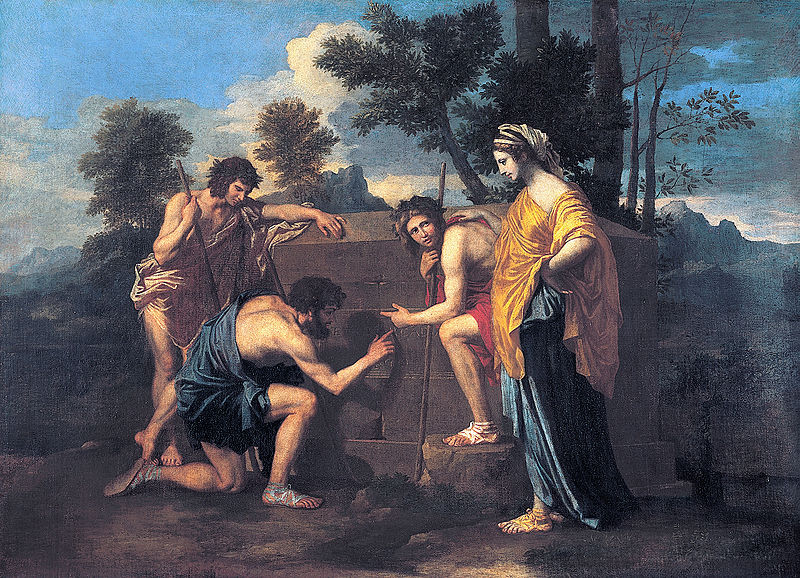
It is, on Marx’s view, characteristic of a much older literary pattern employed first by Virgil in his Eclogues. The harmony of man with nature, positioned between civilization on the one side and wilderness on the other, is troubled by the intrusion of some “counterforce” which signals the greater reality within which the pastoral ideal is played out. The same gesture is made visible in the landscape paintings of the 17th century that introduced some momento mori into the idealized scenery. It is, for example, spelled out by Poussin when his shepherds stumble upon a grave with the inscription, “Et in Arcadia Ego.”

The trains whistle, then, symbolically signaled the larger realities that were inescapably inserting themselves into the cultural landscape. The train’s whistle signaled the arrival of Industrialization and the disordering and reordering of society that came in its wake. Emerson, for example, is explicit about this:

“I hear the whistle of the locomotive in the woods. Wherever that music comes it has its sequel. It is the voice of the civility of the Nineteenth Century saying, “Here I am.” It is interrogative: it is prophetic: and this Cassandra is believed: ‘Whew! Whew! Whew! How is real estate here in the swamp and wilderness? Ho for Boston! Whew! Whew! … I will plant a dozen houses on this pasture next moon …”

It is as if these “little events” were analogous to our asking where we were when Kennedy was shot or when the Twin Towers were attacked. We all, at least those of a certain age, have little narratives we tell about such moments when reality harshly intruded into our idylls and signaled the changing of the times.

As I read all of this, I also wondered whether similar widely shared, equally mundane “little events” were characteristic of other periods of social change. Perhaps, the first time one heard the ring of the telephone or the engine of an airplane overhead. What about our own time? I remember when I first began to notice, in the mid-1990s, that ads on television were now prominently featuring web site addresses. Perhaps, if we’re going for jarring, we might recall the when we began to notice people talking for all to hear on their cell phones in public spaces. I can imagine a contemporary, Hawthorne-like, taking in the scenery at a park let’s say, and then suddenly startled by ones side of some too-audible conversation. (Interestingly, this very scenario was the inspiration for a recent essay by Jonathan Franzen, a literary figure of our time if ever there was one.) All of these “little events,” these little annoyances, might be, like Hawthorne’s train whistle, signifiers of shifting social worlds and mental/emotional states of being.

Any other suggestions?  What your “little events” that in retrospect were harbingers of significant cultural change? What change did they signal? What symbolic role did they play? What larger meanings did they clarify?

Whither the Future?

“There have been men who loved the future like a mistress, and the future mixed her breath into their breath and shook her hair about them, and hid them from the understanding of their times.”

— William Butler Yeats

With those evocative words Yeats began his essay on William Blake. Blake was, in Yeats’ estimation, one of these men who loved the future like a mistress. If he were thinking of nations rather than individuals, Yeats’ might have spoken those same words  of American culture. To say that throughout their history Americans have been more interested  in looking forward to the future rather than backwards at the past is a generalization, but it is rather safe one to make.

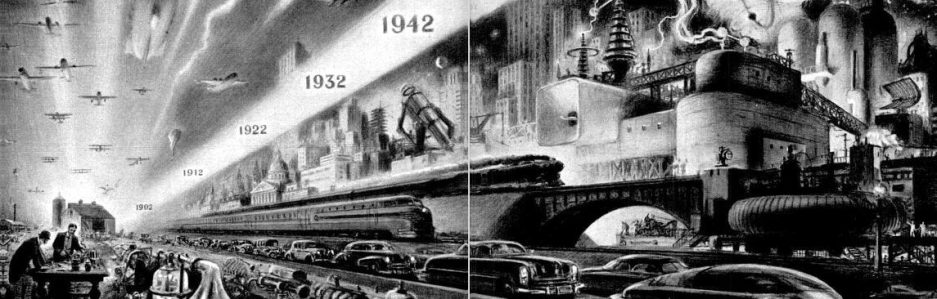
One stunning and not too distant instance of this future orientation was on display at the 1939 New York World’s Fair. I’ve been reading about the fair in both David Nye’s Electrifying America and his later American Technological Sublime. The 1939 Fair is interesting on a number of levels, but I’m especially taken by the manner in which the Fair synthesized perhaps the most remarkable generation or so of technological development with a (corporate) modernist aesthetic to produce an evocative and cohesive utopian vision of the future. The future, or The World of Tomorrow, was the theme of just about every major exhibit at the Fair, and for the first time the most extravagant and well-conceived exhibits were not the national exhibits, but the corporate ones (General Electric, General Motors, AT&T, Chrysler, to name a few). Three major exhibits featured intricate scale model representations of the future city complete with dramatic narration, symphonic music, and 1000 voice choirs making the whole a “quasi-religious experience of escape into an ideal future.”

During the planning that had led up to the Fair, architect and philosopher of technology Lewis Mumford had called for the Fair to be a concrete anticipation of “the future of the whole civilization.” This heady, vaguely spiritualized optimism and expectation for the world of tomorrow is all the more remarkable when we consider that it was articulated and experienced in the latter years of the Great Depression. This may not be all that surprising if we imagine that the hardship of the Depression made people all the more hungry for an escapist model of the future. However, we might also consider the possibility that the Depression could just as easily have quelled all optimism and hope for the future after the very long decade.

And this is our segue to the present. It appears that the cultural mood has shifted. Our collective eyes seemed to be fixed not on the future, but on the past. One indicator of this shift is the resurgence of nostalgia in popular culture that we have noted here before. The nostalgic turn, however, did not just emerge with Mad Men (and now its imitations) and Instagram’s faux-vintage photo apps. It was noted by scholars in the 1990’s and is complicit with the postmodern repurposing of the past as far back as the 1970s. Take all of these together and over the last generation something has been afoot. And if it might be described as a gradual reorientation of American society’s collective gaze toward past rather than the future, then it amounts a startling transformation of immense cultural consequence.

All of this had been flitting about my head for the past several weeks when I came across a piece by Peter Thiel titled “The End of the Future”. Therein, Thiel argues suggestively that, despite appearances to the contrary, scientific and technological development has stagnated over the last couple of decades (with the not insignificant exception of information processing) and our current economic crisis is, in part, a reflection of this stagnation. Consider the following paragraph:

When tracked against the admittedly lofty hopes of the 1950s and 1960s, technological progress has fallen short in many domains. Consider the most literal instance of non-acceleration: We are no longer moving faster. The centuries-long acceleration of travel speeds — from ever-faster sailing ships in the 16th through 18th centuries, to the advent of ever-faster railroads in the 19th century, and ever-faster cars and airplanes in the 20th century — reversed with the decommissioning of the Concorde in 2003 … Today’s advocates of space jets, lunar vacations, and the manned exploration of the solar system appear to hail from another planet. A faded 1964 Popular Science cover story — “Who’ll Fly You at 2,000 m.p.h.?” — barely recalls the dreams of a bygone age.

Thiel also cites this 1967 passage from Jean-Jacques Servan-Schreiber’s The American Challenge,

In 30 years America will be a post-industrial society. . . . There will be only four work days a week of seven hours per day. The year will be comprised of 39 work weeks and 13 weeks of vacation. With weekends and holidays this makes 147 work days a year and 218 free days a year. All this within a single generation.

It’s not unusual, of course, for predictions of this sort to dissolve in the more turbulent waters of reality, but it’s not just that the prediction turned out to be mistaken, it’s that the thought of making any kind of similar prediction today would appear absurd, silly, or infantile.

I’m not necessarily endorsing Thiel’s argument, in fact, I’m not even sure Thiel is endorsing his argument, it felt more like a speculative piece than an argument. But it does add to the growing number of data points that together suggest Americans may be losing their confidence in the future. It would be ill advised to pin this on any one cause, but I especially want to resist pinning this on the economic downturn itself. Remember the exuberance of the 1939 World’s Fair came after ten years of the Great Depression and while the light at the end of the tunnel was not quite visible.

So any thoughts? What’s your take on the future? Any other relevant cultural indicators you can think of?