Techne, Logos, Technology, Technique

In Nature, Technology and the SacredBronislaw Szerszynski writes:

“Aristotle had only conjoined the words techne and logos once, and this in the Rhetoric, seeming to use the term to refer to the way that words, divorced from their, in our terms, vertical relation to universal reason, could be used solely as a means to quotidian, horizontal ends. The Greek word technologousi was used in this sense up to the twelfth century — not as craft subordinated to reason, but as reasoning subordinated to craft and artfulness. But with the Reformation, and particularly with Puritanism, came a new emphasis on reducing the arts to universal, univocal methodological principles — on finding the logos of techne itself, the science that defines all the arts, and thus overcoming the recalcitrance of matter and making it subservient to logos. Technologia, and its synonym, technometria, emerged as Latin terms in the work of the sixteenth-centruy French Protestant rhetorician Peter Ramus, who used them in the more modern sense of ‘the logos of all relations among all technai‘. But it was in the eighteenth century, for example in the work of Johann Beckamann, that the concept of technology as a ‘functional description of the process of production’ emerges in its recognizably modern sense [citing Carl Mitcham].”

Szerszynksi describes this as the “extension of logos, of speech and reason, deeper into the fabrication process, expunging the residual animism that was involved in conceiving the craftworker as having to co-operate with matter.”

Later in the same chapter, after offering a discussion of Heidegger and Foucault, Szerszynski turns to Ellul:

In The Technological System Jacques Ellul seeks to capture features of this new technological condition — both the way that technology in modern society seems to promise a this-worldly salvation by removing uncertainty from human affairs, and its distinctive, self-reproducing dynamic. He distinguishes between traditional ‘technical operations’ and the ‘technical phenomenon’, in terms of the way that the latter takes what was tentative … and ‘brings it to the realm of clear, voluntary and reasoned concepts’. The technical phenomenon (la technique) is a uniquely modern form of making and using artifacts — ‘the totality of methods rationally arrived at and having absolute efficiency … in every field of human activity’. He explores the way that technique resists incorporation into non-technical contexts, and becomes the measure for itself. Traditional technai were located in the context of a non-technical matrix of human ends, with accounts of human flourishing incorporating ideas of beauty, justice and contemplation. But with modern technique, the ends-context of any specific technological application is itself construed in technical terms, so that there is no non-technical context to which technology is understood as subordinate. Technique thus becomes ‘self-directing’, a closed, self-determining phenomenon. Further, technique expands, linking together different techniques in relations of mutual dependency, and absorbs non-technical activities into its orbit. Fundamentally, technique becomes an end in itself, in which elements are functional — adapted not to specific ends but to the needs of the system as a whole. Thus no individual steers the technological process; rather than individuals being the wielders and directors of technology, they are ‘responsible only for seeing that the technical act is done correctly’ [citing Robert Daly, all other quotations in paragraph from Ellul].

Here’s my summary: “Technology” brings together making and thinking. To the Greeks, making was clearly subordinate to thinking. In the early modern period, making is deeply invested with thinking. In the end, the making that emerges from the infusion of thinking is such that its emergent properties as a system triumph over thinking by binding thinking to the logic of making.

Earlier, Szersynski, following Robert W. Daly, offered the following breakdown of tool use according to Aristotle’s four causes:

“… the tool user was the ‘efficient cause’ of the final product, the resource substance used the ‘material cause’, the specific goal of the technological intervention the ‘formal cause’, and the lifeworld context within which that goal was intelligible the ‘final cause’.”

Borrowing these categories, the trajectory outlined above, and Ellul’s position, seems to be that the tool user has become the material cause and the technological system itself simultaneously the efficient, formal, and final causes. This certainly amounts to a strong technological determinism.

An Earthy, Festive Life

Feeling less than satisfied with life these days? Hilaire Belloc has some advice for you:

“… the most important cause of this feeling of satisfaction is that you are doing what the human race has done for thousands upon thousands of years … Whatever is buried right into our blood from immemorial habit, that we must be certain to do if we are to be fairly happy (of course no grown man or woman can really be very happy for long — but I mean reasonably happy), and, what is more important, decent and secure of our souls. Thus one should from time to time hunt animals, or at the very least shoot at a mark; one should always drink some kind of fermented liquor with one’s food – and especially deeply upon great feast-days; one should go out on the water from time to time; and one should dance on occasions; and one should sing in chorus. For all these things man has done since God put him in a garden and his eyes first became troubled with a soul. Similarly some teacher or ranter or other, whose name I forget, said lately one very wise thing at least, which was that every man should do a little work with his hands.”

I appreciate the allowance for those who are not terribly keen on hunting. Now the only question is what fermented liquor to have with breakfast.

Oh, The Miracles You’ll See: The View from 1950

Serendipitously, given recent topics, I came across a post at How To Be A Retronaut reproducing a 1950 article in Popular Mechanics titled, “Miracles You’ll See in the Next Fifty Years.” I’m unable to reproduce the images here, so you’ll have to click over to take a look. Here is some of what you’ll find:

In the realm of “not far off the mark if you squint,” there is the prediction that you’ll shop by a kind of television like picture-phone which also allows for business men to tele-conference. The Internet gives us something in the ballpark.

Related to the city-centered vision of the future, take a look at the images on the first couple of pages. The city’s layout itself is part of the vision. It is composed of a series of concentric rings connected by roads that slice up the city like a pizza. The inner ring is dense and urban and the outer ring is suburban and green.

Related to housework and labor saving devices, and this is really the best thing in the whole article, “Because everything in her house is waterproof, the housewife is 2000 can do her daily cleaning with a hose.” There was, in case you are wondering, a drain in the middle of the room. Oh, and speaking of drains, you’ll also be glad to know that plastic plates will make cleaning up a breeze since they’ll melt under hot water and just float down the drain.

Men, we can look forward to the end of shaving with a razor since we’ll be take care of our facial hair with a “chemical solution.” But you’ll get personal helicopters to make up for it.

Interestingly, while they predict that wrinkles will be merely a sign of neglect, they play it rather safe on the matter of health. The life-span will be 85, which is just about right, and cancer will not have been eradicated even though progress will have been made. They are also optimistic about the possibilities of electrical treatments to help control neurological disorders.

There is much more besides, but here is the closing:

“It is astonishing how easily the great majority of us fall into step with our neighbors. And after all, is the standardization of life to be deplored if we can have a house like Joe Dobson’s [the fictional man of 2000], a standardized helicopter, luxurious standardized household appointments, and food that was out of the reach of any Roman emperor?”

Ah, the virtues of standardization.

The Future In All Its Sterile, Data-Crunching, Over-worked, Privatized Glory

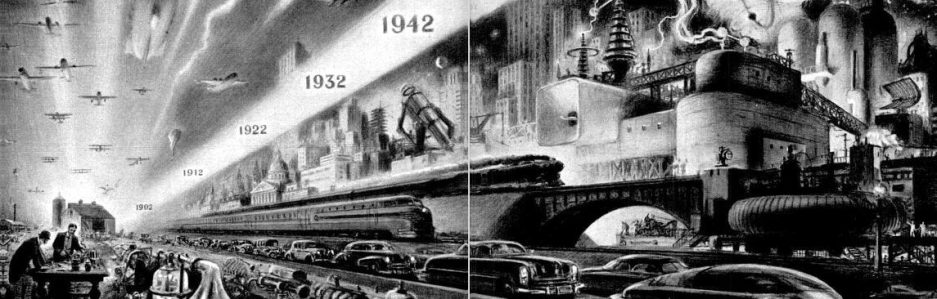
In the past few weeks I’ve written a handful of times about the 1939 World’s Fair and the techno-uptopian vision of the future that infused the major pavilions. I was impressed by the scale of the vision. Coming at the end of one of the most difficult decades in American history, the Fair managed to exude a stunning confidence in what the fusion of corporate, modernist, and technological resources would achieve in just 20 years time — 1960.

The 1939 New York Fair was followed by another New York Fair in 1964. Four years into the projected utopia, it was clear that the hopes of the 1939 Fair were dramatically unrealized. The 1964 Fair, however, still tried its hand at forecasting the future, although this time without setting a date. The famous Carousel of Progress at Walt Disney World, for example, debuted at GE’s pavilion. Pivoting our focus on Disney, EPCOT Center, which is a kind of permanent World’s Fair, debuted in 1983 and with it the Horizons pavilion which also offered a vision of the future in the grand World’s Fair style. The future was still being projected in a rather big way. If you have any doubts about the impact of Horizons, do a quick search on Google to get a glimpse of the cult following the ride engendered.

All of this to ask, are there any comparable contemporary projections of the future? Well, it’s not quite comparable in terms of the experience, but with this question in mind I came across a video produced by Microsoft which presents us with a vision of the future. Take a look:

There’s some interesting stuff in there I suppose, but it certainly fails to capture the imagination, no? A bit sterile and uninviting, and apparently the future is dominated by visual displays of data. Charts, lots of charts. Granted the video is explicitly centered on the theme of productivity and it is a bit hard to cast a vision of the future based on that theme alone.

This future is also one in which our experience is even more thoroughly mediated through screens and interfaces, and one in which no one seems to speak outside the home and office. And whereas the earlier classic appeal of technology was the promise of reducing labor, it appears that now the appeal of technology is in its ability to allow us to work from anywhere and to fill every idle minute with yet more work. Productivity indeed.

Most notably, by contrast with the future visions discussed earlier, this was also a rather privatized vision of the future. There was very little, if anything at all by way of a societal vision. It’s no longer a big vision of the future that requires a panoramic diorama of the city to fully capture, in fact, the city as city is largely absent from this future. The home and the office take center stage and when there are glimpses of the city, it is only as the immediate background of the users experience of some personal technology.

I don’t go in for utopian visions, but there is something vaguely depressing about a failure to imagine a utopia that might even be remotely evocative, to say nothing of offering a substantive challenge to the status quo.

Weekend Reading, 10/29/11

We’ll start this week’s assortment of links with a quick look back at a key moment in the history of American technology:

“150 Years Ago a Primitive Internet United the USA” by John Rogers in The Sydney Morning Herald: 

Journalist revisits the completion of the first transcontinental telegraph line. Easy to forget how truly revolutionary the telegraph was at the time. For the first time in history, human communication could travel faster on land than a man on a horse. By the way, keeping in mind the technology/religion theme that has been in evidence here lately, let’s not forget the first telegraphic message: “What hath God wrought?”

From the past to the future. Here are two pieces on the much hyped “Singularity.” In the first, Cory Doctorow interviews Ray Kurtzweil, Singularity’s most well-known prophet/advocate. In the second, Microsoft co-founder Paul Allen explains why the Singularity is almost certainly not going to take place by 2045.

“Thought Experiments: When The Singularity Is More Than A Literary Device”

“The Singularity Isn’t Near”

From the likely or unlikely future, back to the past. Here are a couple of offerings I came across at Brainpickings. The first is a brief look at the history of books through a series of really interesting and compelling images (portraits, drawings, frescoes, etc.) and the second is a video compiling the closing segments of a series documentaries on the health of the city by renowned urbanist and critic Lewis Mumford.

“Books: A Living History”

“Lewis Mumford on the City: Rare Footage from 1936”

Finally, here is an older essay from Wendell Berry. Berry, in case you are not familiar with his work, is a poet, essayist, farmer, and advocate of the agrarian life and local communities. His insights are out of step with modern assumptions and values and do not easily fit into our narrow left/right political and social schemas, and they are all the wiser for it. Here he writes on sustaining vibrant and healthy local communities.

“Conserving Communities”

Enjoy, and have a great weekend. If you’re reading in the American North East, enjoy the early snow!