
Disabilities, Bias, and Online Education

In “The Invisible Audience and the Disembodied Voice: Online Teaching and the Loss of Body Image,” Joanne Buckley offers a very personal reflection on the possibilities online education offers professors and students with physical disabilities. Buckley, who was diagnosed with cerebral palsy as a child, found that her “experiences teaching writing online have been the most experimental, fruitful, and often the most intimate work I have done, mainly because I feel freed from the real—and perceived—constraints of my physical body.”

Buckley’s paper is based largely on the contrasting responses she has received in online as opposed to traditional classroom settings. She believes that in the online environment she is unencumbered by the biases that unfortunately confront physically handicapped professors. But not only professors: “The absence of barriers between students that may result from differences in age, race, and gender seems to help make communication among students easier and less restrained.”

Furthermore, while it is obvious that the online classroom relieves disabled students and professors from the physical constraints of inadequately designed classrooms, Buckley argues that the online classroom also confers psychological benefits. To a list of benefits that includes the privacy needed to write well, greater opportunity for participation, and personalized pacing, she adds “the chance to avoid being judged by one’s physical appearance.” Buckley also believes that greater credibility attaches to her person when she is communicating in disembodied venues. Finally, Buckley also contends that her wheelchair as well as the difficulty with which she stands up to write on the board or use the overhead projector amounts to a significant distraction from the actual content of her teaching.

For all of these reasons, Buckley is hopeful that the disembodied experience of online education will create opportunities for students to learn and express themselves without having to deal with the prejudices that sometimes shape fully embodied interactions. Moreover, the professor or student is freed not only from the bias of others, but also from the anxieties that attend the anticipation of such treatment. The online space then, precisely because of its disembodied character, becomes a utopian space where pure minds engage free from the complications attending the body and its particularities.

Underlying Buckley’s analysis is the assumption that the body and the self (or, selves) are only contingently related to one another. So, for example, she approvingly cites the following observation by a person interviewed by Sherry Turkle for Life on the Screen: “why grant such superior status to the self that has the body when the selves that don’t have bodies are able to have different kinds of experiences?” Likewise, she borrows Emerson’s metaphorical rendering of soul and body as dreams and beasts respectively and suggests, again following Turkle, that computer mediated communication can, for a time, hold “the beast at bay in pursuit of the dream.”

For those with physical disabilities, a technology that enhances access to educational opportunities is a welcome development. Buckley reminds us that most of our thinking about online education is conducted through the lens of those whose bodies are whole. But one wonders whether in its hiding from view the body and its particularities, online education does not perpetuate, to some degree,  the very prejudices it purportedly overcomes. In fact, such prejudices are not overcome at all. It seems preferable to bring students together in a fully embodied context so that whatever prejudices exist are not merely bracketed, but rather confronted and truly overcome.
Online Education and Its Discontents

A good deal of my course work over the last couple of years has been conducted in online environments. My university offers three types of courses: face-to-face courses, hybrid courses with online and face-to-face components, and fully online course. The majority of my courses have been either hybrid or fully online. On the whole, I’ve not been pleased. This is not necessarily an indictment of the professors who have supervised these courses. It is true that some have been better executed than others, but even the best have been a disappointment despite the professor’s best efforts.

I’m not sure how typical my estimation of online education may be, but The Chronicle of Higher Education recently reported that the growth of online courses has slowed and may be approaching a plateau. Here are some of the findings of the survey of more than 2,500 institutions of higher education:

  • An online course is now part of the experience of 31% of all students
  • Enrollment in online courses grew by 10%, considerably less than last year’s 21%
  • 67% of academic leaders rated online education as the same or superior to face-to-face learning
  • Fewer than one-third of chief academic officers feel their faculty “accept the value and legitimacy of online education. This percent has changed little over the last eight years.”

For my part, and take this with a grain of salt, I suspect that “academic leaders” may be driven by considerations that have less to do with quality education than with other benefits that may arise from the implementation of online classes. More online classes, for example, mean growing the student body without necessarily expanding the physical plant which is always an expensive venture.

Online classes do confer certain benefits on students, of course, flexibility being only the most obvious. Again, though, I wonder how many of these benefits are related to the actual educational quality of the online experience. I realize that face-to-face classes in many instances will also leave much to be desired, but based on my limited experience, I’ll take an imperfect face-to-face class over an ideal online class in most cases.

Ultimately, I attribute this to the manner in which the medium abstracts the body from the learning experience. In the next day or two I’ll be posting some more reflections on the topic. If you have had any experiences as either a student or a teacher in an online environment, I’d love to hear your thoughts.

Cell Phones and Longbows: Watershed Moments In History And The Technologies That Facilitate Them

In a recent NY Times editorial, historian Paul Kennedy drew our attention away from developments in consumer technology and toward what he called “the hard worlds of economics and politics.” Kennedy believes that we may be passing through a watershed moment in human history largely unawares because we are distracted by less important facets of present circumstances.

Rather than obsess about the latest gadgets that come on the market, we should be paying attention to at least four developments that are, according to Kennedy, of momentous import. They are, in his words:

a. “the waning of the dollar’s heft”

b. “the unwinding of European dreams” of political union

c. “the arms race in Asia”

d. “the paralysis of the U.N. Security Council”

These are indeed significant developments and one should hope that they are not being ignored, by either the voting public, or those voted into office to steer the ship of state through these turbulent waters (although on the latter see the last post.) But it is unfortunate that Kennedy opposes attention to these economic and political developments and attention given to technological developments.

It is unfortunate, and also curious given some of what Kennedy himself alludes to in his essay.

Describing two previous watershed moments in the history of the West he writes,

“No one alive in 1480 would recognize the world of 1530 — a world of new nation-states, Christendom splintered, European expansion into Asia and the Americas, the Gutenberg communications revolution. Perhaps this was the greatest historical watershed of all time, at least in the West.

There are other examples, of course. Someone living in England in 1750, before the widespread use of the steam engine, would have been staggered at its application 50 years later: The Industrial Revolution had arrived!”

Well, as I think about these moments of great historical change, it seems to me that technology was inextricably implicated in each. Technology, or better, technologies were not the sole factor driving historical change in these instances, but it would be hard to imagine the change taking place without the technologies.

Notably, Kennedy later refers to the critical role of the printing press in a rather odd paragraph:

“So what about today? Many newspaper correspondents and technology pundits point excitedly to our ongoing communications revolution (cell phone, iPad and other gadgetry), and to its impact upon states and peoples, upon traditional authorities and new liberation movements. The evidence for this view is clear across the entire Middle East, and even in the very tame “Occupy Wall Street” movement, although one wonders if any of the high-tech prophets proclaiming that a new era in world affairs has arrived have ever bothered to study the impact of the Gutenberg printing press, or of F.D.R.’s radio chats to tens of millions of Americans in the 1930s and early 1940s.”

This is an odd paragraph because the events it cites seem to undermine the gist of his argument, and because of the closing line. I’m not sure which “hight-tech prophets” Kennedy has in mind, but, in fact, the printing press is often enough cited as a precedent of note when exploring the social transformations wrought by technological change. While I doubt her work informs much of the popular level discourse, Elizabeth Eisenstein’s magisterial two-volume, The Printing Press as an Agent of Change certainly explores the consequences of the printing press in fine-grain detail.

I suspect that Kennedy may be mostly distraught by the attention given to something like the release of the latest iPhone and the ensuing consumerist frenzy/orgy. Fair enough. But when we consider the larger “communications revolution,” to use Kennedy’s own formulation, of which the latest iPhone is but a bit part, then the focus on technology is not at all misplaced.

In fact, I wonder whether technology could not be implicated in the four developments that Kennedy himself lists from the hard world of economics and politics. I suspect so. For example, I would think it impossible to discuss the current monetary situation and fluctuations in currency values from the interconnected world of electronic, computerized buying, selling, and trading.

Finally, it was Kennedy’s conclusion that led to the train of thought developed in this post. Kennedy wrapped with the following:

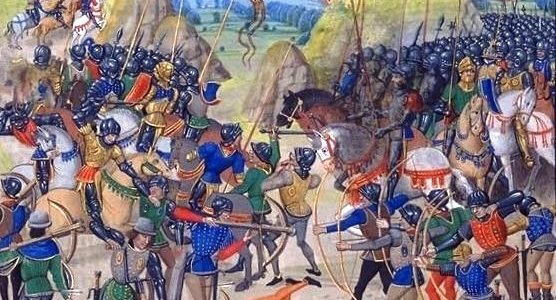
“It is as if one were back in 1500, emerging from the Middle Ages to the early-modern world. The crowds at that time were marveling at a new and more powerful longbow. Surely we can take our world a bit more seriously than that?”

The irony here is that if you consider Lynn White’s work on medieval society, then you might conclude the attention to the longbow was not at all misplaced. White’s thesis taken by itself is probably reductionistic, but it does point to important factors. He argued that the feudal system and the consequent social order was premised on the invention of the stirrup which led to the appearance of mounted, armored soldiers and the rise of wealthy, landed aristocrats  who could afford to maintain mounted knights in their service. This social order was itself challenged by the invention of the longbow which, given its long range and armor piercing capability, drastically undermined the combat effectiveness of mounted knights. Historian Theodore Rabb, in The Last Days of the Renaissance, has likewise argued for the analogous role played by gunpowder in the evolution of the modern nation state.

Looking only at technology, especially if by that we mean consumer electronics in suburban context, is certainly too narrow a frame by which to understand our times. But the reverse is also true: trying to understand political and economic realities while ignoring the underlying technologies that shape those realities is likewise ill advised.

Technology, politics, and economics — not to mention all of the other complex social realities we too neatly compartmentalize by the very act of naming them — these are all recursively interrelated and entangled in fascinating ways and we do well resist the temptation to take refuge in explanations and understandings that refuse the complexity by unduly privileging one dimension of social reality over all others.

Froissart’s “Battle of Crecy”

“Harry Truman” … the Song

Before they started belting out ’80s power ballads, the band Chicago put out more, how shall we say … politically interesting music.  Having recently heard David McCullough, Harry Truman had been on my mind, and today I remembered that Chicago released a song titled “Harry Truman” back in 1975.

In the wake of the Watergate scandal it’s easy to see why the song did so well on the charts, peaking at #13. Today it might race to #1.

“Harry Truman”

by Robert Lamm

America needs you
Harry Truman
Harry could you please come home
Things are looking bad
I know you would be mad
To see what kind of men
Prevail upon the land you love

America’s wondering
How we got here
Harry all we get is lies
We’re gettin’ safer cars
Rocket ships to mars
From men who’d sell us out
To get themselves a piece of power

We’d love to hear you speak your mind
In plain and simple ways
Call a spade a spade
Like you did back in the day
You would play piano
Each morning walk a mile
Speak of what was going down
With honesty and style

America’s calling
Harry Truman
Harry you know what to do
The world is turnin’ round and losin’ lots of ground
Oh Harry is there something we can do to save the land we love


The Not So Dark Ages

Actually, it depends what period you label as the Dark Ages, but here is an excerpt from a longish interview Douglas Rushkoff gave at HiLobrow that gives us a counterintuitive perspective:

PN: They didn’t get money from Rome to fund their cathedrals?

DR: They did not. The Vatican and central Rome did not build the cathedrals. The funds came from local currency, which was very different than money as we use it now. It was based on grain, which lost value over time. The grain would slowly rot or get eaten by rats or cost money to store, so the money needed to be spent as quickly as possible before it became devalued. And when people spend and spend and spend a lot of money, you end up with an economy that grows very quickly.

Now unlike a capitalist economy where money is hoarded, with local currency, money is moving. The same dollar can end up being the salary for three people rather than just one. There was so much money circulating that they had to figure out what to do with it, how to reinvest it. Saving money was not an option, you couldn’t just stick it in the bank and have it grow because it would not grow there, it would shrink. So they paid the workers really well and they shortened the work week to four and in some cases three days per week. And they invested in the future by way of infrastructure — they started to build cathedrals. They couldn’t build them all at once, but they took the long view — with three generations of investment they could build an entire cathedral, and their great-grandchildren could live in a rich town! That’s how the great cathedrals were built, like Chartres. Some historians actually term the late Middle Ages “The Age of Cathedrals.”

Here’s the really interesting part:

They were the best-fed people in the history of Europe; women in England were taller than they are today, and men were taller than they have been at any point in time until the 1970s or 80s (with the recent growth spurt largely the result of hormones in the food supply). Life expectancy of course was still lower; they lacked modern medicine, but people were actually healthier and stronger and better back then, in ways that we don’t admit.

That was right before the corporation and the original chartered monopolies were created, before central currency was created and local currencies were outlawed. When everything gets moved into the center, things began to change.

PN: It seems like the Dark Ages were not perhaps so “dark.”

DR: Yes, I think that’s disinformation. I’m not usually a conspiracy theorist about these things, but I think the reason why we celebrate the Renaissance as a high point of western culture is really a marketing campaign. It was a way for Renaissance monarchs and nation-states, and the industrial age powers that followed, to recast the end of one of the most vibrant human civilizations we’ve had, as a dark, plague-ridden, horrible time.

Read the whole thing, it is a very engaging reflection on the history of corporations and currency. Depending on your interests, that may sound as appealing as watching paint dry on a muggy day, but really, it’s quite good and comes complete with imbedded video including scenes from Monty Python and Rudolph the Red Nose Reindeer.

Oh, and I almost forgot to add: No, I don’t want to be a medieval peasant.