
Considering Online K-12 Courses? Some Things to Keep in Mind

This past weekend, The Wall Street Journal ran a story covering the rapid growth of online K-12 education. “My Teacher is an App,” by Stephanie Banchero and Stephanie Simon, discusses the rise of online and hybrid classrooms providing a fairly balanced account of successes and disappointments. Here are some of the key points:

  • “In just the past few months, Virginia has authorized 13 new online schools. Florida began requiring all public-high-school students to take at least one class online, partly to prepare them for college cybercourses. Idaho soon will require two. In Georgia, a new app lets high-school students take full course loads on their iPhones and BlackBerrys. Thirty states now let students take all of their courses online.”
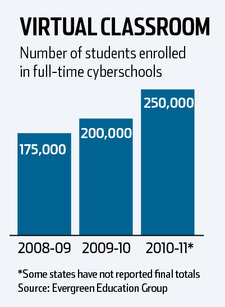
  • “Nationwide, an estimated 250,000 students are enrolled in full-time virtual schools, up 40% in the last three years, according to Evergreen Education Group, a consulting firm that works with online schools. More than two million pupils take at least one class online, according to the International Association for K-12 Online Learning, a trade group.”
  • “Although some states and local districts run their own online schools, many hire for-profit corporations such as K12 Inc. of Herndon, Va., and Connections Academy in Baltimore, a unit of education services and technology company Pearson PLC.”
  • “A few states, however, have found that students enrolled full-time in virtual schools score significantly lower on standardized tests, and make less academic progress from year to year, than their peers.”
  • “At Southwest Learning Centers, a small chain of charter schools in Albuquerque, N.M., standardized test scores routinely outpace state and local averages, according to data provided by the schools. Students complete most lessons online but come into class for teacher support and hands-on challenges, such as collaborating to design and build a weight-bearing bridge.”
  • “The growth of cybereducation is likely to affect school staffing, which accounts for about 80% of school budgets. A teacher in a traditional high school might handle 150 students. An online teacher can supervise more than 250, since he or she doesn’t have to write lesson plans and most grading is done by computer.
Mill. Factory. Sweat shop. I’m sorry, I think I may have just editorialized. Hardly a sweat shop I know, but it strikes me that most of what makes teaching worthwhile gets lost in an online model that reduces the teacher to some combination of a manager, customer experience expert, and help desk attendant.
.
  • “In Idaho, Alan Dunn, superintendent of the Sugar-Salem School District, says that he may cut entire departments and outsource their courses to online providers. “It’s not ideal,” he says. “But Idaho is in a budget crisis, and this is a creative solution.”

Other states see potential savings as well. In Georgia, state and local taxpayers spend $7,650 a year to educate the average student in a traditional public school. They spend nearly 60% less—$3,200 a year—to educate a student in the statewide online Georgia Cyber Academy, saving state and local tax dollars. Florida saves $1,500 a year on every student enrolled online full time.”

“Two companies, K12 and Connections Academy, dominate the market for running public cyberschools. Full-time enrollment in online schools using the K12 curriculum has doubled in the past four years, to 81,000, the company says. K12’s revenue grew 35% to $522 million in its fiscal year ended June 30, when it reported net income of $13 million.”

Beware the profit motive. I’m no opponent of the free market properly understood, but limited experience with for-profit schools (which do not include all private schools) suggests to me that the quality of education often gets undermined by the dynamics of the market. (And that was putting it kindly.) It may be especially problematic when for-profit schools tap into government money.

  • “In the end, virtual schooling “comes down to what you make of it,” says Rosie Lowndes, a social-studies teacher at Georgia Cyber Academy. Kids who work closely with parents or teachers do well, she says. “But basically letting a child educate himself, that’s not going to be a good educational experience.” The computer, she says, can’t do it alone.”

True, but “what you can make of it” is already limited by the constraints of the medium.

To sum up: Enrollment in online courses is increasing rapidly. School districts are saving money. Some private companies are turning an impressive profit. Online teachers help students navigate ready made modules and supervise more students than their in classroom peers. Results are mixed. Hybrid appears to work better than all online. Parent involvement remains important.

For a more detailed and impassioned breakdown of the article see Will Richardson’s post here.

Things to consider: Students vary as do their needs and the circumstances under which they flourish. It is as misleading to argue that online learning is the cure for all the ills plaguing K-12 education as it would be to suggest that it is never, under any circumstances a viable option. I’ve been mostly critical of the online learning experience. This criticism is informed by my experience as a student in numerous online courses and my experiences as a classroom teacher. (You can read my mostly critical comments in this series of posts.) But it is increasingly likely that students will encounter at least one online course during their high school or college career.

When deciding whether or not to enroll students in online courses, here are some things to take into consideration:

  • What is the respective quality of available educational options? In my estimation, the ideal face-to-face classroom beats the ideal online experience, all other factors being equal. But very often the ideal face-to-face classroom is far from the reality on offer at local schools. Know your school and the faculty’s strengths and weaknesses.
  • What courses work well online and which do not? A math course which already tends to be designed in progressive modular fashion will translate into an online environment more effectively than a literature class in which, ideally, lively discussion characterizes the face-to-face dynamic. Science classes that are heavy in hands-on experimentation may also loses something significant in translation. Students may also find that both subjects that are difficult for them and subjects that they are very interested in are better taken face-to-face in the presence of expert teachers.
  • What is the motivation for taking online courses? Online courses may allow students who are unable to attend traditional schools due to health issues to keep up with their education and this is certainly a good reason to consider online learning. Additionally, motivated students may desire to learn about a subject that is not offered at traditional schools. Again, sound motivation. Some students, on the other hand, may believe that online coursework is easier and that it will afford them maximal freedom and down time at home. This may not be the best motivation especially since studies have suggested that students who do best in online coursework are highly motivated, diligent, and well organized.
  • What are the student’s strengths and weaknesses? Since students that tend to do well in online environments tend to be those who are intrinsically motivated and well-organized, it is important to honestly consider whether a student has already demonstrated these qualities in traditional settings since it is not likely that those qualities will spontaneously emerge in a less structured setting.
  • Finally, remember that face-to-face interactions regarding the subject matter will always augment the online experience. Ask your student questions about the courses they are taking online. Granted most teenagers may not be very forthcoming; but, if they are willing, a dinner table conversation about what they are learning online could go a long way toward making a less than idea learning situation more valuable.
Remembering George Kennan

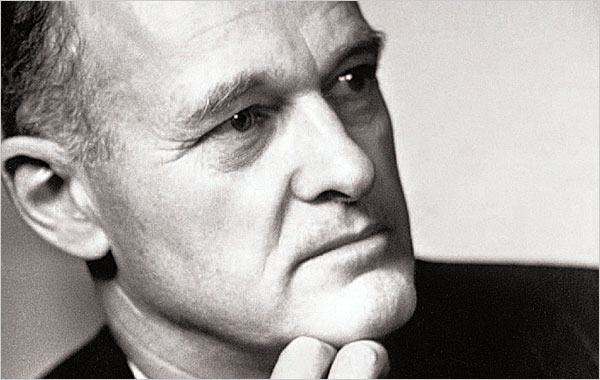
Early on in the life of this blog I wrote a couple of posts referencing George Kennan, the American diplomat and scholar who played a seminal role in the evolution of American foreign policy in the years following the close of the Second World War. Kennan’s “Long Telegram,” for example, is generally considered to be the ur-text of containment, even if Kennan later disavowed its application. Kennan’s influence later permeated the State Department under George C. Marshall. After the Truman administration, Kennan would serve from time to time in an advisory capacity but largely as an outsider — a status he keenly felt.

In the second of those posts last summer I noted the following observation from a review of Peter Beinhart’s The Icarus Syndrome: A History of American Hubris:

Kennan once set out to write a biography of Chekhov; as Beinart dryly observes, “Bush sent a man to run Iraq, L. Paul Bremer, who had never before been posted to the Arab world. To grasp the intellectual chasm between American foreign policy toward the U.S.S.R. in 1946 and American foreign policy toward Iraq in 2003, one need only try to envision Bremer writing a biography of an Iraqi writer, or, for that matter, being able to name one.”

Perhaps I may be forgiven for a certain nostalgic and perhaps romanticized longing for a foreign policy team that featured George C. Marshall and Dean Acheson along with George Kennan. Acheson, Kennan, and four other contemporaries feature in Walter Isaacson and Evan Thomas’ The Wise Men: Six Friends and the World They Made. And Kennan is the subject of a new biography by John Lewis Gaddis, dean of Cold War studies, titled George F. Kennan: An American Life.

It’s doubtful that I’ll get a chance to read Gaddis’ book any time soon, so I am glad for two long reviews that have appeared to give a taste of the whole: Louis Menand’s review in the New Yorker and Henry Kissinger’s in the NY Times. Here is the conclusion of Menand’s review:

“Still, buried within Kennan’s realism there is a moral view: that in relations of power, which is what he thought international relations ultimately are, people can’t be trusted to do the right thing. They will do what the scorpion does to the frog—not because they choose to but because it’s their nature. They can’t help it. This is an easy doctrine to apply to other nations, as it is to apply to other people, since we can always see how professions of benevolence might be masks for self-interest. It’s a harder doctrine to apply to ourselves. And that was, all his life, Kennan’s great, overriding point. We need to be realists because we cannot trust ourselves to be moralists.

This was the danger that the United States faced after Europe had destroyed itself in the Second World War. We had power over other nations to a degree unprecedented in our history, possibly in the world’s history, and it was natural for us to conclude that we deserved it. “Power always thinks it has a great soul,” as another Adams, John, once said. Containment was intended as a continual reminder that we do not know what is best for others. It is a lesson to be ignored only with humility.”

And this from Kissinger’s:

“In a turbulent era, Kennan’s consistent themes were balance and restraint. Unlike most of his contemporaries, he applied these convictions to his side of the debate as well. He testified before the Senate Foreign Relations Committee against the Vietnam War but on the limited ground that there was no strategic need for it. He emphasized that the threat posed by Hanoi was exaggerated and that the alleged unity of the Communist world was a myth. But he also warned elsewhere against ‘violent objection to what exists, unaccompanied by any constructive concept of what, ideally ought to exist in its place.’ He questioned the policy makers’ judgment but not their intent; he understood their dilemmas even as he both criticized and sought to join them.”

It is too easy to idealize historical figures after the more jagged edges of their performance on history’s stage have been smoothed over by the passage of time. But I cannot help but think that Kennan — and Acheson and Marshall — represented a seriousness that at times seems to be wholly absent from the present political scene.

Kennan had his contradictions and, being human, he was not without flaws and blind spots. And yet, we might safely conclude that he was no fool, and that, regrettably, seems to be more than we can say as we survey the population of our present political landscape. We are in the thrall of great frivolity and there is a disheartening lack of seriousness to our political discourse. And little wonder, we seem long ago to have lost the patience for intellectual rigor and nuance. That a diplomat would undertake the biography of a foreign literary figure is likely to strike us as a waste of resources.

The realities of lived, concrete experience demand a certain provisionality and openness, anchored by deep learning, that issues in practical wisdom. This wisdom coupled with moral courage is what the times demand. And, if I may be pardoned a moment of unseemly cynicism, it is precisely this package of virtues that our political discourse seems to forbid by the logic of the media ecosystem in which it plays out. In this environment our political options have calcified into grotesque parodies of themselves and it is at times hard to be hopeful.

In his 1994 memoir, Kennan wrote,

“… let us, acting on the principle that peoples tend, over the long run, to get the kind of government they deserve, leave the peoples of these ‘nondemocratic’ countries to be governed or misgoverned as habit and tradition may dictate …”

The principle that “peoples tend, over the long run, to get the kind of government they deserve” may not always be a fair historical assessment, but if there is even a grain of truth to it, as I suspect there is, then this does not bode well for us.

From Novice to Expert: The Body’s Role in the Acquisition of Knowledge

Hubert Dreyfus, following Martin Heidegger and Maurice Merleau-Ponty, considers the body an indispensable component of knowledge acquisition. For Dreyfus, and those who place a similar emphasis on embodiment, human beings are not merely minds who process information. We are embodied minds who learn and experience reality by processing more than just discreet bits of data which can be formalized and verbalized. Much of what we know, in their view, cannot, in fact, be verbalized or formalized. Instead, this sort of knowledge is carried in the body in the form of habit or pre-rational understanding that yields intuitive comprehension and action. In light of this view of knowledge, Dreyfus is skeptical of online learning because of the manner in which it appears to abstract the body from the experience of learning.

Dreyfus expressed his concerns with online eduction in his 2001 book, On the Internet. He begins by noting the enthusiasm with which some educators were then touting the potential of the Internet to transform education. He cites, for example, Reed Hundt, one time dean at Yale University who believed that “the new Internet system of education” had the potential to “bring down” the older, traditional model of education.

Hundt, to be clear, was cheery about this possibility. Dreyfus notes that some educators were much less sanguine about the potential of the Internet, but in his estimation neither side offered anything by way of an argument for their position. To fill this gap, Dreyfus articulates a theory of skill and knowledge acquisition in which the body plays a central role. By implication, if Dreyfus’ theory holds, then online education would appear to be an inadequate environment for education.

In Dreyfus’ view, a learner proceeds through the following stages of skills acquisition: novice, advanced beginner, competence, proficiency, expertise, and practical wisdom. As he considers each of these stages, Dreyfus provides three variations of skill acquisition: a motor skill, an intellectual skill, and “what takes place in the lecture hall.”

The running example in the first two variations are, respectively, learning to drive and learning to play chess. It is in these first two variations that the strength of his exposition is most evident, but I’ll use the third variation to briefly describe Dreyfus’ model. Here then are the stages of knowledge acquisition briefly explained.

Novice: At this stage context independent information about the domain is communicated along with basic rules that the learner can recognize without yet possessing the skill in question.

Advanced beginner: Context comes into play at this stage as learners, through experience with the material, are led to recognize context dependent meaning of the information and rules that they learned as novices.

Competence: As students learn more about the material they may be overwhelmed by the amount of relevant information and aspects of a situation that they are now able to discern. Achieving competence depends on developing the ability to make decisions about what is most important or relevant to a particular situation or problem. At this point, since the volume of potentially relevant information is so large, a learner must begin to intuitively discern rather than consciously process all of the possibilities. Additionally, at this stage Dreyfus also notes that a certain emotional response, either the despair of failure or the exhilaration of success, will significantly influence whether or not the learner continues on to the later stages.

Proficiency: The proficient learner, reinforced by positive emotional experiences, will internalize knowledge gained from extensive experience with problems in the domain of learning and will intuitively recognize the salient features of any new problem and see, without consciously processing a wide array of rules and maxims, what needs to be solved.

Expertise: In Dreyfus’ own words, “The expert not only sees what needs to be achieved; thanks to his vast repertoire of situational discriminations, he also sees immediately how to achieve his goal.”

Practical wisdom: Finally, the learner will have not only mastered a skill so as to intuitively solve problems, they will also learn “the general ability to do the appropriate thing, at the appropriate time, in the appropriate way.”This essentially entails a culturally aware and sensitive manner of being an expert.

Dreyfus does not argue that online learning is without value. Online learning may get us as far as the first two stages; but not, in his view, much farther than that. Beyond the first couple of stages of knowledge/skill acquisition, embodiment is indispensable:

“Distance learning enthusiasts … need to realize that only emotional, involved, embodied human beings can become proficient and expert and only they can become masters. So, while they are teaching specific skills teachers must also be incarnating and encouraging involvement. Moreover, learning through apprenticeship requires the presence of experts, and picking up the style of life that we share with others in our culture requires begin in the presence of our elders.”

It is always worth asking what view of knowledge or what philosophy of education is assumed when we engage in discussions and debates about pedagogy, on- or offline. It seems to me that the most optimistic visions for online learning attain a certain plausibility only on the assumption of a rather narrow view of what knowledge or an education entails. Sometimes this is the best that can be hoped for and we should not besmirch online learning’s ability to bring some education to those whose only other option would be no education at all; again context and situation matter. But strictly online education hardly represents an ideal — unless we already assume that knowledge and learning amount to the mere aggregation of discreet bits of data.

Teaching: What is There to Love?

Dini Metro-Roland and Paul Farber offer an elegiac defense of traditional, face-to-face teaching in their 2010 essay, “Lost Causes: Online Instruction and the Integrity of Presence.” Their implicit critique of online learning is framed as a lover’s concern for the well-being of the beloved, in this case the craft of teaching. The authors note that there is a sense of inevitability to the growth of online courses, and, while noting that fiscal considerations play some role in this, they acknowledge that the online format confers certain benefits upon students. Believing that the most important difference between traditional and online settings is the form of presence involved in each, the authors group the perceived benefits of online instruction under the notion of “utility of presence” which they contrast to the “integrity of presence” that attends face-to-face instruction.

Utility of presence is premised on the freedom, flexibility, and control that online instruction offer to participants. Free from the constraints of embodiment, online students may engage their courses asynchronously at their own convenience and they may exert “maximal control over when and for how long one will do what is called for in making one’s presence felt.” Altogether the medium allows for “engagement constituted by patterns of individual choice.”

Metro-Roland and Farber correctly link the dynamics of utility of presence to the ethos of the broader online experience in which online learning is embedded. They note, for example, that, “Being online carries with it the ready capacity, moment to moment, to layer content (for example, background music, instant messaging, online gaming) or launch into other forms of activity altogether — whether course related or not — at any time.”

Consequently, the online learning experience privileges “the capacity to attend to just what one wants or needs right now and, recognizing the vast range of options, learning to dismiss or disregard the rest.” This form of “knowingness” is “not suspended when one comes to an online course.” In their estimation, the virtual presence that constitutes online learning is finally “the product of judgments as to how to gratify one’s inclinations and efficiently serve one’s purposes online.”

This is a point that is all too often missed. The medium of online learning is the Internet and the habits and practices that intend the medium, including for example fractured patterns of attention, likewise shape the experience online courses. Metro-Roland and Farber do not ground the elaboration of the “utility of presence” in an indictment of the quality of students who enroll in online courses nor in mere nostalgia for traditional forms. Rather, they ground their discussion in what they take to be the nature of the medium and the modes of interaction it necessarily elicits from users:

We speculate that the tendency favors the virtues of convenience, accessibility, efficiency, personal satisfaction, (and profitability). To take hold in the boundless context of mediated choice, all involved must be attuned to what they choose to bring to the transaction and the purposes they have for doing so. 

By contrast, embodied presence is constrained and bounded with regard to space, time, and self-presentation: “Students and teachers alike are branded by their dress, gender, and skin color and time-space constraints often contribute to our anxiety, frustration, and ennui.”

Yet for all of these limitations, the authors believe that what they term “integrity of presence” is an unpredictably emergent property of embodied classrooms that sustains the love of teaching. Quick to distance their notion of integrity from traces of elitism that term may invoke, they clarify the concept as follows: “Integrity as we are speaking of it is not a matter of the fixed character of an individual; rather it is inherent in the quality of attention, and arises as an effect of the engagement of those present.”

This kind of attention has the possibility of generating genuinely transformative encounters between embodied participants in the unpredictable and sometimes messy space of the face-to-face classroom. This kind of engagement is irreducibly embodied and, in the authors’ view, unattainable in online environments. As they put it, “Integrity of presence is thus tenuous and unpredictable, not the product of pure will.” Putting the matter thus reinforces the contrast with utility of presence which is characterized by the expansion of choice and exercise of will.

Metro-Roland and Farber conclude by conceding that “embodied presence in teaching, even in optimal cases, is inefficient” and that “it is unclear that traditional instruction can compete.” Online instruction “promises egalitarian relationships of utility and a field of choices with which one can tailor one’s presence, secured from critical scrutiny and unwanted entanglements” and by do doing is aligned with culture’s mediated zeitgeist. But for all of its utility and efficiency, the online experience fails to generate the sorts of moments that redeem the practice of teaching. Describing those moments, the authors write,

Such things happen, as we all know, though we never quite know when, or why. Slogging along, grappling with the forms and content of face-to-face teaching, the endless iterations of classroom meetings, the situation sometimes gels. Most everyone has been there we suspect, though here we must appeal to your experience of things coming together — maybe not for all or all at once, but tangibly — it gets “real,” the body language changes, eyes brighten, a restless desire of some to jump in and take part becomes evident, perhaps a hearty gale of shared laughter, a plenitude of significant connections and avenues to pursue comes into view, the enervation morphs into heightened energy.

It is moments like these, that answer the most fundamental question: “in the embodied presence of face-to-face teaching, burdened as it is by spatial, temporal, and social limitations, just what is there to love?”

With an eloquence and style uncharacteristic of articles that appear in scholarly journals of education, Metro-Roland and Farber remind us that there is in fact much to love.

Learning and Virtue

In their essay on online education,  Dini Metro-Roland and Paul Färber make the following observation:

“If leaming is authentic, it represents a movement away from self towards something other, Hans-Georg Gadamer describes this process (and its achievement) as Bildung, it is finding a home in the alien and rising from the particularity of one’s private desires and purposes to a higher universal.”

They then illustrate the point with the following passage from Iris Murdoch”s, The Sovereignty of Good, in which she describes the work of learning Russian:

“I am confronted by an authoritative structure which commands my respect. The task is difficult and the goal is distant and perhaps never entirely attainable. My work is a progressive revelation of something which exists independently of me…. Love of Russian leads me away from myself towards something alien to me, something which my consciousness cannot take over, swallow up, deny or make unreal. The honesty and humility required of the student — not to pretend to know what one does not know — is the preparation for the honesty and humility of the scholar who does not even feel tempted to suppress the fact which damns his theory.”

Once more, for emphasis:

“The honesty and humility required of the student — not to pretend to know what one does not know — is the preparation for the honesty and humility of the scholar who does not even feel tempted to suppress the fact which damns his theory.”

Learning and knowledge are grounded in virtue, particularly the virtues of honesty and humility. That is ancient wisdom, but it is too easily forgotten and we do well to remind ourselves of it from time to time.

(You can read the whole essay here. The link opens a PDF download.)