Here’s a moment in time from which one could build a book.
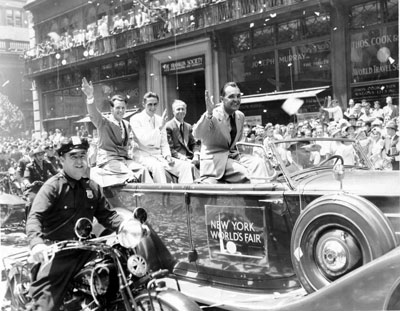
In 1938, a preview parade for the New York World’s Fair with its corporate modernist ethos wound its way through the city. The parade was ten miles long and it included cars from every state in the union.
At the intersection of Thirteenth Street and Seventh Avenue it was cut off by a 50,000-100,000 strong parade celebrating May Day.
Sources: Robert Rydell mentions the incident in World of Fairs: The Century of Progress Expositions. He cites a 1938 NY TImes article, “Divided Leftists in Quiet May Day,” and “Red Light for May Day March” in World-Telegram.
I suspect that when you think about World’s Fairs, if ever you do, you think about those that have already receded into the modestly distant past. Arguably, the last notable fair held in the US — with apologies to Knoxville and New Orleans — was the unsanctioned New York Fair of 1964-65.
Unsanctioned because that fair did not receive the approval of the Bureau International des Expositions (International Bureau of Expositions, although I suspect the translation was rather self-evident). The fair, of course, proceeded in any case under the leadership of Robert Moses who was not one to take “no” for an answer. For the record, the US ended its membership in the Bureau International des Expositions in June 2001.
World’s fairs and expositions, however, are still held around the globe. Since we tend to get rather little news about international happenings unless they are tragic or otherwise immediately relevant to American affairs, the fairs tend to get little notice. Case in point: I was blissfully unaware until fairly recently that an ambitious and impressive fair was held in Shanghai in 2010, Expo Shanghai. (If you follow the link, you’l be taken to an interactive map from which you can virtually experience the many exhibits at the Expo). And in the tradition of the 1939 New York Fair, the Shanghai Expo featured a sizable “Pavilion of the Future.”
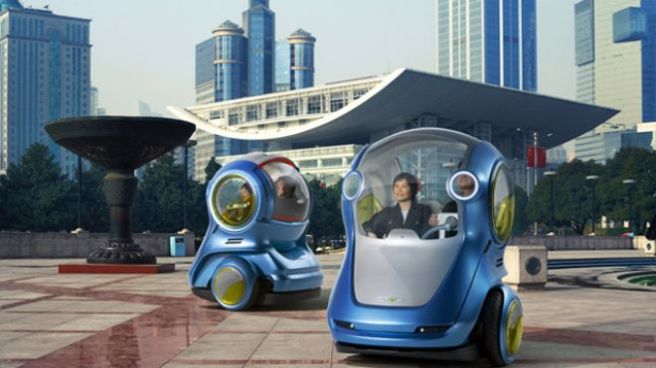
General Motors, the corporation that sponsored the original Futurama in 1939 and its sequel in 1964, is apparently not altogether out of the business of shaping the vision of transportation for the world of tomorrow. At the Shanghai Expo, GM debuted its EN-V concept car pictured below. The EN-V is equipped with a sophisticated navigation system that is intended to render it virtually accident proof. In this it shares in a vision already articulated in the 1939 Futurama which predicted the appearance of cars which would be kept at safe distances from each other by radio control while careening down as yet unbuilt interstate highways.
What’s more, the car, if we can call it that (and I don’t mean that disparagingly), is set to play an important role in a working “city of the future,” the Tianjin Eco-City, a joint effort by the governments of China and Singapore. If you click the image below, you’ll be taken to a slide show of Eco-City concept drawings. The story linked just above gives this brief description:
“Located on the outskirts of one of China’s largest existing metropolises, the Tianjin Eco-City was conceived as a large-scale prototype for sustainable, high-density communities. A reliance on renewable energy sources and mass transit are key elements in its environmentally-friendly design.
But even though its creators are planning for 90 percent of its eventual population of 350,000 to get around town using a light rail system, there will still be a need for individual point to point transportation, and that’s where GM comes in.”
It’s a long way from realization, but I’ve got to say, it’s an impressive project.
It would seem that we have out-sourced the future.
It is, I’m afraid, quite likely that the unusually light posting over the last couple of weeks will be the norm rather than the exception for the foreseeable future. Lots going on this semester to keep me busy. But perhaps that is for the better, maybe lighter posting means better writing and better reading.
In any case, one of the activities that is keeping me busy for the next few months is an internship with the Synthetic Reality Lab at the University of Central Florida’s Institute for Simulation and Training. Specifically, I’ll be conducting research for a rather cool project, a virtual recreation of the 1964-65 New York World’s Fair. Check out the website for more on the project: Come Back to the Fair.
I’m sure you’ve noticed that the World’s Fairs have been on my mind the past few months. As things stand right now, the ’39 New York Fair will serve as a case study of sorts for my dissertation. It is all still very much a work in progress, but my hope is to tie together some work on embodiment and spatial practices by Pierre Bourdieu, Henri Lefebvre, and Mark Johnson among others with a view to better understanding the social construction of technology.
I know, I know … I’ve got to figure out a way of talking about all of that so that it doesn’t sound dry as dirt. In fact, I’m quite excited about the whole thing. And, if you stick around, I’m sure you’ll get a feel for the whole project as it develops over the coming months. Stay tuned.
In a recent post I alluded to the interesting relationship between World’s Fairs/Expositions and economic downturns in American history. In that earlier post I suggested that perhaps the most peculiar thing about our present ongoing period of economic turmoil may be the absence of a World’s Fair. I thought I might provide a little support for that suggestion.
Of course, there is nothing like a 1:1 correlation between the many downturns and the numerous fairs and expositions that have been held in the United States over the last 150 years or so. There is nonetheless a very intriguing correlation between many of the more significant downturns and notable fairs. Here’s a sampling:
The Panic of 1873 triggered what is sometimes called Long Depression which lasted until 1896, a period which also included the Panic of 1893. This same period witnessed the Centennial Exposition of 1876 in Philadelphia which was held three years into the period of depression and the Columbian Exposition of 1893 in Chicago which was held in the same year as the second Panic that punctuated the Long Depression.
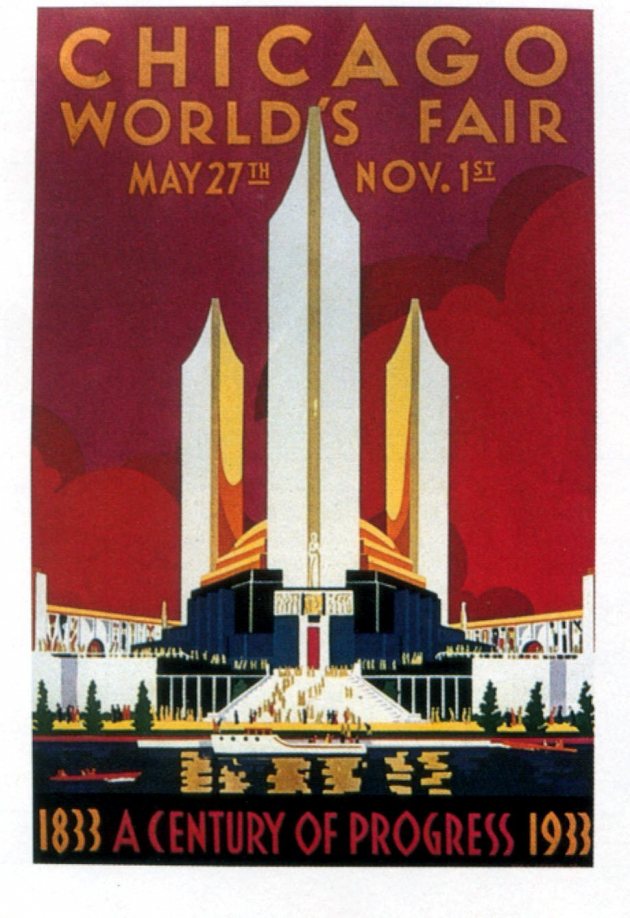
The decade of the Great Depression was also the decade when two major fairs were held, the Century of Progress Exposition of 1933 in Chicago and the New York World’s Fair of 1939. Incidentally, during this famously severe period of economic hardship seven minor fairs were also held throughout the United States.
A few weeks ago I wrote a post or two which mentioned the 1939 New York World’s Fair. The ’39 Fair in particular caught my attention as a remarkable fusion of technology and modernism in the service of a utopian vision of the future. But the ’39 Fair is only one of many Fairs and Expositions held in the US and around the world since 1851, the year of London’s Crystal Palace Exhibition.
It’s quite likely that you’ll be hearing a bit more about these fairs, particularly the ’39 Fair in the coming weeks. They are fascinating historical snapshots capturing at once the past, present, and hoped for future. Many of the fairs included a retrospective look back at the culture’s achievement. For example, the 1876 Philadelphia Fair explicitly remembered the first 100 years of American history following the Declaration of Independence. The fairs also look forward to the future. This was most obviously the case in the ’39 Fair that took “The World of Tomorrow” as its theme, but it is an element of all the fairs. And, of course, in the way they remembered the past and the way they envisioned the future the fairs were perhaps above all else leading indicators of their own time.
Historian Robert W. Rydell has made a career out of telling the story of the World’s Fairs and Expositions, especially those held in America. In the Introduction to All the World’s a Fair, Rydell provides a useful frame by which we might approach the significance of the Fairs.
Following sociologists Peter Berger and Thomas Luckman, Rydell suggests that we understand the Fairs as “symbolic universes.” In their view, a symbolic universe placed “all collective events in a cohesive unity that includes past, present, and future. With regard to the future, it establishes a common frame of reference for the projection of individual actions.”
It is also interesting to consider the fairs as quasi-relgious experiences. Rydell notes Henry Adams suggestive claim that he “professed the religion of the World’s Fairs.” Interestingly, there is an etymological basis to the comparison: we “fair” derive from the Latin feria which means “holy day” and the German Messe suggests both “mass” and “fair.” More importantly, as Rydell puts it,
“America’s world’s fairs resembled religious celebrations in their emphasis on symbols and ritualistic behavior. They provided visitors with a galaxy of symbols that cohered as ‘symbolic universes.’ These constellations, in turn, ritualistically affirmed fairgoer’s faith in American institutions and social organization, evoked a community of shared experience, and formulated responses to questions about the ultimate destiny of mankind in general and of Americans in particular.”
The fairs were also consciously arranged around the theme of progress. “Expositions are timekeepers of progress,” President William McKinley famously proclaimed. “They record the world’s advancement. They stimulate the energy, enterprise, and intellect of the people and quicken human genius.” (McKinley, incidentally, was killed at a World’s Fair, the 1901 Pan-American Exposition in Buffalo.) In Rydell’s summary, the “mythopoeic grandeur” of the fairs lay in their translation of “an ideology of economic development, labeled ‘progress,'” into “a utopian statement about the future.”
Perhaps not surprisingly, many of the fairs were held during times of severe economic and social strain. The ’39 Fair, coming years after the Great Depression had been in full swing, is only the most obvious example. In fact, the most striking feature of the present period of economic difficulty considered in light of the past 150 years may be the absence of a World’s Fair. I suspect that we are now too knowing and ironically self-aware to take something like a World’s Fair seriously. The mythic aspect of the fairs has been significantly paired down into a theme park experience. Consider Disney’s Carousel of Progress the hinge. It debuted at the 1964 New York World’s Fair before making Disney Land its home. Subsequently, EPCOT has functioned as a kind of permanent World’s Fair.
Finally, one more item for all of those interested in a bit of cultural archeology. Below is a 50-minute film prepared by the Westinghouse Corporation for the 1939 Fair. The film is fascinating at a number of levels. I’ll leave it to you to watch the whole, but here’s a very brief synopsis. The Middletons are an average American family who have come to New York to visit the Fair. The daughter, who had been living in New York, is now involved with a socialist, anti-American art professor. At the fair, she runs into her old flame, a clean cut, All-American engineer working for Westinghouse at the Fair and determined to the defend the American way of life. Enjoy.