“It’s like, you know … the end of print disciplined speech?”

In “What Happens in Vagueness Stays in Vagueness,” Clark Whelton takes aim at what he calls “the linguistic virus that infected spoken language in the late twentieth century” — vagueness.  Here’s the opening example:

I recently watched a television program in which a woman described a baby squirrel that she had found in her yard. “And he was like, you know, ‘Helloooo, what are you looking at?’ and stuff, and I’m like, you know, ‘Can I, like, pick you up?,’ and he goes, like, ‘Brrrp brrrp brrrp,’ and I’m like, you know, ‘Whoa, that is so wow!’ ” She rambled on, speaking in self-quotations, sound effects, and other vocabulary substitutes, punctuating her sentences with facial tics and lateral eye shifts. All the while, however, she never said anything specific about her encounter with the squirrel.

In the mid-1980s, Mr. Whelton began noticing increasingly aberrant speech patterns in prospective interns for New York City mayor Edward Koch’s speech writing staff.  “Like,” “you know,” “like, you know,” along with non-committal interrogative tones particularly distressed Whelton.  He goes on to add,

Undergraduates … seemed to be shifting the burden of communication from speaker to listener. Ambiguity, evasion, and body language, such as air quotes—using fingers as quotation marks to indicate clichés—were transforming college English into a coded sign language in which speakers worked hard to avoid saying anything definite.

Whelton comes closest to the true nature of the situation here, but I think there is an important consideration that is missing.  I’m inclined to think that the sorts of language patterns Whelton criticizes reflect a reversion to language environments that are more oral in nature than they are literate (a situation that Walter Ong called secondary orality).

The cadences and syntax of “high,” “correct,” “proper,” etc. English are a product of writing in general and intensified by print; they are not a necessary function of spoken language itself which is ordinarily much more chaotic.  Writing is removed from the holistic context that helps give face-to-face communication its meaning.  To compensate writing must work hard to achieve clarity and precision since the words themselves bear the burden of conveying the whole of the meaning.  Oral communication can tolerate vagueness in words and syntax because it can rely on intonation, volume, inflection, and other non-verbal cues to supply meaning. As an experiment try transcribing anyone of your countless verbal exchanges and note the sometimes startling difference between spoken language and written language.

Where print monopolizes communication, the patterns of written speech begin to discipline spoken language. “Vague” talk then may be characteristic of those whose speech patterns, because they have been formed in a world in which print’s monopoly has been broken, have not been so disciplined by print literacy.

Interestingly, new media is often quite “print-ish,” that is text isolated from sound — emails, text messaging, Twitter, blogs, Facebook (although with images there) — and this has required the invention of a system of signs aimed at taming the inherent “vagueness” of written communication that is restricted in length and thus not given the freedom to compensate for the loss of non-verbal and auditory cues with precise syntax and copious language.  : )

Memory, Writing, Alienation

Some more reflections in interaction with Walter Ong’s work, this time an essay originally published in The Written Word: Literacy in Transition (Oxford, 1986) titled “Writing Is a Technology that Restructures Thought.”

Literacy does its work of transformation by restructuring the cultural and personal economy of memory and installing a self-alienation at the heart of literate identity.

The world of orality is fundamentally evanescent.  Spoken words themselves have begun to pass out of existence before they are fully formed by the speaker’s mouth.  The spoken word is in this way a telling image of oral society; each generation is always already fading into the unremembered past as it inhabits the present.  The accumulated knowledge and wisdom of an oral society exists only as it is remembered by individuals so that each member of the group shares in the cognitive burden of sustaining and transmitting the group’s cultural inheritance.  This work of memory preoccupies the cultural life of oral societies and configures the individual as a node within a network of cultural remembering.  Oral society is thus fundamentally conservative and collective.

Writing disrupts and rearranges this situation by offloading, to a significant degree, the cognitive burden of remembering from the living memory of each individual to the written word.  This work of cognitive offloading generates recurring debates, as we first encounter in Plato, about the proper modes of memory.  These debates reflect the (often unrecognized) force with which new mnenotechnologies impact a society.  As Ong notes, the frozen, lifeless written word is in another, paradoxical sense alive.  It achieves permanence and is “resurrected into limitless living contexts by a limitless number of living readers.”  Furthermore, the “lifeless” written word, by both resourcing and reconfiguring the economy of memory, also injects a new dynamism into literate cultures. It does so by relieving the conservative pressure of cultural remembrance thus encouraging what we might call intellectual entrepreneurship.

This new dynamism is, however, accompanied by various forms of alienation.  Crucially, writing dislodges a portion of one’s memory, a critical aspect of identity, from oneself.  To the extent that identity is constituted by memory, identity must be, to some extent, divided in literate societies.  Ong details the alienating work of writing when he lists fourteen instances of separation effected by writing:

1. Writing separates the known from the knower

2. Writing separates interpretation from data

3. Writing distances the word from sound

4. Writing distances the source of communication from the recipient

5. Writing distances the word from the context of lived experience

6. Due to 5., writing enforces verbal precision unavailable in oral cultures.  (In other words, without the context provided by face-to-face communication, words have to work harder in writing to make meaning clear.  This is why we sometimes feel compelled to use smiley faces in electronic communication — to communicate tone.)

7. Writing separates past from present.

8. Writing separates administration — civil, religious, commercial — from other types of social activities.

9. Writing makes it possible to separate logic from rhetoric.

10. Writing separates academic learning from wisdom.

11. Writing can divide society by splitting verbal communication between a “high” spoken language controlled by writing and a “low” controlled by speech.  (For example, “proper” English is really “written” English, while devalued vulgar and colloquial speech patterns are “spoken” English.)

12. Writing differentiates grapholects, dialect taken over by writing and made into a national language, from other local dialects

13. Writing divides more evidently and effectively as its form becomes more abstract, that is more removed from the world of sound to the world of sight.

14. Writing separates being from time.

By making thought (and so also the self) present to itself, literacy introduces an irreparable fissure into identity and consciousness, but one that is, in Ong’s account, ultimately “humanizing.”  Last word from Ong:

To say writing is artificial is not to condemn it but to praise it . . . By distancing thought, alienating it from its original habitat in sounded words, writing raises consciousness.  Alienation from a natural milieu can be good for us and indeed is in many ways essential for fuller human life.  To live and to understand fully, we need not only proximity but also distance.  This writing provides for, thereby accelerating the evolution of consciousness as nothing else before it does.

What I Might Have Written About If I Had More Time

Some blogs have a regular post each week (sometimes cleverly titled, unlike mine) in which they list a bunch of links that they think readers might enjoy visiting.  Without being regular about it, I have in the past put up similar posts, and now may be good time to revisit the format.  So here are some items that, had I more time, may have generated something more than passing reference, but, as it stands …

  • At the New York Times, Maureen Dowd considers the Catholic Church’s efforts to minister through the Internet in “Forgive Me, Father, For I Have Linked”.  Here’s her clever (depending on your mood) rendition of the Lord’s Prayer:

Our Father, who art in pixels,
linked be Thy name,
Thy Web site come, Thy Net be done,
on Explorer as it is on Firefox.
Give us this day our daily app,
and forgive us our spam,
as we forgive those
who spam against us,
and lead us not into aggregation,
but deliver us from e-vil. Amen.

  • In The New Yorker, Adam Gopnik has a long review essay of 2010 books that addressed the impact of the Internet on our thinking including, of course, Nick Carr’s The Shallows and Clay Shirky’s Cognitive Surplus

Two pieces that will either excite you or depress you depending on your disposition:

And, finally, on publishing revolutions old and new:

Technique, Perception, and Friendship

Ivan Illich

Illich on Ellul

In 1993, at a gathering in honor of Jacques Ellul, Ivan Illich spoke of Ellul’s influence on his own thinking, particularly through Ellul’s theorizing of technique.  Along the way, Illich gives us this intriguing genealogy of his first encounter with Ellul’s work:

La technique entered my existence in 1965 in Santa Barbara, the day when, at Robert Hutchins’s Center, John Wilkinson gave me a copy of The Technological Society that he had just translated, following up on the strong recommendation of Aldous Huxley.

The author of Brave New World clearly found much to admire in Ellul.  Illich goes on to explain the advantage conferred by appropriating Ellul’s analytical concept:

I have adopted this Ellulian concept because it permits me to identify – in education, transport, modern medical and scientific activities – the threshold at which these projects absorb, conceptually and physically, the client into the tool; the threshold where the products of consumption change into things which themselves consume; the threshold where the milieu of technique transforms into numbers those who are entrapped in it; the threshold where technology is decisively transformed into Moloch, the system.

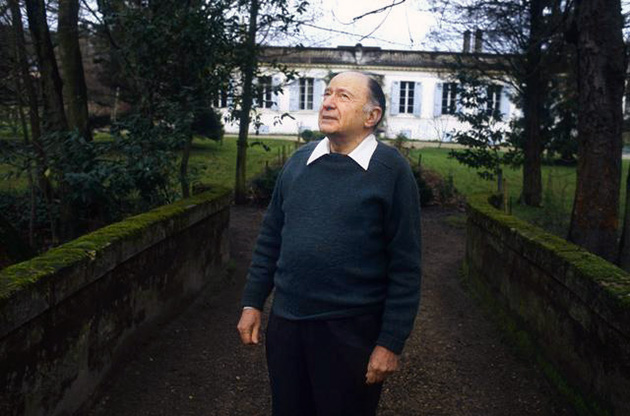
That, of course, is a rather grim analysis of the imperialism of technique, which for Ellul is not simply equated with technology. In The Technological Society, Ellul defines technique as “the totality of methods, rationally arrived at and having absolute efficiency (for a given stage of development) in every field of human activity.”  He goes on explain how “technique enslaves people, while proffering them the mere illusion of freedom, all the while tyrannically conforming them to the demands of the technological society with its complex of artificial operational objectives.”  So the target of Ellul’s criticism was not technology per se, but a society that had reduced human existence to the tyranny of machinic standards of efficiency and production.  In other words, his target was not so much the machines, as the society that reduces persons to machines.

Echoing McLuhan on media as extensions of man, Illich continues in dire vein:

Existence in a society that has become a system finds the senses useless precisely because of the very instruments designed for their extension. One is prevented from touching and embracing reality. Further, one is programmed for interactive communication, one’s whole being is sucked into the system. It is this radical subversion of sensation that humiliates and then replaces perception.  We submit ourselves to fantastic degradations of image and sound consumption in order to anesthetize the pain resulting from having lost reality.

Precisely (and perversely) where we have adopted a tool to connect us with reality, we have lost touch with reality.

It is interesting in the end to note the point to which Illich brings his appreciation of Ellul and his own indictment of technological society:

Therefore, it appears to me that we cannot neglect the disciplined recovery, an asceticism, of a sensual praxis in a society of technogenic mirages. This reclaiming of the senses, this promptitude to obey experience, the chaste look that the Rule of St. Benedict opposes to the cupiditas oculorum (lust of the eyes), seems to me to be the fundamental condition for renouncing that technique which sets up a definitive obstacle to friendship.

One is reminded of the conclusion of Alasdair MacIntyre’s After Virtue in which we are left waiting “not for a Godot, but for another — doubtless very different — St. Benedict.”  MacIntyre hinged his moral philosophy on the recovery of “local forms of community within which civility and the intellectual and moral life can be sustained” — or, with Illich, friendship.
Jacques Ellul