Resisting Disposable Reality, II: The Pen

Consumerism, together with the technology it drives, generates disposable reality. That was my conclusion in a post a few months back that synthesized some insights drawn from William Cavanaugh and Albert Borgmann. In that same post I suggested that the book was an instance of resistance to disposable reality as it is very often purchased and kept, sometimes for a lifetime. This is one important way in which e-books differ from traditional print books.

Since then I’ve had the lingering idea of documenting similar instances of resistance to disposable reality, and this past Sunday morning one such instance presented itself on CBS’s morning show. A short four and a half minute segment profiled Richard Binder, a former computer programmer who devoted himself to the care and repair of pens. Not the disposable kind, of course, and that is the point. These are mostly fountain pens and have in some instances been handed down from one generation to the next. It may come as a surprise to learn that Binder has a four month back-log of work.

Naturally, it is about more than a pen, it is about what we might call the culture of the pen that includes the care of the pen, the memories it carries, and the practice of writing it supports. To borrow Borgmann’s terminology, these are the focal practices that gather around the commanding presence of the pen as a focal thing (read the original post for a translation). Taken together they suggest a posture toward lived experience that is radically at odds with the culture of disposable reality. And resistance to disposable reality may yet help us calibrate the pace of our lives to a more humane rhythm.

Enjoy the clip below and feel free to send my way any instances of resistance to disposable reality that cross your path.

[Update: Clip has since been taken down.]

Giving Them the Thumbs

So I was at the dentist’s office this morning and the dental hygienist asked me what I did for a living as one customarily does to make small talk. I was a teacher and graduate student I replied. She asked what I was studying. I told her that I was working on a PhD in a program titled Texts & Technology. This usually elicits a slight pause of unfamiliarity, so I quickly glossed the program by explaining that it explores the intersections of technology and culture. Usually this works just fine and typically intrigues people. What it doesn’t usually trigger, as it did this morning, is a soap-box rant. It was a polite and subdued rant, but a rant no less. I do believe the phrase “these kids” was used at some point.

My dental hygienist proceeded to inform me that she did not own a cell phone and was mildly disgusted by public texting, particularly texting while driving and while having x-rays (not sure if there was an implied correlation between those two).

Most of all, she was dismayed by the readiness to disregard personal presence inherent in the act of texting while ostensibly interacting with another. This is by now a commonplace complaint, and while no less valid for being so, not by itself worthy of comment. It was how she described the offense and captured its feel that caught my attention. While miming the standard tw0-handed, thumbs twirling texting gesture with a slight thrust of both hands in my direction, she declared that it is as if she were being given the finger.

Well, they’re thumbs technically, but point taken.

John Mayer and John Piper: Twitter Case Studies

I’ve never read the tweets of John Mayer, but I suspect they are an improvement on the tweets of Kanye West. In any case, Mayer apparently tweeted a lot, in fact, he recently owned up to a case of Twitter addiction. At a Berklee Performance Center Clinic for aspiring musicians, he had this to say:

“The tweets are getting shorter, but the songs are still 4 minutes long. You’re coming up with 140-character zingers, and the song is still 4 minutes long…I realized about a year ago that I couldn’t have a complete thought anymore. And I was a tweetaholic. I had four million twitter followers, and I was always writing on it. And I stopped using twitter as an outlet and I started using twitter as the instrument to riff on, and it started to make my mind smaller and smaller and smaller. And I couldn’t write a song.”

Mayer’s comments came to the attention of John Piper, a prominent Christian pastor with his own not insignificant Twitter following.  In a blog post, Piper offered his own experience as an alternative to Mayer’s:

My experience of publishing three Tweets a day (usually written and scheduled a week or two ahead of time) is different. Mayer said, “I couldn’t have a complete thought anymore.” To me this is almost the opposite of what happens. But that may depend on what we aim to do with Twitter.

Piper goes on to add, in what amounts to his philosophy of tweeting, that he aims to be capacious, concise, and compelling when he composes his tweets (preachers seem to have a hard time resisting alliteration). Along the way he likens tweets to proverbs and explains that, “Tweets for me are a kind of poetry.” This is all very nicely put, and I suspect it makes for pretty decent tweets.

Two users, admittedly two very different users, and two quite different experiences. Of course, there is nothing particularly surprising about this.  We shouldn’t necessarily expect any two users to have the same experience with any technology. Yet, I couldn’t help but wonder what might account for the difference, or if one were more typical.

We get a hint at what the difference might be when Piper writes, “My experience of publishing three Tweets a day (usually written and scheduled a week or two ahead of time) is different.”

That parenthetical statement suggests to me that Piper is not really tweeting. Obviously, he is composing words that are eventually shared via Twitter, but he is doing so in a manner that almost renders the platform irrelevant from the standpoint of personal experience. I would even bet that Piper is not the one interacting with the Twitter interface, in other words I wonder if he passes his composed tweets on to a third party who then types them in and publishes them. (There wouldn’t be a thing wrong with this, of course.) A quick look at Piper’s Twitter feed confirms the suspicion that his use of the interface is minimal since we find only the carefully composed statements and occasional links, but no interaction with other Twitter users. He has 185,000+ followers, and follows only 66. There are no @s0andso, no signs of conversation.

So let me suggest that Piper might as well be composing fortune cookie messages. Piper’s experience and habits are solidly in the world of old media. Piper’s thinking is not being influenced by Twitter because he is not using Twitter. In other words, Piper’s experience tells us nothing about the consequences of Twitter for someone who is actually robustly engaged with the interface, like John Mayer for example.

Piper’s closing paragraph further suggests that he is not exactly experiencing Twitter:

I don’t ask that others Tweet the way I try to. I only write this blog post to explain why I don’t experience Twitter the way John Mayer did, and why you don’t have to either. If your goal is to spread capaciousconcisecompelling truth about God and his ways, the Tweet is a fruitfully demanding form.

To describe a Tweet as a “fruitfully demanding form” is to view Twitter through the lens of the literary. Piper is measuring Twitter strictly in light of its verbal qualities, in the same way he might view a sonnet or a haiku. This a valid level of engagement and analysis, but has little to do with the way Twitter is experienced by most of its users. Moreover, it misses the significant points of contrast between print and digital media environments.

I hope it is clear that I’m certainly not criticizing Piper. My point is to understand the influence of technology, and I suspect that it is found in part in the habits formed by use of technology, or the practice of an interface. Piper has not experienced the effects of Twitter because he has not entered into the practice of Twitter defined as a robust and sustained engagement with the interface. I suspect that his Twitter account isn’t open on his desktop or smartphone. He probably is not emerged in the flow of TwitterTime. This is probably a good thing. By not really using the medium, he is not being used by it either. In any case, I would suggest that a tool’s influence will not really be felt until its use becomes a practice integrated into our form of life.

________________________________________________________

H/T: Mr. Greenwald for pointing me to Piper post.
Neil Postman, Technopoly, and Technological Theology

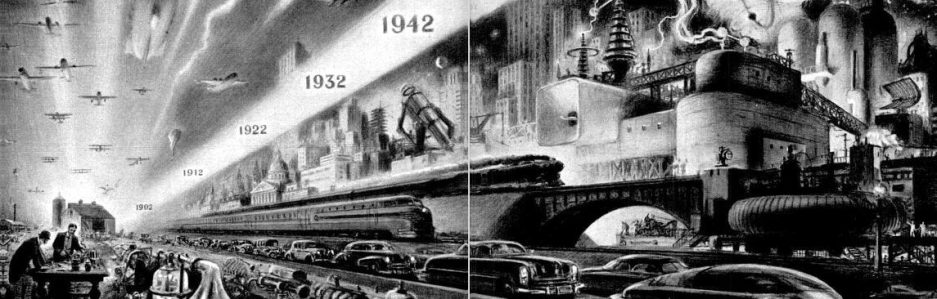
Early in his book Technopoly, Neil Postman presents a helpful summary of the variety of schema or classifications offered by historians for the history of the relationship of technology to culture:

We think at once of the best-known classification:  the Stone Age, the Bronze Age, the Iron Age, the Steel Age.  We speak easily of the Industrial Revolution, a term popularized by Arnold Toynbee, and, more recently, of the Post-Industrial Revolution, so named by Daniel bell.  Oswald Spengler wrote of the Age of Machine Technics, and C. S. Peirce called the nineteenth century the Railway Age.  Lewis Mumford, looking at matters from a longer perspective, gave us the Eotechnic, the Paleotechnic, and Neotechnic Ages.  With equally telescopic perspective, Jose Ortega y Gasset wrote of three stages in the development of technology:  the age of technology of chance, the age of technology of the artisan, the age of technology of the technician.  Walter Ong has written about Oral cultures, Chirographic cultures, Typographic cultures, and Electronic cultures.  McLuhan himself introduced the phrase “the Age of Gutenberg” (which, he believed, is now replaced by the Age of Electronic Communication).

A lot is packed into that paragraph, and if we were to go on and read each of these scholars in order to understand their classifications we would end up with an impressive grasp on the relationship of technology to culture. To these Postman adds his own schema.  He divides cultures into three types:  tool-using cultures, technocracies, and technopolies. Here is a quick overview for your consideration:

In a tool-using culture according to Postman, tools were “largely invented to do two things”:  “solve specific and urgent problems of physical life” and “serve the symbolic world of art, politics, myth, ritual, and religion …” Additionally, “in a tool-using culture technology is not seen as autonomous, and is subject to the jurisdiction of some binding social or religious system.”

In a technocracy, society is “only loosely controlled by social custom and religious tradition” and it is “driven by the impulse to invent.” A technocracy, however, “does not have as its aim a grand reductionism in which human life must find its meaning in machinery and technique.  Technopoly does.”

Technopoly, in Postman’s most succinct formulation, features “the submission of all forms of cultural life to the sovereignty of technique and technology.”  Postman took the assumptions informing Frederick Taylor’s The Principles of Scientific Management to be more less the assumptions of the “thought-world of Technopoly.” These included the following beliefs:

  • “the primary, if not the only, goal of human labor and thought is efficiency”
  • “technical calculation is in all respects superior to human judgment”
  • “human judgment cannot be trusted because it is plagued by laxity, ambiguity, and unnecessary complexity”
  • “subjectivity is an obstacle to clear thinking”
  • “what cannot be measured either does not exist or is of no value”
  • “the affairs of citizens are best guided and conducted by experts.”

Ironically, in Postman’s view, these assumptions amount to a “technological theology.”  In other words, while traditional theologies which governed tool-using cultures are displaced in a technocracy, in a  Technolopy a governing ideology in the mode of theology is reintroduced to order society. The function of theology has not been eradicated, it has just been reconfigured, which rather reminds me of a Dylan tune:

But you’re gonna have to serve somebody, yes indeed
You’re gonna have to serve somebody
Well, it may be the devil or it may be the Lord
But you’re gonna have to serve somebody.

I’ll leave the applications to you.

Training Perecption, Awakening to Experience

The challenge of McLuhan’s work, both in the sense that it is challenging to read and that it lays down a challenge to be taken up, involves the difficulty of thinking about that which shapes our thinking — it is akin to attempting to jump over your own shadow.

Not surprisingly, a good deal of his method, perplexing and infuriating as it could be, seems designed to coax readers over their shadows, to become aware of how their thinking has been formed by the media environment.  Biographer W. Terrence Gordon, citing McLuhan’s own description of his teachers at Cambridge, gets at this when he writes, “There could be no more succinct statement of his own aims, as he left Cambridge to begin a teaching career, than ‘the training of perception.'”

Later on, Gordon cites a letter to Mrs. Pound in which McLuhan writes, “The appeal must be to the young … they have been systematically deprived of all the linguistic tools by which they could nourish their own perceptions at first hand at the usual traditional sources.”

Walter Ong, a former student of McLuhan’s and outstanding scholar in his own right, classified teachers as follows:

A good teacher is one who can encourage others to think actively.  A superior teacher can make the thinking pleasant for the learners. A superb teacher can make the thinking an overpowering activity, delightful even when it is disturbing and exhausting.

“By this criteria,” Ong went on, “Marshall McLuhan was a superb teacher who could stir people’s minds.”  Ong also noted that, “… even with the most brilliant teacher, if the learners are to do any learning, they are the ones who have to do it.”

Putting all of this together yields, in my estimation, the nature of McLuhan’s enduring significance.  In one respect he may be likened to the hedgehog in Isaiah Berlin’s illustration who knows one big thing — changes in media environments change the way we think and the way we experience life.  But he was also a little like the fox who knows many things in that he approached the one big idea from countless angles and drawing promiscuously from the whole of experience.

As some have noted in taking the measure of McLuhan, he drove that one idea home so well that he rendered his work superfluous.  But this is not quite right.  While others have perhaps done a better job of articulating and systematizing the big idea, they have perhaps also domesticated it.  Knowledge has been imparted, but perceptions have not been trained.  Ironically, this may be attributed to a lack of sensitivity to the medium, i.e. McLuhan’s method.

McLuhan understood, as Ong put it, that if learners are too learn anything they are the ones who will have to do it.  All of the probes, the paradoxes, the gnomic statements, the quirkiness, the esotericisms, the inconsistencies, the absurdities, the juxtapositions, the koanish assertions, the puns — all of it aimed at drawing out the work of learning from the learner in such a way that their perceptions would be trained.  Simply clarifying the big idea, extracting and re-presenting the kernel of the thought only captured the data, it did not train perceptions, it did not heighten sensibilities, it did not lead to practical wisdom.  In the end it may very well darken and numb perception.

This insistence on the training of perception, fully embodied perception involving the whole human sensorium, may have been McLuhan’s chief contribution.  Perceiving the world, which is to say being alive to the world, is not a given and much less so in certain media environments.  McLuhan as a teacher seems bent on awakening us to experience; agitating, provoking, inciting us to perceive.  That is no small thing when some degree of variously imposed numbness becomes the cultural default.