The Art of Technology and Empire

The phrase “Manifest Destiny” is likely one of those bits from high school history class that lingers on in most Americans’ memory for no obvious reason; in much the same way, for example, that I remember William Katt’s name (you know, the guy who starred in Greatest American Hero). If our memory serves us a little better than most, we’ll recall that the destiny that was so plainly manifest was America’s destiny to possess all of the territory between the eastern states and Pacific Ocean. “Go West young man!” and all of that.

What you may not immediately think of even if you do remember your American history class lucidly is the important role that technology played in the ideology of Westward expansion. In Dominance by Design: Technological Imperatives and America’s Civilizing Mission, Michael Adas lays out that case in convincing detail. If David Nye’s American Technological Sublime successfully argues that the experience of the technological sublime has been America’s civil religion, then Adas has documented the attendant missionary project.

In the likely event that you don’t have time to read Adas’ sizable book, here’s the “Manifest Destiny” portion of his argument in a visual nutshell:

John Gast, “American Progress” (1872)

Yes, that is telegraph line that she is stringing out. I tend to think that the old line, “A picture is worth a thousand words,” is generally misleading, but in this case, it just might work. The portrait, according to historian Merritt Roe Smith*, was commissioned by publicist George Crofutt who tasked John Gast with painting a “beautiful and charming female … floating westward through the air, bearing on her forehead the ‘Star of Empire.'” The beautiful female was to carry a book in her right hand symbolizing the “common school — the emblem of education” while with her left she “unfolds and stretches the slender wires of the telegraph, that are to flash intelligence throughout the land …”

Crofutt also wanted Gast to depict certain elements “fleeing from ‘Progress'”; these included “the Indians, buffalo, wild horses, bears and other game.” The Indians were to “turn their despairing faces toward the setting sun, as they flee from the presence of wondrous vision. The ‘Star’ is too much for them.” We should, by now, know this unfortunate part of the story well.

Smith neatly summarizes the significance of the painting: “As art goes, ‘American Progress’ is not a work of great distinction. But as a popular allegory that amalgamates the idea of America’s Manifest Destiny with an old republican symbol (the goddess Liberty, now identified as Progress) and associates progress with technological change (represented by telegraph lines, the railroads, the steam ships, the cable bridge, and the urban landscape in the background), it is a remarkable achievement.”

One could read a political allegory into the evolution of goddess Liberty into goddess Progress. A similar sort of allegory that might arise if we were to compare John Trumbull’s famous (if not quite accurate) paining of the signing of the Declaration of Independence with this later painting by Christian Schussele, “Men of Progress”:

Christian Schussele, “Men of Progress” (1863)

The two paintings are linked by the image of Benjamin Franklin who, in Trumbull’s paining, is positioned prominently before the Declaration of Independence by the side of John Hancock and, in Schussele’s work, appears in the portrait in the top left of the scene watching approvingly over these 19th century men of progress. These men included Samuel Colt, Cyrus McCormick, Charles Goodyear, Elias Howe, and Samuel Morse. We might safely call this the American Pantheon, and may not be too far off the mark if we gather that the reverence paid the Founders had been, by the middle of the 19th century, transferred to these “men of progress.”

And, of course, the century was all about Progress. That sentiment was captured in this lithograph by Currier and Ives from 1876:

Currier and Ives, “The Progress of the Century” (1876)

The telegraph tape reads, “Liberty and Union, Now and Forever” along with “One and Inseparable” and “Glory to God in the Highest, On Earth Peace and Good Will Toward Men.” These political and religious sentiments are not only conveyed by the telegraph; the realities they articulate are effectively secured by the telegraph — and the railroad, and the steam boat, etc. It is technology that binds the nation together and the whole project is given a theological hue (further reinforcing Nye’s thesis).

James P. Boyd, writing in 1899, looked back upon the 19th century and marveled: “Indeed, it may be said that along many lines of invention and progress which have most intimately affected the life and civilization of the world, the nineteenth century has achieved triumphs and accomplished wonders equal, if not superior, to all other centuries combined.” This was a rose colored assessment, to be sure; it glossed over some of the century’s darker shades and, of course, seemed oblivious to the cataclysms that lay ahead.

What Boyd’s rhetoric does capture is the reduction of the notion of Progress to the narrow channel of technical advance. All other measures — be they political, religious, or cultural — are subsumed within the grand narrative of the evolution of technology. The lineaments of what Neil Postman termed technopoly have, by the close of the 19th century, begun to appear.

Early into the 21st century, we may find a painting like “American Progress” naive at best, if not offensive and misguided. Boyd’s rhetoric may strike us as grandiose and a bit too earnest. Both together suffering from a bad case of what Adas has called techno-hubris. And yet, how far do we have to go back to find similarly effusive and eschatological hopes attached to the World Wide Web and the Information Superhighway? To what degree have we continued to measure progress by the single measure of technical innovation, forsaking more demanding political and ethical standards? And haven’t we also paid homage to the goddess of technological progress, stripped perhaps of some of her earlier glory, no longer radiant, illuminated now by the lesser light of some backlit screen?

_________________________________________________________

*Citations from Merritt Roe Smith are drawn from his essay, “Technological Determinism in American Culture,” in Does Technology Drive History? The Dilemma of Technological Determinism.

“It’s okay, the Internet will be just fine without you”

Occasionally I’ve enjoyed taking a television commercial as an invitation to explore some dynamic of the social-technological milieu. For example, a Droid commercial offered an opportunity to explore the technology as prosthetic metaphor. A Visa commercial allowed me to rail against the mindless pace of contemporary consumer culture. And finally, unless I’m forgetting a post, a Jeep commercial spoke better than it knew (most likely) when it claimed that the things we make, make us.

Now a new Dodge commercial offers another occasion to reflect, although this time in a slightly different direction. The commercial plays off of our love affair with the great outdoors, although one has to wonder how sincere that love affair may be since we often seem quite untroubled by our infidelity to our would-be lover. Nonetheless, this commercial positions the great outdoors as an antidote to the Internet, or perhaps better yet, to Internet fatigue.

“People don’t make a list of websties they want to see before they die,” we are told in the commercial’s opening line. “Like being there” is not “like being there,” the commercial continues. And, we are assured, “It’s okay, the Internet will be just fine without you.” Finally, we are invited to think of the Dodge Journey as a “search engine for the World Wide World.”

Its somewhat noteworthy that our marketing geniuses believe appealing to Internet fatigue or to some otherwise nondescript unease with digital life an effective sales strategy. The aura of technology, especially novel digital technology, is more often than not a selling point. Of course, in the commercial it is a GPS that gets you were you need to go, so you are tacitly reassured that the technology is there when you need it.

So sure, they’re selling you something, something you certainly don’t need to have a fuller experience of the world. But at this juncture, I’ll applaud the advice to unplug wherever it may come from. The real issue, after all, may not be whether the Internet will be just fine without us, but whether we will be just fine without the Internet.

______________________________________________________________________

Update: Courtesy of Nick Carr, lest we credit Chrsyler too much, here’s the uber-connected Grand Caravan. At least the Journey’s presentation is a bit more evocative.

Weekend Reading, 11/19/11

With apologies for not posting any suggested reading last weekend, here a good list to make up for it. Be sure to check out the Robinson piece and the three essays reviewing recent books on what ails the academy. The video is pretty cool too

“Difference Engine: Luddite Legacy” at The Economist technology blog, “Babbit”: The title is not much help in this case. The post examines the possibility that what has been known as the Luddite Fallacy, that increased automation leads to fewer jobs, may no longer be so fallacious. It suggests that the stubbornly high rate of unemployment might be owed to the increasing number of white collar jobs that can be done by computers running AI. The post ends in rather hopeful fashion, but the compelling case made throughout seemed to me to make the hope rather like wishful thinking.

“Engineering the 10,000-Year Clock” by David Kushner at Spectrum: Great story about how two engineers with the backing of Amazon’s Jeff Bezos set out to design and build a clock that would run on its own power for 10,000 years. When it is completed, it will certainly count as a marvel of engineering. They’re goal? To get us to thinking more long term. No argument here.

“Teens, Kindness, and Cruelty on Social Network Sites” by Pew Internet and American Life Project: Title tells you all you need to know. Information on adults as well. The link takes you to the summary of findings.

“King James Bible” by Adam Nicolson in National Geographic: Explores the global legacy of the King James translation from Westminster Abbey to an American rodeo to Jamaican Rastafarians. Well done, with a lovely photo gallery as you would expect from National Geographic.

Three important reviews of recent books on education, they are each worth your time if you are at all interested in education:

“The Educational Lottery” by Steven Brint in the Los Angles Review of Books

“Out Universities: Why are they failing?” by Anthony Grafton in the New York Review of Books

“Can Teaching Really Matter?” by Peter Lawler

“Night Thoughts of a Baffled Humanist” by Marilynne Robinson at The Nation: I linked this in my post yesterday, but I wanted to put in your way one more time. It is a piece worthy of your consideration.

“Brain Scan Overload” by Jonah Lehrer in the Wall Street Journal: Lehrer cautions, wisely it seems to me, against grounding too much speculative stock in brain imaging.

Finally, here is a video you’ll want to take a look at if you haven’t already seen it or one like it. Three dimensional copying. Ink + Light = 3D object: “2D Patterns Self Assemble Into 3D Objects” courtesy of Wired UK.

Considering Online K-12 Courses? Some Things to Keep in Mind

This past weekend, The Wall Street Journal ran a story covering the rapid growth of online K-12 education. “My Teacher is an App,” by Stephanie Banchero and Stephanie Simon, discusses the rise of online and hybrid classrooms providing a fairly balanced account of successes and disappointments. Here are some of the key points:

  • “In just the past few months, Virginia has authorized 13 new online schools. Florida began requiring all public-high-school students to take at least one class online, partly to prepare them for college cybercourses. Idaho soon will require two. In Georgia, a new app lets high-school students take full course loads on their iPhones and BlackBerrys. Thirty states now let students take all of their courses online.”
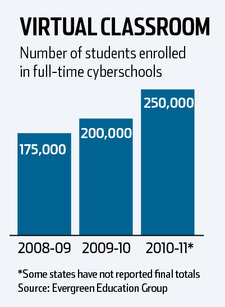
  • “Nationwide, an estimated 250,000 students are enrolled in full-time virtual schools, up 40% in the last three years, according to Evergreen Education Group, a consulting firm that works with online schools. More than two million pupils take at least one class online, according to the International Association for K-12 Online Learning, a trade group.”
  • “Although some states and local districts run their own online schools, many hire for-profit corporations such as K12 Inc. of Herndon, Va., and Connections Academy in Baltimore, a unit of education services and technology company Pearson PLC.”
  • “A few states, however, have found that students enrolled full-time in virtual schools score significantly lower on standardized tests, and make less academic progress from year to year, than their peers.”
  • “At Southwest Learning Centers, a small chain of charter schools in Albuquerque, N.M., standardized test scores routinely outpace state and local averages, according to data provided by the schools. Students complete most lessons online but come into class for teacher support and hands-on challenges, such as collaborating to design and build a weight-bearing bridge.”
  • “The growth of cybereducation is likely to affect school staffing, which accounts for about 80% of school budgets. A teacher in a traditional high school might handle 150 students. An online teacher can supervise more than 250, since he or she doesn’t have to write lesson plans and most grading is done by computer.
Mill. Factory. Sweat shop. I’m sorry, I think I may have just editorialized. Hardly a sweat shop I know, but it strikes me that most of what makes teaching worthwhile gets lost in an online model that reduces the teacher to some combination of a manager, customer experience expert, and help desk attendant.
.
  • “In Idaho, Alan Dunn, superintendent of the Sugar-Salem School District, says that he may cut entire departments and outsource their courses to online providers. “It’s not ideal,” he says. “But Idaho is in a budget crisis, and this is a creative solution.”

Other states see potential savings as well. In Georgia, state and local taxpayers spend $7,650 a year to educate the average student in a traditional public school. They spend nearly 60% less—$3,200 a year—to educate a student in the statewide online Georgia Cyber Academy, saving state and local tax dollars. Florida saves $1,500 a year on every student enrolled online full time.”

“Two companies, K12 and Connections Academy, dominate the market for running public cyberschools. Full-time enrollment in online schools using the K12 curriculum has doubled in the past four years, to 81,000, the company says. K12’s revenue grew 35% to $522 million in its fiscal year ended June 30, when it reported net income of $13 million.”

Beware the profit motive. I’m no opponent of the free market properly understood, but limited experience with for-profit schools (which do not include all private schools) suggests to me that the quality of education often gets undermined by the dynamics of the market. (And that was putting it kindly.) It may be especially problematic when for-profit schools tap into government money.

  • “In the end, virtual schooling “comes down to what you make of it,” says Rosie Lowndes, a social-studies teacher at Georgia Cyber Academy. Kids who work closely with parents or teachers do well, she says. “But basically letting a child educate himself, that’s not going to be a good educational experience.” The computer, she says, can’t do it alone.”

True, but “what you can make of it” is already limited by the constraints of the medium.

To sum up: Enrollment in online courses is increasing rapidly. School districts are saving money. Some private companies are turning an impressive profit. Online teachers help students navigate ready made modules and supervise more students than their in classroom peers. Results are mixed. Hybrid appears to work better than all online. Parent involvement remains important.

For a more detailed and impassioned breakdown of the article see Will Richardson’s post here.

Things to consider: Students vary as do their needs and the circumstances under which they flourish. It is as misleading to argue that online learning is the cure for all the ills plaguing K-12 education as it would be to suggest that it is never, under any circumstances a viable option. I’ve been mostly critical of the online learning experience. This criticism is informed by my experience as a student in numerous online courses and my experiences as a classroom teacher. (You can read my mostly critical comments in this series of posts.) But it is increasingly likely that students will encounter at least one online course during their high school or college career.

When deciding whether or not to enroll students in online courses, here are some things to take into consideration:

  • What is the respective quality of available educational options? In my estimation, the ideal face-to-face classroom beats the ideal online experience, all other factors being equal. But very often the ideal face-to-face classroom is far from the reality on offer at local schools. Know your school and the faculty’s strengths and weaknesses.
  • What courses work well online and which do not? A math course which already tends to be designed in progressive modular fashion will translate into an online environment more effectively than a literature class in which, ideally, lively discussion characterizes the face-to-face dynamic. Science classes that are heavy in hands-on experimentation may also loses something significant in translation. Students may also find that both subjects that are difficult for them and subjects that they are very interested in are better taken face-to-face in the presence of expert teachers.
  • What is the motivation for taking online courses? Online courses may allow students who are unable to attend traditional schools due to health issues to keep up with their education and this is certainly a good reason to consider online learning. Additionally, motivated students may desire to learn about a subject that is not offered at traditional schools. Again, sound motivation. Some students, on the other hand, may believe that online coursework is easier and that it will afford them maximal freedom and down time at home. This may not be the best motivation especially since studies have suggested that students who do best in online coursework are highly motivated, diligent, and well organized.
  • What are the student’s strengths and weaknesses? Since students that tend to do well in online environments tend to be those who are intrinsically motivated and well-organized, it is important to honestly consider whether a student has already demonstrated these qualities in traditional settings since it is not likely that those qualities will spontaneously emerge in a less structured setting.
  • Finally, remember that face-to-face interactions regarding the subject matter will always augment the online experience. Ask your student questions about the courses they are taking online. Granted most teenagers may not be very forthcoming; but, if they are willing, a dinner table conversation about what they are learning online could go a long way toward making a less than idea learning situation more valuable.

From Novice to Expert: The Body’s Role in the Acquisition of Knowledge

Hubert Dreyfus, following Martin Heidegger and Maurice Merleau-Ponty, considers the body an indispensable component of knowledge acquisition. For Dreyfus, and those who place a similar emphasis on embodiment, human beings are not merely minds who process information. We are embodied minds who learn and experience reality by processing more than just discreet bits of data which can be formalized and verbalized. Much of what we know, in their view, cannot, in fact, be verbalized or formalized. Instead, this sort of knowledge is carried in the body in the form of habit or pre-rational understanding that yields intuitive comprehension and action. In light of this view of knowledge, Dreyfus is skeptical of online learning because of the manner in which it appears to abstract the body from the experience of learning.

Dreyfus expressed his concerns with online eduction in his 2001 book, On the Internet. He begins by noting the enthusiasm with which some educators were then touting the potential of the Internet to transform education. He cites, for example, Reed Hundt, one time dean at Yale University who believed that “the new Internet system of education” had the potential to “bring down” the older, traditional model of education.

Hundt, to be clear, was cheery about this possibility. Dreyfus notes that some educators were much less sanguine about the potential of the Internet, but in his estimation neither side offered anything by way of an argument for their position. To fill this gap, Dreyfus articulates a theory of skill and knowledge acquisition in which the body plays a central role. By implication, if Dreyfus’ theory holds, then online education would appear to be an inadequate environment for education.

In Dreyfus’ view, a learner proceeds through the following stages of skills acquisition: novice, advanced beginner, competence, proficiency, expertise, and practical wisdom. As he considers each of these stages, Dreyfus provides three variations of skill acquisition: a motor skill, an intellectual skill, and “what takes place in the lecture hall.”

The running example in the first two variations are, respectively, learning to drive and learning to play chess. It is in these first two variations that the strength of his exposition is most evident, but I’ll use the third variation to briefly describe Dreyfus’ model. Here then are the stages of knowledge acquisition briefly explained.

Novice: At this stage context independent information about the domain is communicated along with basic rules that the learner can recognize without yet possessing the skill in question.

Advanced beginner: Context comes into play at this stage as learners, through experience with the material, are led to recognize context dependent meaning of the information and rules that they learned as novices.

Competence: As students learn more about the material they may be overwhelmed by the amount of relevant information and aspects of a situation that they are now able to discern. Achieving competence depends on developing the ability to make decisions about what is most important or relevant to a particular situation or problem. At this point, since the volume of potentially relevant information is so large, a learner must begin to intuitively discern rather than consciously process all of the possibilities. Additionally, at this stage Dreyfus also notes that a certain emotional response, either the despair of failure or the exhilaration of success, will significantly influence whether or not the learner continues on to the later stages.

Proficiency: The proficient learner, reinforced by positive emotional experiences, will internalize knowledge gained from extensive experience with problems in the domain of learning and will intuitively recognize the salient features of any new problem and see, without consciously processing a wide array of rules and maxims, what needs to be solved.

Expertise: In Dreyfus’ own words, “The expert not only sees what needs to be achieved; thanks to his vast repertoire of situational discriminations, he also sees immediately how to achieve his goal.”

Practical wisdom: Finally, the learner will have not only mastered a skill so as to intuitively solve problems, they will also learn “the general ability to do the appropriate thing, at the appropriate time, in the appropriate way.”This essentially entails a culturally aware and sensitive manner of being an expert.

Dreyfus does not argue that online learning is without value. Online learning may get us as far as the first two stages; but not, in his view, much farther than that. Beyond the first couple of stages of knowledge/skill acquisition, embodiment is indispensable:

“Distance learning enthusiasts … need to realize that only emotional, involved, embodied human beings can become proficient and expert and only they can become masters. So, while they are teaching specific skills teachers must also be incarnating and encouraging involvement. Moreover, learning through apprenticeship requires the presence of experts, and picking up the style of life that we share with others in our culture requires begin in the presence of our elders.”

It is always worth asking what view of knowledge or what philosophy of education is assumed when we engage in discussions and debates about pedagogy, on- or offline. It seems to me that the most optimistic visions for online learning attain a certain plausibility only on the assumption of a rather narrow view of what knowledge or an education entails. Sometimes this is the best that can be hoped for and we should not besmirch online learning’s ability to bring some education to those whose only other option would be no education at all; again context and situation matter. But strictly online education hardly represents an ideal — unless we already assume that knowledge and learning amount to the mere aggregation of discreet bits of data.