Opaque Surfaces and the Worlds They Hide

Thinking about the opacity of life.

All around us our devices present us with surfaces below which lie complexities few understand. Our technologies are increasingly opaque to us. But this is, from a certain perspective, not very different from much of the rest of our experience.

As I look up at the sky, it presents me with a surface which, during the day, hides from my view the vastness of the space that lies beyond it. Even at night, the starlit sky discloses only a glimmer of the magnitude of the universe.

As I look at the blade of grass and my hand that holds it, a surface presents itself beyond which lies another, atomic and sub-amtomic, universe whose infinitesimal scale is entirely concealed to my unaided senses.

How much of reality lies beyond these surfaces that present themselves to us as the perceived limits of lived experience? And yet there is one other surface that veils a world from view.

As I look into the eyes of the persons I encounter day in and day out, a surface once again presents itself in seemingly uncomplicated fashion. But beyond this surface too lies a complex and unfathomable universe. The mind, dare I say soul of every person is another world — vast, complex, mysterious, wondrous, and beyond the reach of my ordinary perception.

In the end, I suspect that of all these, it is my own consciousness that is most opaque to my perception and the most challenging to penetrate.

All our learning is finally an effort to see beyond these surfaces.

Weekend Reading, 11/26/11

Happy Thanksgiving weekend everyone. I hope the past few days have been filled with good food, laughter, celebration, family and friends, and, of course, much gratitude. And here’s hoping that you all managed to stay clear of any Black Friday pepper-spray instances of “competitive shopping.”

We’ll start this week with a piece on cyber-security (is that still an acceptable use of “cyber-“?).

“Palantir, the War on Terror’s Secret Weapon” by Aslee Vance and Brad Stone in Business Week: Yes, Tolkien fans, you read that correctly. The highly-prized security software that had its start as PayPal’s anti-fraud program is named after the seeing-stones in The Lord of the Rings, and Palantir’s CEO unabashedly explains that the company’s mission is to “protect the Shire.” It’s an interesting company that seeks to keep its soul in what might be a seedy business. We hope they succeed, because as a friend and Tolkien enthusiast noted, “While the original Palantir were made by elves for the forces of good, they were eventually turned to evil ends. That may serve as a good allegory for those of us who get worried about Big Brother having infinite information about our lives.”

From the rather serious to a lighter piece.

“The Amazing History and the Strange Invention of the Bendy Straw” by Derek Thompson at The Atlantic: The history of technology — and yes, the bendy straw is a technology — is full of interesting and quirky stories like this which shows how much went into designing and making objects we take entirely for granted. It’s a quick read and you’ll have a great an interesting anecdote with which to bore entertain people every time they pull out a bendy straw.

And now for a slightly whimsical take on a rather profound matter.

“The Umbrella Man” produced by Errol Morris at the NY Times: This is a great little documentary, it comes in at under seven minutes, based on the “umbrella man” that mysteriously stood on the route of JFK’s motorcade the decidedly sunny day he was shot in 1963. It finally makes a great point about our understanding and study of history.

Now, in case you were tempted to join the Black Friday madness, here is a little inoculation for you.

“Rabbi Lets Consumerism Have It Between the i’s” by Jonathan Wynne-jones and Martin Beckford in The Sydney Morning Herald. This is not a new message, but it is stated once more with some force by a prominent British Rabbi and member of the House of Lords, Jonathan Sacks. While not wanting to invoke too much self-loathing, I did find it interesting that, as the article noted, “Although religious leaders have recently used increasingly strong language to condemn banks and politicians over the financial crisis and the gap between rich and poor, few have directly criticised ordinary people for their materialism.” There is a lot of finger pointing going on these days, but seemingly very little by way of introspection. I’ll leave it at that.

Speaking of which, if you place yourself right of center on the political spectrum, you may find these two pieces from prominent conservative writers instructive:

“A Caveman Won’t Beat a Salesman” by Peggy Noonan in the Wall Street Journal

and

“When Did the GOP Lose Touch with Reality” by David Frum in NY Magazine

If you are left of center, here is the companion piece to Frum’s:

“When Did Liberals Become So Unreasonable” by Jonathan Chait.

I’ll leave you to answer those two questions.

Moving from politics to a very political and technological issue: energy policy.

“The Myth of Renewable Energy” by Dawn Stover in The Bulletin of the Atomic Scientists: I’m far from expert on these matters, but this struck me as a rather grim, but well reasoned piece. The key point is straightforward: all renewable energies seem to have hidden and unsustainable factors worked in.

Not wanting to leave you on a downer this weekend, here is another sharp post from the folks at Cyborgology.

“Hipster Rivivalism: Authentic Technologies of Days Gone Past” by David Strohecker: Strohecker takes a look at the hipster fascination with vintage technologies and the quest for authenticity. It’s an interesting cultural trend as I’ve noted before here, and, I suspect, a symptom of the human condition groping for expression.

It’s a messy world out there right now, and storm clouds seem perpetually to be gathering on the horizon. At the risk of sounding trite, such times, for all of the angst they induce, can also have the effect of clarifying and reordering our priorities. I trust you still found much to be thankful for this week and, having already mentioned Tolkien, I’ll leave you with one of my favorite lines from the Two Towers. At the bleakest moment, Aragorn nonetheless manages to affirm, “Yet, dawn is ever the hope of men.”

Technology and Trust

The best kind of blog posts and essays are the ones that make you think, and that was exactly the effect of PJ Rey’s smart post on Cyborgology, “Trust and Complex Technology: The Cyborg’s Modern Bargain.” After doing some of that thinking, I offered some on-site comments. Because they are related to previous posts on this site (here, here and here), I’m going to also post them here. Before reading them, I recommend you click over to Rey’s post and read the whole thing which would only take a few minutes.

In case, you’re in a hurry, here’s Rey’s argument in brief, as I understand it: We live in a world of increasingly complex technologies, the workings of which the average person is, for the most part, unable to understand. Because we nonetheless use these technologies, often without so much as a second thought, this means that we are trustingly committed to these technologies and the expert systems that generate them. This trust, which presupposes a lack of self-sufficiency, is a fundamentally social dynamic.

In light of that argument, here are my comments, edited somewhat so as to make better sense as a stand alone statement:

I’m not sure how well this describes the actual existential experience of modern technology. Mostly, I wonder if there is not a distinction between implicit and explicit trust when we talk about the sociability of technology use. In other words, I’m not sure if the users of complex technologies such as the iPhone or social media platforms are consciously deploying what we might meaningfully call “trust” in their use of these technologies and platforms.

We could argue that their use implies a kind of de facto trust in the equipment, but does this amount to the kind of trust that operates in truly social relationships? Trusting systems and trusting persons seem to me to be two different phenomenon. And while it’s possible to argue that people set up and run systems so that finally we’re trusting in them, but I would suggest that the system, if it is running well, practically obscures the human element. So if we’ve outsourced our trust as it were to expert systems, is it still trust that we are talking about or habituated responses to (mostly) predictable systems?

Historians of technology (and Arthur C. Clarke) have pointed to an affinity between magic and technology that can be traced back to the early modern era. I would suggest that our existential experience of using an iPad, for example, more readily approximates our experience of magic than it does trust among social relations. As I write this it occurs to me that perhaps the analysis assumes the other half of the atomized (political) individual that is being criticized, the rational (economic) actor whose decision making is a fully conscious, calculated affair. In other words, I suspect most people are not consciously rationalizing their use of technologies by invoking trust in the persons who stand behind the technologies, rather they use the technology as if it were a magical tool that “just worked” — Apple products, I think, are paradigmatic here. And, if the trust in persons is not explicit, can it meaningfully be called social?

One last thought. Philosopher Albert Borgmann’s “device paradigm” comes to mind here. In brief, he argues that our tools are increasingly offering ease of use, effectiveness, and efficiency but at the expense of becoming increasingly opaque to the average user — much the same dynamic that you describe. But this opacity, in his view, has the effect of alienating us from the technology, and to some degree from the experiences mediated by those technologies. In part, I suspect, this is precisely because we are made to use that which we don’t even remotely understand, and this is not really trust, but a kind of gamble. Trust, in social relations, is not quite blind faith; it is risky, but not, in most cases, a gamble. Coming back to the airplane, for many people, statistics not withstanding, boarding an airplane feels like a gamble and involves very little trust at all.

To wrap up, I’m suggesting that we need to phenomenologically parse out “trust”: reasoned, explicit trust; reasonable, implicit trust; unreasonable, implicit trust; unreasonable, explicit trust (blind faith); explicitly untrusting acquiescence; gambles; etc. Our use of technology relies on many of these, but not all of them amount to the kind of trust that might render us meaningfully social.

There you have it; comments, as always, welcome.

Update: The conversation continues at Cyborgology. Click through to read Rey’s response, etc.

Gratitude as a Measure of Technology

Last Thanksgiving I posted a few lines from G. K. Chesterton on gratitude. Chesterton carries some weight around here; you’ll notice that another of his memorable observations serves as the tag line for this blog. Chesterton had his flaws, of course, but we would all do well to cultivate the kind of gratitude that pervaded his posture toward existence. His conversion, for example, was famously occasioned by an overwhelming sense of sheer gratitude for the resplendent gratuity of being and the realization that there must be some Being to which such gratitude should properly be directed. And Chesterton’s gratitude and mirth also infiltrated the thinking of another individual who looms large on this blog’s tag cloud, Marshall McLuhan.

And so, perhaps establishing something of a tradition, here again is Chesterton on gratitude:

  • “I would maintain that thanks are the highest form of thought, and that gratitude is happiness doubled by wonder.”
  • “You say grace before meals. All right. But I say grace before the concert and the opera, and grace before the play and pantomime, and grace before I open a book, and grace before sketching, painting, swimming, fencing, boxing, walking, playing, dancing and grace before I dip the pen in the ink.”

Last year I paired Chesterton with a poem by Wendell Berry, this year I want to tie gratitude more directly to the question which lies at the heart of much of what I write here: How do we live well with technology?

Chesterton, as the latter quotation suggests, recognized that there was much more to be thankful for than the food on our table. He recognized that God’s gifts encompassed the whole of lived experience.  This led me to wonder what else we might add to that list of activities before which we ought to, and would gleefully, acknowledge a debt of gratitude; and more to the point, I wondered what technologies we might include in such a list. This in turn suggested the following thought: Might we measure the value of a technology by the degree to which we were grateful for it? Could gratitude, in other words, be the measure by which we evaluate our technologies?

Evaluating our technologies, placing them on the dock as the Brits might say, interrogating them (although perhaps not under “enhanced” techniques), these are necessary if we are to live well with our technologies. They are part of the work of attaining a critical distance from our technologies so that we may learn to use our tools toward human ends, rather than find ourselves being conformed to the logic of our technologies. But how do we do this? By what standard or measure do we evaluate our tools and what do we have to know about them in order apply whatever standard or measure we arrive at? Well, it’s complicated, but here is one way to approach the matter.

Gratitude — unlike, say, the “Like” button — is a complex response, and yet one that is not difficult to formulate. As a response it is deeper, more layered than mere approval or even enjoyment. Some of that for which I am grateful, I would scarcely label pleasant; and some of what I might not call unpleasant, would yet fail to trigger gratitude. In this way gratitude becomes a telling measure of what we value, what is meaningful, and what adds genuine value to our lives.

Chesterton’s point, of course, is that there is for most of us very much indeed for which we ought to be grateful. One might be tempted to say that finally there is very little for which we ought not be grateful. Gratitude was for Chesterton more a way of experiencing life than a discreet response to a list of items and experiences. But gratitude does admit distinction. We are justified in ranking that for which we are grateful. It is coherent to ask what one is most grateful for even if it makes less sense to ask what one is least grateful for.

So with all of this in mind, then, we might ask two questions of technology: Am I grateful for it? and, In what relationship does it stand to the things for which I am most grateful?

The first of these questions is the most straightforward. But answering it, and following through on the implications of our answers may prove instructive. So, for example, from where I sit I can see my refrigerator. We are so used to its presence in our houses that we take it for granted and we may not immediately think of it when we think of technologies in our lives. But, of course, it is a technology and I find that I am indeed grateful for it. But if this is not to be a superficial exercise, I should also ask why I am grateful for it. In this case, and perhaps most cases relating to particular technologies, it is not necessarily for the thing itself that I am grateful, but for what it enables; namely, the preservation of food that I both need and find enjoyable. This signals something about the value of our tools: it is often derivative. I may be thankful for the presence of a friend whether or not that friend is at that moment “useful” to me. But it is rarely the mere presence of a technology for which we are grateful.

I might also ask if I could do without the technology as a measure of my gratitude for it. As for the refrigerator, I would have to say, not without great difficulty. Now, having affirmed my gratitude for the refrigerator, I should also ask what makes the refrigerator possible? This becomes a lesson in the complexity of technological systems. Refrigerators are not of much use without electricity and so, when I think about my gratitude for the refrigerator, I have to consider all that makes the power grid possible. Taking these connected factors into consideration might temper or complicate my gratitude or it might extend my gratitude further still.

But, staying in the kitchen, what about the microwave? If I ask myself, “Am I grateful for the microwave?” I find that I am hesitant to say “yes.” I realize that the microwave is often very convenient and it has saved me time and effort on countless occasions. Yet, I am not quite grateful for it and this is the thing about gratitude, either you feel it or you don’t. Admittedly, it is possible in principle for someone to lack gratitude when by every objective measure they ought to be grateful. But — narcissists, misanthropes, and teenagers aside — how common is this really? I can’t bring myself to say I am grateful for the microwave even though I can say I am grateful for the refrigerator. That signals something, no?

Why the hesitation? The microwave, for one thing, is not quite necessary in the same way as the refrigerator. It would take a few adjustments, but I could do without the microwave well enough. And what does the microwave secure that is unique to it and not a conventional oven? Efficiency, speed, convenience? For whatever reason, these fail to elicit gratitude from me. Now, let me quickly add, gratitude is sensitive to context. A single mother of four who works throughout the day and then comes home and has to prepare dinner for her tribe may readily profess her deep gratitude for the microwave. No argument here. This reminds us of the complexities of technology, human context is a part of the equation when evaluating a technology and that is a dynamic and unstable variable. Rarely can we take a technology as a discreet object and evaluate it apart from the uses to which it is put in the context of particular lives and concrete realities.

When we consider digital technologies, things get even more difficult to parse since we are no longer dealing with singular items with a narrow range of functions. The Internet and the growing number of devices through which we access it, infiltrate so many dimensions of lived experience that it may be difficult to apply the standard of gratitude meaningfully. When thinking of digital technologies, then, it may be better to examine the sets of practices that gather around particular platforms and applications rather than the devices in themselves.

And since digital technologies diffuse into the fabric of everyday life, this also leads us to the second question, in what relationship does a technology stand to the things for which I am most grateful? In many cases, we might have little cause to be grateful for a technology in itself. It is rather for the role the technology plays within the complex dynamic of everyday experience that we may or may not be grateful for it. The single mother, for example, may be most grateful for time spent with her children. In which case the microwave, which theoretically reduces her time in the kitchen, frees her up to spend more of her precious time with her children. I realize that in real life the distribution of time is rarely quite so simple, but the basic principle seems sound enough — a technology’s value is heightened if it stands in positive relation to that for which we are most grateful. Under different circumstances, the microwave may in fact undermine that for which we are most grateful by, for example, atomizing and dispersing members of the family rather than drawing them around the work of preparing a meal and sharing it together. The question of gratitude then is a context sensitive measure of value.

Altogether, I’m suggesting that the question of gratitude in relation to technology functions as a lens that focuses our perception. When we consider all for which we are most thankful, we are considering those things which make life worth living. Most often these involve health, loving relationships, and meaningful experiences of beauty and joy.  It is these things which ought to structure our life and order our choices. Considering technologies in light of gratitude, then, is a way of disciplining our use of technology for the sake of those things which truly enhance the quality of our lives.

Take a look around you. Ask yourself if you are grateful for the devices and tools that gather around you. Ask yourself whether these devices and tools enhance and augment your relationship to those things for which you are most grateful. And then, in light of how you respond to those two questions, ask yourself if the amount of time, attention, and money you invest in your tools and devices is reasonably proportional to the gratitude they elicit or the manner in which they relate to that for which you are most grateful.

I’m not suggesting this is the only, or even the best, way to go about evaluating our technologies and their place in our lives. But I do think it is a useful way of approaching the issue and I know that it has helped me identify imbalances in need of correction. Ultimately, it is just a way of aligning our practice with our priorities, a simple thing that our technologies have an uncanny way of complicating.

So be grateful and extend that gratitude to technology when it is warranted, but don’t allow any technology to undermine your experience of those things for which you are most grateful.
The Invention of Invention

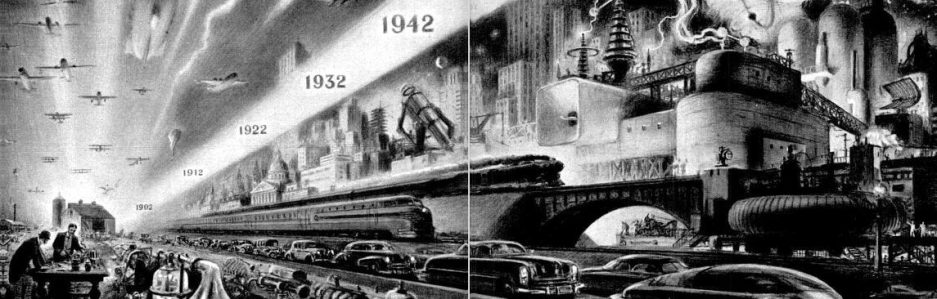
It’s tempting to think that the experience of rapid technological change is something novel to our own time. In fact, I know I’ve been guilty of giving that impression myself. But consider this passage* from a sermon delivered by Dominican Fra Giordano of Pisa at Santa Maria Novella in Florence on February 23, 1306:

“Not all the arts have been found; we shall never see an end of finding them. Everyday one could discover a new art … indeed they are being found all the time. It is not twenty years since there was discovered the art of making spectacles which help you to see well, and which is one of the best and most necessary in the world. And that is such a short time ago that a new art, which never before existed, was invented …. I myself saw the man who discovered and practiced it, and I talked with him.”

We might debate the real pace of technological advance then and now, but the phenomenological experience of change described by Giordano has a rather contemporary ring. According to historian of technology Lynn White, not only does this passage give us the best evidence for the appearance of eye glasses, it also gives witness to the “invention of invention.” According to White, it was at the height of the much maligned Medieval period that, “Technicians … in large numbers began to consider systematically all the imaginable ways of solving a problem.”

__________________________________________________________

* Lynn White cites this passage in his essay, “Cultural Climates and Technological Advance,” found in Medieval Religion and Technology.