Et in Facebook ego

In Nicolas Poussin’s mid-seventeenth century painting, Et in Arcadia ego, shepherds have stumbled upon an ancient tomb on which the titular words are inscribed. Understood to be the voice of death, the Latin phrase may be roughly translated, “Even in Arcadia there am I.” Because Arcadia had come to symbolize a mythic pastoral paradise, the painting suggested the ubiquity of death. To the shepherds, the tomb was a momento mori: a reminder of the inescapability of death.

Nicolas Poussin, Et in Arcadia ego, 1637-38

Poussin was not alone among artists of the period in addressing the certainty of death. During the seventeenth and eighteenth century, vanitas art flourished. The designation stems from the Latin phrase vanitas vanitatum omni vanitas, a recurring refrain throughout the biblical book of Ecclesiastes:  “vanity of vanities, all is vanity.” Paintings in the genre were still lifes depicting an assortment of objects which represented all of that we might pursue in this life. In their midst, however, one would also find a skull and an hour glass:  symbols of death and the brevity of life. The idea, of course, was to encourage people to make the most of their living years.

Edwart Collier, 1690

For the most part, we don’t go in for this sort of thing anymore. Few people, if any, operate under the delusion that we might escape death (excepting the Singularity folks I guess), but we do a pretty good job of forgetting what we know about death. We keep death out of sight and, hence, out of mind. We’re certainly not going out of our way to remind ourselves of death’s inevitability. And, who knows, maybe that’s for the better. Maybe all of those skulls and hourglasses were morbidly unhealthy. I honestly don’t know.

But while vanitas art has gone out of fashion, a new class of memento mori has emerged: the social media profile.

I’m one of those on again, off again Facebook users. Lately, I’ve been on again, and recently I noticed one of those birthday reminders Facebook places in the left hand column where it puts all of the things Facebook would like you to do and click on. It was for a high school friend whom I had not spoken to in over eight years. It was in that respect a very typical Facebook friendship:  the sort that probably wouldn’t exist at all any longer were it not for Facebook. And that’s not necessarily a knock on the platform. I appreciate being able to maintain at least a minimal connection with people I’d once been quite close to. In this case, though, it demonstrated just how weak those ties can be.

Upon clicking over to their profile, I read a few odd birthday notes, and very quickly it became obvious that my high school friend had died over a year ago. It was a shock, of course. It had happened while I was off of Facebook and news had not reached me by any other channel. But there it was. Out of nowhere and without warning my browser was haunted by the very real presence of death. Momento mori.

Just a few days prior I logged on to Facebook and was greeted by the tragic news that a former student had unexpectedly passed away. Because we had several mutual connections, photographs of the young man found their way into my news feed for several days. It was odd and disconcerting and terribly sad all at once. I don’t know what I think of social media mourning. It makes me uneasy, but I won’t criticize what might bring others solace. In any case, it is, like death itself, an unavoidable reality of our social media experience. Death is no digital dualist.

Facebook sometimes feels like a modern-day Arcadia. It is a carefully cultivated space in which life appears Edenic. The pictures are beautiful, the events exciting, the face are always smiling, the children always amusing, the couples always adoring. Certain studies even suggest that comparing our own experience to these immaculately curated slices of life leads to envy, discontent, and unhappiness. Naturally … if we assume that these slices of life are comprehensive representations of the lives people lead. Of course, they are not.

But there, alongside the pets and witty status updates and wedding pictures and birth announcements, we will increasingly find our social media platforms haunted by the digital, disembodied presence of the dead.

In that dreary opening chapter of The Scarlett Letter, Hawthorne wrote, “The founders of a new colony, whatever Utopia of human virtue and happiness they might originally project, have invariably recognized it among their earliest practical necessities to allot a portion of the virgin soil as a cemetery, and another portion as the site of a prison.”

And so it is with our digital utopias, our virtual Arcadias.

Et in Facebook ego.

The Ethics of Ethical Tools

In a passage I’m rather fond of, T.S. Eliot wrote of “the endless cycle of idea and action, Endless invention, endless experiment.” How one reads those few words might reveal a good bit about that person’s posture toward technology. If you read it triumphantly, then odds are you are on the whole at peace with the world wrought by modern technology. Eliot, naturally, intended them a bit more gloomily. Endless invention and endless experiment partake in our growing ignorance that brings us nearer to death and no nearer to God. It prompts his well-known series of questions,

“Where is the Life we have lost in living?
Where is the wisdom we have lost in knowledge?
Where is the knowledge we have lost in information?

Whatever you make of the relative merits of endless invention and endless experiment, the former at least is built into the technological project. Melvin Kranzberg captured this reality in the second of his six laws of technology. Reversing the cliché, Kranzberg’s second law reads, “Invention is the mother of necessity.” “Every technical innovation,” he explains, “seems to require additional technical advances in order to make it fully effective.”

And that is a relatively cheery way of putting it. We might simply say that technology creates as many problems as it solves. Naturally, we then turn to additional technologies to solve those problems. Endless invention, endless experiment – for better and for worse. All of this said, consider Blokket.

Blokket is a stylish pouch woven of nylon and silver thread designed to block cell phone signals. (That its name happens to sound as if it were a profane Nordic expression of exasperation is a felicitous coincidence as far as I can tell.)  As one write-up puts it, “once you slip your smartphone in, there will be no calls, texts, or notifications to alert you to activities happening outside arm’s reach.” In the same article, Chelsea Briganti, one of the lead designers, explains Blokket’s usefulness: “Blokket helps people engage in the present moment by providing interludes of relief from technology.”

I don’t know about you, but my initial response to this was decidedly … mixed. As I’ve written before, I’m very much on the side of those who urge us to give our attention, so far as we are able, to those fellow human beings in our immediate presence. Moreover, that attention can be as delicate and tenuous as it is precious.

There are, of course, perfectly reasonable extenuating circumstances. If, for example, your dear friend, who has been out of touch for weeks, is calling from Burkina Faso where she is an aid worker, then, please, by all means take the call. If, while we are talking baseball over beers, your ailing grandmother, wherever she might be, wants to hear the sound of your voice, please do oblige. If, while we are hiking the Appalachian Trail, I am bit by a rattlesnake, then, yes, I release you to check your smartphone for the appropriate first aid protocol. All of that should go without saying.

But otherwise, I’m of the party that finds the recent Facebook Home ad campaign … what is the word … grotesque. Or, as Evan Selinger more eloquently put it, “Social media — including self-indulgent interfaces like Home — only gets in the way of us being genuinely responsive to and responsible for others if we let it undermine ethical effort in maintaining meaningful connections. It only diminishes our characters and true social networks if we treat Selfish Girl as a role model rather than a tragically misguided soul.”

Attention is a precious resource these days, and we need to be better at directing it ethically rather than self-servingly or even efficiently. Incidentally, making that point is a perfectly good excuse to include a short film rendering a relevant portion of David Foster Wallace’s Kenyon College address (see below).

So I am naturally inclined to appreciate a product that markets itself as an aid to the humane deployment of attention. Good for them. Of course, another response soon arises from the more cynical recesses of my consciousness. Do we really need to buy what amounts to a fashion accessory in order to behave like minimally decent human beings? Are we so pathetic that we have to enlist the help of ethical props in order achieve the mere baseline of civilized action? Isn’t this merely the aestheticization and commodification of decency?

Well, maybe. As my cynicism subsides, I consider the fact that we are rarely as good as we want to be. Many seem not to want to be good at all, but that is a separate problem. I know, from my own experience, that when the moment comes to act on the principles I embrace, I don’t always follow through. I know what is right in the abstract, but when it comes time to act concretely, I appear to forget. Of course, I am not really forgetting. I am simply heeding other motives and desires, which at that moment override my desire to act generously or selflessly.

Our wills are divided. Certain philosophers have talked about this reality in terms of desires and second order desires. Second order desires are understood to be desires about our desires. Applied to the present case, we may find ourselves desiring to momentarily ignore the person we are with in order to check our smartphone for no good reason. But our better self wishes that we didn’t feel that desire. Our better self knows better and it rues that urge to do otherwise. That better self expresses the second order desire that we would not desire to fiddle with our smartphone at all. But alas we do, and our better self does not always win the battle of our divided wills.

This is not a new problem. St. Paul complains in one of his letters, “I do not understand my own actions. For I do not do what I want, but I do the very thing I hate … I have the desire to do what is right, but not the ability to carry it out. For I do not do the good I want, but the evil I do not want is what I keep on doing.”

The most famous illustration is typically drawn from Homer’s Odyssey in which Odysseus both knows that he should not heed the Siren’s song and that, when the moment comes, he most likely will. So he takes precautions: he plugs the ears of his crew, and then he has them tie him to the mast of his ship. In other words, while his better, wiser self is in charge he makes provisions to bind his weaker self.

A more recent illustration was supplied offhandedly by tech critic Evgeny Morozov in an interview. Here is how he describes the lengths to which he must go in order to moderate his use of the Internet:

“I have bought myself a type of laptop from which it was very easy to remove the Wi-Fi card – so when I go to a coffee shop or the library I have no way to get online. However, at home I have cable connection. So I bought a safe with a timed combination lock. It is basically the most useful artefact in my life. I lock my phone and my router cable in my safe so I’m completely free from any interruption and I can spend the entire day, weekend or week reading and writing. … To circumvent my safe I have to open a panel with a screwdriver, so I have to hide all my screwdrivers in the safe as well. So I would have to leave home to buy a screwdriver – the time and cost of doing this is what stops me.”

Morozov’s safe is another instance of Odysseus’ mast. Other examples could be easily supplied. Perhaps you have a few of your own. We wish that we had the strength of will to simply act how we know we ought to act, but alas we do not (and this for a whole host of reasons). The whole notion of a sense of duty, now rather regrettably out of fashion, was premised on the honest recognition that, apart from a sense of duty, we would not always spontaneously act in the most morally appropriate fashion.

Without digressing too much further, though, it would seem that if the choice is between, on the one hand, acting decently with the help of some extension of our will or ethical prosthetic, or, on the other, not acting decently at all, then let us embrace the extension of our will. Buy yourself a Blokket and slip your phone inside straightaway.

Yet … I can’t quite still that little voice inside of me that says, “Wouldn’t it be better still if you would just become the sort of person that didn’t need such extensions of the will?”

I think the answer to that question is, probably, yes. The question arises from that nagging sense that extensions of the will, well-intentioned and effective though they may be, feel as if they are a waving of the white-flag of moral surrender. But it need not be that at all, and this is where the write-up I cited earlier registers an important point. It appears that when the design company field tested Blokket, they found that, in the article’s words, “using the pouch actually helped to create new habits; users found themselves comfortably making the decision to keep interactions face to face and in the flesh.”

This warms my Aristotelian heart.

Simplistically stated, Aristotle’s theory of virtue is premised on the cultivation of habits that then become inner dispositions. In other words, if you know what the right thing to do is, but you don’t always act on that knowledge, then figure out a way of making that action habitual – by an extension of the will for example – and when that habit is internalized, you will then act on it instinctively as a matter of character.

Within this framework then, extensions of the will are not so much white flags of moral surrender as they are training wheels that will eventually be discarded.

That is all very neat and tidy. In the trenches of our moral lives, it is admittedly quite a bit messier than that. But all in all, it is not a bad way (even if it is incomplete) to think about our moral formation. If nothing else, something like Blokket is a step in the direction of mindfulness. That silly little pouch will at least make us conscious of the stakes. It is a token to remind us of what we know is the better way to be with others. We may not always choose that way – how hard is it to slip the phone out of the pouch anyway – but at the very least we will have a small obstacle to arrest the automatic and unthinking selfishness that is, for many of us, our habitual default.

[UPDATE: The video I refer to above has apparently been taken due to copyright issues. Here is a link to the audio of commencement address on which the video was based.]

The Lifestream Stops

David Gelernter, 2013:

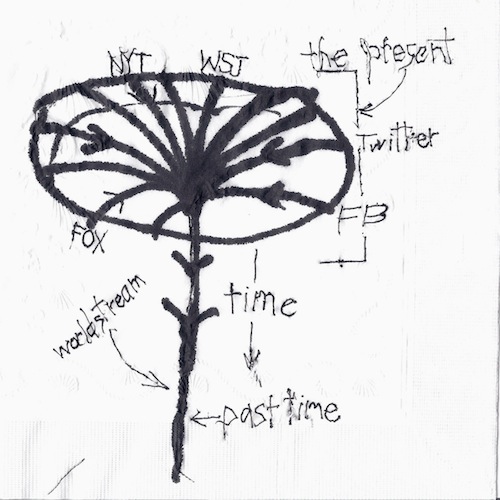
“And today, the most important function of the internet is to deliver the latest information, to tell us what’s happening right now. That’s why so many time-based structures have emerged in the cybersphere: to satisfy the need for the newest data. Whether tweet or timeline, all are time-ordered streams designed to tell you what’s new … But what happens if we merge all those blogs, feeds, chatstreams, and so forth? By adding together every timestream on the net — including the private lifestreams that are just beginning to emerge — into a single flood of data, we get the worldstream: a way to picture the cybersphere as a whole … What people really want is to tune in to information. Since many millions of separate lifestreams will exist in the cybersphere soon, our basic software will be the stream-browser: like today’s browsers, but designed to add, subtract, and navigate streams.”

E. M. Forster, 1909:

“Who is it?” she called. Her voice was irritable, for she had been interrupted often since the music began. She knew several thousand people, in certain directions human intercourse had advanced enormously.

But when she listened into the receiver, her white face wrinkled into smiles, and she said:

“Very well. Let us talk, I will isolate myself. I do not expect anything important will happen for the next five minutes-for I can give you fully five minutes …”

She touched the isolation knob, so that no one else could speak to her. Then she touched the lighting apparatus, and the little room was plunged into darkness.

“Be quick!” She called, her irritation returning. “Be quick, Kuno; here I am in the dark wasting my time.”

[Conversation ensues and comes to an abrupt close.]

Vashti’s next move was to turn off the isolation switch, and all the accumulations of the last three minutes burst upon her. The room was filled with the noise of bells, and speaking-tubes. What was the new food like? Could she recommend it? Has she had any ideas lately? Might one tell her one”s own ideas? Would she make an engagement to visit the public nurseries at an early date? – say this day month.

To most of these questions she replied with irritation – a growing quality in that accelerated age. She said that the new food was horrible. That she could not visit the public nurseries through press of engagements. That she had no ideas of her own but had just been told one-that four stars and three in the middle were like a man: she doubted there was much in it.

When I read Gelernter’s piece and his world-stream metaphor (illustration below), I was reminded of Forster’s story and the image of Vashti, sitting in her chair, immersed in cacophonic real-time stream of information. Of course, the one obvious difference between Gelernter’s and Forster’s conceptions of the relentless stream of information into which one plunges is the nature of the interface. In Forster’s story, “The Machine Stops,” the interface is anchored to a particular place. It is an armchair in a bare, dark room from which characters in his story rarely move. Gelernter assumes the mobile interfaces we’ve grown accustomed to over the last several years.

In Forster’s story, the great threat the Machine poses to its users is that of radical disembodiment. Bodies have atrophied, physicality is a burden, and all the ways in which the body comes to know the world have been overwhelmed by a perpetual feeding of the mind with ever more derivative “ideas.” This is a fascinating aspect of the story. Forster anticipates the insights of later philosophers such as Merleau-Ponty and Hubert Dreyfus as well as the many researchers helping us understand embodied cognition. Take this passage for example:

You know that we have lost the sense of space. We say “space is annihilated”, but we have annihilated not space, but the sense thereof. We have lost a part of ourselves. I determined to recover it, and I began by walking up and down the platform of the railway outside my room. Up and down, until I was tired, and so did recapture the meaning of “Near” and “Far”. “Near” is a place to which I can get quickly on my feet, not a place to which the train or the air-ship will take me quickly. “Far” is a place to which I cannot get quickly on my feet; the vomitory is “far”, though I could be there in thirty-eight seconds by summoning the train. Man is the measure. That was my first lesson. Man”s feet are the measure for distance, his hands are the measure for ownership, his body is the measure for all that is lovable and desirable and strong.

But how might Forster have conceived of his story if his interface had been mobile? Would his story still be a Cartesian nightmare? Or would he understand the danger to be posed to our sense of time rather than our sense of place? He might have worried not about the consequences of being anchored to one place, but rather being anchored to one time — a relentless, enduring present.

Were I Forster, however, I wouldn’t change his focus on the body. For isn’t our body and the physicality of lived experience that the body perceives also our most meaningful measure of time? Do not our memories etch themselves in our bodies? Does not a feel for the passing years emerge from the transformation of our bodies? Philosopher Merleau-Ponty spoke of the “time of the body.” Consider Shaun Gallagher’s exploration of Merleau-Ponty’s perspective:

“Temporality is in some way a ‘dimension of our being’ … More specifically, it is a dimension of our situated existence. Merleau-Ponty explains this along the lines of the Heideggerian analysis of being-in- the-world. It is in my everyday dealings with things that the horizon of the day gets defined: it is in ‘this moment I spend working, with, behind it, the horizon of the day that has elapsed, and in front of it, the evening and night – that I make contact with time, and learn to know its course’ …”

Gallagher goes on to cite the following passage from Merleau-Ponty:

“I do not form a mental picture of my day, it weighs upon me with all its weight, it is still there, and though I may not recall any detail of it, I have the impending power to do so, I still ‘have it in hand.’ . . . Our future is not made up exclusively of guesswork and daydreams. Ahead of what I see and perceive . . . my world is carried forward by lines of intentionality which trace out in advance at least the style of what is to come.”

Then Gallagher adds, “Thus, Merleau-Ponty suggests, I feel time on my shoulders and in my fatigued muscles; I get physically tired from my work; I see how much more I have to do. Time is measured out first of all in my embodied actions as I ‘reckon with an environment’ in which ‘I seek support in my tools, and am at my task rather than confronting it.'”

That last distinction between being at my task rather than confronting it seems particularly significant, especially as it involves the support of tools. Our sense of time, like our sense of place, is not an unchangeable given. It shifts and alters through technological mediation. Melvin Kranzberg, in the first of his six laws of technology, reminds us, “Technology is neither good nor bad; nor is it neutral.” Our technological mediation of space and time is never neutral; and while it may not be “bad” or “good” in some abstract sense, it can be more or less humane, more or less conducive to our well-being. If the future of the Internet is the worldstream, we should perhaps think twice before plunging.

Worldstream Gelernter

Suffering, Joy, and Incarnate Presence

“I have much to write you, but I do not want to do so with pen and ink. I hope to see you soon, and we will talk face to face.” With this, John closed the third New Testament epistle that bears his name. The letter is nearly 1,900 years old, yet the sentiment is entirely recognizable. In fact, many of us have likely expressed similar sentiments; only for us it was more likely an electronic medium that we preferred to forego in favor of face to face communication. There are things better said in person; and, clearly, this is not an insight stumbled upon by digital-weary interlocutors of the 21st century.

Yet, John did pen his letter. There were things the medium would not convey well, but he said all that could be said with pen and ink. He recognized the limits of the medium and used it accordingly, but he did not disparage the medium for its limits. Pen and ink were no less authentic, no less real, nor were they deemed unnatural. They were simply inadequate given whatever it was that John wanted to communicate. For that, the fullness of embodied presence was deemed necessary. It was, I think, a practical application of a theological conviction which John had elsewhere memorably articulated.

In the first chapter of his Gospel, John wrote, “The Word became flesh and made his dwelling among us.” It is a succinct statement of the doctrine of the incarnation, what Christians around the world celebrate at Christmas time. The work of God required the embodiment of divine presence. Words were not enough, and so the Word became flesh. He wept with those who mourned, he took the hand of those no others would touch, he broke bread and ate with outcasts, and he suffered. All of this required the fullness of embodied presence. John understood this, and it became a salient feature of his theology.

For my part, these thoughts have been passing in and out of mind inchoately and inarticulately since the Newtown shooting, and specifically as I thought about the responses to the shooting throughout our media environment. I was troubled by the urge to post some reaction to the shooting, but, initially, I don’t think I fully understood what troubled me. At first, it was the sense that I should say something, but I’ve come to believe that it was rather that I should say something.

Thinking about it as a matter of I saying something struck me as an unjustifiably self-indulgent. I still believe this to be part of the larger picture, but there was more. Thinking about it as a matter of I saying something pointed to the limitations of the media through which we have been accustomed to interacting with the world. As large as images loom on digital media, the word is still prominent. For the most part, if we are to interact with the world through digital media, we must use our words.

We know, however, that our words often fail us and prove inadequate in the face of the most profound human experiences, whether tragic, ecstatic, or sublime. And yet it is in those moments, perhaps especially in those moments, that we feel the need to exist (for lack of a better word), either to comfort or to share or to participate. But the medium best suited for doing so is the body, and it is the body that is, of necessity, abstracted from so much of our digital interaction with the world. With our bodies we may communicate without speaking. It is a communication by being and perhaps also doing, rather than by speaking.

Of course, embodied presence may seem, by comparison to its more disembodied counterparts, both less effectual and more fraught with risk. Embodied presence enjoys none of the amplification that technologies of communication afford. It cannot, after all, reach beyond the immediate place and time.  And it is vulnerable presence. Embodied presence involves us with others, often in unmanageable, messy ways that are uncomfortable and awkward. But that awkwardness is also a measure of the power latent in embodied presence.

Embodied presence also liberates us from the need to prematurely reach for rational explanation and solutions — for an answer. If I can only speak, then the use of words will require me to search for sense. Silence can contemplate the mysterious, the absurd, and the act of grace, but words must search for reasons and fixes. This is, in its proper time, not an entirely futile endeavor; but its time is usually not in the aftermath. In the aftermath of the tragic, when silence and “being with” and touch may be the only appropriate responses, then only embodied presence will do. Its consolations are irreducible. This, I think, is part of the meaning of the Incarnation: the embrace of the fullness of our humanity.

Words and the media that convey them, of course, have their place, and they are necessary and sometimes good and beautiful besides. But words are often incomplete, insufficient. We cannot content ourselves with being the “disincarnate users” of electronic media that McLuhan worried about, nor can we allow the assumptions and priorities of disincarnate media to constrain our understanding of what it means to be human in this world.

At the close of the second epistle that bears his name, John also wrote, “I have much to write to you, but I do not want to use paper and ink.” But in this case, he added one further clause. “Instead,” he continued, “I hope to visit you and talk with you face to face, so that our joy may be complete.” Joy completed. Whatever it might mean for our joy to be completed, it is a function of embodied presence with all of its attendant risks and limitations.

May your joy be complete.

Violence and Technology

There is this well known line from Wittgenstein’s Tractatus that reads, “Whereof one cannot speak, thereof one must be silent.” There is much wisdom in this, especially when one extends its meaning beyond what Wittgenstein intended (so far as I understand what he intended). We all know very well that words often fail us when we are confronted with unbearable sorrow or unmitigated joy. In the aftermath of the horror in Newtown, Connecticut, then, what could one say? Everything else seemed trivial.

I first heard of the shooting when I logged on to Twitter to post some frivolous comment, and, of course, I did not follow through. However, I then felt the need to post something — something appropriate, something with sufficient gravitas. But I asked myself why? Why should I feel the need to post anything? To what end? So that others may note that I responded to the tragedy with just the right measure of grace and seriousness? Or to self-righteously admonish others, implicitly of course, about their own failure to respond as I deemed appropriate?

When we become accustomed to living and thinking in public, the value of unseen action and unshared thoughts is eclipsed. “I should be silent,” a part of us may acknowledge, but then in response, a less circumspect voice within us wonders, “But how will anyone know that I am being silent? A hashtag perhaps, #silent?”

I felt just then, with particular force, the stunning degree of self-indulgence invited by social media. But then, of course, I had to reckon with the fact that the well of self-indulgence tapped by social media springs from no other source but myself.

There is only one other point that I want to consider. Within my online circles, many have sought to challenge the slogan “Guns don’t kill people,” and they have done so based on premises which I am generally inclined to support. I have myself associated the technological neutrality position with this slogan, and I have found it an inadequate position. Guns, like other technologies, yield a causal force independent of the particular uses to which they are put. They enter actively and with consequence into our perception and experience of the world. This, I continue to believe, is quite true.

Several months ago, in the wake of another tragic shooting, Evan Selinger wrote a well-considered piece on this very theme and I encourage you to read it: “The Philosophy of the Technology of the Gun.”

Less effectively, in my view, but thoughtfully still, PJ Rey revisited Zeynep Tufekci’s appropriation of Aristotle’s categories of causality to frame the gun as the material cause of acts of violence. The argument here is also against technological neutrality, I’m just not entirely sure that Aristotle’s categories are fully understood by Rey or Tufekci (which is not to say that I fully understand them). The material cause is not “that without which,” but “that out of which.” But then again, I put Wittgenstein’s dictum to my own uses; I suppose Aristotle too can be used suggestively, if not rigorously. Maybe.

Thus far, I’ve been sympathetic to the claims advanced, but there is latent in these considerations (but not necessarily in the thinking of these authors) an opposite error that I’ve also seen expressed explicitly and forcefully. Last night, I caught the following comment on Twitter from Prof. Lance Strate. Strate is a respected media ecologist and I have in the past appreciated his insights and commentary. I was, however, stopped short by this tweet:

I want to make all the requisite acknowledgements here. It is a tweet, after all, and the medium is not conducive to nuance. Nor is one required to say everything one thinks about a matter whenever one speaks of that matter. And, in fairness to Strate, I also want to provide a link to his fuller discussion of the situation on his blog, “On Guns and More,” much of which I would agree with.

That said, “Surely the blame is also on him,” was my initial response to this tweet. Again, I want to read generously, particularly in a medium that is given to misunderstanding. I don’t know that Strate meant to recuse the shooter of all responsibility; in fact, I have to believe such was not the case. But this comment reminded me that in our efforts to critique the neutrality of technology position, we need to take care less we end up endorsing, in my view, more pernicious errors of judgment.

Thinking again about the manner in which a gun enters into our phenomenological experience, it is true to say that a gun wants to be shot. But this does not say everything there is to say; it doesn’t even say the most important and relevant things that could be said. Why is it, at times, not shot at all? Further, to say it wants to be shot is not yet to say what it will be shot at or why? We cannot dismiss the other forms of causality that come into play. If Aristotle is to be invoked, after all,  it should be acknowledged that he privileged final causation whenever possible.

Interestingly, in his illustration of the four causes –the making of a bronze statue — Aristotle did not take the craftsman to be the best example of an efficient cause. It was instead the knowledge the craftsman possessed that best illustrated the efficient cause. If we apply this analogously onto the present case, it suggests that knowledge of how to inflict violence is the efficient cause. And this reminds us, disturbingly, of what is latent in all of us.

It reminds me as well of some other well known lines, not from Wittgenstein this time, but from Solzhenitsyn: “If only there were evil people somewhere insidiously committing evil deeds, and it were necessary only to separate them from the rest of us and destroy them. But the line dividing good and evil cuts through the heart of every human being. And who is willing to destroy a piece of his own heart?”

Kyrie Eleison.