
“Reading toward Wisdom”

More from Ivan Illich’s In the Vineyard of the Text.  Excerpts from the first chapter, “Reading toward Wisdom” (page numbers in parenthesis).  Previous post in the series:  “In the Vineyard of the Text”.

There is a line, whose source I’ve forgotten, that goes something like, “The past is a foreign country, they do things differently there.”  Reading about the past is then a little like visiting a foreign country.  Such visits can teach us a good deal about ourselves by throwing our own habits and patterns of thought into relief against the backdrop of the past.  To recognize our difference from the other is to see ourselves a little more clearly.

And so Illich is our guide on this particular foray into the past and below are some observations that touch on the end or goal of reading, the relationship between reading/learning and character, and the correlation between new forms of reading and new understandings of the self:

  • Omnium expetendorum prima est sapentia.  ‘Of all things to be sought, the first is wisdom.’  This is how Jerome Taylor translates the lead sentence of the Didascalicon of Hugh of Saint Victor, written around 1128.” (7)
  • “Hugh’s writings are drenched in Augustine.  He lived in a community that followed Augustine’s rule.  He read, reread, and copied the texts of his master.  Reading and writing were for him two almost indistinguishable sides of the same studium.” (9)
  • “As with Augustine, wisdom was for Hugh not something but someone.  Wisdom in the Augustinian tradition is the second person of the Trinity, Christ . . . . The wisdom Hugh seeks is Christ himself.  Learning and, specifically, reading, are both simply forms of a search for Christ the Remedy, Christ the Example and Form which fallen humanity, which has lost it, hopes to recover.  The need of fallen humanity for reunion with wisdom is central to Hugh’s thought.  This makes the concept of remedium, remedy or medicine, crucial for an understanding of Hugh.”  (10)
  • “Hugh, by developing the concept of remedium, provides for the twentieth-century thinker a unique way to address the issue of technique or technology.  Reading, as Hugh perceives and interprets it, is an ontologically remedial technique.  I intend to explore it as such.  I analyze what Hugh has to say about the techniques used in reading in order to explore the role that alphabetic technology played around 1130 in the shaping of these techniques.”  (11)
  • “I am here concerned primarily with ‘alphabetic technology’ which interacts in a unique, epoch-specific way around 1130 with the northwest European symbolic universe, and how changes in world perception in turn facilitated and oriented the choice of technologies.  In taking this approach to the alphabet as a technology I am indebted to Walter Ong, S. J., Orality and Literacy . . .”  (11, footnote 11)
  • “Authorities, in this now obsolete sense, are sentences which created precedents and defined reality . . . The sentence states an obvious truth precisely because it has been disembedded from the discourse of this or that particular author; it had become a free-floating statement.  As such a verbal institution, the auctorias [sentence worthy of repetition] quoted by Hugh became an exemplary testimony to untouchable tradition.”  (13)
  • “. . . the thought of an ultimate goal of all readings is not meaningful to us.  Even less is there any idea that such a goal could motivate or ’cause’ our action whenever we open a book.  We are steeped in the spirit of engineering and think of the trigger as the cause of a process.  We do not think of the heart as the cause of the bullet’s trajectory . . . . Even more thoroughly, the idea of one first or primary Final Cause, one ultimate motivating reason of all desires that are hidden in the nature of the stone or of the plant or of the reader, has become foreign to our century.  ‘End stage’ in the twentieth-century mental universe connotes death.  Entropy is our ultimate destiny. We experience reality as monocausal.  We know only efficient causes. ”  (13-14)
  • “Studies pursued in a twelfth-century cloister challenged the student’s heart and sense even more than his stamina and brains.  Study did not refer to a liminal epoch of life, as it usually does in modern times, when we say that someone ‘is still a student.’  They encompassed the person’s daily and lifelong routine, his social status, and his symbolic function.” (14-15)
  • “The studium legendi forms the whole monk and reading will become perfect as the monk himself strives for, and finally reaches, perfection.

The beginning of discipline is humility . . . and for the reader there are three lessons taught by humility that are particularly important:  First, that he hold no knowledge or writing whatsoever in contempt.  Second, that he not blush to learn from any man.  Third, that when he as attained learning himself, he not look down upon anyone else.”  (15-16)

  • “The reader is one who has made himself into an exile in order to concentrate his entire attention and desire on wisdom, which thus becomes the hoped-for home.” (17)
  • “That which we mean today when, in ordinary conversation, we speak of the ‘self’ or the ‘individual,’ is one of the great discoveries of the twelfth century . . . .  A social reality in which our kind of self is taken for granted constitutes an eccentricity among cultures . . . .  [Hugh] wants the reader to face the page so that  by the light of wisdom he shall discover his self in the mirror of the parchment.  In the page the reader will acknowledge himself not in the way others see him or by the titles or nicknames by which they call him, but by knowing himself by sight.”  (22-23)
  • “With the spirit of self-definition, estrangement acquires a new positive meaning.  Hugh’s call away from the ‘sweetness of one’s native soil’ and to a journey of self-discovery is but one instance of the new ethos . . . . [that] addresses people at all levels of the feudal hierarchy to leave the common mind-set of the neighborhood, within which identity comes from the way others have named me and treat me, and to discover their selves in the loneliness of the long road . . . . Hugh’s insistence on the need that the scholar be an exile-in-spirit echoes this mood.”  (23)
  • “I am not suggesting that the ‘modern self’ is born in the twelfth century, nor that the self which here emerges does not have a long ancestry.  We today think of each other as people with frontiers.  Our personalities are as detached from each other as are our bodies.  Existence in an inner distance from the community, which the pilgrim who set out to Santiago or the pupil who studied the Didascalicon had to discover on their own, is for us a social reality, something so obvious that we would not think of wishing it away.  We were born into a world of exiles . . . . This existential frontier is of the essence for a person who wants to fit into our kind of world.  Once it has shaped a child’s mental topology, that being will forever be a foreigner in all ‘worlds’ except those integrated by exiles like himself.”
  • “What I want to stress here is a special correspondence between the emergence of selfhood understood as a person and the emergence of ‘the’ text from the page.  Hugh directs his reader to a foreign land.  But he does not ask him to leave his family and accustomed landscape to move on the road from place toward Jerusalem or Santiago.  Rather he demands that he exile himself to start on a pilgrimage that leads through the pages of a book.  He speaks of the Ultimate which should attract the pilgrim, not as the celestial city for pilgrims of the staff, but as the form of Supreme Goodness which motivates the pilgrims of the pen.  He points out that on this road the reader is on his way into the light which will reveal his own self to him.”
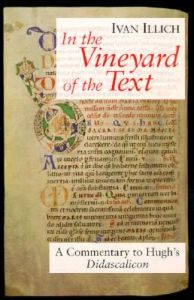
“In the Vineyard of the Text”


That is the title of a slender volume authored by historian and social critic Ivan Illich in 1993 and subtitled, A Commentary to Hugh’s Didascalicon.  The Hugh in question is Hugh of St. Victor, a medieval theologian, philosopher, and mystic who wrote the Didascalicon around 1128.  According to Illich, Hugh’s Didascalicon was the “first book written on the art of reading” and  Illich believes that revisiting this 12th century work will help us better understand our ongoing transition from “bookish” reading to whatever multiple forms of reading have been emerging in the wake of the electronic or digital revolution.

In the spirit of the commonplace book, I’m going to transcribe some excerpts from In the Vineyard of the Text below and in subsequent posts over the next several days.  Realizing that there are countless books I would like to read and for a variety of reasons will simply not ever get to, I appreciate it when I can nonetheless get some gleanings from one of those books through a review or post that excerpts some of the key ideas worth considering.  Hardly the best form of reading, but nonetheless a useful one I think.  So in the hope that this will prove useful and because I do think Illich wrote a remarkably insightful little book, here are some selections from the Introduction:

  • “I concentrate my attention on a fleeting but very important moment in the history of the alphabet when, after centuries of Christian reading, the page was suddenly transformed from a score for pious mumblers into an optically organized text for logical thinkers.  After this date a new kind of classical reading became the dominant metaphor for the highest form of social activity.”
  • “Quite recently reading-as-a-metaphor has been broken again.  The picture and its caption, the comic book, the table, box, and graph, photographs, outlines, and integration with other media demand from the user textbook habits which are contrary to those cultivated in scholastic readerships.”
  • Quoting George Steiner:  “The development of the modern book and of book-culture as we know it seems to have depended on a comparable fragility of crucial and interlocking factors.”
  • “Classical print culture was an ephemeral phenomenon.  According to Steiner, to belong to ‘the age of the book’ meant to own the means of reading.  The book was a domestic object; it was accessible at will for re-reading.  The age presupposed private space and the recognition of the right to periods of silence, as well as the existence of echo-chambers such as journals, academies, or coffee circles.  Book culture required a more or less agreed-upon canon of textual values and modes . . . . [T]he formalities involved in this one kind of reading defined, and did not just reflect, the dimensions of social topology.”
  • “The book has now ceased to be the root-metaphor of the age; the screen has taken its place.  The alphabetic text has become but one of many modes of encoding something, now called ‘the message.'”
  • “Bookish reading can now clearly be recognized as an epochal phenomenon and not as a logically necessary step in the progress toward the rational use of the alphabet; as one mode of interaction with the written page among several; as a particular vocation among many, to be cultivated by some, leaving other modes to others.”
  • “. . . in the first six chapters I describe and interpret a technical breakthrough which took place  around 1150, three hundred years before movable type came into use.  This breakthrough consisted in the combination of more than a dozen technical inventions and arrangements through which the page was transformed from score to text.  Not printing, as is frequently assumed, but this bundle of innovations, twelve generations earlier, is the necessary foundation for all stages through which bookish culture has gone since.  This collection of techniques and habits made it possible to imagine the ‘text’ as something detached from the physical reality of  a page.  It both reflected and in turn conditioned a revolution in what learned people did when they read — and what they experienced reading to mean.”
  • “By centering our analysis on the object that is shaped by letters, and on the habits and fantasies connected with its use, we turn this object into a mirror reflecting significant transformations in the mental shape of western societies, something not easily brought out by other approaches.”
  • “What had started as a study in the history of technology, ended up as a new insight into the history of the heart.  We came to understand Hugh’s ars legendi [art of reading] as an ascetic discipline focused by a technical object.  Our meditation on the survival of this mode of reading under the aegis of the bookish text led us to enter upon a historical study of an asceticism that faces the threat of computer ‘literacy.'”

The Introduction as a whole challenges us to think again about the activity of reading.  We assume reading to be a singular activity, we assume it is always done in the same way and for the same reasons, we do not think of the alphabet as a technology that can be deployed in multiple modes, we do not think of a whole cultural milieu depending on something so mundane as reading, we do not think that changes in reading habits and assumptions about reading could reorder society.  By taking us back some 900 years Illich aims to show us that these are mistaken assumptions.

More to come.

Another “Slow” movement

From Patrick Kingsley’s article, “The Art of Slow Reading,” in The Guardian:

If you’re reading this article in print, chances are you’ll only get through half of what I’ve written. And if you’re reading this online, you might not even finish a fifth. At least, those are the two verdicts from a pair of recent research projects – respectively, the Poynter Institute’s Eyetrack survey, and analysis by Jakob Nielsen – which both suggest that many of us no longer have the concentration to read articles through to their conclusion.

And just in case the research proves predictive in your case,

What’s to be done, then? All the slow readers I spoke to realise that total rejection of the web is extremely unrealistic, but many felt that temporary isolation from technology was the answer. Tracy Seeley’s students, for example, have advocated turning their computer off for one day a week. But, given the pace at which most of us live, do we even have time? Garrard seems to think so: “I’m no luddite – I’m on my iPhone right now, having just checked my email – but I regularly carve out reading holidays in the middle of my week: four or five hours with the internet disconnected.”

Shared Sensibilities

Rochelle Gurstein captures in lovely prose a handful of thoughts I have attempted, with less eloquent results, to express in recent days.  “The Perils of Progress”, a brief essay appearing in The New Republic, opens with a story about “a lecture by an exquisitely sensitive, painfully alert poet friend of ours about how we live today” which elicits tired labels contemptuously applied.  As Gurstein puts it:

These days, even a few well-considered, measured reservations about digital gadgetry apparently cannot be tolerated, and our poet friend was informed by forward-looking members of the audience that she was fearful of change, nostalgic, in short, reactionary with all its nasty political connotations.

And this presumably from a learned and sophisticated audience.

Gurstein goes on to challenge the same NY Times editorial by Steven Pinker which drew some of my own comments a few days ago.  She observes that in …

… disputes about the consequences of innovation, those on the side of progress habitually see only gains. They have no awareness that there are also losses—equally as real as the gains (even if the gain is as paltry as “keeping us smart”)—and that no form of bookkeeping can ever reconcile the two.

Gurstein concludes with some poignant reflections on the materiality of the book and the difference it makes to the experience of reading and the reader’s relationship to the author.  The essay truly is worth a few minutes of your time to read.  Also reading the few comments posted in response to Gurstein’s essay tends to reinforce her concerns.

At one point in the essay Gurstein spoke of Pinker’s “stacking the deck against” her sensibility.  That word, sensibility, struck me.  This is I think near to the heart of matter.  What Gurstein and others like her attempt to defend and preserve is not merely a point of view or a particular truth.  It is more subjective than that, but is not merely preference.  It is not at all like a preference, which, I suspect, is precisely what those who do not understand it will try to label it.  It is, well, a sensibility — a certain disposition or way of being in the world.  It is an openness and a sensitivity to certain kinds of experience and to certain dimensions of reality.  Because of this it resists description and facile reduction to the terms of a cost/benefit analysis.  Consequently, it can be difficult to convincingly defend a sensibility to those who know nothing of it.  Maybe it is best described as a “seeing the world as” or, perhaps better still, a “feeling the world as.”  A sensibility is a posture toward life, a way of inhabiting the world.

What all of this groping for words may have at its center is the experiential quality of a sensibility, and experience is, after all, incommunicable.   Unless, that is, two people share the sensibility and then words may even seem superfluous.  In this sense, those who share a sensibility, share the world.  Those who lack or fail to appreciate the sensibility Gurnstein articulates know only to shake their heads in condescending bemusement.  What those, like Gurnstein and her poet friend, who grieve the passing of a culture that nurtured their sensibility fear may be the onset of a long loneliness.

Dread of the Unread

Several years ago I came across a well-known line from Erasmus: “When I get a little money I buy books; and if any is left I buy food and clothes.”  Apparently this is a variant, the line from one of Erasmus’ letters dated 1500 runs thus:  “I have turned my entire attention to Greek.  The first thing I shall do, as soon as money arrives, is to buy some Greek authors; after that, I shall buy clothes.”  Although the variant is more pithy, the sentiment seems to me largely the same in either case. I clipped the quote and stuck it in my wallet.  It would serve as a gentle reminder of where the money went.  Book shops perpetually tempt, and used book stores in particular tempt beyond my power to resist.

All that is fine and well.  It may be a vice, but it is a splendid vice.  However, there is a dark side to the book shop; entering therein incites a certain anxiety and sadness.  A sign should hang over every book shop declaring, “Abandon all hope, all ye who enter in … you cannot read it all.”  The sentiment is ancient.  Ecclesiastes warned, “of making many books there is no end” … to say nothing of reading them.  I’ve thought in the past that I had overcome this anxiety, this psychological burden of the unread.  In “The Pleasures of Reading,” Joseph Epstein’s writes,

Gertrude Stein said that the happiest moment of her life was that moment in which she realized that she wouldn’t be able to read all the books in the world.  I suppose what made it happy for her was that it took off a fair amount of pressure.

And so I thought, upon reading that testimonial, that I too had now suddenly come to terms with the awful realization.  But no, it was a false dawn.  While the angst fades, it still abides and from time to time reasserts itself with a certain gleeful vengeance.  Epstein went on to say,

I have finally come to the realization that I shan’t be able to read even all the good books in the world, and, far from making me happy, it leaves me, a naturally acquisitive fellow, a little sad.

I rather sympathize.

With all of that in mind, consider Will Self’s column in the New Statesman that came to my attention via Alan Jacobs this morning.  Here’s a sampling:

Back then, I laboured under the healthy delusion that, although I could not be as well read as Coleridge (who was said to be the last man to have read everything), I might yet read all that truly mattered.

Now, just as the possibility of joyous congress among the stacks retreats on hushed puppies, so the idea of all those unread books has become a screaming torment. Even the most innocuous of local libraries feels to me like Borges’s library of Babel, with its infinite number of texts ….

If the consciousness of unread books was bad enough, what about the consciousness of unread web pages?

It all puts me in mind of the Cha’an meditation illness: an incontinent recall of Buddhist texts that is the symptom of a Zen pupil’s overstrained psyche, and which can only be rectified by his master hitting him on the head with a stick. Otherwise, the texts proliferate across his visual field, while the meaning of every word is instantly grasped by him. At first, there are just texts the pupil knows, but soon enough these are joined by others he has only heard of – yet these, too, are comprehended in their entirety.

There is worse to come, as flying from all angles wing still more texts that the pupil is compelled to include in his screaming wits – texts he has never heard of at all, texts he didn’t know could exist, texts written by alien civilisations, texts doodled on the Etch a Sketch of God by archangels peaking on acid! No stick is big enough to beat this pupil – Humanity. So the maddening and delusory library expands, while the real and useful one is shut down.