Neither his fans nor his foes saw him clearly. The central fact of McLuhan’s life, as Coupland makes clear, was his conversion, at the age of twenty-five, to Catholicism, and his subsequent devotion to the religion’s rituals and tenets. Though he never discussed it, his faith forms the moral and intellectual backdrop to all his mature work. What lay in store, McLuhan believed, was the timelessness of eternity. The earthly conceptions of past, present, and future were, by comparison, of little consequence. His role as a thinker was not to celebrate or denigrate the world but simply to understand it, to recognize the patterns that would unlock history’s secrets and thus provide hints of God’s design. His job was not dissimilar, as he saw it, from that of the artist.
Below is a clip of the exchange between McLuhan and Norman Mailer that Carr references in his review:
One of my favorite YouTube videos is a clip from a Canadian television show in 1968 featuring a debate between Norman Mailer and Marshall McLuhan. The two men, both heroes of the ’60s, could hardly be more different. Leaning forward in his chair, Mailer is pugnacious, animated, engaged. McLuhan, abstracted and smiling wanly, seems to be on autopilot. He speaks in canned riddles. “The planet is no longer nature,” he declares, to Mailer’s uncomprehending stare; “it’s now the content of an art work.”
After watching the clip, I’ve got to agree with Carr; ten minutes well spent.
“The medium is the message.” Or so Marshall McLuhan would have it. The idea behind the catchy line is simple: the medium is at least as significant, if not more so, as the content of a message. In Understanding Media, McLuhan puts it this way:
Our conventional response to all media, namely that it is how they are used that counts is the numb stance of the technological idiot. For the “content” of a medium is like the juicy piece of meat carried by the burglar to distract the watchdog of the mind. (UM, 18)
Or, in case that wasn’t straightforward enough,
The content or message of any particular medium has about as much importance as the stenciling on the casing of an atomic bomb. (The Essential Mcluhan, 238)
This has remained one of media studies guiding principles. However, earlier this week, in a post titled “Content Matters”, Jonah Lehrer offers the following comments on an article in the journal Neuron:
One of the recurring themes in the article is that it’s that very difficult to generalize about “technology” in the abstract. We squander a lot of oxygen and ink worrying about the effects of “television” and the “internet,” but the data quickly demonstrates that these broad categories are mostly meaningless. When it comes to changing the brain, content is king. Here are the scientists:
In the same way that there is no single effect of ‘‘eating food,’’ there is also no single effect of ‘‘watching television’’ or ‘‘playing video games.’’ Different foods contain different chemical components and thus lead to different physiological effects; different kinds of media have different content, task requirements,and attentional demands and thus lead to different behavioral effects.
You can read the study, “Children, Wired: For Better or for Worse,” online. The article makes the case that different content presented by the same medium will impact children in different ways. So, for example, children who watch Sesame Street test better for literacy than do children who watch Teltubbies. The report also concluded that while media that was intended to be educational, such as Baby Einstein videos, can some times have detrimental consequences, media that were intended for entertainment, such as action video games, could sometimes yield positive educational outcomes. On that note, Lehrer quoted the following excerpt:
A burgeoning literature indicates that playing action video games is associated with a number of enhancements in vision, attention, cognition, and motor control. For instance, action video game experience heightens the ability to view small details in cluttered scenes and to perceive dim signals, such as would be present when driving in fog (Green and Bavelier, 2007; Li et al., 2009). Avid players display enhanced top-down control of attention and choose among different options more rapidly (Hubert-Wallander et al., 2010; Dye et al., 2009a). They also exhibit better visual short-term memory (Boot et al., 2008; Green and Bavelier, 2006), and can more flexibility switch from one task to another (Boot et al., 2008; Colzato et al., 2010; Karle et al., 2010).
Now perhaps I’m being somewhat of a curmudgeon, but it seems to me that, a heightened ability to drive in the fog notwithstanding, most of this amounts to saying that people who play video games get better at the skills needed to play video games. All in all, I think we might prefer that people learn to make certain kinds of decision more deliberately, rather than more rapidly. In any case, the article goes on to conclude that more research is needed and that researchers are just now beginning to get their footing in the field.
The point Lehrer seizes on, that content matters, is true enough. I don’t know too many people who would argue that all content on any given media is necessarily equal. However, this is not to say that the content is all that matters. The studies cited by the article focused on different content within the same medium, but what of those who don’t use the medium at all compared to those who do regardless of the content they receive. In other words, is there more of a difference between those who grow up watching television and those who don’t than there is between those who watch two different kinds of television programs? Unless I missed something, the article (and the studies it cites) does not really address that issue.
Dr. Robert Weis, a psychology professor at Denison University, confirmed this suspicion in a randomized controlled trial of the effect of video games on academic ability. Boys with video games at home, he found, spend more time playing them than reading, and their academic performance suffers substantially. Hard to believe, isn’t it, but Science has spoken.
The secret to raising boys who read, I submit, is pretty simple—keep electronic media, especially video games and recreational Internet, under control (that is to say, almost completely absent). Then fill your shelves with good books.
Ignore the unfortunate “Science has spoken” bit — I’m not sure what the capitalization is supposed to suggest anyway — and notice that this study is considering not differences in content within a medium (which is not insignificant), but differences between media.
To use a taxonomy coined by Joshua Meyrowitz, the first study focuses on media as conduits or vessels that merely transmit information. On this model the vessel is less important than the content being transmitted. There is certainly a place for this kind of analysis, but there is usually more going on. Meyrowitz encourages us to look at media not only as conduits, but as environments that have significant consequences beyond the particular effects of the content. As Meyrowitz puts it,
Of course media content is important, especially in the short term. Political, economic, and religious elites have always attempted to maintain control by shaping the content of media . . . But content questions alone, while important, do not foster sufficient understanding of the underlying changes in social structures encouraged or enabled by new forms of communication.
Content matters, but so does the medium (arguably more so).
Most everyone knows by now that it was the late Marshall McLuhan who told us that “the medium is the message” and who also first alerted us to the emergence of the “global village.” He is widely recognized as a communication and media theorist of abiding significance and among the most astute observers of our technological age. Not surprisingly, in its 1993 debut issue, Wired magazineadopted McLuhan as its patron saint .
Depending on how familiar one is with McLuhan, however, the following exchange from an interview he gave in 1966 may be a bit surprising:
Fulford: What kind of a world would you rather live in? Is there a period in the past or a possible period in the future you’d rather be in?
McLuhan: No, I’d rather be in any period at all as long as people are going to leave it alone for a while.
Fulford: But they’re not going to, are they?
McLuhan: No, and so the only alternative is to understand everything that is going on, and then neutralize it as much as possible, turn off as many buttons as you can, and frustrate them as much as you can. I am resolutely opposed to all innovation, all change, but I am determined to understand what’s happening because I don’t choose just to sit and let the juggernaut roll over me. Many people seem to think that if you talk about something recent, you’re in favor of it. The exact opposite is true in my case. Anything I talk about is almost certainly to be something I’m resolutely against, and it seems to me the best way of opposing it is to understand it, and then you know where to turn off the button.
(Understanding Me: Lectures and Interviews, 101-102)
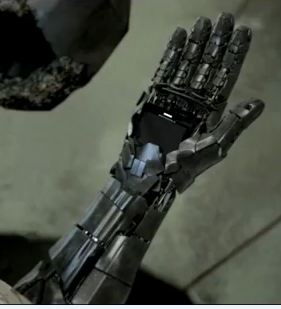
A cadre of people decked out in half space suits, half combat armor walk through a desolate, arid wilderness toward a bunker. A door opens revealing a passageway into an abandoned underground installation. On a platform elevator they descend hundreds of feet. As they continue through hexagonal corridors they notice a helmet, not unlike theirs, lying ominously on the ground. Finally, they enter a room where a solitary metallic object suspended in mid-air spins on its axis. One man removes his armor from his right arm and extends his now bare arm into an opening in the object. The object stops spinning. His comrades look on with apprehension; the man pulls out his arm. As he does so his arm morphs into a mechanical, cyborg arm. Then, and this is the climax, from the palm of his newly mechanized arm, the Droid X emerges.
Now there’s a commercial, and if you haven’t already seen it, you can watch for yourself at the end of this post. I first saw this commercial sitting in the theater waiting for Inception to begin, only I didn’t immediately realize it was a commercial. Had I walked in just then I would have assumed the previews had started. A bit over-the-top perhaps, but maybe not.
There’s a lot that can be said about this elaborate piece of sci-fi marketing, but let’s take it at face value. It is actually a rather straightforward dramatization of an important and intriguing metaphor: technology as prosthesis. Marshall McLuhan, patron saint of media studies, popularized the concept that our tools or technologies function as prosthetic extensions of our bodies. For example, the hammer functions as an extension of the hand, the wheel as an extension of the foot, or electric technology functions as an extension of the nervous system. McLuhan, however, was neither the first nor the last to employ the metaphor. In Civilization and Its Discontents, Sigmund Freud suggested that, “Man has, as it were, become a kind of prosthetic god.” But man also wore his prosthetic divinity awkwardly. Freud goes on to say, “When he puts on all his auxiliary organs he is truly magnificent; but those organs have not grown on to him and they still give him much trouble at times.”
Technology as a prosthetic enhancement has been a rich concept deployed by a variety of philosophers and critics including Martin Heidegger, Jacques Derrida, and Donna Haraway. In her “Cyborg Manifesto,” Haraway in particular argued that our technologies have been making the line between natural and artificial, machine and organism, cyborg and human more than a little fuzzy. Often the idea of technology as prosthetic is paired with the related metaphor of amputation — something gained, something lost — so that on the whole there is a certain ambiguity about our prosthetic tools. You can read more about the concept in a well-written overview here, but I want to focus on the very simple idea that our technologies became a part of us.
Think about this in light of the question that I asked in yesterday’s post, “A God that Limps.” Why do we react so defensively when we hear someone criticize our technologies? The concept of prosthesis suggests a compelling response: because we take it not as a criticism of some object apart from us, but rather as an object that has become in some sense a part of us. We hear such criticism as a criticism of ourselves.
The more seamlessly a technologies blends in with our bodies, the more attached we become. Take the Blue Tooth enhanced cell phone, for example, responsible for all those people seemingly talking to themselves. Notice how this metaphor helps explain that odd development. The device has become transparent, we forget it is even there. This makes the communication seem almost unmediated consequently causing us to act as naturally as if we were in the person’s presence (and only that person’s presence). Or take the iTouch/iPhone/iPad that allows us to magically touch the Internet; now that is an extension of the central nervous system! Gone is the clunky mouse or keyboard, we now appear to be touching the information itself, the layers of mediation seem to be peeling away.
The better these tools work, the more invisible they become; or, as the Droid X commercial suggests, the more they become a part of us. Tweaking Arthur C. Clarke’s Third Law just a little, we might say that any sufficiently advanced technology is indistinguishable from our bodies. Naturally, we are pretty defensive of our bodies; not surprisingly we tend to be pretty defensive of our technologies as well.



 , 238)


 L.M. Sacasas