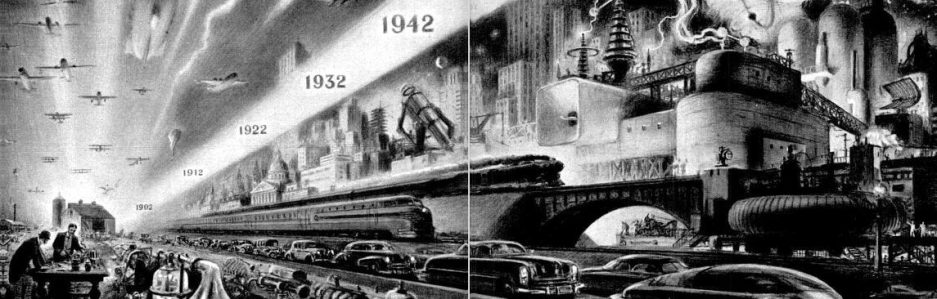
Back when the Machine was the dominant technological symbol, a metaphor arose to articulate the fear that individual significance was being sacrificed to large-scale, impersonal social forces: it was the fear of becoming “a cog in the machine.”
The metaphor is in need of an update.
This train of thought (speaking of archaic metaphors) began when I read the following paragraph from Leon Wieseltier’s recent commencement address at Brandeis University:
In the digital universe, knowledge is reduced to the status of information. Who will any longer remember that knowledge is to information as art is to kitsch-–that information is the most inferior kind of knowledge, because it is the most external? A great Jewish thinker of the early Middle Ages wondered why God, if He wanted us to know the truth about everything, did not simply tell us the truth about everything. His wise answer was that if we were merely told what we need to know, we would not, strictly speaking, know it. Knowledge can be acquired only over time and only by method.
It was that last phrase that stayed with me: knowledge can only be acquired by time and method. I was already in fundamental agreement with Wieseltier’s distinction between information and knowledge, and his prescription of time and method as the path toward knowledge also seemed just about right.
It also seemed quite different than what ordinarily characterized my daily encounter with digital information. For the most part, I’m doing well if I keep on top of all that comes my way each day through a variety of digital channels and then pass along – via this blog, Twitter, FB, or now Tumblr – items that I think are, or ought to be of interest to the respective audiences on each of those platforms. Blog, reblog. Like, share. Tweet, retweet. Etc., etc., etc.
Read, then discard or pass along. Repeat. That’s my default method. It’s not, I suspect, what Wieseltier had in mind. There is, given the sheer volume of information one takes in, a veneer of learnedness to these habits. But there is, in fact, very little thought involved, or judgment. Time under these circumstances is not experienced as the pre-condition of knowledge, it is rather the enemy of relevance. The meme-cycle, like the news-cycle is unforgivingly brief. And method – understood as the deliberate, sustained, and, yes, methodical pursuit of deep understanding of a given topic – is likewise out of step with the rhythms of digital information.
Of course, there is nothing about digital technology that demands or necessitate’s this kind of relationship to information or knowledge. But while it is not demanded or necessitated, it is facilitated and encouraged. It is always easier to attune oneself to the dominant rhythms than it is to serve as the counterpoint. And what the dominant rhythm of digital culture encourages is not that we be cogs in the machine, but rather relays in the network.
We are relays in a massive network of digital information. Information comes to me and I send it out to you and you pass it along to someone else, and so on, day in and day out, moment by moment. In certain circles it might even be put this way: we are neurons within a global mind. But, of course, there is no global mind in any meaningful sense that we should care about. It is a clever, fictive metaphor bandied about by pseudo-mystical techno-utopians.
The minds that matter are yours and mine, and their health requires that we resist the imperatives of digital culture and re-inject time and method into our encounters with information. It begins, I think, with a simple “No” to the impulse to quickly skim-read and either share or discard. May be even prior to this, we must also renounce the tacit pressure to keep up with it all (as if that were possible anyway) and the fear of missing out. And this should be followed by a willingness to invest deep attentiveness, further research, and even contemplation over time to those matters that call for it. Needless to say, not all information justifies this sort of cognitive investment. But all of us should be able to transition from the nearly passive reception and transmission of information to genuine knowledge when it is warranted.
At their best, digital technologies offer tremendous resources to the life of the mind, but only if we cultivate the discipline to use these technologies against their own grain.
 , in which the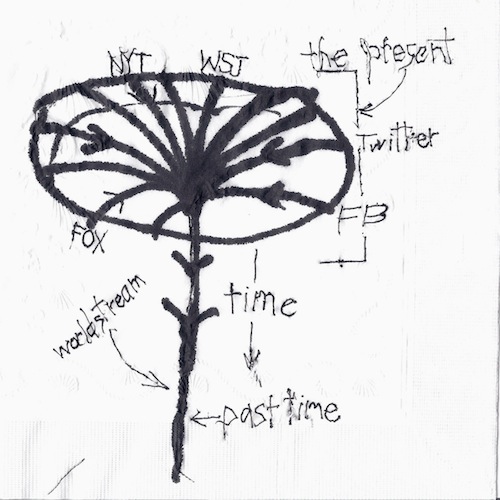
 L.M. Sacasas