
I’ve not been one to jump on the Malcolm Gladwell bandwagon; I can’t quite get past the disconcerting hair. That said, his recent piece in The New Yorker, “Small Change: Why the revolution will not be tweeted,” makes a compelling case for the limits of social media when it comes to generating social action.
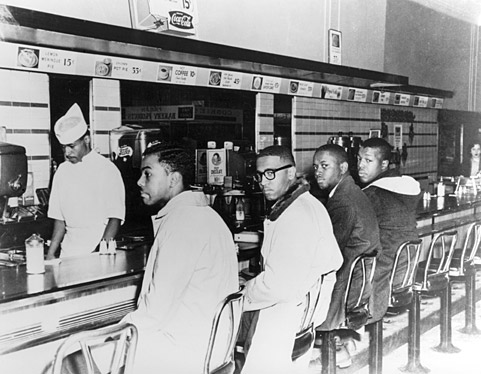 Gladwell frames his piece as a study in contrasts. He begins by recounting the evolution of the 1960 sit-in movement that began when four freshmen from North Carolina A & T sat down and ordered coffee at the lunch counter of the local Woolworth’s and refused to move when the waitress insisted, “We don’t serve Negroes here.” Within days the protest grew and spread across state lines and tensions mounted.
Some seventy thousand students eventually took part. Thousands were arrested and untold thousands more radicalized. These events in the early sixties became a civil-rights war that engulfed the South for the rest of the decade—and it happened without e-mail, texting, Facebook, or Twitter.
Almost reflexively now, the devotees of social media power will trot out the Twitter-enabled 2009 Iranian protests as an example of what social media can do. Gladwell, anticipating as much, quotes Mark Pfeifle, a former national-security adviser, who believes that, “Without Twitter the people of Iran would not have felt empowered and confident to stand up for freedom and democracy.” Pfeifle went so far as to call for Twitter’s nomination for the Nobel Peace Prize. That is a bit of a stretch one is inclined to believe, and Gladwell explains why:
In the Iranian case … the people tweeting about the demonstrations were almost all in the West. “It is time to get Twitter’s role in the events in Iran right,” Golnaz Esfandiari wrote, this past summer, in Foreign Policy. “Simply put: There was no Twitter Revolution inside Iran.” The cadre of prominent bloggers, like Andrew Sullivan, who championed the role of social media in Iran, Esfandiari continued, misunderstood the situation. “Western journalists who couldn’t reach—or didn’t bother reaching?—people on the ground in Iran simply scrolled through the English-language tweets post with tag #iranelection,” she wrote. “Through it all, no one seemed to wonder why people trying to coordinate protests in Iran would be writing in any language other than Farsi.”
You can read the Foreign Policy article by Esfandiari Gladwell, “Misreading Tehran: The Twitter Devolution,” online. Gladwell argues that social media is unable to promote significant and lasting social change because they foster weak rather than strong-tie relationships. Promoting and achieving social change very often means coming up against entrenched cultural norms and standards that will not easily give way. And as we know from the civil rights movement, the resistance is often violent. As Gladwell reminds us,
. . . Within days of arriving in Mississippi, three [Freedom Summer Project] volunteers—Michael Schwerner, James Chaney, and Andrew Goodman—were kidnapped and killed, and, during the rest of the summer, thirty-seven black churches were set on fire and dozens of safe houses were bombed; volunteers were beaten, shot at, arrested, and trailed by pickup trucks full of armed men. A quarter of those in the program dropped out. Activism that challenges the status quo—that attacks deeply rooted problems—is not for the faint of heart.
A subsequent study of the participants in the Freedom Schools was conducted by Doug McAdam:
“All of the applicants—participants and withdrawals alike—emerge as highly committed, articulate supporters of the goals and values of the summer program,” he concluded. What mattered more was an applicant’s degree of personal connection to the civil-rights movement . . . . [P]articipants were far more likely than dropouts to have close friends who were also going to Mississippi. High-risk activism, McAdam concluded, is a “strong-tie” phenomenon.
Gladwell also goes on to explain why hierarchy, another feature typically absent from social media activism, is indispensable to successful movements while taking some shots along the way at Clay Shirky’s much more optimistic view of social media outlined in Here Comes Everybody: The Power of Organizing Without Organizations
Not suprisingly, Gladwell’s piece has been making the rounds online the past few days. In response to Gladwell, Jonah Lehrer posted “Weak Ties, Twitter and the Revolution” on his blog The Frontal Cortex. Lehrer begins by granting, “These are all worthwhile and important points, and a necessary correction to the (over)hyping of Twitter and Facebook.” But he believes Gladwell has erred in the other direction. Basing his comments on Mark Granovetter’s 1973 paper, “The Strength of Weak Ties,” Lehrer concludes:
. . . I would quibble with Gladwell’s wholesale rejection of weak ties as a means of building a social movement. (I have some issues with Shirky, too.) It turns out that such distant relationships aren’t just useful for getting jobs or spreading trends or sharing information. According to Granovetter, they might also help us fight back against the Man, or at least the redevelopment agency.
Read the whole post to get the full argument and definitely read Lehrer’s excellent review of Shirky’s book linked in the quotation above. Essentially Lehrer is offering a kind of middle ground between Shirky and Gladwell. Since I tend toward mediating positions myself, I think he makes a valid point; but I do lean toward Gladwell’s end of the spectrum nonetheless.
Here, however, is one more angle on the issue: perhaps the factors working against the potential of social media are not only inherent in the form itself, but also a condition of society that predates the arrival of digital media by generations. In The Human Condition, Hannah Arendt argued that power, the kind of power to transform society that Gladwell has in view,
. . . is actualized only where word and deed have not parted company, where words are not empty and deeds not brutal, where words are not used to veil intentions but to disclose realities, and deeds are not used to violate and destroy but to establish relations and create new realities.
Arendt made that claim in the late 1950’s and she argued that even then words and deeds had been drifting apart for some time. I suspect that since then the chasm has yawned ever wider and that social media participates in and reinforces that disjunction. It would be unfair, however, to single out social media since the problem extends to most forms of public discourse, of which social media is but one example.
In The Disenchantment of Secular Discourse
It is hardly an exaggeration to say that the very point of ‘public reason’ is to keep the public discourse shallow – to keep it from drowning in the perilous depths of questions about ‘the nature of the universe,’ or ‘the end and object of life,’ or other tenets of our comprehensive doctrines.
If Smith is right — you can read Stanley Fish’s review in the NY Times to get more of a feel for his argument — social media already operate within a context in which the habits of public discourse have undermined our ability to take words seriously. To put it another way, the assumptions shaping our public discourse encourage the divorce of words and deeds by stripping our language of its appeal to the deeper moral and metaphysical resources necessary to compel social action. We tend to get stuck in the analysis and pseudo-debate without ever getting to action. As Fish puts it:
While secular discourse, in the form of statistical analyses, controlled experiments and rational decision-trees, can yield banks of data that can then be subdivided and refined in more ways than we can count, it cannot tell us what that data means or what to do with it . . . . Once the world is no longer assumed to be informed by some presiding meaning or spirit (associated either with a theology or an undoubted philosophical first principle) . . . there is no way, says Smith, to look at it and answer normative questions, questions like “what are we supposed to do?” and “at the behest of who or what are we to do it?”
 Combine this with Kierkegaard’s 19th century observations about the Press that now appear all the more applicable to the digital world. Consider the following summary of Kierkegaard’s fears offered by Hubert Dreyfus in his little book On the Internet
. . . the new massive distribution of desituated information was making every sort of information immediately available to anyone, thereby producing a desituated, detached spectator. Thus, the new power of the press to disseminate information to everyone in a nation led its readers to transcend their local, personal involvement . . . . Kierkegaard saw that the public sphere was destined to become a detached world in which everyone had an opinion about and commented on all public matters without needing any first-hand experience and without having or wanting any responsibility.
Kierkegaard suggested the following motto for the press:
Here men are demoralized in the shortest possible time on the largest possible scale, at the cheapest possible price.
I’ll let you decide whether or not that motto may be applied even more aptly to existing media conditions. In any case, the situation Kierkegaard believed was created by the daily print press in his own day is at least a more likely possibility today. A globally connected communications environment geared toward creating a constant, instantaneous, and indiscriminate flow of information, together with the assumptions of public discourse described by Smith, numbs us into docile indifference — an indifference social media may be powerless to overthrow, particularly when the stakes are high. We are offered instead the illusion of action and involvement, the sense of participation in the debate. But there is no meaningful debate, and by next week the issue, whatever the issue is, will still be there, and we’ll be busy discussing the next thing. Meanwhile action walks further down a lonely path, long since parted from words.

 , we do a lot of our thinking and understanding through metaphors that structure our thoughts and concepts. So pervasive are these metaphors, that in most cases we don’t even realize we are using metaphors at all. Recently, metaphors related to shallowness and depth have caught my attention.
 .
. she notes that the “respectable newspapers” were only just then catching up on implications of science which,
 L.M. Sacasas