
Two Skeptical Takes on Technology and Education

I want to draw your attention to a couple of recent essays on technology in education. The first, “Step 1: give every kid a laptop. Step 2: learning begins?” by Cyrus Farivar, appeared a few days ago in Ars Technica. The second, “Apple for Teacher” by Kieran Healy, was posted at the blog Crooked Timber. I would describe both as reasonably skeptical of two specific approaches to employing technology in the classroom. Farivar examines the success of 1:1 lap top programs and Healy comments on Apple’s recently announced plans for the education market.

I won’t try to summarize either of the pieces, I encourage you to click through and read each if education and technology is of interest to you. Feel free to post your thoughts below if you do.

Here are a couple of interesting excerpts.

Farivar cites Jeff Mao, the learning technology policy director for the state of Maine which operates the most extensive 1:1 program in the country, who makes the following observation:

“Test Scores and one-to-one are tough to link. The deployment of one-to-one technologies alone doesn’t change outcomes. As we discussed, it’s the teaching and learning practices that really make the change.”

This strikes me as an honest and chastened position to take; no hint of techno-utopianism there and that’s a good thing. Here is Mao again on his state’s 1:1 program:

“Since our beginnings, we’ve always looked at notions of creation,” Mao said. “It’s not about consumption of content, it’s about the creation of knowledge.”

Now that, I’m afraid, strikes me as a string of buzz words with little meaning. But perhaps that’s too harsh. I certainly would need to hear what constituted the “creation of knowledge.”

In his piece, Farivar makes the following observation:

“Schools have been down the techno-salvation path before with other kinds of hardware and software. It’s worth remembering just how many technologies we already have that were supposed to transform education beyond all recognition. Radio, the television, the VCR, the personal computer, email, the Internet and the web … All of these have been trumpeted by someone as having the power to make education What It Really Ought To Be. The same goes for smaller developments within larger technological shifts. Chatrooms, MUDs, bulletin boards, blogs, FaceBook, Twitter, on and on.”

It’s good to keep this history in mind. I say that not to diminish the real possibilities that new technologies may offer, but rather to emphasize the importance of smart implementation. The mere appearance of this or that technology will not, cannot by itself transform education. Correction: it may very well transform education, but not for the better. Technology must be paired with the practical wisdom of good teachers if it is to enhance learning.

One last thought. I suspect that our educational dysfunctions are not susceptible to a technological fix. They are linked to the incoherence of our responses to a very straightforward question, What is an education for?

Tacit answers to that question lie beneath and shape most of our discussions about technology in schools, as they do most discussions related to educational policy. At this stage of our history it would probably be impossible to formulate a consensus response that was also substantive. At the very least, though, we should get these more philosophical assumptions on the table rather than bracketing them or otherwise allowing them to remain unspoken.

______________________________________________________________

Related: The Ends of Learning
On the Reading of Old Books

Following on the Christmas holiday, here is a little something that is, given the book from which it is taken, tangentially related. Both of these paragraphs are from C. S. Lewis’ Introduction to an edition of Athanasius’ On the Incarnation. They each contain a great deal of wisdom about the reading of old books. First, on actually reading the old books:

“There is a strange idea abroad that in every subject the ancient books should be read only by the professionals, and that the amateur should content himself with the modern books. Thus I have found as a tutor in English Literature that if the average student wants to find out something about Platonism, the very last thing he thinks of doing is to take a translation of Plato off the library shelf and read the Symposium. He would rather read some dreary modern book ten times as long, all about “isms” and influences and only once in twelve pages telling him what Plato actually said. The error is rather an amiable one, for it springs from humility. The student is half afraid to meet one of the great philosophers face to face. He feels himself inadequate and thinks he will not understand him. But if he only knew, the great man, just because of his greatness, is much more intelligible than his modern commentator. The simplest student will be able to understand, if not all, yet a very great deal of what Plato said; but hardly anyone can understand some modern books on Platonism. It has always therefore been one of my main endeavours as a teacher to persuade the young that firsthand knowledge is not only more worth acquiring than secondhand knowledge, but is usually much easier and more delightful to acquire.”

And secondly, on the epistemological benefits of reading the old books:

“Every age has its own outlook. It is specially good at seeing certain truths and specially liable to make certain mistakes. We all, therefore, need the books that will correct the characteristic mistakes of our own period. And that means the old books. All contemporary writers share to some extent the contemporary outlook – even those, like myself, who seem most opposed to it. Nothing strikes me more when I read the controversies of past ages than the fact that both sides were usually assuming without question a good deal which we should now absolutely deny. They thought that they were as completely opposed as two sides could be, but in fact they were all the time secretly united – united with each other and against earlier and later ages – by a great mass of common assumptions. We may be sure that the characteristic blindness of the twentieth century – the blindness about which posterity will ask, “But how could they have thought that?” – lies where we have never suspected it, and concerns something about which there is untroubled agreement between Hitler and President Roosevelt or between Mr. H. G. Wells and Karl Barth. None of us can fully escape this blindness, but we shall certainly increase it, and weaken our guard against it, if we read only modern books. Where they are true they will give us truths which we half knew already. Where they are false they will aggravate the error with which we are already dangerously ill. The only palliative is to keep the clean sea breeze of the centuries blowing through our minds, and this can be done only by reading old books. Not, of course, that there is any magic about the past. People were no cleverer then than they are now; they made as many mistakes as we. But not the same mistakes. They will not flatter us in the errors we are already committing; and their own errors, being now open and palpable, will not endanger us. Two heads are better than one, not because either is infallible, but because they are unlikely to go wrong in the same direction. To be sure, the books of the future would be just as good a corrective as the books of the past, but unfortunately we cannot get at them.”

That said, then, to quote from one very old book, tolle lege.

Opaque Surfaces and the Worlds They Hide

Thinking about the opacity of life.

All around us our devices present us with surfaces below which lie complexities few understand. Our technologies are increasingly opaque to us. But this is, from a certain perspective, not very different from much of the rest of our experience.

As I look up at the sky, it presents me with a surface which, during the day, hides from my view the vastness of the space that lies beyond it. Even at night, the starlit sky discloses only a glimmer of the magnitude of the universe.

As I look at the blade of grass and my hand that holds it, a surface presents itself beyond which lies another, atomic and sub-amtomic, universe whose infinitesimal scale is entirely concealed to my unaided senses.

How much of reality lies beyond these surfaces that present themselves to us as the perceived limits of lived experience? And yet there is one other surface that veils a world from view.

As I look into the eyes of the persons I encounter day in and day out, a surface once again presents itself in seemingly uncomplicated fashion. But beyond this surface too lies a complex and unfathomable universe. The mind, dare I say soul of every person is another world — vast, complex, mysterious, wondrous, and beyond the reach of my ordinary perception.

In the end, I suspect that of all these, it is my own consciousness that is most opaque to my perception and the most challenging to penetrate.

All our learning is finally an effort to see beyond these surfaces.

Weekend Reading, 11/19/11

With apologies for not posting any suggested reading last weekend, here a good list to make up for it. Be sure to check out the Robinson piece and the three essays reviewing recent books on what ails the academy. The video is pretty cool too

“Difference Engine: Luddite Legacy” at The Economist technology blog, “Babbit”: The title is not much help in this case. The post examines the possibility that what has been known as the Luddite Fallacy, that increased automation leads to fewer jobs, may no longer be so fallacious. It suggests that the stubbornly high rate of unemployment might be owed to the increasing number of white collar jobs that can be done by computers running AI. The post ends in rather hopeful fashion, but the compelling case made throughout seemed to me to make the hope rather like wishful thinking.

“Engineering the 10,000-Year Clock” by David Kushner at Spectrum: Great story about how two engineers with the backing of Amazon’s Jeff Bezos set out to design and build a clock that would run on its own power for 10,000 years. When it is completed, it will certainly count as a marvel of engineering. They’re goal? To get us to thinking more long term. No argument here.

“Teens, Kindness, and Cruelty on Social Network Sites” by Pew Internet and American Life Project: Title tells you all you need to know. Information on adults as well. The link takes you to the summary of findings.

“King James Bible” by Adam Nicolson in National Geographic: Explores the global legacy of the King James translation from Westminster Abbey to an American rodeo to Jamaican Rastafarians. Well done, with a lovely photo gallery as you would expect from National Geographic.

Three important reviews of recent books on education, they are each worth your time if you are at all interested in education:

“The Educational Lottery” by Steven Brint in the Los Angles Review of Books

“Out Universities: Why are they failing?” by Anthony Grafton in the New York Review of Books

“Can Teaching Really Matter?” by Peter Lawler

“Night Thoughts of a Baffled Humanist” by Marilynne Robinson at The Nation: I linked this in my post yesterday, but I wanted to put in your way one more time. It is a piece worthy of your consideration.

“Brain Scan Overload” by Jonah Lehrer in the Wall Street Journal: Lehrer cautions, wisely it seems to me, against grounding too much speculative stock in brain imaging.

Finally, here is a video you’ll want to take a look at if you haven’t already seen it or one like it. Three dimensional copying. Ink + Light = 3D object: “2D Patterns Self Assemble Into 3D Objects” courtesy of Wired UK.

Considering Online K-12 Courses? Some Things to Keep in Mind

This past weekend, The Wall Street Journal ran a story covering the rapid growth of online K-12 education. “My Teacher is an App,” by Stephanie Banchero and Stephanie Simon, discusses the rise of online and hybrid classrooms providing a fairly balanced account of successes and disappointments. Here are some of the key points:

  • “In just the past few months, Virginia has authorized 13 new online schools. Florida began requiring all public-high-school students to take at least one class online, partly to prepare them for college cybercourses. Idaho soon will require two. In Georgia, a new app lets high-school students take full course loads on their iPhones and BlackBerrys. Thirty states now let students take all of their courses online.”
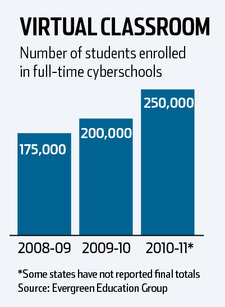
  • “Nationwide, an estimated 250,000 students are enrolled in full-time virtual schools, up 40% in the last three years, according to Evergreen Education Group, a consulting firm that works with online schools. More than two million pupils take at least one class online, according to the International Association for K-12 Online Learning, a trade group.”
  • “Although some states and local districts run their own online schools, many hire for-profit corporations such as K12 Inc. of Herndon, Va., and Connections Academy in Baltimore, a unit of education services and technology company Pearson PLC.”
  • “A few states, however, have found that students enrolled full-time in virtual schools score significantly lower on standardized tests, and make less academic progress from year to year, than their peers.”
  • “At Southwest Learning Centers, a small chain of charter schools in Albuquerque, N.M., standardized test scores routinely outpace state and local averages, according to data provided by the schools. Students complete most lessons online but come into class for teacher support and hands-on challenges, such as collaborating to design and build a weight-bearing bridge.”
  • “The growth of cybereducation is likely to affect school staffing, which accounts for about 80% of school budgets. A teacher in a traditional high school might handle 150 students. An online teacher can supervise more than 250, since he or she doesn’t have to write lesson plans and most grading is done by computer.
Mill. Factory. Sweat shop. I’m sorry, I think I may have just editorialized. Hardly a sweat shop I know, but it strikes me that most of what makes teaching worthwhile gets lost in an online model that reduces the teacher to some combination of a manager, customer experience expert, and help desk attendant.
.
  • “In Idaho, Alan Dunn, superintendent of the Sugar-Salem School District, says that he may cut entire departments and outsource their courses to online providers. “It’s not ideal,” he says. “But Idaho is in a budget crisis, and this is a creative solution.”

Other states see potential savings as well. In Georgia, state and local taxpayers spend $7,650 a year to educate the average student in a traditional public school. They spend nearly 60% less—$3,200 a year—to educate a student in the statewide online Georgia Cyber Academy, saving state and local tax dollars. Florida saves $1,500 a year on every student enrolled online full time.”

“Two companies, K12 and Connections Academy, dominate the market for running public cyberschools. Full-time enrollment in online schools using the K12 curriculum has doubled in the past four years, to 81,000, the company says. K12’s revenue grew 35% to $522 million in its fiscal year ended June 30, when it reported net income of $13 million.”

Beware the profit motive. I’m no opponent of the free market properly understood, but limited experience with for-profit schools (which do not include all private schools) suggests to me that the quality of education often gets undermined by the dynamics of the market. (And that was putting it kindly.) It may be especially problematic when for-profit schools tap into government money.

  • “In the end, virtual schooling “comes down to what you make of it,” says Rosie Lowndes, a social-studies teacher at Georgia Cyber Academy. Kids who work closely with parents or teachers do well, she says. “But basically letting a child educate himself, that’s not going to be a good educational experience.” The computer, she says, can’t do it alone.”

True, but “what you can make of it” is already limited by the constraints of the medium.

To sum up: Enrollment in online courses is increasing rapidly. School districts are saving money. Some private companies are turning an impressive profit. Online teachers help students navigate ready made modules and supervise more students than their in classroom peers. Results are mixed. Hybrid appears to work better than all online. Parent involvement remains important.

For a more detailed and impassioned breakdown of the article see Will Richardson’s post here.

Things to consider: Students vary as do their needs and the circumstances under which they flourish. It is as misleading to argue that online learning is the cure for all the ills plaguing K-12 education as it would be to suggest that it is never, under any circumstances a viable option. I’ve been mostly critical of the online learning experience. This criticism is informed by my experience as a student in numerous online courses and my experiences as a classroom teacher. (You can read my mostly critical comments in this series of posts.) But it is increasingly likely that students will encounter at least one online course during their high school or college career.

When deciding whether or not to enroll students in online courses, here are some things to take into consideration:

  • What is the respective quality of available educational options? In my estimation, the ideal face-to-face classroom beats the ideal online experience, all other factors being equal. But very often the ideal face-to-face classroom is far from the reality on offer at local schools. Know your school and the faculty’s strengths and weaknesses.
  • What courses work well online and which do not? A math course which already tends to be designed in progressive modular fashion will translate into an online environment more effectively than a literature class in which, ideally, lively discussion characterizes the face-to-face dynamic. Science classes that are heavy in hands-on experimentation may also loses something significant in translation. Students may also find that both subjects that are difficult for them and subjects that they are very interested in are better taken face-to-face in the presence of expert teachers.
  • What is the motivation for taking online courses? Online courses may allow students who are unable to attend traditional schools due to health issues to keep up with their education and this is certainly a good reason to consider online learning. Additionally, motivated students may desire to learn about a subject that is not offered at traditional schools. Again, sound motivation. Some students, on the other hand, may believe that online coursework is easier and that it will afford them maximal freedom and down time at home. This may not be the best motivation especially since studies have suggested that students who do best in online coursework are highly motivated, diligent, and well organized.
  • What are the student’s strengths and weaknesses? Since students that tend to do well in online environments tend to be those who are intrinsically motivated and well-organized, it is important to honestly consider whether a student has already demonstrated these qualities in traditional settings since it is not likely that those qualities will spontaneously emerge in a less structured setting.
  • Finally, remember that face-to-face interactions regarding the subject matter will always augment the online experience. Ask your student questions about the courses they are taking online. Granted most teenagers may not be very forthcoming; but, if they are willing, a dinner table conversation about what they are learning online could go a long way toward making a less than idea learning situation more valuable.