“Reading toward Wisdom”

More from Ivan Illich’s In the Vineyard of the Text.  Excerpts from the first chapter, “Reading toward Wisdom” (page numbers in parenthesis).  Previous post in the series:  “In the Vineyard of the Text”.

There is a line, whose source I’ve forgotten, that goes something like, “The past is a foreign country, they do things differently there.”  Reading about the past is then a little like visiting a foreign country.  Such visits can teach us a good deal about ourselves by throwing our own habits and patterns of thought into relief against the backdrop of the past.  To recognize our difference from the other is to see ourselves a little more clearly.

And so Illich is our guide on this particular foray into the past and below are some observations that touch on the end or goal of reading, the relationship between reading/learning and character, and the correlation between new forms of reading and new understandings of the self:

  • Omnium expetendorum prima est sapentia.  ‘Of all things to be sought, the first is wisdom.’  This is how Jerome Taylor translates the lead sentence of the Didascalicon of Hugh of Saint Victor, written around 1128.” (7)
  • “Hugh’s writings are drenched in Augustine.  He lived in a community that followed Augustine’s rule.  He read, reread, and copied the texts of his master.  Reading and writing were for him two almost indistinguishable sides of the same studium.” (9)
  • “As with Augustine, wisdom was for Hugh not something but someone.  Wisdom in the Augustinian tradition is the second person of the Trinity, Christ . . . . The wisdom Hugh seeks is Christ himself.  Learning and, specifically, reading, are both simply forms of a search for Christ the Remedy, Christ the Example and Form which fallen humanity, which has lost it, hopes to recover.  The need of fallen humanity for reunion with wisdom is central to Hugh’s thought.  This makes the concept of remedium, remedy or medicine, crucial for an understanding of Hugh.”  (10)
  • “Hugh, by developing the concept of remedium, provides for the twentieth-century thinker a unique way to address the issue of technique or technology.  Reading, as Hugh perceives and interprets it, is an ontologically remedial technique.  I intend to explore it as such.  I analyze what Hugh has to say about the techniques used in reading in order to explore the role that alphabetic technology played around 1130 in the shaping of these techniques.”  (11)
  • “I am here concerned primarily with ‘alphabetic technology’ which interacts in a unique, epoch-specific way around 1130 with the northwest European symbolic universe, and how changes in world perception in turn facilitated and oriented the choice of technologies.  In taking this approach to the alphabet as a technology I am indebted to Walter Ong, S. J., Orality and Literacy . . .”  (11, footnote 11)
  • “Authorities, in this now obsolete sense, are sentences which created precedents and defined reality . . . The sentence states an obvious truth precisely because it has been disembedded from the discourse of this or that particular author; it had become a free-floating statement.  As such a verbal institution, the auctorias [sentence worthy of repetition] quoted by Hugh became an exemplary testimony to untouchable tradition.”  (13)
  • “. . . the thought of an ultimate goal of all readings is not meaningful to us.  Even less is there any idea that such a goal could motivate or ’cause’ our action whenever we open a book.  We are steeped in the spirit of engineering and think of the trigger as the cause of a process.  We do not think of the heart as the cause of the bullet’s trajectory . . . . Even more thoroughly, the idea of one first or primary Final Cause, one ultimate motivating reason of all desires that are hidden in the nature of the stone or of the plant or of the reader, has become foreign to our century.  ‘End stage’ in the twentieth-century mental universe connotes death.  Entropy is our ultimate destiny. We experience reality as monocausal.  We know only efficient causes. ”  (13-14)
  • “Studies pursued in a twelfth-century cloister challenged the student’s heart and sense even more than his stamina and brains.  Study did not refer to a liminal epoch of life, as it usually does in modern times, when we say that someone ‘is still a student.’  They encompassed the person’s daily and lifelong routine, his social status, and his symbolic function.” (14-15)
  • “The studium legendi forms the whole monk and reading will become perfect as the monk himself strives for, and finally reaches, perfection.

The beginning of discipline is humility . . . and for the reader there are three lessons taught by humility that are particularly important:  First, that he hold no knowledge or writing whatsoever in contempt.  Second, that he not blush to learn from any man.  Third, that when he as attained learning himself, he not look down upon anyone else.”  (15-16)

  • “The reader is one who has made himself into an exile in order to concentrate his entire attention and desire on wisdom, which thus becomes the hoped-for home.” (17)
  • “That which we mean today when, in ordinary conversation, we speak of the ‘self’ or the ‘individual,’ is one of the great discoveries of the twelfth century . . . .  A social reality in which our kind of self is taken for granted constitutes an eccentricity among cultures . . . .  [Hugh] wants the reader to face the page so that  by the light of wisdom he shall discover his self in the mirror of the parchment.  In the page the reader will acknowledge himself not in the way others see him or by the titles or nicknames by which they call him, but by knowing himself by sight.”  (22-23)
  • “With the spirit of self-definition, estrangement acquires a new positive meaning.  Hugh’s call away from the ‘sweetness of one’s native soil’ and to a journey of self-discovery is but one instance of the new ethos . . . . [that] addresses people at all levels of the feudal hierarchy to leave the common mind-set of the neighborhood, within which identity comes from the way others have named me and treat me, and to discover their selves in the loneliness of the long road . . . . Hugh’s insistence on the need that the scholar be an exile-in-spirit echoes this mood.”  (23)
  • “I am not suggesting that the ‘modern self’ is born in the twelfth century, nor that the self which here emerges does not have a long ancestry.  We today think of each other as people with frontiers.  Our personalities are as detached from each other as are our bodies.  Existence in an inner distance from the community, which the pilgrim who set out to Santiago or the pupil who studied the Didascalicon had to discover on their own, is for us a social reality, something so obvious that we would not think of wishing it away.  We were born into a world of exiles . . . . This existential frontier is of the essence for a person who wants to fit into our kind of world.  Once it has shaped a child’s mental topology, that being will forever be a foreigner in all ‘worlds’ except those integrated by exiles like himself.”
  • “What I want to stress here is a special correspondence between the emergence of selfhood understood as a person and the emergence of ‘the’ text from the page.  Hugh directs his reader to a foreign land.  But he does not ask him to leave his family and accustomed landscape to move on the road from place toward Jerusalem or Santiago.  Rather he demands that he exile himself to start on a pilgrimage that leads through the pages of a book.  He speaks of the Ultimate which should attract the pilgrim, not as the celestial city for pilgrims of the staff, but as the form of Supreme Goodness which motivates the pilgrims of the pen.  He points out that on this road the reader is on his way into the light which will reveal his own self to him.”

“In the Vineyard of the Text”


That is the title of a slender volume authored by historian and social critic Ivan Illich in 1993 and subtitled, A Commentary to Hugh’s Didascalicon.  The Hugh in question is Hugh of St. Victor, a medieval theologian, philosopher, and mystic who wrote the Didascalicon around 1128.  According to Illich, Hugh’s Didascalicon was the “first book written on the art of reading” and  Illich believes that revisiting this 12th century work will help us better understand our ongoing transition from “bookish” reading to whatever multiple forms of reading have been emerging in the wake of the electronic or digital revolution.

In the spirit of the commonplace book, I’m going to transcribe some excerpts from In the Vineyard of the Text below and in subsequent posts over the next several days.  Realizing that there are countless books I would like to read and for a variety of reasons will simply not ever get to, I appreciate it when I can nonetheless get some gleanings from one of those books through a review or post that excerpts some of the key ideas worth considering.  Hardly the best form of reading, but nonetheless a useful one I think.  So in the hope that this will prove useful and because I do think Illich wrote a remarkably insightful little book, here are some selections from the Introduction:

  • “I concentrate my attention on a fleeting but very important moment in the history of the alphabet when, after centuries of Christian reading, the page was suddenly transformed from a score for pious mumblers into an optically organized text for logical thinkers.  After this date a new kind of classical reading became the dominant metaphor for the highest form of social activity.”
  • “Quite recently reading-as-a-metaphor has been broken again.  The picture and its caption, the comic book, the table, box, and graph, photographs, outlines, and integration with other media demand from the user textbook habits which are contrary to those cultivated in scholastic readerships.”
  • Quoting George Steiner:  “The development of the modern book and of book-culture as we know it seems to have depended on a comparable fragility of crucial and interlocking factors.”
  • “Classical print culture was an ephemeral phenomenon.  According to Steiner, to belong to ‘the age of the book’ meant to own the means of reading.  The book was a domestic object; it was accessible at will for re-reading.  The age presupposed private space and the recognition of the right to periods of silence, as well as the existence of echo-chambers such as journals, academies, or coffee circles.  Book culture required a more or less agreed-upon canon of textual values and modes . . . . [T]he formalities involved in this one kind of reading defined, and did not just reflect, the dimensions of social topology.”
  • “The book has now ceased to be the root-metaphor of the age; the screen has taken its place.  The alphabetic text has become but one of many modes of encoding something, now called ‘the message.'”
  • “Bookish reading can now clearly be recognized as an epochal phenomenon and not as a logically necessary step in the progress toward the rational use of the alphabet; as one mode of interaction with the written page among several; as a particular vocation among many, to be cultivated by some, leaving other modes to others.”
  • “. . . in the first six chapters I describe and interpret a technical breakthrough which took place  around 1150, three hundred years before movable type came into use.  This breakthrough consisted in the combination of more than a dozen technical inventions and arrangements through which the page was transformed from score to text.  Not printing, as is frequently assumed, but this bundle of innovations, twelve generations earlier, is the necessary foundation for all stages through which bookish culture has gone since.  This collection of techniques and habits made it possible to imagine the ‘text’ as something detached from the physical reality of  a page.  It both reflected and in turn conditioned a revolution in what learned people did when they read — and what they experienced reading to mean.”
  • “By centering our analysis on the object that is shaped by letters, and on the habits and fantasies connected with its use, we turn this object into a mirror reflecting significant transformations in the mental shape of western societies, something not easily brought out by other approaches.”
  • “What had started as a study in the history of technology, ended up as a new insight into the history of the heart.  We came to understand Hugh’s ars legendi [art of reading] as an ascetic discipline focused by a technical object.  Our meditation on the survival of this mode of reading under the aegis of the bookish text led us to enter upon a historical study of an asceticism that faces the threat of computer ‘literacy.'”

The Introduction as a whole challenges us to think again about the activity of reading.  We assume reading to be a singular activity, we assume it is always done in the same way and for the same reasons, we do not think of the alphabet as a technology that can be deployed in multiple modes, we do not think of a whole cultural milieu depending on something so mundane as reading, we do not think that changes in reading habits and assumptions about reading could reorder society.  By taking us back some 900 years Illich aims to show us that these are mistaken assumptions.

More to come.

Data Seeks A Story

Digitization has enabled the accumulation, storage, and manipulation of enormous amounts of data.  The numbers involved are mind boggling and we’re becoming familiar with ever larger orders of magnitude (remember when a gigabyte was a big deal?).  And we’ve been hearing similar claims long enough now that we hardly notice when someone like Google CEO Eric Schmidt tells us that every two days we create as much information as we did from the beginnings of civilization until  2003.  And, of course, we are told that the pace will only quicken and we will keep achieving ever larger orders of magnitude in data production.

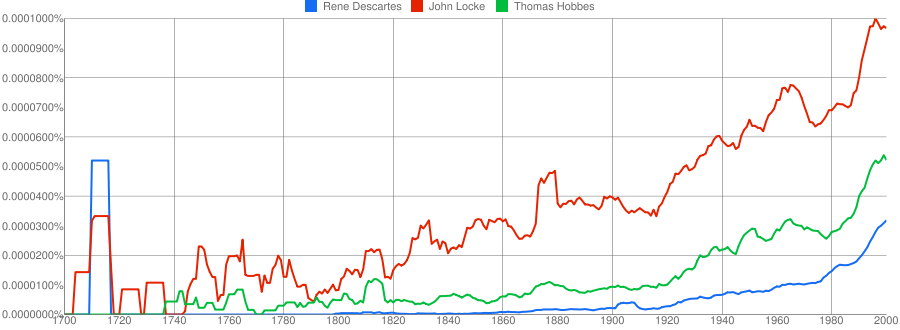
So the question seems to be, what do we do with all of this data?  A good deal of it is of little or no value, and so filtering through it presents a significant challenge.  Representing data meaningfully can also be a challenge and here visualization can be quite helpful.  A couple of recent instances of visualized data come to mind.  The first is Google Lab’s Books Ngram Viewer.  The Ngram Viewer allows a user to search a database of  digitized books published from 1500 to the present for particular words or phrases.  The Viewer then generates a graph plotting the frequency with which the words or phrases have been used during a particular time period.  So for example, here is a graph tracking the occurrences in English books written between 1700 and 2010 of the names of three philosophers —  Rene Descartes, John Locke, and Thomas Hobbes:

One of the limitations of the approach comes to mind when you can’t be sure if a movement in the mentions of “John Locke” is owed to greater interest in modern political philosophy or a certain television character (or, more interestingly, both together).

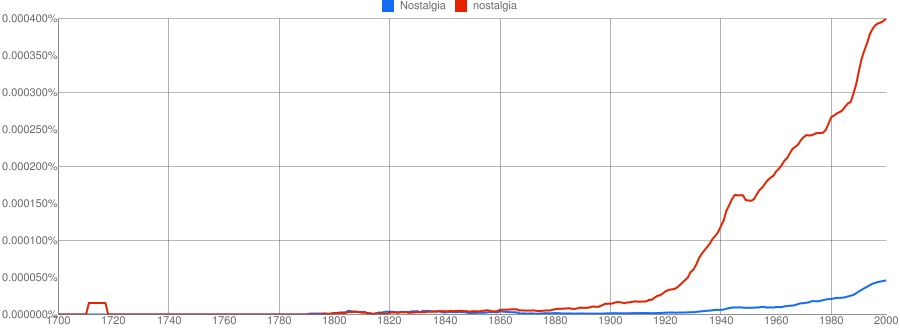
Here is another graph, this one plotting the use of the words nostalgia and Nostalgia (the search is case sensitive) just because I’m intrigued by the idea:

Another recent and more elegant instance of visualized data comes from Facebook.  The graphic below was generated by potting lines representing a sampling of FB friendships.  What is most fascinating about this graphic is that no independent lines representing the continents were included, all shapes emerged from the data:

So we have two instances of data rendered intelligible, at least let us say manageable or usable. But there is still another question, what does it mean?  How do we interpret the data.  The charts and image above represent a tremendous amount of data, but what do we make of it?  That still requires judgment, context, and a story.  This is more or less the point Katherine Hayles makes in her response to Ed Folsom’s “Database as Genre:  The Epic Transformation of Archives.” Here are some comments I’ve taken from Hayles’ essay which apply rather well to both cases, especially to Google’s Ngram Viewer (keep in mind her responses are to Ed Folsom who maintains the Walt Whitman Archive online):

What it means that Whitman, say, used a certain word 298 times in Leaves of Grass while using another word only three times requires interpretation—and interpretation, almost inevitably, invokes narrative to achieve dramatic impact and significance …

These structures imply that the primary purpose of narrative is to search for meaning, making narrative an essential technology for human beings, who can arguably be defined as meaning-­seeking animals …

Manovich touches on this contrast when he perceptively observes that for narrative, the syntagmatic order of linear unfolding is actually present on the page, while the paradigmatic possibilities of alternative word choices are only virtually present. For databases, the reverse is true: the paradigmatic possibilities are actually present in the columns and the rows, while the syntagmatic progress of choices concatenated into linear sequences by SQL commands is only virtually present …

No longer singular, narratives remain the necessary others to database’s ontology, the perspectives that invest the formal logic of database operations with human meanings and that gesture toward the unknown hovering beyond the brink of what can be classified and enumerated.

In other words, data seeks a story because humans seek a story — it’s our primordial way of navigating the increasingly dense forest of data.  It is also worth bearing in mind Jerome McGann’s observations regarding databases (also in response to Folsom):

No database can function without a user interface, and in the case of cultural materials the interface is an especially crucial element of these kinds of digital instruments. Interface embeds, implicitly and explicitly, many kinds of hierarchical and narrativized organizations. Indeed, the database—any database—represents an initial critical analysis of the content materials, and while its structure is not narrativized, it is severely constrained and organized. The free play offered to the user of such environments is at least as much a function of interface design as it is of its data structure—whether that structure be a database structure or, as in the case of The Walt Whitman Archive, a markup structure . . .

Bottom line:  The interface is not neutral and for that matter neither is the data because it has already been tagged and marked up in certain way when the database architecture was designed and the information entered in accordingly.

If databases and interfaces that give us access to the immense amount of information being digitized are going to be useful to us, we need to make sure we understand the embedded limitations so that these limitations do not become immense blind spots for us as we try to do what we must always do with information — make a story out of it.  And the making of the story, a basic human drive, requires an awareness of context, judgment and discernment, and a certain wisdom that, as of yet, the database and clever, even elegant, means of representing the data stored in them, are not by themselves going to bring to the task.  It may be worth remembering the old adage, information is not knowledge and knowledge is not wisdom.

Agitate for Beauty

One of the convenient consequences of posting one’s thoughts on a blog is that readers (the happy few in my case) will send along links to interesting ideas or stories related to what I’ve written.  Yesterday I wrote about resisting the temptation to communicate thoughtlessly and artlessly via digital media and pushing back against the pressures for more efficient, mechanical, and soulless communication.  In response I received a link to a post titled, “How ‘EOM’ Makes Your Email More Efficient.” (h/t:  DFR)

EOM, for the blissfully uninitiated, is short for “End of Message.”  The idea is pretty simple: turn your email subject lines into the actual content of the message and add on “EOM” so that the recipient knows they don’t need click through to read the body.  This saves you the time of writing a subject line and a greeting and a body and a closing.  It also saves the recipient the effort of clicking through to the main text of the email.  But wait there’s more!  Actually there are TEN listed benefits to EOM-ing (might as well — texting, emailing, Facebooking, Twittering, friending —  in our exciting, transgressive times nouns become verbs!).  Other advantages include:  if you do it, others will do it too and EOM encourages 100% readership!

All very efficient to be sure.  Reading the cheerfully and engagingly written post I was almost convinced this was a wonderful, life-changing practice.  Okay, dropping the sarcasm, I get it, seriously.  There are certain exchanges that happen over email that do not need to be packaged in the style and form of a royal proclamation or a papal encyclical.  Fine, fair enough.  And to their credit, one of the advantages listed is that you encourage more face-to-face communication.  If you can’t say it efficiently via email, then maybe you just need to go talk to the person (pause for audible gasp).  Great, that would be wonderful (unless our face-to-face adopt the syntax and style of our online communication).  The work place is busy, hectic, stressful; easing the demands of always online work life is commendable.

But (you knew it was coming), there is still this lingering fear that the ideals of efficiency and instrumentality, perfectly appropriate at some points and in certain contexts, will spread into realms of human communication where they ought properly to be unwelcome and shunned.  Yet, efficiency and instrumentality are alluring ideals that make few demands and promise great rewards, and so they insidiously infiltrate and colonize.

Sometimes I wonder if we are not operating under the unspoken assumption that perfect communication is something like the telepathic communication depicted in science fiction and fantasy.   That would be efficient indeed.  No words, no sounds, no effort.  No risk, no charm, no beauty.

So my tendency is to resist the push for increasing efficiency and instrumentality in our communication; not because I fail to see the advantages, but precisely because I recognize their appeal.  I tend to think Goethe was right, “We should do our best to encourage the Beautiful, for the Useful encourages itself.”  Agitate for beauty.

I’ll leave off with another poet, W. H. Auden, who also knew a thing or two about language, beauty, and responsibility.

As I listened from a beach-chair in the shade
To all the noises that my garden made,
It seemed to me only proper that words
Should be withheld from vegetables and birds.

A robin with no Christian name ran through
The Robin-Anthem which was all it knew,
And rustling flowers for some third party waited
To say which pairs, if any, should get mated.

Not one of them was capable of lying,
There was not one which knew that it was dying
Or could have with a rhythm or a rhyme
Assumed responsibility for time.

Let them leave language to their lonely betters
Who count some days and long for certain letters;
We, too, make noises when we laugh or weep:
Words are for those with promises to keep.

(“Their Lonely Betters”)

Second Thoughts on “Growing Up Digital”

A few days ago I posted some reflections on Matt Ritchel’s NY Times article, “Growing Up Digital,” and committed to posting some further thoughts.  So here they are.  But first some clarification.  I closed the last post with the following:

Parent missing the point:

“If you’re not on top of technology, you’re not going to be on top of the world.”

Insightful students who know what is really going on:

“Video games don’t make the hole; they fill it.”

“Facebook is amazing because it feels like you’re doing something and you’re not doing anything. It’s the absence of doing something, but you feel gratified anyway.”

Jim Wilson/The New York Times

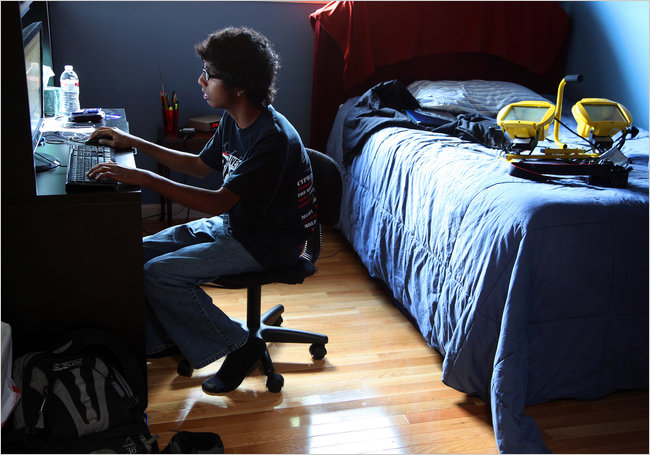
Two things always strike me when I hear parents talking about their kids and technology.  The first is a palpable anxiety about their kids getting left behind in a world of rapidly changing technology.  But this is a misplaced fear, or rather, it is a fear particular to the digital immigrant, not the digital native.  Part of the skill set that comes with having grown up digital is a certain facility with new technologies.  It comes “naturally.”  Try to remember the last time you witnessed someone under the age of 30 reading an instruction manual.  Exactly.

The second is the reduction of technology to a means of achieving financial security. I take this to be what the parent quoted above meant by “being on top of the world” (or else they’ve watched Titanic one time too many).  But students recognize that there is something deeper going on.  Their ubiquitous technologies are nothing short of accessories to their humanity.  The intensity of the withdrawal symptoms experienced when these tools are for some reason taken away or are disconnected suggests that without these tools those who have grown up digital have little idea of how to be in the world.  Or rather, it is as if world is no longer the one they know and are comfortable inhabiting. You might as well be cutting off their oxygen.  Reducing the significance of technology to some silly “you’ll need these skills to get a good job” pep talk does not come close to doing justice to the place these tools have in student’s lives.

On to the new stuff:

Students say that their parents, worried about the distractions, try to police computer time, but that monitoring the use of cellphones is difficult. Parents may also want to be able to call their children at any time, so taking the phone away is not always an option . . .

He says he sometimes wishes that his parents would force him to quit playing and study, because he finds it hard to quit when given the choice.

Two things here.  This is an instance of what Thomas de Zengotita has labeled “Justin’s Helmet Principle.” Sure Justin looks ridiculous riding down the street with his training wheels on, more pads than a lineman, and a helmet that makes him look like Marvin the Martian, but do I want the burden of not decking out Justin in this baroque assemblage of safety equipment, have him fall, and seriously injure himself?  No probably not.  So on goes the safety crap.  Did we sense that there was something a little off when we started sending off our first graders to school with cell phones, just a fleeting moment of incongruity perhaps?  Maybe.  Did we dare risk not giving them the cell phone and have them get lost or worse without a way of getting help?  Nope.  So there goes Johnny with the cell phone.

Then there’s this matter about not being able to quit, even wishing parents would impose limits.  Your instinct may be to say, “Get over it, find the off button, and get to work.”  Right, cut off the oxygen and tell them to breathe.  Easier said than done.  I’m not interested in eliminating personal responsibility, nor do I believe that these tools are by themselves the cause of the problem as if they were conscious agents.  But . . . embodied creatures that we are, our mind is not simply an organ of disembodied, spontaneous will.  This is to say that our will is intertwined with the action of our body in such a way that habituated action shapes our disposition and ability to make choices.  We shape our will by repeated and then habitual practices.  This is not new information — Aristotle knew this in his own way — although it is being reinforced by recent cognitive scientific research.

Sam Crocker, Vishal’s closest friend, who has straight A’s but lower SAT scores than he would like, blames the Internet’s distractions for his inability to finish either of his two summer reading books.

“I know I can read a book, but then I’m up and checking Facebook,” he says . . . He concludes: “My attention span is getting worse.”

Internet use and attention span is a big issue so I’ll simply point you to a recent interview of Linda Stone on Henry Jenkins’ blog and an important essay on the issue by N. Katherine Hayles.  Something is going on with our brains and our attention; it seems fair to say that much.  What exactly and why may not yet be entirely clear.  But we should remember, as Hayles points out, deep attention is probably not the biological default.  More likely it was a learned behavior associated with the advent of literacy.  A different form or style of attention is likely emerging along with our immersion in digital media environments.  Ritchel cites a couple of studies exploring this development:

The researchers looked at how the use of these media affected the boys’ brainwave patterns while sleeping and their ability to remember their homework in the subsequent days. They found that playing video games led to markedly lower sleep quality than watching TV, and also led to a “significant decline” in the boys’ ability to remember vocabulary words. The findings were published in the journal Pediatrics . . .

In that vein, recent imaging studies of people have found that major cross sections of the brain become surprisingly active during downtime. These brain studies suggest to researchers that periods of rest are critical in allowing the brain to synthesize information, make connections between ideas and even develop the sense of self.

Researchers say these studies have particular implications for young people, whose brains have more trouble focusing and setting priorities . . . . Like Dr. Rich, he says he believes that young, developing brains are becoming habituated to distraction and to switching tasks, not to focus.

Back to the optimistic principal:

Mr. Reilly says that the audio class provides solid vocational training and can get students interested in other subjects.

“Today mixing music, tomorrow sound waves and physics,” he says. And he thinks the key is that they love not just the music but getting their hands on the technology. “We’re meeting them on their turf.”

Mr. Reilly hopes that the two can meet — that computers can be combined with education to better engage students and can give them technical skills without compromising deep analytical thought.

As I indicated last time, this is the hope.  Sometimes I share it.  In my own teaching, I’ve sought to avoid the introduction of technology for technology’s sake, but I have also experimented with class blogs, Wikis, multi-media presentations, Facebook related projects, etc.  Results have been decidedly . . . mixed.

More often than not, I tend to think that immersion in our digital media environment may very well erode (or more dramatically, cannibalize) the skills and dispositions associated with print so that it cannot be merely a matter of adding one skill set to the other.

. . . in Vishal’s case, computers and schoolwork seem more and more to be mutually exclusive.

This is not the final word, of course.  We have still to ask what difference does this make?  The answer to that question will be relative to the ends we are interested in pursuing, to the vision of the good life and human flourishing that animates us.   In other words, actually to borrow Keith Thomas’ words, “We cannot determine the purpose of the universities without first asking, “What is the purpose of life?”

Likewise, I would suggest that we cannot determine the purpose of technology in education without first asking, “What is the purpose of life?”