 We avert catastrophes by making adjustments. At times those adjustments are sudden swerves out of the path of some suddenly on-rushing disaster. More often our adjustments amount to subtle course corrections as distant dangers become visible on the horizon. My sense is that a growing number of people are beginning to make just these kinds of small but deliberate adjustments in their interaction with the wide array of technologies that envelop our daily lives.
In a remarkably helpful post (complete with charts), “Are You An Internet Optimist or Pessimist? The Great Debate over Technology’s Impact on Society,” Adam Thierer surveys the major voices in the debate and proposes a pragmatic middle ground between unbridled optimism and reactionary pessimism. In his view, the pragmatic middle should, all things considered, lean toward optimism. The pragmatic middle is not a bad place to be, although my tendency is to slouch toward pessimism. I attribute this to my sense that we are more likely to embrace technologies uncritically rather than the reverse, so it is important to advocate for a certain critical distance. Again, this is just my sense and I could be off target.
One thing I am sure about though: very few people care about the criticism you offer unless you also have some solutions in tow, practical solutions that can be readily implemented. Now, in the case of navigating the world the Internet created, I’m not sure that solutions are quite what we’re looking for. Perhaps the better word is strategies, and a growing number of people are talking about the strategies they employ to strike a more fulfilling balance between the technology in their lives and other significant priorities.
A constellation of these strategies can be group together under the heading “slow movements.” These are strategies designed to counteract the break-neck speed of our digitally enhanced world. In his article, “The Art of Slow Reading,” a somewhat skeptical Patrick Kingsley tells us,
First we had slow food, then slow travel. Now, those campaigns are joined by a slow-reading movement – a disparate bunch of academics and intellectuals who want us to take our time while reading, and re-reading. They ask us to switch off our computers every so often and rediscover both the joy of personal engagement with physical texts, and the ability to process them fully.
Along the same lines, in his 2009 article, “Not So Fast,” John Freeman advocates “slow communication.” We have come to take progress for granted, but Freeman is surely right in observing that “the ultimate form of progress … is learning to decide what is working and what is not,” and, in his view, the pace of our digitally enhanced communication is one of those things that is not working for us:
The speed at which we do something — anything — changes our experience of it. Words and communication are not immune to this fundamental truth. The faster we talk and chat and type over tools such as email and text messages, the more our communication will resemble traveling at great speed. Bumped and jostled, queasy from the constant ocular and muscular adjustments our body must make to keep up, we will live in a constant state of digital jet lag.
The remedy Freeman suggests is simple and yet elegantly stated,
The difference between typing an email and writing a letter or memo out by hand is akin to walking on concrete versus strolling on grass. You forget how natural it feels until you do it again. Our time on this earth is limited, the world is vast, and the people we care about or need for our business life to operate will not always live and work nearby; we will always have to communicate over distance. We might as well enjoy it and preserve the space and time to do it in a way that matches the rhythms of our bodies.
Like Freeman, Linda Stone is attentive to the forgotten significance of our embodiment. In “A new era of post-productivity computing?” Stone takes issue with recent applications such as Freedom which are designed to “force” us to focus on our work by locking us out of the Internet for predetermined amounts of time. She is concerned that with such an approach,
… we re-assign the role of tyrant to the technology. The technology dictates to the mind. The mind dictates to the body. Meanwhile, the body that senses and feels, that turns out to offer more wisdom than the finest mind could even imagine, is ignored.
For example, she draws our attention to something so basic that it easily slips beneath our notice: just breathe.
At the heart of compromised attention is compromised breathing. Breathing and attention are commutative. Athletes, dancers, and musicians are among those who don’t have email apnea. Optimal breathing contributes to regulating our autonomic nervous system and it’s in this regulated state that our cognition and memory, social and emotional intelligence, and even innovative thinking can be fueled.
Neither Stone nor Freeman suggest that we abandon our technologies; they carry no pitchforks or torches. Their very legitimate concern is that we not allow our technologies to determine the pace and shape of our lives. Better that our lives be attuned to more humane rhythms that honor our embodiment and our personhood.
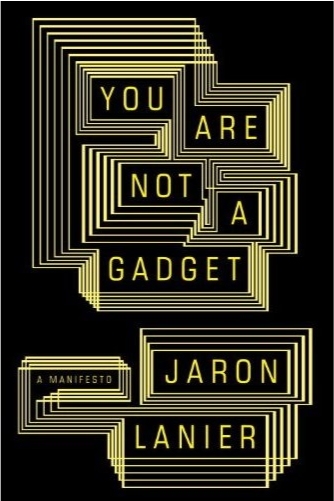
 Jaron Lanier, a tech-industry insider if ever there was one, also voices concerns about the loss of personhood in his 2010 book You Are Not a Gadget: A Manifesto
 . In a recent post at Text Patterns, Alan Jacobs helpfully summarizes the very practical advice Lanier offers for those interested in preserving their integrity as a human person while online:
“These are some of the things you can do to be a person instead of a source of fragments to be exploited by others.”
- Don’t post anonymously unless you really might be in danger.
- If you put effort into Wikipedia articles, put even more effort into using your personal voice and expression outside of the wiki to attract people who don’t yet realize that they are interested in the topics you contributed to.
- Create a website that expresses something about who you are that won’t fit into the template available to you on a social networking site.
- Post a video once in a while that took you one hundred times more time to create than it takes to view.
- Write a blog post that took weeks of reflection before you heard the inner voice that needed to come out.
- If you are twittering, innovate in order to find a way to describe your internal state instead of trivial external events, to avoid the creeping danger of believing that objectively described events define you, as they would define a machine.
All of it very good, and very practical advice. Like Stone and Freeman, Lanier is not advising people to disconnect and unplug. His advice is for those desiring to navigate the Internet world rather than retreat from it. There have been some, however, who have experimented with the option of unplugging altogether. James Sturm, for example, has recently concluded a four month experiment in Life Without the Web. He has chronicled his experience through a series of columns at Slate (he used a third party to submit his columns). He writes engagingly about his experiment and he appears to have inspired more than a few others (look up “quitting the internet” on Google, all the while noting the irony, but then keeping it to yourself because it is really not that clever).
In his last post, Sturm reflected on the possibility of writing a book based on his experience. Feeling four months might be unreasonable for those whose livelihood now depends on the Internet, he wonders if a 30 day hiatus might not be more manageable. But then he writes,
… even if a few of you could disconnect for 30 days, then what? It’s only a finger in the proverbial dike. One month might be a futile effort—how long until you’re back in front of the computer, incessantly updating your Facebook page? When dealing with something as powerful as the Internet, perhaps a more extreme measure is needed, a manifesto along the lines of Jerry Mander’s 1978 classic Four Arguments for the Elimination of Television . I’m not hard-core enough to write a book that advocates living entirely without the Internet, but I do find taking such a forceful position appealing.
In the end it might be a less severe approach that turns out to be most helpful. In a 2008 post on his blog MediaShift, Mark Glaser observed a growing trend “among bloggers and media people who are overwhelmed with the always-on nature of the broadband Internet and smartphones. [And for whom] the overwhelming feeling, is exacerbated by instant messaging, social networking and services such as Twitter, that allow us to do more informal communications electronically rather than in person.” It was a trend toward taking a “Technology Sabbath.” Not surprisingly, it was also a trend emerging in certain Jewish and Christian circles. In the two years since Glasser wrote, the circle of the overwhelmed has almost certainly expanded.
 There is a good chance that talk of keeping Sabbath will most likely suggest a rather drab and joyless affair, a relic of a grayer age. Either that or it conjures images of debilitating attention to countless puritanical rules regulating the life out of an otherwise pleasant day. We tend, after all, to equate restriction with loss. But consider this alternative vision articulated by Jewish scholar Abraham Heschel in his class work, The Sabbath
 :
:
To observe the seventh day does not mean merely to obey or to conform to the strictness of a divine commandment. To observe is to celebrate the creation of the world and to create the seventh day all over again, the majesty of holiness in time, a day of rest, a day of freedom …
Heschel goes on to quote a Jewish prayer that describes the Sabbath as “a day of rest and holiness, a rest in love and generosity, a true and genuine rest, a rest that yields peace and serenity, tranquility and security, a perfect rest with which Thou art pleased.”
This vision of the Sabbath should resonate with those who may be experiencing tech-fatigue accompanied by that disquieting sense that their tools are running, rather than facilitating their lives. The Sabbath was intended to remind us that while we must work and work can be noble and useful, we were not made for work and work is not our highest calling. Taking a day, or even some hours in a day, to disconnect and rest from our technologies, useful and noble as they may otherwise be, can likewise remind us that we were not made for our technology and being connected is not our highest calling.
The idea of a technology Sabbath presents a number of advantages. It is simple, practical, and effective. It recognizes the significance of intentional practices in shaping our habits and our dispositions. It avoids extremes. And it creates a space for both silence and introspection on the one hand, and on the other, celebration and joy in company friends and family.
It may be that deliberate and regular unplugging can help us rediscover a more humane rhythm for our lives, one that is attuned to the needs of our bodies and in sync with the world around us. If so, then perhaps celebration, rest, freedom, love and generosity, peace, serenity, and tranquility may more frequently characterize our experience.

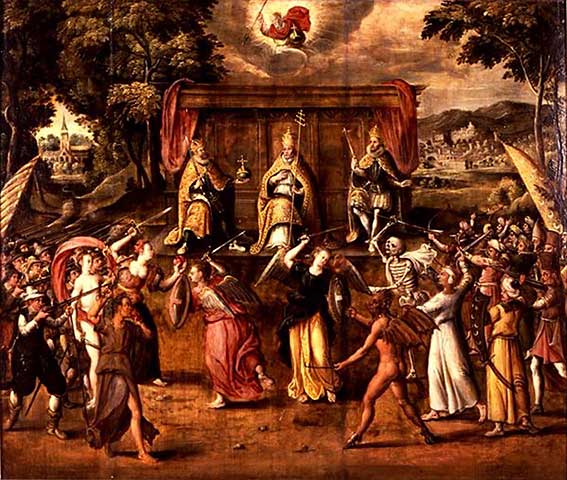 In the wake of the Protestant Reformation, religious violence tore across Europe. The Wars of Religion, culminating with the Thirty Years’ War, left the continent scarred and exhausted. Out of ashes of war the secular nation state arose to establish a new political order which privatized religion and enshrined reason and tolerance as the currency of the public sphere ensuring an end to irrational violence.
 Cavanaugh presents a counter-intuitive thesis and he takes care to make his case. It is a case he has been working out since 1995 when, as a graduate student, he published “‘A fire strong enough to consume the house:’ The Wars of Religion and the Rise of the Nation State.” In the intervening years he has honed and strengthened his argument which finds mature expression in the The Myth of Religious Violence.
 , or thoughts. Pascal is today remembered, if at all, either for his law of fluid pressure or an argument for God’s existence known as Pascal’s Wager. Neither quite does justice to the depth of his insight into what we used to call the human condition.
 ,
,

 L.M. Sacasas