Teachers, Resistance is Futile

Related to the last post, a friend passed along a link this afternoon to a story in the NY Times about a school district in North Carolina that is having notable success implementing technology in the classroom. Here’s a representative passage:

“Mooresville’s laptops perform the same tasks as those in hundreds of other districts: they correct worksheets, assemble progress data for teachers, allow for compelling multimedia lessons, and let students work at their own pace or in groups, rather than all listening to one teacher. The difference, teachers and administrators here said, is that they value computers not for the newest content they can deliver, but for how they tap into the oldest of student emotions — curiosity, boredom, embarrassment, angst — and help educators deliver what only people can.

Many classrooms have moved from lecture to lattice, where students collaborate in small groups with the teacher swooping in for consultation. Rather than tell her 11th-grade English students the definition of transcendentalism one recent day, Katheryn Higgins had them crowd-source their own — quite Thoreauly, it turned out — using Google Docs. Back in September, Ms. Higgins had the more outgoing students make presentations on the Declaration of Independence, while shy ones discussed it in an online chat room, which she monitored.”

Yes, you read that correctly. He did write “quite Thoreauly.” As unfortunate as that line may be, it’s not the most disturbing:

“Many students adapted to the overhaul more easily than their teachers, some of whom resented having beloved tools — scripted lectures, printed textbooks and a predictable flow through the curriculum — vanish. The layoffs in 2009 and 2010, of about 10 percent of the district’s teachers, helped weed out the most reluctant, Mr. Edwards said; others he was able to convince that the technology would actually allow for more personal and enjoyable interaction with students.”

Once more, the layoffs “helped weed out the most reluctant.”

I’m far from suggesting that there is never a time to let go of incompetent teachers, but it seems to me that this is a net that is just as likely to snare competent teachers as incompetent ones.

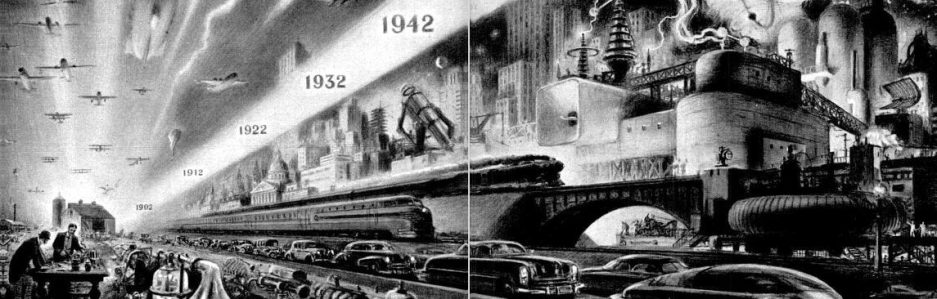
The message in this case seems clear: resistance is futile, I believe is the line. It rather reminds me of the motto of the 1933 Century of Progress World’s Fair which I stumbled upon recently — “Science Finds, Industry Applies, Man Conforms”.

So it would seem, at least as this writer presents the case.

Two Skeptical Takes on Technology and Education

I want to draw your attention to a couple of recent essays on technology in education. The first, “Step 1: give every kid a laptop. Step 2: learning begins?” by Cyrus Farivar, appeared a few days ago in Ars Technica. The second, “Apple for Teacher” by Kieran Healy, was posted at the blog Crooked Timber. I would describe both as reasonably skeptical of two specific approaches to employing technology in the classroom. Farivar examines the success of 1:1 lap top programs and Healy comments on Apple’s recently announced plans for the education market.

I won’t try to summarize either of the pieces, I encourage you to click through and read each if education and technology is of interest to you. Feel free to post your thoughts below if you do.

Here are a couple of interesting excerpts.

Farivar cites Jeff Mao, the learning technology policy director for the state of Maine which operates the most extensive 1:1 program in the country, who makes the following observation:

“Test Scores and one-to-one are tough to link. The deployment of one-to-one technologies alone doesn’t change outcomes. As we discussed, it’s the teaching and learning practices that really make the change.”

This strikes me as an honest and chastened position to take; no hint of techno-utopianism there and that’s a good thing. Here is Mao again on his state’s 1:1 program:

“Since our beginnings, we’ve always looked at notions of creation,” Mao said. “It’s not about consumption of content, it’s about the creation of knowledge.”

Now that, I’m afraid, strikes me as a string of buzz words with little meaning. But perhaps that’s too harsh. I certainly would need to hear what constituted the “creation of knowledge.”

In his piece, Farivar makes the following observation:

“Schools have been down the techno-salvation path before with other kinds of hardware and software. It’s worth remembering just how many technologies we already have that were supposed to transform education beyond all recognition. Radio, the television, the VCR, the personal computer, email, the Internet and the web … All of these have been trumpeted by someone as having the power to make education What It Really Ought To Be. The same goes for smaller developments within larger technological shifts. Chatrooms, MUDs, bulletin boards, blogs, FaceBook, Twitter, on and on.”

It’s good to keep this history in mind. I say that not to diminish the real possibilities that new technologies may offer, but rather to emphasize the importance of smart implementation. The mere appearance of this or that technology will not, cannot by itself transform education. Correction: it may very well transform education, but not for the better. Technology must be paired with the practical wisdom of good teachers if it is to enhance learning.

One last thought. I suspect that our educational dysfunctions are not susceptible to a technological fix. They are linked to the incoherence of our responses to a very straightforward question, What is an education for?

Tacit answers to that question lie beneath and shape most of our discussions about technology in schools, as they do most discussions related to educational policy. At this stage of our history it would probably be impossible to formulate a consensus response that was also substantive. At the very least, though, we should get these more philosophical assumptions on the table rather than bracketing them or otherwise allowing them to remain unspoken.

______________________________________________________________

Related: The Ends of Learning

On the Reading of Old Books

Following on the Christmas holiday, here is a little something that is, given the book from which it is taken, tangentially related. Both of these paragraphs are from C. S. Lewis’ Introduction to an edition of Athanasius’ On the Incarnation. They each contain a great deal of wisdom about the reading of old books. First, on actually reading the old books:

“There is a strange idea abroad that in every subject the ancient books should be read only by the professionals, and that the amateur should content himself with the modern books. Thus I have found as a tutor in English Literature that if the average student wants to find out something about Platonism, the very last thing he thinks of doing is to take a translation of Plato off the library shelf and read the Symposium. He would rather read some dreary modern book ten times as long, all about “isms” and influences and only once in twelve pages telling him what Plato actually said. The error is rather an amiable one, for it springs from humility. The student is half afraid to meet one of the great philosophers face to face. He feels himself inadequate and thinks he will not understand him. But if he only knew, the great man, just because of his greatness, is much more intelligible than his modern commentator. The simplest student will be able to understand, if not all, yet a very great deal of what Plato said; but hardly anyone can understand some modern books on Platonism. It has always therefore been one of my main endeavours as a teacher to persuade the young that firsthand knowledge is not only more worth acquiring than secondhand knowledge, but is usually much easier and more delightful to acquire.”

And secondly, on the epistemological benefits of reading the old books:

“Every age has its own outlook. It is specially good at seeing certain truths and specially liable to make certain mistakes. We all, therefore, need the books that will correct the characteristic mistakes of our own period. And that means the old books. All contemporary writers share to some extent the contemporary outlook – even those, like myself, who seem most opposed to it. Nothing strikes me more when I read the controversies of past ages than the fact that both sides were usually assuming without question a good deal which we should now absolutely deny. They thought that they were as completely opposed as two sides could be, but in fact they were all the time secretly united – united with each other and against earlier and later ages – by a great mass of common assumptions. We may be sure that the characteristic blindness of the twentieth century – the blindness about which posterity will ask, “But how could they have thought that?” – lies where we have never suspected it, and concerns something about which there is untroubled agreement between Hitler and President Roosevelt or between Mr. H. G. Wells and Karl Barth. None of us can fully escape this blindness, but we shall certainly increase it, and weaken our guard against it, if we read only modern books. Where they are true they will give us truths which we half knew already. Where they are false they will aggravate the error with which we are already dangerously ill. The only palliative is to keep the clean sea breeze of the centuries blowing through our minds, and this can be done only by reading old books. Not, of course, that there is any magic about the past. People were no cleverer then than they are now; they made as many mistakes as we. But not the same mistakes. They will not flatter us in the errors we are already committing; and their own errors, being now open and palpable, will not endanger us. Two heads are better than one, not because either is infallible, but because they are unlikely to go wrong in the same direction. To be sure, the books of the future would be just as good a corrective as the books of the past, but unfortunately we cannot get at them.”

That said, then, to quote from one very old book, tolle lege.

Embodied Art

Annie Dillard on the embodied nature of art:

“The body of literature, with its limits and edges, exists outside some people and inside others. Only after the writer lets literature shape her can she perhaps shape literature. In working-class France, when an apprentice got hurt, or when he got tired, the experienced workers said, ‘It is only the trade entering his body.’ The art must enter the body, too. A painter cannot use paint like glue or screws to fasten down the world. The tubes of paint are like fingers; they work only if, inside the painter, the neural pathways are wide and clear to the brain. Cell by cell, molecule by molecule, atom by atom, part of the brain changes physical shape to accommodate and fit paint.

You adapt yourself, Paul Klee said, to the contents of a paintbox. Adapting yourself to the contents of the paintbox, he said, is more important than nature and its study. The painter, in other words, does not fit the paints to the world. He most certainly does not fit the world to himself. He fits himself to the paint.”

“It is only the trade entering his body.” Love that.

From The Writing Life.

Opaque Surfaces and the Worlds They Hide

Thinking about the opacity of life.

All around us our devices present us with surfaces below which lie complexities few understand. Our technologies are increasingly opaque to us. But this is, from a certain perspective, not very different from much of the rest of our experience.

As I look up at the sky, it presents me with a surface which, during the day, hides from my view the vastness of the space that lies beyond it. Even at night, the starlit sky discloses only a glimmer of the magnitude of the universe.

As I look at the blade of grass and my hand that holds it, a surface presents itself beyond which lies another, atomic and sub-amtomic, universe whose infinitesimal scale is entirely concealed to my unaided senses.

How much of reality lies beyond these surfaces that present themselves to us as the perceived limits of lived experience? And yet there is one other surface that veils a world from view.

As I look into the eyes of the persons I encounter day in and day out, a surface once again presents itself in seemingly uncomplicated fashion. But beyond this surface too lies a complex and unfathomable universe. The mind, dare I say soul of every person is another world — vast, complex, mysterious, wondrous, and beyond the reach of my ordinary perception.

In the end, I suspect that of all these, it is my own consciousness that is most opaque to my perception and the most challenging to penetrate.

All our learning is finally an effort to see beyond these surfaces.