Technological Momentum and Education

“There is absolutely no inevitability as long as there is a willingness to contemplate what is happening.”  — Marshall McLuhan, The Medium is the Massage

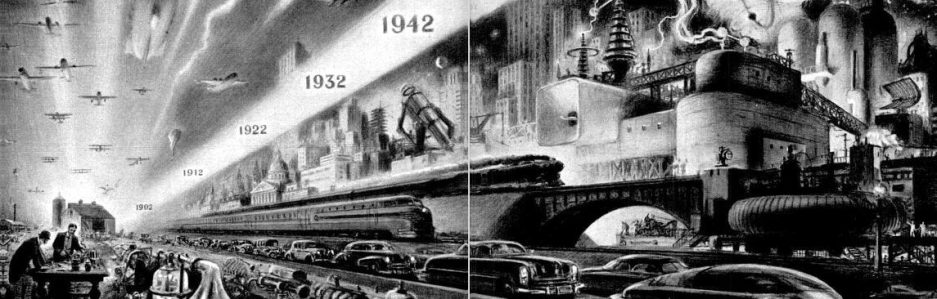
Conversations about technology and education, in my experience, eventually invoke certain vague notions of inevitability. There is often talk about getting on the train before it leaves the station and all of that.  Perhaps it is the case that notions of inevitability will surface in most discussions about technology whether or not education is involved — the specter of technological determinism casts a long shadow. I am not a technological determinist. Nevertheless, I do believe technology influences us in significant ways. How do we describe this condition of being influenced, but not determined?

The concept of technological momentum employed by historian Thomas Hughes provides a helpful way of thinking about this question.  In Technology Matters: Questions to Live With, David Nye explains Hughes concept and offers some examples.

Hughes argues that technical systems are not infinitely malleable.  If technologies such as the bicycle or the automobile are not independent forces shaping history, they can still exercise a “soft determinism” once they are in place …

“Technological momentum” is not inherent in any technological system when first deployed. It arises as a consequence of early development and successful entrepreneurship, and it emerges at the culmination of a period of growth. The bicycle had such momentum in Denmark and the Netherlands from 1920 until the 1960s, with the result that a system of paved trails and cycling lanes were embedded in the infrastructure before the automobile achieved momentum. In the United States, the automobile became the center of a socio-technical system more quickly and achieved momentum a generation earlier. Only some systems achieve “technological momentum” …. The concept seems particularly useful for understanding large systems. These have some flexibility when being defined in their initial phases. But as technical specifications are established and widely adopted, and as a system comes to employ a bureaucracy and thousands of workers, it becomes less responsive to outside pressures …

Hughes makes clear when discussing “inertia” that the concept is not only technical but also cultural and institutional. A society may choose to adopt either direct current or alternating current, or to use 110 volts, or 220 volts, or some other voltage, but a generation after these choices have been made it is costly and difficult to undo such a decision. Hundreds of appliance makers, thousands of electricians, and millions of homeowners have made a financial commitment to these technical standards. Furthermore, people become accustomed to particular standards and soon begin to regard them as natural. Once built, an electrical grid is “less shaped by and more the shaper of its environment.” This may sound deterministic, but it is not entirely so, for people decided to build the grid and selected its specifications and components. To later generations, however, such technical systems seem to be deterministic.

Coming back to the more specific topic of technology in education in light of Nye’s observations, I want to suggest that teachers and administrators think carefully about the implementation of technology, particularly in its early stages.  There is no inevitability.  We have choices to make.  Those choices may lead to the adoption of certain technologies and corresponding practices, and later the institutionalization of those technologies and practices may eventually make it very hard to discard them.  This kind of inertia is what retrospectively makes the adoption and implementation of certain technologies appear inevitable.  But at the outset, there were choices to be made.

It is probably the case that in some circumstances the choice is not really a choice at all.  For example, in certain industries one may either have to constantly adopt and adapt or else lose business and fail.  Exercise of choice may also lead to marginalization — witness the Amish.  Choices come with consequences and costs.  I grant that those costs may sometimes amount to coercive pressure.

Perhaps education is one of these industries (calling it such is already to prejudice the matter) in which this sort of coercive pressure exists.  One hopes, however, that better aims and ideals are steering the ship. Teachers and administrators need to be clear about their philosophy of education, and they need to allow their vision for education to drive their choices about the adoption and implementation of new technology. If they are not self-conscious and intentional in this respect, and if they view technology merely as a neutral set of tools at their disposal, they will be disappointed and frustrated.

As media theorists have noted, the ecological metaphor can be a helpful way of thinking about and understanding our technologies. Once a new element is introduced into an ecosystem, we don’t get the same ecosystem plus a new element; we get a new ecosystem. The consequences may be benign, or they could be destructive. Think of the classroom as an ecosystem; the introduction of new technologies reconstitutes the classroom’s media ecosystem. Consequently, the adoption and implementation of new classroom technologies should be guided by clear thinking about how new technologies alter the learning environment and a sober estimation of their compatibility with a school’s philosophy of education.


“Questionable Classrooms”

It’s been awhile since Nicholas Carr has made an appearance, so here is Carr’s recent interview with The Chronicle of Higher Education.  Some highlights below.

On technology and teaching:

Q. Some professors are interested in integrating social technology—blogs, wikis, Twitter—into their teaching. Are you suggesting that is a misguided approach?

A. I’m suggesting that it would be wrong to assume that that path is always the best path. I’m certainly not suggesting that we take a Luddite view of technology and think it’s all bad. But I do think that the assumption that the more media, the more messaging, the more social networking you can bring in will lead to better educational outcomes is not only dubious but in many cases is probably just wrong. It has to be a very balanced approach. Educators need to familiarize themselves with the research and see that in fact one of the most debilitating things you can do to students is distract them.

On recovering one’s attention span:

Q. If the Internet is making us so distracted, how did you manage to write a 224-page book and read all the dense academic studies that much of it is based on?

A. It was hard. The reason I started writing it was because I noticed in myself this increasing inability to pay attention to stuff, whether it was reading or anything else. When I started to write the book, I found it very difficult to sit and write for a couple of hours on end or to sit down with a dense academic paper. One thing that happened at that time is I moved from outside of Boston, a really highly connected place, to renting a house in the mountains of Colorado. And I didn’t have any cellphone service. I had a very slow Internet connection. I dropped off of Facebook. I dropped out of Twitter. I basically stopped blogging for a while. And I fairly dramatically cut back on checking e-mail. After I got over the initial period of panic that I was missing out on information, my abilities to concentrate did seem to strengthen again. I felt in a weird way intellectually or mentally calmer. And I could sit down and write or read with a great deal of attentiveness for quite a long time.

And on “smart classrooms” in colleges:

Q. Colleges refer to a screen-equipped space as a “smart classroom.” What would you call it?

A. I would call it a classroom that in certain circumstances would be beneficial and in others would actually undermine the mission of the class itself. I would maybe call it a questionable classroom.

Another “Slow” movement

From Patrick Kingsley’s article, “The Art of Slow Reading,” in The Guardian:

If you’re reading this article in print, chances are you’ll only get through half of what I’ve written. And if you’re reading this online, you might not even finish a fifth. At least, those are the two verdicts from a pair of recent research projects – respectively, the Poynter Institute’s Eyetrack survey, and analysis by Jakob Nielsen – which both suggest that many of us no longer have the concentration to read articles through to their conclusion.

And just in case the research proves predictive in your case,

What’s to be done, then? All the slow readers I spoke to realise that total rejection of the web is extremely unrealistic, but many felt that temporary isolation from technology was the answer. Tracy Seeley’s students, for example, have advocated turning their computer off for one day a week. But, given the pace at which most of us live, do we even have time? Garrard seems to think so: “I’m no luddite – I’m on my iPhone right now, having just checked my email – but I regularly carve out reading holidays in the middle of my week: four or five hours with the internet disconnected.”

Studying Optional

From Keith O’Brien’s “What happened to studying?” in The Boston Globe:

According to time-use surveys analyzed by professors Philip Babcock, at the University of California Santa Barbara, and Mindy Marks, at the University of California Riverside, the average student at a four-year college in 1961 studied about 24 hours a week. Today’s average student hits the books for just 14 hours.

This probably didn’t come as much of a surprise to anyone, the question is, Why?  The suggested answer is perhaps more troubling than the data.

The easy culprits — the allure of the Internet (Facebook!), the advent of new technologies (dude, what’s a card catalog?), and the changing demographics of college campuses — don’t appear to be driving the change, Babcock and Marks found. What might be causing it, they suggest, is the growing power of students and professors’ unwillingness to challenge them.

And …

One theory, offered by Babcock and Marks, suggests that the cause, or at least one of them, is a breakdown in the professor-student relationship. Instead of a dynamic where a professor sets standards and students try to meet them, the more common scenario these days, they suggest, is one in which both sides hope to do as little as possible.

“No one really has an incentive to make a demanding class,” Marks said. “To make a tough assignment, you have to write it, grade it. Kids come into office hours and want help on it. If you make it too hard, they complain. Other than the sheer love for knowledge and the desire to pass it on to the next generation, there is no incentive in the system to encourage effort.”

The problem dates back to the 1960s, said Murray Sperber, a visiting professor in the graduate school of education at the University of California Berkeley. Sperber, at the time, was a graduate student at Berkeley and was part of an upstart movement pushing for students to rate their professors. The idea, Sperber said, was to give students a chance to express their opinions about their classes — a noble thought, but one that has backfired, according to many professors. Course evaluations have created a sort of “nonaggression pact,” Sperber said, where professors — especially ones seeking tenure — go easy on the homework and students, in turn, give glowing course evaluations.

If there is a bright spot in the story it might be this:  At least students are self-aware of the problem.

In a 2008 survey of more than 160,000 undergraduates enrolled in the University of California system, students were asked to list what interferes most with their academic success. Some blamed family responsibilities, some blamed jobs. The second most common obstacle to success, according to the students, was that they were depressed, stressed, or upset. And then came the number one reason, agreed upon by 33 percent of students, who said they struggled with one particular problem “frequently” or “all the time”: They simply did not know how to sit down and study.

This also suggests that the problem cannot be blamed entirely on the breakdown of the teacher-student relationship cited above, although I suspect that bears a good bit of the responsibility.

The Bookshelf as Memory Theater

Nathan Schneider’s “In Defense of the Memory Theater” begins thus:

What concerns me about the literary apocalypse that everybody now expects—the at least partial elimination of paper books in favor of digital alternatives—is not chiefly the books themselves, but the bookshelf. My fear is for the eclectic, personal collections that we bookish people assemble over the course of our lives, as well as for their grander, public step-siblings. I fear for our memory theaters.

And concludes as follows:

As the business of reading technology continues along its trajectory, whether apocalyptic or utopian or both, perhaps those of us who continue to fancy ourselves concerned readers—however much we give in to the new and shiny—might turn our attention anew to what one might call “inner work.” In the part of ourselves which is not technological, we could rediscover the tautology that what makes knowledge so precious is its precariousness, not the surety of our control over it. We’ll need to cultivate the arts of memory and forgetting alluded to in these lines by William Blake, which came to me in a letter from a friend, a librarian who, for years now, has been slowly dying in a monastery:

He who binds to himself a joy
Doth the winged life destroy.
He who kisses the joy as it flies,
Lives in eternity’s sunrise.

Even among these wonders now available to us and still to come, all having remains no less a preparation for loss.

Ready? Because that’s what is at stake.

Read everything in between at Open Letters Monthly.

In case you don’t, here is at least one more dose:

Modern life, if we can still call it that, occurs as a sequence of gleeful apocalypses. One world constantly gives way to another. If it doesn’t, “consumers”—as people now call themselves—get anxious. We’re familiar with the drill: new audio/video formats arrive every decade; a new “generation” of cell phone every couple years; and, on a rolling basis, there’s the expectation that several totally unexpected paradigm shifts are in the works—the internet, global climate change, a new fundamental particle, and that sort of thing.