Pattern Recognition: The Genius of our Time?

What counts for genius in our times?  Is it the same as what has always counted for genius?  Or, are there shifting criteria that reflect the priorities and affordances of a particular age?

Mary Carruthers  opens The Book of Memory, her study of  memory in medieval culture, with a contrast between Thomas Aquinas and Albert Einstein.  Both were regarded as the outstanding intellects of their era; each elicited enthusiastic, wonder-struck praise from his contemporaries.  Carruthers cites a letter by an associate of each man as typical of the praise that each received.  Summing up both she writes:

Of Einstein: ingenuity, intricate reasoning, originality, imagination, essentially new ideas couples with the notion that to achieve truth one must err of necessity, deep devotion to and understanding of physics, obstinacy, vital force, single-minded concentration, solitude.  Of Thomas Aquinas: subtlety and brilliance of intellect, original discoveries coupled with deep understanding of Scripture, memory, nothing forgotten and knowledge ever-increasing, special grace, inward recourse, single-minded concentration, intense recollection, solitude.

Carruthers goes on to note how similar the lists of qualities are “in terms of what they needed for their compositional activity (activity of thought), the social isolation required by each individual, and what is perceived to be the remarkable subtlety, originality, and understanding of the product of such reasoning.”  The difference, appropriate to the object of Carruther’s study, lies in the relationship between memory and the imagination.

Carruthers is eager to remind us that “human beings did not suddenly acquire imagination and intuition with Coleridge, having previously been poor clods.”  But there is a difference in the way these qualities were understood:

The difference is that whereas now geniuses are said to have creative imagination which they express in intricate reasoning and original discovery, in earlier times they were said to have richly retentive memories, which they expressed in intricate reasoning and original discovery.

This latter perspective, the earlier Medieval perspective, is not too far removed from the connections between memory and creativity drawn by Jim Holt based on the experiences of French mathematician, Henri Poincare. We might also note that the changing status of memory within the ecology of genius is owed at least in part to the evolution of technologies which supplement the memory.  Aquinas, working in a culture for which books were still relatively scarce, would have needed a remarkably retentive memory to continue working with the knowledge he acquired through reading.  This becomes less of a priority for post-Gutenberg society.

Mostly, however, Carruthers’ comparison suggested to me the question of what might count for genius in our own time.  We are not nearly so far removed from Einstein as Einstein was from Aquinas, but a good deal has changed nonetheless which makes the question at least plausible.  I suspect that, as was the case between Aquinas and Einstein, there will be a good deal of continuity, a kind of base-line of genius perhaps.  But that baseline makes the shifts in emphasis all the more telling.

I don’t have a particular model for contemporary genius in mind, so this is entirely speculative, but I wonder if today, or in coming years, we might not transfer some of the wonder previously elicited by memory and imagination to something like rapid pattern recognition.  I realize there is significant overlap within these categories.  Just as memory and imagination are related in important ways, so pattern recognition is also implicit in both and has always been an important ability.  So again, it is a matter of emphasis.  But it seems to me that the ability to rapidly recognize, or even generate meaningful patterns from an undifferentiated flow of information may be the characteristic of intelligence most suited to our times.

In Aquinas’ day the emphasis was on the memory needed in order to retain the knowledge which was relatively scarce. In Einstein’s time the emphasis was on the ability to jump out of established patterns of thought generated by abundant, but sometimes static knowledge.  In our day, we are overwhelmed by a torrent of easily available and ever shifting information, we won’t quite say knowledge.  Under these conditions memory loses its pride of place, as does perhaps imagination.  However, the ability to draw together disparate pieces of information or to connect seemingly unrelated points of data into a meaningful pattern that we might count as knowledge now becomes a dimension of human intelligence that may inspire comparable awe and admiration from culture drowning in noise.

Perhaps an analogy to wrap up:  Think of the constellations as instances of pattern recognition.  Lot’s of data points against the night sky drawn into patterns that are meaningful, useful, and beautiful to human beings.  For Aquinas the stars of knowledge might appear but for a moment and to recognize the pattern he had to hold in memory their location as he learned and remembered the location of other stars.  For Einstein many more stars had appeared and they remained steadily in his intellectual field of vision, seeing new patterns were old ones had been established was his challenge.

Today we might say that the night sky is not only full to overflowing, but the configuration is constantly shifting.  Our task is not necessarily to remember the location of few but fading stars, nor is it to see new patterns in a fuller but steady field.  It is to constantly recognize new and possibly temporary patterns in a full and flickering field of information. Those who are able to do this most effectively may garner the kind of respect earlier reserved for the memory of Aquinas and the imagination of Einstein.

For a different, but I think related take on a new form of thinking for our age that draws on the imagery of constellations I encourage you to take a look at this thread at Snark Market.


iSpirituality: Religous Apps and Spiritual Practices

Religious apps for the iPhone and iPad have been in the news lately.  In “Religion on Your iPhone?”, Lisa Fernandez discusses a variety of apps created for Christians, Muslims, Jews, Hindus, and Buddhists.  The Apple app store is, if nothing else, an apparently ecumenical space.  Among the various religious apps, however, “Confession: A Roman Catholic App” has probably received the most attention and a good deal of it seemingly misguided.  The folks at Get Religion have broken down some of the misleading news stories related to the app and the Catholic League collected a few of the offending headlines including:

• “Can’t Make it to Confession? There’s an App for That”
• “Catholic Church Approves Confession by iPhone”
• “Bless Me iPhone for I Have Sinned”
• “Catholic Church Endorses App for Sinning iPhone Users”
• “Forgiveness via iPhone: Church Approves Confession App”
• “New, Church-Approved iPhone Offers Confession On the Go”
• “Confess Your Sins to a Phone in Catholic Church Endorsed App”
• “Catholics Can Now Confess Using iPhone App”

Bottom line: the app is intended to help prepare for confession and is not intended to substitute for face-to-face confession.  There is no virtual priest, and there is no virtual absolution.  As Terry Mattingly put it at Get Religion,

This app is actually a combination between a personal diary and the “examination of conscience” booklets and tracts that Catholic and Orthodox Christians have carried in their pockets, wallets and purses for generations.

You may also want to take a look at Maureen Dowd’s rather snarky take on the Confession app in her NY Times column, “Forgive Me, Father, For I Have Linked.”

Click image to see WSJ video report

The Wall Street Journal has also recently posted a video report on religious apps:  “From apps that let you tweet Bible verses to those that help you face Mecca or pray the right Hebrew blessings with the right foods, some of the pious are embracing mobile technology.”  The story follows the usual pattern:  new thing > positive reaction to new thing > negative reaction to new thing > conclusion offering moderating position.  Concerns, voiced mainly by a Christian pastor, include the danger of disengaging from the face-to-face community and misdirecting the focus of religious experience onto the device and away from God.

Professor Rachel Wagner, author of the forthcoming “Godwired: Religion, Ritual and Virtual Reality,” also appears in the report and frames the issue as a struggle between relevance to contemporary culture and faithfulness to ancient traditions.  She suggests that what is at issue is the degree of interactivity with the ritual or practice that the apps allow.  As she puts it, “Those religious groups that want to stay true to their traditions are going to allow less wiggle room.”  It’s not entirely clear from the segment what exactly Wagner means by interactivity, but I suspect she has in view the flexibility of the rituals.  In other words, interactivity implies that ancient rituals may be reshaped by their re-presentation in new media.

Putting the issue this way recalls Paul Connerton’s thesis in How Societies Remember.  In Connerton’s analysis,

Both commemorative ceremonies and bodily practices therefore contain a measure of insurance against the process of cumulative questioning entailed in all discursive practices.  This is the source of their importance and persistence as mnemonic systems.  Every group, then, will entrust to bodily automatisms the values and categories which they are most anxious to conserve.  They will know how well the past can be kept in mind by a habitual memory sedimented in the body.

In other words, embodied practices or rituals represent the most durable mode of remembering.  This is in part because they are less likely to be questioned and altered than knowledge encoded in spoken or written texts.  The core of a tradition’s identity then is wrapped up in its rituals and embodied practices; changes to the rituals and practices effect changes to collective memory and identity.

Consider, for example, that while the Reformation clearly involved the reformulation of key doctrines, it also restructured the embodied rituals of Catholic practice and re-ordered the material conditions of worship.  Bodily habits such as crossing oneself and material conditions such as the architecture of churches changed as much as doctrinal standards.  I suspect one could argue convincingly that for laymen and women, the changes in embodied practice and material conditions of worship were more significant than abstract doctrinal reformulations.

Anecdotally, I vividly recall some years ago being in a certain Protestant context and witnessing a young boy being pulled up rather brusquely from a kneeling posture during prayer with the very straightforward admonition, “We don’t do that here!”  It apparently smacked of Catholicism.  A particular vision of the faith was thereby inculcated by regulating the body.

With this in mind, then, the most interesting thing about religious apps may not be their content, but the way that they insert themselves into the embodied experience of worship and religious practice.  This may occur through the use of a cell phone to access the apps during worship.  (Remember how easy it is to spot someone who is being attentive to their cell phones by simply observing their posture.)  It may also occur through the way an app repackages a ritual or practice for digital mediation, perhaps abstracting bodily elements while preserving more mental components.  In either case, religious apps are likely leave their mark by subtly reshaping the way the body engages in worship and spiritual practice.

Technology, Men, and War

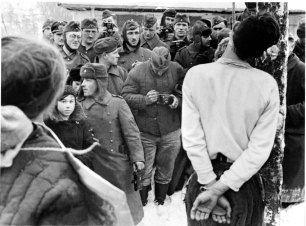
We are still learning more about World War II, and much of it is rather depressing.  Recently German researchers have published the transcripts of conversations among German soldiers held as POW’s.  The soldiers and airmen were secretly recorded by the Allies and their conversations offer a disturbingly honest glimpse of the war from the soldier’s perspective.  You can read about the transcripts in a Der Spiegel Online article, “Nazi War Crimes Described by German Soldiers.” Here is an excerpt that caught my attention:

Men love technology, a subject that enables them to quickly find common ground. Many of the conversations revolve around equipment, weapons, calibers and many variations on how the men “whacked,” “picked off” or “took out” other human beings.

The victim is merely the target, to be shot and destroyed — be it a ship, a building, a train or even a cyclist, a pedestrian or a woman pushing a baby carriage. Only in very few cases do the soldiers show remorse over the fate of innocent civilians, while empathy is almost completely absent from their conversations. “The victim in an empathic sense doesn’t appear in the accounts,” the authors conclude.

Be advised the content of the article is at points graphic and disturbing.

Cell Phone Memories

Much of what we use our cell phones for has very little to do with making a phone call.  In fact, one could argue that the calling feature of our phones is becoming largely irrelevant.  Our cell phones are more likely to be used to access the Internet, send a text message, or take a picture.  Our cell phones have also become memory devices.  Most of us have taken a picture of something we want to remember, a trivial thing perhaps like the name of a book we want to later buy.  The picture is a mental note, except that it is not in the brain.  We set alarms to remind us of meetings, we’ve long since stopped remembering phone numbers, we text directions to ourselves, we send ourselves text messages with reminders, we record the baby’s first words, and the list goes on.  Our cell phones have become an integral part of our memory, to lose them is to find ourselves in a state of partial amnesia.

In a 2007 study, 180 students at London South Bank University between the ages of 19 and 41 were asked to express in one word how they felt when they were without their cell phones.  The responses, reported by Anna Reading in “Memobilia:  The Mobile Phone and the Emergence of Wearable Memories,” included:  uncomfortable, isolated, lost, lonely, disconnected, unsafe, insecure, unguarded, naked, and without time.   This language suggested to Reading that cell phones more or less functioned as an extension of the self and their absence was experienced as the “loss of part of the ‘me’ or part of themselves.”

This, however, was only one side of the story.  Other respondents also used the words free, more private, and peaceful.  This suggested that cell phones also had the effect of generating a panoptic claustrophobia, or a sense of being always available/never alone.  Taken as a whole the study suggests a rather ambivalent relationship with the access and availability cell phones enable.

As the title of her article implies, however, Reading’s focus is on the cell phone as a memory device, and one that is wearable, portable, and social.  The cell phone wearability renders it an extension of the self carried unobtrusively on the body.  Its portability constitutes almost any environment as field of memories waiting to be captured.  Finally, its sociability (my word for her “meme-like qualities,” essentially its connectivity) allows for the instant publication of memories to selected others or more indiscriminate audience via the Internet, particularly social media sites.

This last quality, sociability, blurs the traditional boundary between private and public memory and creates what Jose van Dijk has termed “mediated memory.”  Mediated memory is simultaneously individual and collective.  Every image or video captured say, or every note taken, is ready to be publicized or shared.  We can’t really imagine the sensibility that lead to Roland Barthes’ refusal to include a picture of his mother as a young girl in his book about photography, Camera Lucida.

The second quality, portability, has the interesting effect of making memory something hunted and taken, so to speak, rather than something that is spontaneously generated.  This same move, however, creates a certain detachment from immediate (unmediated) experience and, one could argue, a certain artificiality as well.  This is not much different than the effect of the camera, especially the digital camera.  We can all remember being on vacation and thinking everything we saw needed to be captured with a photograph, so much so that we didn’t experience the vacation so much as we documented it.  In such case my memories are not of time past, but very narrowly of the images I captured.  We don’t always carry a digital camera, however; we always have our cell phones.

Cell phones are by now more or less a taken for granted feature of contemporary life.  They’ve almost blended into the unnoticed and unremarkable background of experience.  It is from this position of ubiquity and transparency that any technology is most likely to have a significant effect on the shape of daily life and our own experience of reality.

_________________________________________________________

Reading’s article can be found in Save As… Digital Memories.

Social Memory, Social Order

“Concerning social memory in particular, we may note that images of the past commonly legitimate a present social order.  It is an implicit rule that participants in any social order must presuppose a shared memory.  To the extent that their memories of a society’s past diverge, to that extent its members can share neither experiences nor assumptions.  The effect is seen perhaps most obviously when communication across generations is impeded by different sets of memories.  Across generations, different sets of memories, frequently in the shape of implicit background narratives, will encounter each other; so that, although physically present to one another in a particular setting, the different generations may remain mentally and emotionally insulated, the memories of one generation locked irretrievably, as it were, in the brains and bodies of that generation …

… images of the past and recollected knowledge of the past … are conveyed and sustained by (more or less ritual) performances …

I believe, furthermore, that the solution to the question posed above — how is the memory of groups conveyed and sustained? — involves bring these two things (recollection and bodies) together …

If there is such a thing as social memory … we are likely to find it in commemorative ceremonies; but commemorative ceremonies prove to be commemorative only in so far as they are performative; performativity cannot be thought without a concept of habit; and habit cannot be thought without a notion of bodily automatisms.”

— Paul Connerton, How Societies Remember, 3-5.

Connerton’s observations, further developed throughout the rest of the book, raise interesting questions about the kind of social order that the personalization and digitization of memory yields.  If Connerton is correct in his claim that a social order rests upon shared memory and that this memory is fundamentally embodied in a quasi-liturgical mode, what becomes of the social order when the memories we most obviously sustain are strictly personal and digitized?

As Connerton also notes in his introduction, this is not merely a technical question, it is also a political question.  If social order hinges on social memory, then, to paraphrase Alasdair MacIntyre, it is worth asking, “Whose memory, which order?”