Happy Saturday morning! For your reading pleasure: studies on the effects of video games and television; quantum stuff; a little history; and reflections on computing, ethics, and the future.
These first two links will warm the old curmudgeon’s heart. Some studies had suggested that video games bore certain cognitive benefits (although even those seemed to me less than significant), but our first report is of a study that claims those earlier studies were deeply flawed. The second report is perhaps of a more serious nature and it points to the potentially negative side-effects of early exposure to television. The jury is still out on the iPad and similar devices, but caution seems to be in order.
The next two pieces delve into the quantum world. I don’t pretend to understand it, but both these links provided some interesting stuff to think about … or just be impressed by, make sure to check out the video.
“Quantum Levitation” from scholars at Tel Aviv University on YouTube: Very cool. Not at all sure what the applications may finally be, but suggestively it was funded in part by Israel’s ministry of Infrastructure.
“Quantum Life: The Weirdness Inside Us”by Michael Brooks atNew Scientist: While we’re on the quantum theme, here is an article that discusses some recent attempts to explore quantum biological effects.
From quantum mechanics to a more philosophical exchange on the meaning of computing:
“Information Is Cheap, Meaning is Expensive,” George Dyson interviewed at The European: Dyson offers his take on the evolution of computing, ethics in a technological age, and how best to face future. “Information is cheap, but meaning is expensive. Where is the meaning? Only human beings can tell you where it is.”
And finally two pieces going back in the history of technology to a famous rivalry and the building of an American technological marvel.
“Edison v. Westinghouse: A Shocking Rivalry” by Gilbert King at Smithsonian.com: Short piece retelling the story of Edison and Westinghouse, the competition over electric current (AC/DC), and the (intentional) electrocution of dogs, animals, and men.
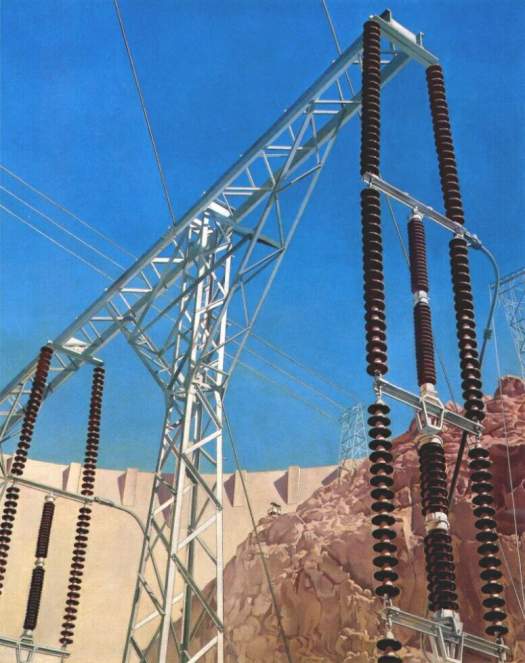
The American painter Charles Sheeler was contracted by Fortune magazine to create a series of paintings that captured the power and majesty of American technology. Nye describes Sheeler’s paintings as follows:
Like many artists of his generation, Charles Sheeler explored the apparent omnipotence of industrialization. In six paintings commissioned by Fortune he depicted the central objects of the technological sublime: the water wheel, the railroad, electrification, and flight. Martin Friedman has observed of the series: ‘Sheeler always depicted power at absolute stasis. In his hermetic visualizations, power is not treated in terms of crashing strength but as an intellectualized concept with its mechanisms always in mint condition.’ The immobility of these paintings creates a tension between the static forms and the reader’s knowledge that all these objects move at great speed. Published together in a single issue of Fortune, Sheeler’s images were presented like a photographic essay. The accompanying text asserted: ‘The heavenly serenity of Sheeler’s style brings out the significance of the instruments of power he portrays here … He shows them for what they truly are: not strange, inhuman masses of material, but exquisite manifestations of human reason.'”
“Heavenly serenity” was not the only religiously inflected language to appear in the text. Here is another portion of the text, cited by Nye, that accompanied Sheeler’s paintings:
“What is this incredible, elusive power that man has taken so magnificently from the waters and the hills? What unguessed secrets of the universe are hinted by its transmission unchanged through unchanging strands of copper or aluminum? In what way have men’s minds, grappling with the raw phenomena of lightning and magnetism, managed to contrive so swift and carefully guarded a channel for a force that no one can fully apprehend? … It is not surprising that the modern scientist, confronted with such questions and with their partial answers, which open up still further questions, should often be a man of deep religious feeling. And it is not surprising either that the modern artist, depicting such a scientist’s handiwork, should put a devout intensity into the painting. This is as truly a religious work of art as any altarpiece, or stained-glass window, or vaulted choir.”
This further points to the entanglement of religion and technology explored by historian David Noble among others. It also suggests to me that while some have referred to the 1930s as America’s most irreligious decade, coming on the heals of the Scopes Trial debacle and fed by H. L. Menken’s acerbic wit, this may be a mischaracterization. It may be better to suggest that in the 1930s the religious impulse was more thoroughly displaced onto technology and its possibilities. Although as Nye’s study of the American technological sublime makes clear, this was a displacement that had long been in the making.
Below is one of the Sheeler’s paintings that appeared in Fortune. Another is included in the preceding post. You can see the whole spread by following the link in the first paragraph.
David Nye, the author of Electrifying America which I cited a handful of times in the past month or so, is also the author American Technological Sublime (1995), a classic work in the history of technology. Except that it is not a work of history in the strict disciplinary sense. Nye draws promiscuously from other fields — citing for example Burke, Kant, Durkheim, Barthes and Baudrillard among others — to present a wide ranging and insightful study into the American character.
The concept of the technological sublime was not original to Nye. It had first been developed by Perry Miller, a prominent mid-twenieth century scholar of early American history, in his study The Life of the Mind in America. There Miller noted in passing the almost religious veneration that sometimes attended the experience of new technologies in the early republic.
Miller found that in the early nineteenth century “technological majesty” had found a place alonside the “starry heavens above and the moral law within to form a peculiarly American trinity of the Sublime.” Taking the steamboat as an illustration, Miller suggests that technology’s cultural ascendancy was abetted by a decidedly non-utilitarian aspect of awe and wonder bordering on religious reverence. “From the beginning, down to the great scenes of Mark Twain,” Miller explains, “the steamboat was chiefly a subject of ecstasy for its sheer majesty and might, especially for its stately progress at night, blazing with light through the swamps and forests of Nature.”
Leo Marx, who I’ve also mentioned here of late, also employed the technological sublime, but again in passing. It fell to David Nye, a student of Marx’s, to develop a book length treatment of the concept. Nye looks to Edmund Burke and Immanuel Kant in order fill out the concept of the sublime, but it is apparent from the start that Nye is less interested in the philosopher’s solitary experience of the sublime in the presence of natural wonders than he is in the popular and often collective experience of the sublime in the presence of technological marvels.
Nye, with a historian’s eye for interesting and compelling sources, weaves together a series of case studies that demonstrate the wonder, awe, and not a little trepidation that attended the appearance of the railroads, the Brooklyn bridge, the Hoover Dam, the factory, skyscrapers, the electrified cityscape, the atomic bomb, and the moon landing. Through these case studies Nye demonstrates how Americans have responded to certain technologies, either because of their scale or their dynamism, in a manner that can best be described by the category of the sublime. And perhaps more importantly, he argues that this experience of the technological sublime laced throughout American history has acted as a thread stitching together the otherwise diverse and divided elements of American society.
If the philosophers provided Nye with the terminology to name the phenomenon, he takes his interpretative framework from the sociologists of religion. Nye’s project is finally indebted more to Emile Durkheim than to either Burke or Kant. Nye notes early on that “because of its highly emotional nature, the popular sublime was intimately connected to religious feeling.” Later he observes that the American sublime was “fused with religion, nationalism, and technology” and ceased to be a “philosophical idea” instead it “became submerged in practice.”
This emphasis on practice is especially important to Nye’s overall thesis and it is on the practices surrounding the technological sublime that he concentrates his attention. For example, with each new sublime technology he discusses, Nye explores the public ceremonies that attended its public reception. The 1939 World’s Fair, to take another example, appears almost liturgical in Nye’s exposition with its carefully choreographed exhibitions featuring religiously intoned narration and a singular vision for a utopian future.
This attention to practices and ceremonies was signaled at the outset when Nye cited David Kertzer’s “Neo-Durkheimian view” that “ritual can produce bonds of solidarity without requiring uniformity of belief.” This functionalist view of religious ritual informs Nye’s analysis of the technological sublime throughout. In Nye’s story, the particular technologies are almost irrelevant. They are significant only to the degree that they gather around themselves a set of practices. And these practices are important to the degree that they serve to unify the body politic in the absence of shared blood lines or religion.
All told, Nye has written a book about a secular civil religion focused on sublime technologies and he has presented a convincing case. Absent the traditional elements that bind a society together, the technological sublime provided Americans a set of shared experiences and categories around which a national character could coalesce.
Nye has woven a rich, impressive narrative that draws technology and religion together to help explain the American national character. There’s a great deal I’ve left out that Nye develops. For example: the evolving relationship of reason to nature and technology as mediated through the sublime or the diminishing active role of citizens, and especially laborers, in the public experience of the technological sublime. But these, in my view, are minor threads.
The take-away insight is that Americans blended, almost seamlessly, their religious affections with their veneration for technology until finally the experience of technology took on the unifying role of religion in traditional societies. Historically American’s have been divided by region, ethnicity, race, religion, and class. American share no blood lines and they have no ancient history in their land. What they have possessed, however, is a remarkable faith in technological progress that his been periodically rekindled by one sublime technology after another all the way to the space shuttle program and its final mission.
The question I’m left with is this: What happens when the technological sublime runs dry? As Nye points out, it is, unlike the natural sublime, a non-renewable sublime. In other words, the sublime response wears off and must find another object to draw it out. If Nye is right — and I do think it is possible to overreach so I want to be careful — there is not much else that serves as well as the technological sublime to bind American society together. Perhaps then, part of our recent sense of unraveling, our heightened sense of disunity, the so called culture wars — perhaps these are accentuated by the withdrawal of the technological sublime. Perhaps, but that would take another book to explore.
‘Beauty is truth, truth beauty,—that is all
Ye know on earth, and all ye need to know.’
— Keats
Perhaps, we might add, that is all you need to know on the Web as well. Tasked with evaluating two different web sites that do more or less the same kind of thing, I found myself initially valuing one over the other and then reversing my judgment after more extensive use of both sites. My initial judgment was almost entirely aesthetic. One site looked clunky, crowded, and out of date, very early 2000s. The other was clean and well organized, minimalistic and inviting. It was only after exploring both sites for a good while that I realized the less aesthetically pleasing site was, in fact, the better site and by far.
That initial aesthetic judgment was, of course, a rather subjective means of evaluating a web site. But I think we do that all the time. It is almost a coping mechanism. If, for example, we are looking for some bit of information and a Google search turns up a 100,000+ hits, who has the time to carefully evaluate even the first 20 results. We open pages and make snap judgments about their worth, we close and move on, or then linger for a slightly more careful consideration. That initial judgment, I think, is probably an entirely aesthetic one. Site design can convey reliability and we pick up on those cues, however trustworthy they may be, almost instantaneously.
To be sure, there are more sophisticated means of evaluating the reliability of a website and I’m sure most of us know what they are and employ them. But how often? I wonder if we fool ourselves into thinking that we reason more about website reliability than we actually do. If we are making initial snap judgments on an impressionistically aesthetic basis, then we are all Keatsian now and mostly out of necessity.
Of course, in another sense, we are not Keatsian at all. For really what we are attuned to is not some ideal form of immutable, eternal beauty, but rather the perpetually shifting styles and fashions of web design. “Contemporaneity in design is truth” may be closer to the mark. And perhaps the more significant manner in which the Web has made us Keatsians is in the fostering of negative capability. Or, more cynically, it may just be apathy.
“The Grand Map” by Avi Steinberg at Paris Review: You’ve probably heard about the driverless cars that Google deploys to gather street-view images for Google Maps, some of you may even have seen one. But what else do these indiscriminate eyes gather into their field of vision? Quite a bit, and a good deal of it is decidedly not pleasant. Fascinating, but be advised some images lean toward disturbing.
“The Consequences of Writing Without Reading” by Buzz Poole at Imprint. Title pretty much describes the piece. Nice reflection on the reading, writing, and solitude in a media-rich age in which solitude is viewed as a punishment of sorts. “Wanting to write without wanting to read is like wanting to use your imagination without wanting to know how.”
“Google and Your Memory” from the staff writers at Online Colleges. A representative of Online Colleges emailed me about their well-conceived and balanced info-graphic after coming across my recent post, “Don’t Offload Your Memory Quite Yet.” Take a look.


 L.M. Sacasas