“Liking” and Loving: Identity on Facebook

By one of those odd twists of associative memory, John Caputo’s little book, On Religion, came to mind today. Specifically, I recalled a particular question that he posed in the opening pages.

“So the question we need to ask ourselves is the one Augustine puts to himself in the Confessions, “what do I love when I love God?,” or “what do I love when I love You, my God?,” as he also puts it, or running these two Augustinian formulations together, “what do I love when I love my God?”.

I appreciate this formulation because it forces a certain self-critical introspection. It refuses us the comforts of thoughtlessness.

A little further on, Caputo takes the liberty of putting his words to the spirit of Augustine’s quest:

“… I am after something, driven to and fro by my restless search for something, by a deep desire, indeed by a desire beyond desire, beyond particular desires for particular things, by a desire for I-know-not-what, for something impossible. Still, even if we are lifted on the wings of such a love, the question remains, what do I love, what am I seeking?”

Then Caputo makes an important observation:

“When Augustine talks like this, we ought not to think of him as stricken by a great hole or lack or emptiness which he is seeking to fill up, but as someone overflowing with love who is seeking to know where to direct his love. He is not out to see what he can get, but out to see what he can give.”

Not too long ago I posted some thoughts on what I took to be the Augustinian notes sounded in Matt Honan’s account of his time at the Consumer Electronics Show in Las Vegas. In that post, “Hole In Our Hearts,” I employed the language Caputo cautioned against, but I’m now inclined to think that Caputo is on to something. His distinction is not merely academic.

Plummeting, perhaps, from the sublime to the … what to call it, let us just say the ordinary, this formulation somehow triggered the question, “what do I like when I “Like” on Facebook?” Putting it this way suggests that what I like may not, in fact, be what I “like”. The question pushes us to examine why it is that we do what we do in social media contexts (Facebook being here a synecdoche).

Very often what we do on social media platforms is analyzed as a performance or construction of the self. On this view, what we are doing is giving shape to our identity. What we like, if you will, is the projected identity, or better yet, the perception and affirmation of that identity by others. This, of course, does not exhaust what is done with social media, but it is a significant part of it.

There are, remembering Caputo’s distinction, two ways we might understand this. Caputo distinguished between love or desire understood as a lack seeking to be filled and love or desire understood as a surplus seeking to be expended. This distinction can be usefully mapped over the motivations driving our social media activity.

When we think about social media as a field for the construction and enactment of identities, we tend to think of it as the projection, authentic or inauthentic, of a fixed reality. Perhaps we would do well to consider the possibility that identity on social networks is not so much being performed as it is being sought, that behind the identity-work on social media platforms there is an inchoate and fluid reality seeking to take shape by expending itself.

The entanglement of our loves (or, likes) and our identity on social media has, it turns out, an antecedent in the Augustinian articulation of the human condition. Caputo went on to note that the question of what we love is also bound up with another Augustinian query:

“Augustine’s question — “what do I love when I love my God?” — persists as a life-long and irreducible question, a first, last, and constant question, which permanently pursues us down the corridors of our days and nights, giving salt to fire to our lives. That is because that question is entangled with the other persistent Augustinian question, “who am I?” …

What we love and desire and who we are — these two are bound up irrevocably with one another.

“I have been made a question to myself,” Augustine famously declared. And so it is with all of us. The problem with our talk about the performance of identity is that it tends to tacitly assume a fixed and knowing identity engaging in the performance. The reality, as Augustine understood, is more complex and whatever it is we are doing online is tied up with that complexity.
Ritual Fairs: Liminality and the World’s Fairs

In 1983, cultural historian Warren Susman wrote a brief but remarkably suggestive essay in the journal Chicago History. The essay, “Ritual Fairs,” evoked the categories of ritual studies and the sociology of religion to understand the significance of World’s Fairs to American culture.

Susman begins by discussing the World’s Fairs as instances of tourism, as the first modern media events, and as the paradigmatic generator of souvenirs. Susman then pivots to draw a comparison between the World’s Fairs of the 19th and 20th centuries and the fairs of medieval society.  According to Susman, “in our era pilgrimage becomes tourism, … souvenirs are a more modern form of relic, and … the iconographic function of some fair’s buildings can be related to the iconographic significance of Gothic cathedrals.”

Like the medieval fairs, World’s Fairs were “idealized towns, utopias, or as H. Bruce Franklin shrewdly suggests about New York’s 1939 fair, works of science fiction.” Consequently, Susman recommends that we understand the fairs in light of the liminal stage that Victory Turner assigned to pilgrimages. The fairs separated the “pilgrim” from their ordinary world and immersed them in another world “somewhere between past, present, and future.” From this vantage point fair goers were led to “an acceptance and participation in a new social order that is emerging technologically, socially, culturally, politically”.

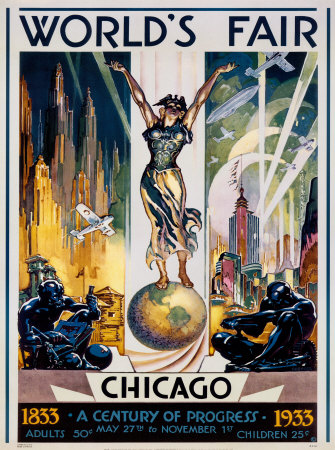
Consider the poster below, from the 1933 Century of Progress Fair in Chicago, a graphic representation of this idea of liminality. The fair’s icon stands posed between the world as it has been and the imagined world of the future.

Borrowing from Emile Durkheim’s notion that religion involves the worship of society, Susman also believes that the fair goers “went to worship or at least stayed to worship a vision of that society or social order.” Susman doesn’t use this language, but it is an eschatological vision that the fairs communicated and invited attendees to worship and participate in. It was not a vision of society as it was or had been, but as it could be. In this respect, the fairs traded in the cultivation of hope; thus their frequent appearance at times of economic or social upheaval.

The golden age of World’s Fairs in America, roughly the period between the 1870s and 1960s, witnessed the nation’s passage from an economy of scarcity and production to one of abundance and consumption. In Susman’s view, the World’s Fairs played an indispensable role in guiding American society through this transition: “… world’s fairs were rites of passage for American society which made possible the full acceptance of a new way of life, new values, and a new social organization.”

To wrap up with a question, is there anything comparable today? Do we have anything that serves a similar function in what is evidently our ongoing transition from one form of society to another?

Teachers, Resistance is Futile

Related to the last post, a friend passed along a link this afternoon to a story in the NY Times about a school district in North Carolina that is having notable success implementing technology in the classroom. Here’s a representative passage:

“Mooresville’s laptops perform the same tasks as those in hundreds of other districts: they correct worksheets, assemble progress data for teachers, allow for compelling multimedia lessons, and let students work at their own pace or in groups, rather than all listening to one teacher. The difference, teachers and administrators here said, is that they value computers not for the newest content they can deliver, but for how they tap into the oldest of student emotions — curiosity, boredom, embarrassment, angst — and help educators deliver what only people can.

Many classrooms have moved from lecture to lattice, where students collaborate in small groups with the teacher swooping in for consultation. Rather than tell her 11th-grade English students the definition of transcendentalism one recent day, Katheryn Higgins had them crowd-source their own — quite Thoreauly, it turned out — using Google Docs. Back in September, Ms. Higgins had the more outgoing students make presentations on the Declaration of Independence, while shy ones discussed it in an online chat room, which she monitored.”

Yes, you read that correctly. He did write “quite Thoreauly.” As unfortunate as that line may be, it’s not the most disturbing:

“Many students adapted to the overhaul more easily than their teachers, some of whom resented having beloved tools — scripted lectures, printed textbooks and a predictable flow through the curriculum — vanish. The layoffs in 2009 and 2010, of about 10 percent of the district’s teachers, helped weed out the most reluctant, Mr. Edwards said; others he was able to convince that the technology would actually allow for more personal and enjoyable interaction with students.”

Once more, the layoffs “helped weed out the most reluctant.”

I’m far from suggesting that there is never a time to let go of incompetent teachers, but it seems to me that this is a net that is just as likely to snare competent teachers as incompetent ones.

The message in this case seems clear: resistance is futile, I believe is the line. It rather reminds me of the motto of the 1933 Century of Progress World’s Fair which I stumbled upon recently — “Science Finds, Industry Applies, Man Conforms”.

So it would seem, at least as this writer presents the case.

Two Skeptical Takes on Technology and Education

I want to draw your attention to a couple of recent essays on technology in education. The first, “Step 1: give every kid a laptop. Step 2: learning begins?” by Cyrus Farivar, appeared a few days ago in Ars Technica. The second, “Apple for Teacher” by Kieran Healy, was posted at the blog Crooked Timber. I would describe both as reasonably skeptical of two specific approaches to employing technology in the classroom. Farivar examines the success of 1:1 lap top programs and Healy comments on Apple’s recently announced plans for the education market.

I won’t try to summarize either of the pieces, I encourage you to click through and read each if education and technology is of interest to you. Feel free to post your thoughts below if you do.

Here are a couple of interesting excerpts.

Farivar cites Jeff Mao, the learning technology policy director for the state of Maine which operates the most extensive 1:1 program in the country, who makes the following observation:

“Test Scores and one-to-one are tough to link. The deployment of one-to-one technologies alone doesn’t change outcomes. As we discussed, it’s the teaching and learning practices that really make the change.”

This strikes me as an honest and chastened position to take; no hint of techno-utopianism there and that’s a good thing. Here is Mao again on his state’s 1:1 program:

“Since our beginnings, we’ve always looked at notions of creation,” Mao said. “It’s not about consumption of content, it’s about the creation of knowledge.”

Now that, I’m afraid, strikes me as a string of buzz words with little meaning. But perhaps that’s too harsh. I certainly would need to hear what constituted the “creation of knowledge.”

In his piece, Farivar makes the following observation:

“Schools have been down the techno-salvation path before with other kinds of hardware and software. It’s worth remembering just how many technologies we already have that were supposed to transform education beyond all recognition. Radio, the television, the VCR, the personal computer, email, the Internet and the web … All of these have been trumpeted by someone as having the power to make education What It Really Ought To Be. The same goes for smaller developments within larger technological shifts. Chatrooms, MUDs, bulletin boards, blogs, FaceBook, Twitter, on and on.”

It’s good to keep this history in mind. I say that not to diminish the real possibilities that new technologies may offer, but rather to emphasize the importance of smart implementation. The mere appearance of this or that technology will not, cannot by itself transform education. Correction: it may very well transform education, but not for the better. Technology must be paired with the practical wisdom of good teachers if it is to enhance learning.

One last thought. I suspect that our educational dysfunctions are not susceptible to a technological fix. They are linked to the incoherence of our responses to a very straightforward question, What is an education for?

Tacit answers to that question lie beneath and shape most of our discussions about technology in schools, as they do most discussions related to educational policy. At this stage of our history it would probably be impossible to formulate a consensus response that was also substantive. At the very least, though, we should get these more philosophical assumptions on the table rather than bracketing them or otherwise allowing them to remain unspoken.

______________________________________________________________

Related: The Ends of Learning

Ideologies at a Crossroad … Literally

Here’s a moment in time from which one could build a book.

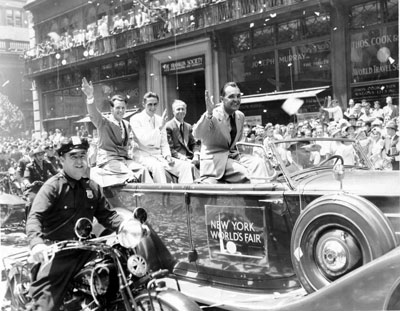
In 1938, a preview parade for the New York World’s Fair with its corporate modernist ethos wound its way through the city. The parade was ten miles long and it included cars from every state in the union.

At the intersection of Thirteenth Street and Seventh Avenue it was cut off by a 50,000-100,000 strong parade celebrating May Day.

One couldn’t script a better symbolic scene.

No disturbances or altercations were reported.

______________________________________________________________

Sources: Robert Rydell mentions the incident in World of Fairs: The Century of Progress Expositions. He cites a 1938 NY TImes article, “Divided Leftists in Quiet May Day,” and “Red Light for May Day March” in World-Telegram.