Christianity and the History of Technology, Part Two

This is the second in a series of posts discussing the work of a handful of scholars exploring the historical relationship between Christianity and technology. First post

In his classic essay, “The Historical Roots of Our Ecological Crisis,” Lynn White, Jr. staked out a position that departed from Ellul at almost every conceivable point. White begins by describing the gap in technical achievement that opened up between Western Europe and both Islamic and Byzantine civilizations to the the east. This gap predated the “Scientific Revolution” of the sixteenth century and was already evident by the late Middle Ages. Consequently, White turns to the Middle Ages to understand the nature of Western technology.

Although White is at this stage in his career moving from the single-factor approach to technological change, elements of the approach are still evident in the “The Historical Roots of Our Ecological Crisis” in which he points to the introduction of the heavy plow as catalyst for changing attitudes about humanity’s relationship to nature. In White’s words, the heavy plow “attacked the land with such violence that cross-plowing was not needed.” White also notes that this new attitude of domination was soon given pictorial expression in Frankish calendars which depicted man and nature in opposition with man as master.

At this juncture in the essay, however, White shifts from a single technological factor analysis of social change to a consideration of the cultural influences that conditioned the development and deployment of technology in adversarial relationship to nature. White finds the Christian religion, as practiced in Western Europe, to be the chief culprit. “Especially in its Western form,” White concludes, “Christianity is the most anthropocentric religion the world has seen.” After briefly recalling the well known plot points and language of the creation narrative in the opening chapter of the book of Genesis, White contrasts Christianity to ancient paganism and the Eastern religions and finds that Christianity “not only established a dualism of man and nature but also insisted that it is God’s will that man exploit nature for his proper ends.” Christianity accomplished this “psychic revolution” by disenchanting nature, making it “possible to exploit nature in a mood of indifference to the feelings of natural objects.”

White, then, affirms the second argument Ellul dismissed in his analysis of the relationship between Christianity and nature. He surmounts one of Ellul’s criticisms — that eastern branches of Christianity did not yield the same relationship to nature and thus religion is not the key factor — by pointing to the significant differences in theological outlook that characterized the activist Latin churches in the West and the contemplative Greek churches of the East. Ellull had noted the difference, taking the Russian Orthodox Church as his case in point, but he concluded that the difference must be cultural and not religious. While the cultural shaping of ancient Christianity should not be overlooked, the fact remains that by the Middle Ages both Eastern and Western Christianity had taken on their distinct shape and were now, as culturally inflected variations of the same religion, shaping the intellectual climate of their respective societies.

Furthermore, White also strengthens the argument by pointing to the sacramental vision of eastern Christianity. Nature existed as a system of signs to be read and through which God spoke to humanity. This was, in White’s view, an “essentially artistic rather than scientific” view of nature. While the West initially shared this sacramental vision, by the late Medieval period it had given way to a natural theology more inclined to “read” nature by understanding the workings of nature rather than merely contemplating its appearance. (Bronislaw Szerszynsk will later take up this semiotic argument in depth.)

The rhetorical frame of White’s article concerns itself with the sources of “the present ecological crisis,” but the body of his argument addresses itself to another question: What accounts for the advance of Western technology beyond its civilizational rivals? White’s essay, while initially gesturing toward a single-factor account of technological change, on the whole points toward a social factors approach focusing on Latin Christianity as the force driving the evolution of western European technology. By so doing, it set the terms and became a key point of departure for subsequent discussion of religion’s relationship to technology. Most notably, it anchored the debate in the Middle Ages, it pointed to the cultural significance of seemingly arcane theological distinctions, it identified Christianity as the most important cultural factor driving technological activity in the West, and it linked the historical question to environmental concerns.

(Next up: More from Lynn White on cultural climates and technological change.)

Christianity and the History of Technology, Part One

This is the first in a series of posts reviewing the work of a handful of scholars exploring the historical relationship between Christianity and technology. 

Since the mid-twentieth century, there has been a sustained, if modest, scholarly conversation about the relationship between technology and religion. Among scholars who have specifically addressed the nature of this relationship, research has focused on the following set of concerns: religion’s role in determining Western society’s posture toward the natural world, religions’s role in abetting technological development, religion’s role in shaping Western attitudes toward “labor and labor’s tools,” and, more recently, the use of religious language and categories to describe technology. The majority of these studies focus almost exclusively on European and North American context and so “religion” amounts to Christianity. Jacques Ellul, Lynn White, George Ovitt, Susan White, David Noble, and Bronislaw Szerszynski have been among the more notable contributors to this conversation.

Jacques Ellul’s comments are the earliest, but they do not set the terms of the debate. That honor falls to Lynn White who in his 1968 essay, “The Historical Roots of Our Ecological Crisis,” first proposed that Europe’s relationship to technology had been distinctly shaped by the Christian worldview. Scholars have repeatedly returned to further scrutinize this thesis and its ecological frame.

George Ovitt’s The Restoration of Perfection: Labor and Technology in Medieval Culture remains the most thorough treatment of the nexus of questions generated by White’s essay. Ovitt concludes that there is good reason to significantly qualify White’s claims.

Susan White’s study, Christian Worship and Technological Change, stands apart as a consideration of technology’s influence on Christian liturgy.

David Noble builds on the work of White and Ovitt to offer an account of what he terms “the religion of technology” which amounts to a pervasive intermingling of religious concerns with the project of technology as a well as a tendency to link the quest for transcendence to technology.

Finally, Bronislaw Szerszynski’s Nature, Technology, and the Sacred offers a theoretically sophisticated reconsideration of White’s argument which, with respect to the technological character of contemporary society, embraces Ellul’s diagnosis of technological society. Szerszynski also moves the argument out of the medieval period to argue that the really decisive transformations in the intellectual and religious context of Europe’s technological history should be located in the Protestant Reformation.

Ellul’s The Technological Society was first published in French in 1954 and the first English translation appeared in 1964. Within the brief historical sketch Ellul provides of the evolution of technique, he examines the relationship between Christianity and technology. In Ellul’s estimation, Christianity as it was practiced through the late Medieval period was at best ambivalent to the advance of technology. He recognizes that received opinion contrasts the Eastern religions, which were supposedly “passive, fatalist, contemptuous of life and action” with Christianity, the religion of the West, which was supposedly “active, conquering, turning nature to profit.”

Although this characterization was widely accepted, Ellul believed it to be in error. It both ignored the real technical advances of Eastern civilizations and misunderstood the posture of Christianity to technical development.

According to Ellul, the emergence of Christianity marked the “breakdown of Roman technique in every area — on the level of organization as well as in the construction of cities, in industry, and in transport.” In his view, Julian the Apostate, and later Gibbon, were not altogether mistaken in attributing the withering of the Empire to rise of the Church. Following the collapse of the Roman Empire in the west, a society emerged under the tutelage of Christianity, which Ellul characterized as “‘a-capitalistic’ as well as ‘a-technical.’” In every sphere of Medieval culture save architecture Ellul sees “the same nearly total absence of technique.”

Ellul goes on to challenge the two historical arguments employed by those who believed that Christianity “paved the way for technical development.” According to the first, Christianity’s suppression of slavery gave impetus to the development of technology to relieve the miseries of manual labor. According to the second, Christianity’s disenchantment of the natural world removed metaphysical and psychological obstacles to its technologically enabled exploitation. The former fails to account for the impressive technical achievements of slave societies, and the latter, while valid to a certain extent, ignores the other strictures Christian faith placed on technical activity, namely its other-worldly and ascetic tendencies. Additionally, Christianity subjected all activity to moral judgment. Accordingly, technical activity was bounded by non-technical considerations. It is within this “narrow compass” that certain technical advances were achieved and propagated by the monasteries.

(Next up: Lynn White Jr. and the roots of our ecological crisis.)

Poetry in an Age of Technology

The juxtaposition of poetry and technology might seem slightly incongruous to some, but there is a great deal that poetry can teach us about living well with technology.   By taking the (significant) liberty of speaking broadly about the poetic and the technological imaginations, I’d like to suggest that the poetic imagination offers a needful supplement to the technological imagination.

To begin with, the technological imagination very often fragments reality into its constituent parts.  The machine with its interchangeable components becomes a kind of master metaphor; the technological imagination sees parts where the poetic imagination takes in the whole.  Consider that poetry very often works through metaphor and metonymy which pushes us to see relationships.  With poetry we understand by bringing reality together rather than by dividing it up.

Along similar lines, James Gleick recently reminded that the key to the digital revolution came when mathematician Claude Shannon recognized that communication could be abstracted from concrete contexts, divorced from meaning, and efficiently transmitted as a series of binary decisions — yes/no, 1/0 — or, as he called them, bits.  Reduce to essentials, kill redundancy; abstract the message from the medium, the content from the form.  These were the principles of information theory and the foundations of the digital age.

Poetry suggests to us the limits of such an approach.  In his review of The Information, Nicholas Carr observed that, “What information theorists call redundancy … is also the stuff of poetry.”  We would have a very hard time abstracting the meaning of poetry from its form.  The assumption that one could do so is probably why so many have such a hard time “understanding” or “getting” poetry.  In a way, the desire to “understand” is misguided because it seeks a “meaning” apart from the form of the text.  It desires to reduce to themes stated in prose what the poem captures in its own unique form.  The meaning is in the reading, and in the reading out loud at that.  When Robert Frost was asked to tell what his poem was about in other words, Frost responded that if he could have done so, he wouldn’t have written the poem.  With poetry the form is the meaning; at least, it is inseparable from the meaning.

Describing her project in How We Became Posthuman — a book that touches on Shannon, cybernetics, and the onset of the information age — Katherine Hayles spoke of explaining “how information lost its body.”  This is a suggestive formulation.  Where digital technologies tend in some respects to push us toward a neglect of the body, poetry relies on embodiment for its meaning.  I emphasized reading out loud above because poetry conveys its meaning and does its work by the operation of the sounds it produces through our body.  Another problem with our “understanding” of poetry may then be that we seek its meaning in the silence of our minds.  We can “hear” something of the sounds in that silence, but not quite in the way that we would when our mouths are forming words and enacting the rhythms of the poem.

One last thought, in so far as poetry remains elusive, it also combats the sense of mastery encouraged by technology.  Technology can, as Heidegger warned, position the world at our service, ready to be manipulated in the worst sense.  Poetry refuses to thus accommodate us, it resists our efforts to “grasp” it and use it.  It provides resistance in a social world that is otherwise increasingly designed to be “frictionless.”  In this way, poetry is an antidote to the worst delusions we might become subject to in a world that, we are repeatedly told, is at our fingertips.

If I am at all on to something, then we can sum up by saying that the poetic imagination (which is to say the imagination nurtured by poetry) balances the technological imagination by seeking to hold the world together and by refusing the abstraction and alienation often engendered by a technological orientation to reality.

____________________________________

“My heart rouses

thinking to bring you news

of something

that concerns you

and concerns many men.  Look at

              what passes for the new.

You will not find it there but in

despised poems.

It is difficult

to get the news from poems

      yet men die miserably every day

for lack

of what is found there.”

William Carlos Williams, from “Asphodel, That Greeny Flower”

Ray Bradbury Goes to Disneyland: Automatons, Animatronics, and Robots

In October of 1965, Ray Bradbury wrote “The Machine-Tooled Happyland,” his reflections on Disneyland. He begins by recalling his delight as a child with all things Disney and then his dismay at an essay in The Nation that equated Disneyland with Las Vegas. Here is Bradbury:

“Vegas’s real people are brute robots, machine-tooled bums.

Disneyland’s robots are, on the other hand, people, loving, caring and eter­nally good.”

Here’s more:

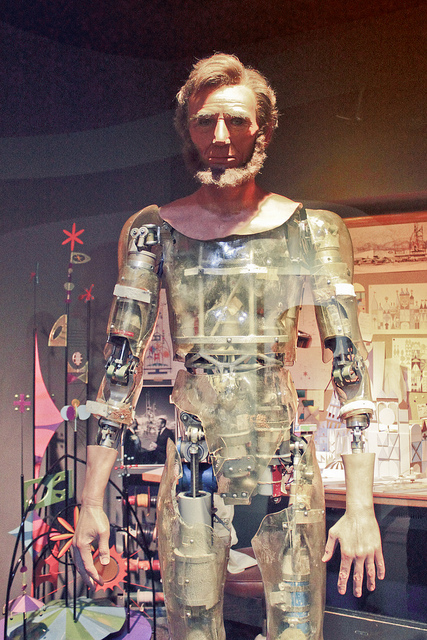
“Snobbery now could cripple our intellectual development. After I had heard too many people sneer at Disney and his audio-animatronic Abraham Lincoln in the Illinois exhibit at the New York World’s Fair, I went to the Disney robot factory in Glendale. I watched the finishing touches being put on a second computerized, electric- and air-pressure-driven humanoid that will “live” at Disneyland from this summer on. I saw this new effigy of Mr. Lincoln sit, stand, shift his arms, turn his wrists, twitch his fingers, put his hands behind his back, turn his head, look at me, blink and prepare to speak. In those fewmoments I was filled with an awe I have rarely felt in my life.

Only a few hundred years ago all this would have been considered blasphemous, I thought. To create man is not man’s business, but God’s, it would have been said. Disney and every technician with him would have been bundled and burned at the stake in 1600.”

Regarding that last thought, perhaps a bit of hyperbole. But there is something to it. Consider this recent fascinating Wilson Quarterly essay by Max Byrd, “Man as Machine.” Byrd discusses the popularity of automatons in Europe, particularly France, during the 18th and 19th centuries:

“Automates of various kinds have been around since antiquity, as toys or curiosities. But in the middle of the 19th century, in one of the odder artistic enthusiasms the French are famously prone to, a positive mania for automates like the dulcimer player swept the country. People flocked to see them in galleries, museums, touring exhibitions. Watchmakers and craftsmen competed to make more and still more impossibly complex clockwork figures, animals and dolls that would dance, caper, perform simple household tasks—in one case, even write a line or two with pen and ink. The magician Robert Houdin built them for his act. Philosophers and journalists applauded them as symbols of the mechanical genius of the age. Like so many such fads, however, the Golden Age of Automates lasted only a short time. By about 1890 it had yielded the stage to even newer technologies: Edison’s phonograph and the Lumière brothers’ amazing cinematograph.”

Back to Bradbury, the whole piece is a touching appreciation of Walt Disney (the man) and the possibilities of animatronics for the teaching of history:

“Emerging from the robot museums of tomorrow, your future student will say: I know, I believe in the history of the Egyptians, for this day I helped lay the cornerstone of the Great Pyramid.

Or, I believe Plato actually existed, for this afternoon under a laurel tree in a lovely country place I heard him discourse with friends, argue by the quiet hour; the building stones of a great Republic fell from his mouth.”

Read the whole thing. Together with Byrd’s piece it offers interesting background to questions such as those posed recently in an excerpt of Patrick Lin’s Robot Ethics in Slate: “The Big Robot Questions”. Read that too.

To Remember, Or To Forget …

Two (and a half) articles for your consideration today:

a. “Technologically Enhanced Memory” by Evan Selinger at Slate.

b. “The Forgetting Pill Erases Painful Memories” by Jonah Lehrer at Wired. See also Lehrer’s related blog post, “Learning to Forget”.

Selinger frames his essay as a discussion of the implications of transactive memory and extended cognition; in short, the ability to offload our memory and thinking onto our environment. That our environment serves as a “memory-prompting tool” is hardly controversial. That in this way it becomes part of our thinking process or an extended mind is a little more so.

Philosopher Andy Clark, a well-known advocate of the extended mind hypothesis, asks us to consider the hypothetical case of Otto and his notebook. Otto suffers from Alzheimer’s and uses a notebook to help him remember information, for example the address of the Museum of Art he wishes to visit. He consults his notebook and acts based on what he finds there in much the same way that someone without an impairment would consult their memory. In this way the notebook is incorporated into his thinking and acting and is thus an extension of his mind (although not, obviously, of his brain).

Notebooks such as Otto’s have a rather elegant history as it turns out. During the nineteenth century, the aide de memoir, a tiny notebook within decorative case on a chain, became a popular (and practical) fashion accessory. Today it seems they flourish mostly on Etsy. For our part, the smart phone has become our aide de memoir. Less elegant perhaps, but more powerful by many orders of magnitude. And it is these orders of magnitude that give Selinger pause. It is one thing to jot down a list of things to do today; it is quite another to have gigabytes of space dedicated to the storage of textual and audiovisual memories. It is quite another still to have the ability to curate those memories for public consumption.

With “Timehop, a lifelogging app that performs “memory engineering” in mind, he cites Elizabeth Lawley who wonders: “If we go through life aware we’re leaving behind a detailed digital archive that future generations can read, might we be inclined to behave inauthentically so that our digital breadcrumbs point back to idealized versions of ourselves?”

This is a dilemma not unlike the emergence of “Facebook Eye” described by Nathan Jurgenson. “Facebook Eye” describes the tendency to experience life with a view to its re-presenation on a social media site like Facebook and the responses that re-presentation is likely to draw.

Pointing to historical antecedents, in this case the aide de memoir, is helpful to a certain degree, but it also risks lulling us into a facile acceptance of a state of affairs that by its quantitative difference becomes also qualitatively (and consequentially) different.

In his Wired article, Lehrer explores the emerging possibility of pharmaceutical forgetting, pills that may be able to target specific and traumatic memories. As Lehrer notes, a more tactical and strategic realization of the capabilities that animate the plot of Eternal Sunshine of Spotless Mind. The premise of Lehrer’s article is that contrary to popular thinking, the best way to handle traumatic memories is not to air them or talk them through, but rather simply to forget them. And a pill that helped patients do just that would be markedly more successful (and efficient) than the talking cure.

Lehrer pays some attention to the ethical concerns, but you’ll have to go elsewhere to consider those more deeply. Analogously to the manner in which a discussion of historical antecedents tends to communicate “there’s nothing of consequence here”, Lehrer is fond of pointing to the natural fallibility of human memory as an antecedent to the pharmaceutically enabled forgetting that, he seems to suggest, renders it more or less unproblematic, at least not seriously so.

It seems odd, however, to point to the natural and inevitable distortions and deletions of memory in defense of drugs designed to help us forget traumatic memories we seem unable to shake.

It is also worth considering what role extended cognition plays in the remembering and forgetting explored by Lehrer. Leher is focused almost exclusively on neurological processes. Yet memory, as the extended mind theorists (among many others) have emphasized, is more than a neurological phenomenon. It is also an embodied, artifactual, spatial, social, and technological reality.

It would not be the first such irony, but perhaps in the future we will take pills to help us dissolve the memories that our technologically enhanced memories won’t let us forget.