Longform version of a six-part series on Christianity and the history of technology.
Introduction
Since the mid-twentieth century, there has been a sustained, if modest, scholarly conversation about the relationship between technology and religion. Among scholars who have specifically addressed the nature of this relationship, research has focused on the following set of concerns: religion’s role in determining Western society’s posture toward the natural world, religions’s role in abetting technological development, religion’s role in shaping Western attitudes toward “labor and labor’s tools,” and, more recently, the use of religious language and categories to describe technology. The majority of these studies focus almost exclusively on European and North American context and so “religion” amounts to Christianity. Jacques Ellul, Lynn White, George Ovitt, Susan White, David Noble, and Bronislaw Szerszynski have been among the more notable contributors to this conversation.
Jacques Ellul’s comments are the earliest, but they do not set the terms of the debate. That honor falls to Lynn White who in his 1968 essay, “The Historical Roots of Our Ecological Crisis,” first proposed that Europe’s relationship to technology had been distinctly shaped by the Christian worldview. Scholars have repeatedly returned to further scrutinize this thesis and its ecological frame.
George Ovitt’s The Restoration of Perfection: Labor and Technology in Medieval Culture remains the most thorough treatment of the nexus of questions generated by White’s essay. Ovitt concludes that there is good reason to significantly qualify White’s claims.
Susan White’s study, Christian Worship and Technological Change, stands apart as a consideration of technology’s influence on Christian liturgy.
David Noble builds on the work of White and Ovitt to offer an account of what he terms “the religion of technology” which amounts to a pervasive intermingling of religious concerns with the project of technology as a well as a tendency to link the quest for transcendence to technology.
Finally, Bronislaw Szerszynski’s Nature, Technology, and the Sacred offers a theoretically sophisticated reconsideration of White’s argument which, with respect to the technological character of contemporary society, embraces Ellul’s diagnosis of technological society. Szerszynski also moves the argument out of the medieval period to argue that the really decisive transformations in the intellectual and religious context of Europe’s technological history should be located in the Protestant Reformation.
Jacques Ellul: A-technical Christianity
Ellul’s The Technological Society was first published in French in 1954 and the first English translation appeared in 1964. Within the brief historical sketch Ellul provides of the evolution of technique, he examines the relationship between Christianity and technology. In Ellul’s estimation, Christianity as it was practiced through the late Medieval period was at best ambivalent to the advance of technology. He recognizes that received opinion contrasts the Eastern religions, which were supposedly “passive, fatalist, contemptuous of life and action” with Christianity, the religion of the West, which was supposedly “active, conquering, turning nature to profit.”
Although this characterization was widely accepted, Ellul believed it to be in error. It both ignored the real technical advances of Eastern civilizations and misunderstood the posture of Christianity to technical development.
According to Ellul, the emergence of Christianity marked the “breakdown of Roman technique in every area — on the level of organization as well as in the construction of cities, in industry, and in transport.” In his view, Julian the Apostate, and later Gibbon, were not altogether mistaken in attributing the withering of the Empire to rise of the Church. Following the collapse of the Roman Empire in the west, a society emerged under the tutelage of Christianity, which Ellul characterized as “‘a-capitalistic’ as well as ‘a-technical.’” In every sphere of Medieval culture save architecture Ellul sees “the same nearly total absence of technique.”
Ellul goes on to challenge the two historical arguments employed by those who believed that Christianity “paved the way for technical development.” According to the first, Christianity’s suppression of slavery gave impetus to the development of technology to relieve the miseries of manual labor. According to the second, Christianity’s disenchantment of the natural world removed metaphysical and psychological obstacles to its technologically enabled exploitation. The former fails to account for the impressive technical achievements of slave societies, and the latter, while valid to a certain extent, ignores the other strictures Christian faith placed on technical activity, namely its other-worldly and ascetic tendencies. Additionally, Christianity subjected all activity to moral judgment. Accordingly, technical activity was bounded by non-technical considerations. It is within this “narrow compass” that certain technical advances were achieved and propagated by the monasteries.
Lynn White: Christianity and the Cultural Climate of Technological Advance
In his classic essay, “The Historical Roots of Our Ecological Crisis,” Lynn White, Jr. staked out a position that departed from Ellul at almost every conceivable point. White begins by describing the gap in technical achievement that opened up between Western Europe and both Islamic and Byzantine civilizations to the the east. This gap predated the “Scientific Revolution” of the sixteenth century and was already evident by the late Middle Ages. Consequently, White turns to the Middle Ages to understand the nature of Western technology.
Although White is at this stage in his career moving from the single-factor approach to technological change, elements of the approach are still evident in the “The Historical Roots of Our Ecological Crisis” in which he points to the introduction of the heavy plow as catalyst for changing attitudes about humanity’s relationship to nature. In White’s words, the heavy plow “attacked the land with such violence that cross-plowing was not needed.” White also notes that this new attitude of domination was soon given pictorial expression in Frankish calendars which depicted man and nature in opposition with man as master.
 At this juncture in the essay, however, White shifts from a single technological factor analysis of social change to a consideration of the cultural influences that conditioned the development and deployment of technology in adversarial relationship to nature. White finds the Christian religion, as practiced in Western Europe, to be the chief culprit. “Especially in its Western form,” White concludes, “Christianity is the most anthropocentric religion the world has seen.” After briefly recalling the well known plot points and language of the creation narrative in the opening chapter of the book of Genesis, White contrasts Christianity to ancient paganism and the Eastern religions and finds that Christianity “not only established a dualism of man and nature but also insisted that it is God’s will that man exploit nature for his proper ends.” Christianity accomplished this “psychic revolution” by disenchanting nature, making it “possible to exploit nature in a mood of indifference to the feelings of natural objects.”
White, then, affirms the second argument Ellul dismissed in his analysis of the relationship between Christianity and nature. He surmounts one of Ellul’s criticisms — that eastern branches of Christianity did not yield the same relationship to nature and thus religion is not the key factor — by pointing to the significant differences in theological outlook that characterized the activist Latin churches in the West and the contemplative Greek churches of the East. Ellull had noted the difference, taking the Russian Orthodox Church as his case in point, but he concluded that the difference must be cultural and not religious. While the cultural shaping of ancient Christianity should not be overlooked, the fact remains that by the Middle Ages both Eastern and Western Christianity had taken on their distinct shape and were now, as culturally inflected variations of the same religion, shaping the intellectual climate of their respective societies.
Furthermore, White also strengthens the argument by pointing to the sacramental vision of eastern Christianity. Nature existed as a system of signs to be read and through which God spoke to humanity. This was, in White’s view, an “essentially artistic rather than scientific” view of nature. While the West initially shared this sacramental vision, by the late Medieval period it had given way to a natural theology more inclined to “read” nature by understanding the workings of nature rather than merely contemplating its appearance. (Bronislaw Szerszynsk will later take up this semiotic argument in depth.)
The rhetorical frame of White’s article concerns itself with the sources of “the present ecological crisis,” but the body of his argument addresses itself to another question: What accounts for the advance of Western technology beyond its civilizational rivals? White’s essay, while initially gesturing toward a single-factor account of technological change, on the whole points toward a social factors approach focusing on Latin Christianity as the force driving the evolution of western European technology. By so doing, it set the terms and became a key point of departure for subsequent discussion of religion’s relationship to technology. Most notably, it anchored the debate in the Middle Ages, it pointed to the cultural significance of seemingly arcane theological distinctions, it identified Christianity as the most important cultural factor driving technological activity in the West, and it linked the historical question to environmental concerns.
Lynn White further developed his thesis in a long 1971 article, “Cultural Climates and Technological Advance in the Middle Ages,” in which he directly set out to identify the sources of the unprecedented “technological thrust of the medieval West.”
White begins by discussing medieval Europe’s propensity for borrowing and elaborating on technologies initially developed in other societies. The culture of medieval Europe “was unique in the receptivity of its climate to transplants” and this accounts in part for the vigor of medieval technological output. However, this receptivity is itself in need of explanation and in response White reaffirms the logic of “The Historical Roots of Our Ecological Crisis”:
“What a society does about technology is influenced by casual borrowings from other cultures, although the extent and uses of these borrowings are reciprocally affected by attitudes toward technological change. Fundamentally, however, such attitudes depend upon what people in a society think about their personal relation to nature, their destiny, and how it is good to act. These are religious questions.”
In what follows, White amplifies and augments the lines of argument adumbrated in the earlier essay while also drawing out additional lines of evidence in support of his thesis. The seminal work of medieval historian Ernst Benz, whose writing on the subject had appeared in Italian in 1964 and was presented in English in 1966, is introduced into White’s argument for the first time. Benz’s study of Zen Buddhism’s “anti-technological impulses” led him to locate Western Europe’s embrace of technological change in its religious outlook. He pointed to Christianity’s linear conception of history, its presentation of God as architect and potter, its theological affirmation of the goodness of material creation, and its presupposition of the “intelligent craftsmanship” of the created order — all in his view unique to Christianity — as the components of what White terms a “cultural climate” remarkably hospitable to technological advance.
White affirms the contours of Benz analysis, but he finds room for improvement. Drawing on two articles independently published in 1956, White once again points to the disenchantment of nature supposedly accomplished by Christianity’s cultural triumph over ancient paganism. He also reaffirms and further develops the importance of the distinction between Latin and Eastern Christianity. Here White strengthens his earlier observations by drawing on iconographic and textual evidence.
Beginning shortly after the turn of the first Christian millennium, Western iconography depicts God in the act of creation as a builder, master craftsman, and later a mechanic — it was a visual tradition never adopted in the Eastern churches. Exegetically, White points to the Western and Eastern interpretations of the story of Martha and Mary in Luke’s gospel. While a surface reading suggests an endorsement of contemplation over activism, Latin interpreters, beginning with Augustine, go out of their way to soften and even reverse the apparent critique of activism and labor.
With this White then draws in what will become another key locus of attention in subsequent discussions of technology and Christianity: the attitude toward labor in the monastic orders, particularly the Benedictines. White notes that in the Byzantine world, which, unlike the West, did not suffer a general collapse of culture, the religious orders were not forced to bear the burden of sustaining all aspects of civilization, secular and religious. In the West, however, following the collapse of Roman authority, the religious orders, notably the Benedictines, found themselves in the position of performing both religious and secular duties, of uniting worship and labor. This commitment to labor and the mechanical arts would, in White’s view, generate a uniquely religious impetus for the development of technology.
White supports his contention by drawing on the work of the pseudonymous Theophilus and Hugh of Saint Victor. Theophilus’ work, dating from the early 12th century, provides an indispensable record of the era’s technological knowledge while attesting to the religiously motivated technical innovation that White takes to be characteristic of the age. Meanwhile, Theophilus’ contemporary, Hugh of Saint Victor incorporated the mechanical arts into his influential classification of knowledge and the arts. While the mechanical arts were accorded the lowest place in the hierarchical ranking of the arts, they were nonetheless included and this was no small thing. Together, the work of Theophilus and Hugh supported White’s thesis regarding Western Christianity’s role in shaping Europe’s technological surge in the Middle Ages.
White concludes with one more corroborating piece of iconographic evidence. An illustration of Psalm 63 in the Utrecht Psalter dating from the mid-ninth century features a confrontation by between King David and the Righteous and a much larger force of the ungodly. While the ungodly use a whetstone to sharpen their sword, the godly employ “the first crank recorded outside China to rotate the first grindstone known anywhere.” Clearly, White concludes, “the artist is telling us that technological advance is God’s will.”
While “The Historical Roots of Our Ecological Crisis” is cited more often and is more frequently taken as a point of departure, it is in “Cultural Climates and Technological Advance in the Middle Ages” that White most persuasively argues the case for Christianity’s formative influence on the history of technology in Western society. With its inclusion of Ernst Benz’ research and its discussion of Benedictine spirituality, this essay frames the research agenda for subsequent research and discussion.
George Ovitt: Challenging the Lynn White Thesis
George Ovitt’s The Restoration of Perfection: Labor and Technology in Medieval Culture, published in 1987, provides the first book length treatment of the major themes advanced in White’s thesis. Ovitt, who in his preface pays appropriate academic homage to White, sets out to explore more fully the claims made on behalf of Christian faith and practice in relation to medieval attitudes toward technology. Ovitt’s analysis is also deeply influenced by Max Weber and Lewis Mumford’s application of Weberian insights to Benedictine monasticism. Finally, Ovitt also tests the alternative claims made by Jacques Le Goff in his 1980 evaluation of medieval attitudes toward labor and technological development. Against White’s thesis, Le Goff argued that shifting theological attitudes toward labor and technology followed upon rather than instigated transformations in economic and material conditions.
In addition to his evaluation of prior scholarship, Ovitt also contributes a chapter on the medieval and Christian roots of the notion of progress. The notion of progress becomes another important semantic net that catches significant elements of the relationship of religion and technology. Ovitt concludes that early Christian writers, and their medieval heirs, acknowledged material progress and human sovereignty over nature, but these were linked inextricably to moral progress and “the striving for sovereignty over the more intractable self.”
Notions of progress, in other words, were not yet, as they later would be, reduced to or considered equivalent to technical progress. In this, as in countless other ways, the Western medieval church took its cue from Augustine whose view of the mechanical arts can best be labeled as ambiguous.
Turning specifically to the claims advanced by White and Benz, Ovitt chooses to test them by conducting an extensive review of the medieval period’s hexaemeral literature, i.e., commentaries on the six days of creation. His review of this literature leads Ovitt to substantially qualify both Benz’s claims regarding the image of God as craftsman and White’s suggestion that Christian theology sanctioned a rapacious posture toward nature.
 Ovitt finds that while there is ample evidence of the portrayals of God as craftsman in the hexaemeral literature of the Latin Church, it is balanced by the continued portrayal of God as a detached and transcendent Creator — a portrayal shared with the Eastern Church — which appears just as frequently as the image of God as craftsman. Additionally, Ovitt suggests that when the image of God as craftsman is employed, it often suggests that as the finished products of the craftsman’s hand are often put to uses contrary to the craftsman’s intentions, so too the work of God’s hands, namely humanity, often rebels against the intentions of the Creator.
Regarding, White’s thesis, Ovitt follows earlier critics in questioning whether, on the one hand, White has adequately described the biblical data and its theological elaboration, and, on the other, whether such a direct, causal connection could in any case be reasonably drawn between a religious perspective and the cultural consensus. Ovitt’s research additionally suggests that the more common depiction of humanity’s relationship to creation is better understood as one of custodianship or stewardship rather than unbridled exploitation. Moreover, Ovitt points out that the idea that nature exists to be used by human beings does not by itself explain the uses to which it is put. Ovitt approvingly cites Mumford’s suggestion that it was not until Francis Bacon’s introduction of “‘a power-hungry technical mentality’ that the West took off on the self-destructive course it now follows.”
Moreover, if we look for the “direct result of the medieval Christian ethic of domination” we find “a long-lived tradition of craftsmanship and subsistence farming” — “democratic polytechnics,” in Mumford’s terms, rather than “authoritarian megatechnics.”
The “really significant question for the histoiry [sic] of technology” in Ovitt’s view, “is not what Christianity taught about the domination of nature, but what Christianity taught about the domination of human beings by other human beings.”
And with this Ovitt turns to consider medieval social and education systems, specifically the practice of labor in the monastic orders and the place of the mechanical arts in medieval classifications of knowledge. Regarding the former, Ovitt indeed finds that the monastic tradition, in both its eremitic and cenobitic manifestations, upheld the fundamental dignity and spiritual usefulness of labor. Moreover, Ovitt finds the Rule of St. Benedict to be the most “effective reconciliation” of the spiritual needs of the individual and the economic needs of the community. Most importantly, he concludes that contrary to the later logic of capitalism, the significance of labor did not reside in “its products or uses of technology and invention quantitatively as a means of enhancing productivity,” rather it resided in the “process of labor” which was aimed at personal holiness and communal self-sufficiency.
Ovitt reasonably concludes that a Weberian analysis of monasticism’s role in incubating incipient capitalism as well as fostering a peculiarly Western enthusiasm for technology should be balanced by the spirit of Augustine’s prayer — “O Lord, I am working hard in this field, and the field of my labors is my own self” — which expressed the dominant medieval priorities.
In his survey of medieval classifications of knowledge, particularly that of Hugh of Saint Victor in the twelfth century and Thomas Aquinas’ in the thirteenth, Ovitt finds a generally positive estimation of the mechanical arts even while they retain the lowest rank among the various arts. In his estimation, more than their admission into the theologians’ classifications of knowledge was needed to generate the particular enthusiasm for technology that would come to distinguish Western society. What was needed was the decoupling of “labor, and labor’s tools from the realm of the sacred and the control of theologians” and a renewed interest in judging technology by its products rather than its effects on the spiritual lives of its users.
This would be achieved, ironically, by the Gregorian Reform movement originating within the church which sought to clarify the respective roles of the church and the state. In so doing, the church sanctioned a three-fold division of society including those who ruled and fought, those who labored, and those who prayed. This division tacitly endorsed the separation of labor from the purview of the church and created the space for technology to evolve apart from moral and spiritual constraints or considerations. Contrary to White, then, Ovitt suggests that Christianity’s chief contribution to the evolution of distinctly Western attitudes to technology may have been its stepping out of the way as it were.
Ovitt’s study significantly complicates the historical arguments made by Benz and White as well as Ellul’s earlier summary of Christianity’s relationship to technique. The total picture is on the whole more ambiguous than the work of any of these scholars would lead readers to believe. Medieval attitudes toward nature, labor, and the mechanical arts were on the whole positive but hardly enthusiastic. More importantly, Ovitt convincingly showed that technical considerations were, as one might expect, consistently subordinated to spiritual ends as demonstrated by the Benedictine’s willingness to lay aside labor when it became possible to commission a lesser order of lay brothers or even paid laborers to perform the work necessitated by the community. Ovitt’s work has appropriately taken its place beside that of White as a major contribution to the scholarly exploration of the relationship of medieval Christianity to Western technology. If we are to find the sources of western enthusiasm for technology it is necessary to begin with medieval Christianity, but after Ovitt’s thorough work it is no longer possible to end there.
Susan White: Technology and Liturgy
In 1994, Cambridge scholar Susan J. White, published a study entitled Christian Worship and Technological Change. White’s study reverses the direction of the inquiry by asking not about the effect of Christianity on the evolution of technology, but about the consequences of technology for Christian worship. In providing the rationale for her study, White cited the earlier work of Ellul, Lynn White, Mumford, and Ovitt exploring the complex relationship between Christianity and technology. In her most compelling chapter, White discusses the role of astronomical technology — the astrolabe, the albion, and the rectangulus — in refining the Christian liturgical calendar which had been in acknowledged disarray as well as the role of the mechanical clock in recalibrating the rhythms of the liturgy. On these points, however, White is mostly following the earlier work of Mumford and Lynn White. Thus her noting the contrast between Eastern Orthodoxy’s longstanding rejection of the mechanical clock and its quick embrace in the western churches, a point also registered by Lynn White.
In a subsequent chapter, “Liturgy and Mechanization,” White takes an approach that resonates with Ellul’s articulation of technique, noting how transformations in Christian liturgical practice during the nineteenth and twentieth centuries were often inspired by the goals and logic of machine technology. In her analogy, liturgy became a form of mechanistic technology.
Susan White’s work is useful for its reframing of the question regarding technology and Christianity in light of technology’s influence on the religion. Her work is especially helpful for those who have never considered the consequences of technological change on liturgical practice. She does not, however, advance the debate initiated by Lynn White regarding the relationship between Christianity and western technology. In 1997, however, historian David F. Noble’s The Religion of Technology raised the question again with renewed vigor.
David Noble: The Religion of Technology
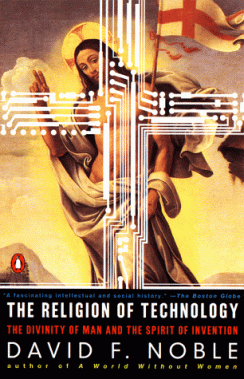 Noble describes “a thousand-year old Western tradition in which the advance of the useful arts was inspired by and grounded upon religious expectation.” Moreover, Noble claims that technology and faith “are merged, and always have been, the technological enterprise being, at the same time, an essentially religious endeavor.” Noble insists that this is not a metaphorical claim, but rather literally true: “modern technology and religion have evolved together …, and as a result, the technological enterprise has been and remains suffused with religious belief.”
In the end, however, it is difficult to isolate what exactly Noble has identified through his discussion of monasticism, millenarianism, Baconian enthusiasm, Free Masonry, and the twentieth century technologies of transcendence including the atomic bomb, space flight, artificial intelligence, and biotechnology. Noble has, from one angle, uncovered the history of an alternative religion, the religion of technology, which might be best understood as a Christian heresy with an immanentized eschatology. He builds on the work of White, Benz, and Ovitt to argue for a major transformation in Christianity’s view of the mechanical arts around the eleventh century, and, in his estimation, it was during this period that technological progress came to be equated with progress toward the material restoration of the created order. It was this faith in technological progress that would henceforth characterize the core of the “religion of technology.”
From another angle, though, Noble has only shown that religious language and religious aspirations are frequently associated with technology, particularly by the elite practitioners that are driving the development and deployment of new technology. Any effort to arrive at a more clearly defined conclusion would falter under close examination since Noble has brought together a remarkably diverse collection of evidence and has not drawn very precise causal relationships. Instead, his method is to drive home a general sense of technology and religion’s entanglement by citing as many plausible instances of the claim as possible. Noble’s slippage between of the use of “faith” and “religion” is indicative of the general nature of his claims.
It is also problematic that Noble’s borrowings from Benz, White, and Ovitt give no indication that there is any underlying tension in their respective accounts of Christianity’s relationship with technology. For example, although he is clearly familiar with Ovitt’s work, he approvingly cites White’s thesis in “The Historical Roots of Our Ecological Crisis” without qualification.
Moreover his deployment of theological terminology in the opening chapter does not inspire confidence in his grasp of nuance in the relevant theological literature. But Noble is less interested in joining that debate than he is in registering a more general complaint. Noble is clearly concerned about the religious hopes for transcendence that have been repeatedly attached to new technologies throughout the history of Western society. In his view, this tendency clouds our ability to think clearly about technology, a problem that grows all the more acute as our technologies evolve into more complex, and potentially dangerous realities. In the end we may say that Noble has established the presence of a religious veneer that frequently appears on the surface of technology to influence its development and adoption without clarifying or systematizing the varieties, sources, and consequences of that veneer.
Bronislaw Szerszynski: Technology, Nature, and the Sacred
In his 2005 book, Nature, Technology, and the Sacred, Bronislaw Szerszynski traces the evolving understandings of nature and the sacred in order to provide an alternative account of secularization and disenchantment, two processes in which technology has traditionally been assigned a critical role.
To begin with, he argues that the best way to understand the evolution of ideas about nature from pre-modern to modern societies is, in fact, not as a process of secularization or disenchantment, but rather as a process of depersonalization. The advent of Christianity did not, as Lynn White (among others) suggested, simply empty nature of its metaphysical content leaving it vulnerable to exploitation. Rather, Christianity removed personal agencies that inhabited nature and replaced them with a semiotic layer of meaning. Nature became alive, not with minor deities and spirits, but with meaning that could be allegorically interpreted. This conception of nature as a religiously meaningful system of signs acted as a brake on the potential exploitation of nature that White and others imagined following on the Christian triumph over the pagan worldview.
However, the Protestant Reformation, in Szerszynski’s view, did lead to a situation like that imagined by White when it collapsed all meanings and interpretations to the level of the literal and effectively contained them in the text of the Bible. In this way, the semiotic cloak that had protected nature was pulled back leaving it defenseless against the advances of science and technology.
The Reformation was decisive, but it did not act alone in reconfiguring the economy of the sacred in relation to nature. In the late twelfth century, conceptions of nature were already beginning to shift owing to the growing influence of voluntarist theology that privileged the unrestrained will and power of God over the potential intelligibility of the created order. Nonetheless, Szerszynski follows Ellul and Ovitt against White in taking medieval Christianity’s attitude toward technology and nature to be mostly ambivalent and not by itself the cause of the Western technological mindset. Even the Reformation, in Szerszynski’s view, did not entirely free technology from moral and religious constraints. The beginnings of this rupture are best traced to Francis Bacon’s privileging of techne over epistme. From this point Szerszynski traces a straight line to the evolution Ellul’s technological society.
At this juncture, Szerszynski introduces David Nye’s exploration of the technological sublime to reinforce his conclusion that by the nineteenth century technology commanded near religious reverence. This religious reverence, however, “echoes” the earlier voluntarist transformation in the theological conception of God: technology, like the voluntarist God was to be “loved for itself, apart from its fitness for human life and purpose.”
Combined with the rise of bio-power documented by Michel Foucault which focused narrowly on the preservation and governance of biological life this meant that all transcendent frames of reference that might have limited technology’s influence were now effectively displaced. As Noble noted, technology itself became the object of transcendent aspirations.
Closing Thoughts
Following Lynn White, the examination of Christianity’s relationship to technology has been firmly anchored in the Medieval period. With the exception of Szerszynski, none of the authors under consideration extensively explored the significance of the Reformation to the history of technology and Szerszynski’s work was thin on historical sources. More work is needed on the Reformation and its relationship to technology. Of course, much work has already been done on the Reformation and the history of one particular technology, the printing press.
Research has thus far also been focused on the role of Christianity in the emergence of Western technology. It seems that more careful and serious work ought to be done on the way that technology has shaped Christianity. Susan White gestured in this direction, but her work was largely derivative of the studies undertaken by Lynn White and Lewis Mumford and was focused on only a handful of illustrative cases.
Joseph Corn, whose work was not discussed above, has shown the importance of exploring religion’s role in the social construction of particular technologies. Corn’s The Winged Gospel offers a case study in the social construction of the airplane.
Drawing on a wide array of sources including newspapers, popular and professional journals, memoirs, and an assortment of varied cultural ephemera, Corn makes his case for the religious dimensions of the airplane’s social construction. The airplane was initially greeted by Thomas-like doubt that demanded sight in order to believe, and was thereafter frequently described with language that appealed to the supernatural — flight was a miracle. Additionally, the use of the airplane and its celebration was often marked by ritual and ceremony that bore a striking resemblance to elements of Christian worship and practice. Finally, attitudes toward the airplane took on the character of a “technological messianism,” a faith in the power of the airplane to bring about a nearly eschatological reordering of society. In the end, of course, these hopes are reigned in by reality.
Similar narrow studies focused on particular technologies and the role religious belief played in their social construction would strengthen our understanding of the relationship between technology and religion which thus far has been treated in mostly broad strokes.
Finally, religious studies can also provide a helpful set of categories for understanding the role of technology in society, particularly given the pervasive interrelationship of technology and religion as documented by Noble. Ritual studies, for example, may usefully augment our understanding of the intersections of technology use and embodied practice. David Nye’s incorporation of Durkheimian categories in his study of the technological sublime provides a helpful model for what this interdisciplinary exchange of methods can accomplish.



 L.M. Sacasas