
“Seldom can we re-create a moment in history in such a dramatic and living way,” Library of Congress preservation director Dianne van der Reyden said at Friday’s announcement of the discovery.
The discovery, as you may have heard over the weekend, was of a word beneath a smudge in an early draft of the Declaration of Independence. The Library of Congress announced the discovery on Friday, July 2nd ahead of the July 4th weekend and you can read the Washington Post’s coverage here. The smudge had long puzzled historians and the application of some high tech wizardry finally allowed them to uncover what lay beneath. Unlike other revisions in the early drafts of the Declaration this word was not merely crossed out, it was painstakingly erased. What’s more, Thomas Jefferson seems to have gone out of his way to make sure the word would never be read. He carefully wrote the letters of the new word, “citizens,” so that they would overlap wherever possible with the letters of the earlier word.
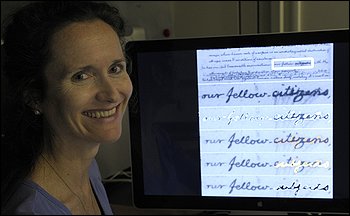 His efforts had succeeded in obscuring his first choice until now. Using “a modified version of the kind of spectral imaging technology developed for the military and for monitoring agriculture” research scientist Fenella France reconstructed the original word. And what was this mystery word? “Subjects.” In a sentence that didn’t even make it into the final draft from the section of the Declaration enumerating the offenses of George III, Jefferson referred to the colonists first as “subjects” of the king and then, apparently realizing the sudden incongruity of the term, opted for the more democratic “citizens.” The significance seems to have been such for Jefferson that he attempted to physically erase every trace of his first infelicitous choice, as if by abjuring the term he would reconstitute the political situation.
Perhaps the designation meant something to Jefferson because he recognized that our own self-understanding would go a long way in shaping our actions. (A recognition, comrade, not lost on subsequent revolutions.) To refer to themselves as subjects in some sense already gave up the cause; to refer to themselves as citizens was as much an act of revolution as were the first shots at Lexington. Now here is the question of the day: By what word do we most frequently refer to ourselves? My vote, and this is not an original observation, is for “consumers.” Try it out. Listen for how often the word “consumers” is used to designate Americans. I suspect “citizen” still makes an appearance in certain obligatory contexts, but “consumers” seems the dominant self-designation.
Jefferson was on to something significant and the recent shift in terminology reveals a great deal about our political and moral environment. Being a consumer implies a wholly different set of associations than being a citizen. Citizenship entails an array of privileges and responsibilities wholly absent from the image of the consumer. The consumer has but one relationship to the world — consumption. The citizen participates, upholds, defends, sacrifices, invests, honors. Perhaps this is why we hardly mind the label, it asks so much less of us. Remember the weeks following 9/11. There was no call to arms, no push to enlist volunteers, and certainly no talk of a draft. The government, however, did urge us to continue buying and spending. This is the whole duty of person as consumer. Buy, spend, purchase — it is your patriotic duty. It’s not hard to see the appeal.
I may yet prefer subject to consumer.
 , 76)
, 76) L.M. Sacasas