Robotic Zeitgeist

Robotics and AI are in the air. A sampling:

“Bot with boyish personality wins biggest Turing test”: “Eugene Goostman, a chatbot with the personality of a 13-year-old boy, won the biggest Turing test ever staged, on 23 June, the 100th anniversary of the birth of Alan Turing.”

“Time To Apply The First Law Of Robotics To Our Smartphones”: “We imagined that robots would be designed so that they could never hurt a human being. These robots have no such commitments. These robots hurt us every day.”

“Robot Hand Beats You at Rock, Paper, Scissors 100% Of The Time”: “This robot hand will play a game of rock, paper, scissors with you. Sounds like fun, right? Not so much, because this particular robot wins every. Single. Time.”

Next, two on the same story coming out of Google’s research division:

“I See Cats”: “Google researchers connected 16,000 computer cores together into a huge neural net (like the network of neurons in your brain) and then used a software program to ask what it (the neural net) “saw” in a pool of 1 million pictures downloaded randomly from the internet.”

“The Triumph of Artificial Intelligence! 16,000 Processors Can Identify a Cat in a YouTube Video Sometimes”: “Perhaps this is not precisely what Turing had in mind.”

Much of this talk about AI has coincided with what would have been Turing’s 100th birthday. Most of it has celebrated the brilliant mathematician and lamented the tragic nature of his life and death. This next piece, however, takes a critical look at the course of AI (or better, the ideology of AI) since Turing:

“The Trouble with the Turing Test”: “But these are not our only alternatives; there is a third way, the way of agnosticism, which means accepting the fact that we have not yet achieved artificial intelligence, and have no idea if we ever will.”

And on a slightly different, post-humanist note (via Evan Selinger):

The International Journal of Machine Consciousness has devoted an entire issue to “Mind Uploading.”

There you go; enough to keep you thinking today.

Technology and Perception: That By Which We See Remains Unseen

“Looking along the beam, and looking at the beam are very different experiences.”
— C. S. Lewis

I wrote recently about the manner in which ubiquitous realities tend to fade from view. They are, paradoxically, too pervasive to be noticed. And I suggested (although, of course, this was nothing like an original observation) that it is these very realities, hiding in front of our noses as the cliché has it, which most profoundly shape our experience. I made note of this phenomenon in order to say that very often these ever-present, unnoticed realities are technological realities.

I want to return to these thoughts and, with a little help from Maurice Merleau-Ponty, unpack at least one of the ways in which certain technologies fade from view while simultaneously shaping our perception. In doing so I’ll also draw on a helpful article by Philip Brey, “Technology and Embodiment in Ihde and Merleau-Ponty.”

The purpose of Brey’s article is to supplement and shore up certain categories developed by the philosopher of technology, Don Ihde. To do so, Brey traces certain illustrations used by Ihde back to their source in Merleau-Ponty’s Phenomenology of Perception.

Ihde sought to create a taxonomy that categorized a limited set of ways humans interacted with technology, and among his categories was one he termed “embodiment relations.” Ihde defined embodiment relations as those in which a technology mediates an individual’s perception of the world and gives a series of examples including glasses, telescopes, hearing aids, and a blind man’s cane. An interesting feature of each of these technologies is that they “withdraw” from view when their use becomes habitual. Ihde lists other examples, however, which Brey finds problematic as exemplars of the category. These include the hammer and a feathered hat.

(The example of the feather hat is drawn from Merleau-Ponty. As a lady wearing a feathered hat makes her way about, she interacts with her surroundings in light of this feature that amounts to an extension of her body.)

In both cases, Brey believes the example is less about perception (although it can be involved) and more about action. Consequently, Brey offers some further distinctions to better get at the kinds of relations Ihde was attempting to classify. He begins by dividing embodiment relations into relations that mediate perception and those that mediate motor skills.

Brey goes on to make further distinctions among the kinds of embodiment relations that mediate motor skills. Some of these involve navigational skills and tend to be of the sort that “enlarge” one’s body. The feathered hat fits into this category as do other items such as a worn backpack that require the user to incorporate the object into one’s body schema in such a way that we pre-consciously navigate as if the object were a part of our body. Then there are embodiment relations which mediate motor skills in interaction with the environment. The hammer fits into this category. These objects become part of our body schema in order to extend our action in the world.

These clarifications and distinctions are helpful, and Brey is right to distinguish between embodiment relations geared toward perception and those geared toward action. But he is also right to point out that even those tools that are geared toward action involve perception to some degree. While a hammer is used primarily to mediate action, it also mediates perception. For example, a hammer strike reveals something about the surface struck.

Yet Brey believes that in this class of embodiment relations the perceptual function is “subordinate” to the motor function. This is probably a sound conclusion, but it does not seem to take into account a more subtle way in which perception comes into play. Elsewhere, I’ve written about the manner in which technology in-hand affects our perception of the world not only by offering sensory feedback, but also by shaping our interpretive acts of perception, our seeing-as. I won’t rehash that argument here; instead I want to focus on the withdrawing character of technologies through which we perceive.

The sorts of tools that mediate perception ordinarily do so while they themselves recede from view. Summarizing Ihde’s discussion of embodiment relations, Brey offers the following description of the phenomenon:

“In embodiment relations, the embodied technology does not, or hardly, become itself an object of perception. Rather, it ‘withdraws’ and serves as a (partially) transparent means through which one perceives one’s environment, thus engendering a partial symbiosis of oneself and it.”

Consider the eye as a paradigmatic example. We see all things through it, but we never see it (unless, of course, in a mirror). This is a function of what Michael Polanyi has called the “from-to” character of perception. Our intentionality is directed from our body outward to the world. “The bodily processes hide,” Mark Johnson explains, “in order to make possible our fluid, automatic experiencing of the world.”

The technologies that we take into an embodied relation do not ordinarily achieve quite so complete a withdrawal, but they do ordinarily fade from our awareness as objects in themselves. Contact lenses, for example, or the blind man’s cane. In fact, almost any tool of which we become expert users tends to withdraw as an object in its own right in order to facilitate our perception or our action.

In short essay titled “Meditation in a Toolshed,” C. S. Lewis offeres an excellent illustration of this dynamic. Granted, he was offering an illustration of different phenomenon, but I think it fits here as well. Lewis described entering into a dark toolshed and seeing before him a shaft of light coming in through a crack above the door. At that moment Lewis “was seeing the beam, not seeing things by it.” But then he stepped into the beam:

“Instantly the whole previous picture vanished. I saw no toolshed, and (above all) no beam. Instead I saw, framed in the irregular cranny at the top of the door, green leaves moving on the branches of a tree outside and beyond that, 90 odd million miles away, the sun. Looking along the beam, and looking at the beam are very different experiences.”

Notice his emphasis on the manner in which the beam itself disappears from view when one sees through it. That through which we perceive ceases to be an object that we perceive. Returning to where we began then, we might say that one manner in which a technology becomes too pervasive too be noticed is by becoming that by which we perceive the world or some aspect of it.

It is easiest to recognize the dynamic at work in objects that are specifically designed to enhance our physical senses — eyeglasses, for example. But the principle may be expanded further (even if the mechanics shift) to include other less obvious ways we perceive through technology. The whole of Marshall McLuhan’s work, in fact, could be seen as an attempt to understand how all technology is media technology that alters perception. In other words, all technology mediates reality in some fashion, but the mediating function withdraws from view because it is that through which we perceive the content. It is the beam of light into which we step to perceive some other thing and, as with the beam, it remains unseen even while it enables and shapes our seeing.


Tip the Writer

$1.00

“An Excess of Speed Turns Into Repose”

“We must here accept a paradox , which is in fact admitted by everyone with the
greatest of ease, and even consumed as a proof of modernity. This paradox is that an
excess of speed turns into repose.” 
— Roland Barthes, “The Jet-Man”

The speed of motion through space is what Barthes had in mind. It was the image of the 1950s era jet-man — the pilot of a jet aircraft, who, while moving through the air at incredible speeds, sat motionless and at ease in his cockpit. Barthes was targeting as well the myth that, in the early years of the jet-age, took shape around the jet-man in his “anti-g suit” and “shiny helmet.” Today it all just sounds like campy science-fiction, these silver-suited men forming a quasi-priestly cadre of humanity mediating between space and earth. Perhaps it strikes us so, in part, because of the success of Barthes’ brand of demythologizing cultural critique. But that one line — “an excess of speed turns into repose” — has lodged itself in my mind and it has refused to budge until I do something with it.

Barthes called it a paradox and claimed that it was taken for granted in the modern age. Perhaps it is even better to see this paradox itself as the hope around which the myth of modernity coalesces. To see this we need to understand “speed” more broadly than the rate at which space is traversed. It includes as well the speed of activity (which does not necessarily involve motion across space) and the speed of information (as opposed to bodies). In each case it is assumed that once a certain threshold is crossed, “speed” will yield to repose. And, of course, it is technology of one form or another that drives the acceleration of motion, activity, or information.

But, as with the jet-man, it is in motion that repose finally comes to be found. The pilot is motionless while approaching the speed of sound. Repose is no longer understood to be the opposite of motion, nor is it what may be found at the far end of furious activity or at the culmination of rapid thought. Repose, the ideal state, is now found in the activity, in the motion, in the consumption of information.

If we accidentally stumble upon repose in the shape of the absence of motion, activity, or the processing of information, we are undone. We do not know what to do with ourselves in such instances. Repose of the sort which was formerly understood to be the goal of motion, activity, and thought now becomes a cursed and anxious state to be avoided at all costs. We are at rest only if we are in motion.

This means of course that motion, activity, and information processing have become and end in themselves rather than a means to some other end. As such, they can never cease or be interrupted. They are self-perpetuating. We pursue motion, activity, and information as if they will bring us to some longed-for state of contentment, fulfillment, or rest; but all the while we are denying or failing to recognize the real state of affairs. We are aiming at nothing so much as the maintenance of motion and activity. We have nowhere to go, but if we keep accelerating we hope not to notice.

The Self in the Age of Digital Reproduction

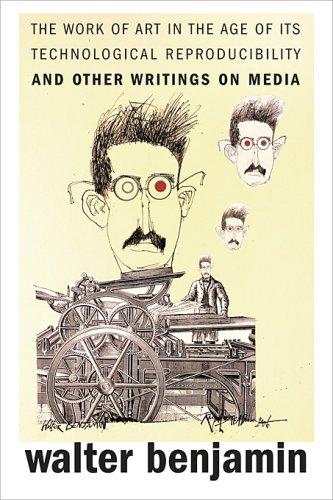
The title suggested itself to me before I had written a word. I picked up Walter Benjamin’s classic essay, “The Work of Art in the Age of Its Technological Reproducibility,”* and in my mind I heard, “The Self in the Age of Its Digital Reproducibility.” I then read through the essay once more with that title in mind to see if there might not be something to the implied analogy. I think there might be.

Of course, what follows is not intended as a strict interpretation and reapplication of the whole of Benjamin’s essay. Instead, it’s a rather liberal, maybe even playful, borrowing of certain contours and outlines of his argument. The borrowing is premised on the assumption that there is a loose analogy between the mechanical reproduction of visual works of art enabled by photography and film, and the reproduction of our personality across a variety of networks enabled by digital technology.

At one point in the essay, Benjamin noted, “commentators had earlier expended much fruitless ingenuity on the question of whether photography was an art – without asking the more fundamental question of whether the invention of photography had not transformed the entire character of art …” Just so. We might say commentators have presently expended much fruitless ingenuity asking about whether this or that digital technology achieved the status of this or that prior analog technology without asking the more fundamental question of whether the invention of digital technology had not transformed the entire character of the field in question. The important question is not, for instance, whether Facebook friendship is real friendship, but how social media has transformed the entire character of relationships. So in this fashion we take Benjamin as our guide letting his criticism suggest lines of inquiry for us.

Benjamin’s essay is best remembered for his discussion of the aura that attended an original work of art before the age of mechanical reproduction. That aura, grounded in the materiality of the work of art, was displaced by the introduction of mechanical reproduction.

“What, then, is the aura?” Benjamin asks. Answer:  “A strange tissue of space and time: the unique apparition of a distance, however near it may be …” And, he adds, “what withers in the age of the technological reproducibility of the work of art is the latter’s aura.”

Aura, to put it more plainly, is a concept that gathers together the authenticity and authority felt in the presence of a work of art. This authenticity and authority of the work of art fail to survive its mechanical (as opposed to manual) reproduction for two principal reasons:

“First, technological reproduction is more independent of the original than is manual reproduction. For example, in photography it can bring out aspects of the original that are accessible only to the lens … but not to the human eye; or it can use certain processes, such as enlargement or slow motion, to record images which escape natural optics altogether. This is the first reason. Second, technological reproduction can place the copy of the original in situations which the original itself cannot attain. Above all, it enables the original to meet the recipient halfway, whether in the form of a photograph or in that of a gramophone record.”

May we speak of the aura that attends a person in “the here and now,” as Benjamin puts it? I would think so. Benjamin himself suggests as much when he discusses the work of the film actor: “The situation can be characterized as follows: for the first time – and this is the effect of film – the human being is placed in a position where he must operate with his whole living person while forgoing its aura. For the aura is bound to his presence in the here and now. There is no facsimile of the aura.”

The analogy I’ve thus far only alluded to is this. Just as mechanical means of reproduction, such as photography, multiplied and distributed an original work or art, likewise do digital technologies, social media most explicitly, multiply and distribute the self. But in so doing they dissolve the aura that attends the person in the flesh and consequently elicit a quest for authenticity.

Consider again the two reasons Benjamin gave for the eclipse of the aura in the face of mechanical reproduction: the independence of the reproduction and its ability to “place the copy in situations which the original itself cannot attain.” The latter of these is most easily reapplied to the digital reproduction of the self. Our social media profiles, for instance, or Skype to take another example, place the self in (multiple, simultaneous) situations that our embodied self cannot attain. But it is the former that may prove most interesting.

Benjamin’s notion of the aura is intertwined with a certain irreducible distance that cannot be collapsed simply by drawing close. Remember his most straightforward definition of aura: “A strange tissue of space and time: the unique apparition of a distance, however near it may be …” The reason for this is that ordinary human vision, even in drawing close, retains an optical inability to penetrate past a certain point. It can only see what it can see, and a manual reproduction cannot improve on that. But a mechanical reproduction can; it can make visible what would remain invisible to the human eye. Imagine for instance what an extreme photographic close-up might reveal about a human face or how high-speed photography may capture a millisecond in time that ordinary human perception would blur into the larger patterns of movement that the unaided human eye is able to perceive.

“Just as the entire mode of existence of human collectives changes over long historical periods,” Benjamin observed, “so too does their mode of perception.” The point then is this: mechanical reproduction, photographs and film, enabled new forms of perception and these new forms of perception effectively neutralized the aura of the original.

Benjamin neatly summed up this dynamic with the notion of the optical unconscious:

“And just as enlargement not merely clarifies what we see indistinctly ‘in any case,’ but brings to light entirely new structures of matter, slow motion not only reveals familiar aspects of movements, but discloses quite unknown aspects within them … Clearly, it is another nature which speaks to the camera as compared to the eye. ‘Other’ above all in the sense that a space informed by human consciousness gives way to a space informed by the unconscious … it is through the camera that we first discover the optical unconscious …”

The camera, in other words, has the ability to bring to the attention of conscious perception what would ordinarily be perceived only at an unconscious level. Benjamin was explicitly pursuing an analogy to the Freudian unconscious. If you prefer to avoid that association, perhaps the term optical non-conscious would suffice. In this way this way this mode of perception may be elided to the bodily forms of intentionality discussed by Merleau-Ponty that are not quite the products of conscious attention. In any case, the capabilities of mechanical reproduction brought to conscious attention what ordinarily escaped it.

So what is the connection to digital reproductions of the self. Well, we might get at it by identifying what could be called the “social unconscious.” Just as photography and film disclosed a real but ordinarily invisible world, might we not also say that digital reproductions of the self materialize real but otherwise invisible relations and mental or emotional states? What else could be the meaning of the “Like” button or the ability to see a visualization of our history with a friend as chronicled on Facebook? Moreover, interactions that before the age of digital reproduction may have passed between two or three persons, now materialize before many more. And while most such interactions would have soon faded into oblivion when they passed out of memory, in the age of digital reproduction they achieve greater durability as well as visibility.

But what are the consequences? Benjamin can help us here as well.

“To an ever-increasing degree, the work reproduced becomes the reproduction of a work designed for reproducibility.” In an age of digital reproduction, the self we are reproducing is increasingly constructed for maximum reproducibility. We live with an eye to the reproductions we will create which we will create with an eye to their being widely reproduced (read, “shared”).

Benjamin also noted the historic tension “between two polarities within the artwork itself … These two poles are the artwork’s cult value and its exhibition value.”  When art was born in the service of magic, the importance of the figures drawn lay in their presence not necessarily their exhibition. By liberating of the work of art from the context of ritual and tradition, mechanical reproduction foregrounded exhibition. In the age of digital reproduction, mere being is incomplete without also being seen. It hasn’t happened if it’s not Facebook official. The private/public distinction is reconfigured for this very reason.

For those keen on registering economic consequences, Benjamin, speaking of the actor before the camera, offers this: “The representation of human beings by means of an apparatus has made possible a highly productive use of the human being’s self-alienation.” Now apply to the person before the apparatus of social-media.

Finally, Benjamin speaking of the human person who will be mechanically reproduced by film, writes:

“While he stands before the apparatus, he knows that in the end he is confronting the masses. It is they who will control him. Those who are not visible, not present while he executes his performance, are precisely the ones who will control it. This invisibility heightens the authority of their control.”

Apply more widely to all who are now engaged in the work of digitally reproducing themselves and cue the quest for authenticity.

____________________________________________________

* I’m drawing on the second version of the essay composed in 1935 and published in Harvard UP’s The Work of Art in the Age of Its Technological Reproducibility and Other Writings on Media (2008)According to the editors, this version “represents the form in which Benjamin originally wished to see the work published.”

Presence Emerges: Bodies in Conversation

Sunday before last I opened up my Twitter feed to find Sherry Turkle getting pummeled for her opinion piece in the Sunday NY Times, “The Flight From Conversation.” Rarely has my feed spoken with such strident uniformity; Turkle had clearly struck a nerve. With other more pressing commitments demanding my attention, however, I bookmarked the essay and several of the responses that came in over the next few days. A little over a week later, the storm having mostly blown over, I want to throw in my belated two cents.

Critics noted that Turkle presented a false dichotomy. Conversations can still happen even in a world that includes social media and text messaging. This is true in principle, of course. And, in principle, I suspect Turkle would agree. But I’m not sure this is really the best way of approaching these sorts of concerns.

Perhaps it would be better to reframe the issue in terms of presence. Granting that, in the abstract, the use of electronic forms of communication does not necessarily preclude the possibility of conversation, and granting, of course, that not every conversation is nor ought to be of the deep and absorbing variety, it seems worthwhile to explore how actual instances of face-to-face conversation might be affected by the kinds of technology Turkle has in view.

And to narrow our focus even further, I’ll focus on the cellular phone. It is after all the cellular phone that materializes electronic communication across the whole field of our experience, and it is the materiality of the cellular phone that presents itself in the context of face-to-face conversation.

It seemed to me that Turkle’s concerns were strongest when they dealt with the manner in which technology impinges on face-to-face communication. And on this point many of her critics agreed with her concerns even while they disagreed with the manner in which they were packaged. This is also the aspect of Turkle’s work that seems to resonate most widely. After all, much to her critics bemusement, the threaded comments seemed mostly to validate Turkle’s point-of-view.

It is easy to see why. Most of us have been annoyed by someone who was unable to give another human being their undivided attention for more than seconds at a time. And perhaps more significantly, most of us have felt the pull to do same. We have struggled to keep our attention focused on the person talking to us as we know we ought to, and we know we ought to because some shred of our humanity remains intact and we know very well that the person in front of us is more significant than the text that just made our phone vibrate in our pocket. We have been on both ends of the kind of distractedness that the mere presence of a smartphone can occasion, and we are alive enough to be troubled by it. We begin to feel the force of Simone Weil’s judgment: “Attention is the rarest and purest form of generosity.”

And so Turkle’s piece, and others like it, resonate despite the theoretical shortcomings that make certain scholars cringe. After all, what difference does it make that some study showed that a statistically significant portion of the population reports feeling less lonely when using social media if I can’t get the person standing two feet away from me to treat me with the barest level of decency.

The question remains, however, “Are smartphones at fault?” This is always the question. Is Google making us stupid? Is Facebook making us lonely? Are smartphones ruining face-to-face conversation? Put that way, I might say, “No, not exactly.” That’s usually not the best way of stating the question. Rather than begin with a loaded question, perhaps it’s better simply to seek clarity and understanding. What is happening when cellular phones become part of an environment that also consists of two people engaged in conversation?

Out of the many possible approaches to this question, it is the path offered by Merleau-Ponty’s notion of the “intentional arc” that I want to take. Merleau-Ponty writes:

“The life of consciousness – cognitive life, the life of desire or perceptual life – is subtended by an ‘intentional arc’ which projects round about us our past, our future, [and] our human setting ….”

Hubert Dreyfus, a philosopher whose work has built on Merleau-Ponty’s, adds this explanatory note:

“It is crucial that the agent does not merely receive input passively and then process it. Rather, the agent is already set to respond to the solicitations of things. The agent sees things from some perspective and sees them as affording certain actions. What the affordances are depends on past experience with that sort of thing in that sort of situation.”

Here’s what all of this amounts to. The “intentional arc” describes the manner in which our experience and perception is shaped by what we intend. Intending here means something more than what we mean when we say “I intended to get up early” or “I intend to go to the store later.” Intention in this sense refers to a mostly non-conscious work of perceiving the world and how that perceiving is shaped by what we are doing or aim to do. Our perception, in other words, is always already interpreting reality rather than simply registering it as a pure fact.

This work of perception-as-interpretation builds up over time as an assortment of “I cans” carried or remembered by our bodies. This assortment becomes part of the background, or pre-understanding, that we bring to bear on new situations. And this is how our intentional arc “projects round about us our past, our future.”

What is particularly interesting for our purposes is how the insertion of a tool into our experience reconfigures the “intentional arc” that is supporting our experience. The phenomenon is neatly captured by the expression, “To a man with a hammer everything looks like a nail.” This line suggests that how we perceive our environment is shaped by the mere presence of a tool in hand. (Notice, by the way, how this “effect” is registered even before the tool is used.)

Merleau-Ponty might analyze the situation as follows: The feel of a hammer in hand, especially given prior use of a hammer, transforms how the environment presents itself to us. Aspects of the environment that would not have presented themselves as things-to-be-struck now do. Our interpretive perception interprets differently. Our seeing-as is altered. New possibilities suggest themselves. The affordances presented to us by our environment are re-ordered.

Try this at home, go pick up a hammer, or for that matter any object you can hold in hand that is weighted on one end. See what you feel. Hold it and look around you and pay really close attention to the way your perceive these objects. Actually, on second thought, don’t try this at home.

Another example, perhaps more readily apprehended (and less fraught with potential danger) is offered by the camera. With camera in hand our environment presents itself differently to us. I would go so far as to suggest that we see differently when we see with camera in hand. The concrete objectivity of the world has not changed, but the manner in which our perception interprets the world has; and this change was effected by the presence of a tool in hand (even prior to its use).

In this sense, the tool does have a certain causal force, it causes the environment to present itself differently to the user. It may not cause action, but it invites it. It causes the environment to hail the user in a new way.

Returning to the situation with which we began, we can ask again how the presence of a smartphone reconfigures face-to-face conversation. How does it alter the intentional arc that suspends the act of conversation? I first began thinking through this question by focusing on the phone itself, but this approach foreclosed itself; it wasn’t proving to be very helpful to me. But then I thought about the act of conversation itself and the question of presence. What would it mean to be fully present to one another and what difference would this make for the act of conversing?

I realized then that the really interesting dynamic involved what two people offered to one another in the act of conversing face-to-face. Presence was not a uni-directional phenomenon involving the intentionality of each partner individually. Presence was not something one person achieved. Rather presence emerged from the manner in which the act of conversation coupled the intentionality of each individual. To borrow Merleau-Ponty’s lingo (and give it my own somewhat sappy twist), two intentional arcs come together to form a circle of presence.

Merleau-Ponty spoke of our body’s natural tendency to seek an “optimal grip” on our environment. In face-to-face conversation, our bodies seek an optimal grip as well. While our conscious attention is focused on words and their meaning, our fuller perceptive capabilities are engaged in reading the whole environment. In conversation, then, each person becomes a part of a field of communication that includes, but is not limited to verbal expression. To put it another way, our intentional arc includes acts of interpretative perception of the other’s body as well as their words.

When we perceive eyes and hands, facial gestures and posture we perceive these not merely as eyes or hands but as eyes that signify, hands that mean, etc. We are attuned to much more than the words a person offers to us. Conversation involves the whole body in an act of holistic communication. And we perceive much of that communication at a non-conscious level; perceiving these dynamics becomes a part of our pre-understanding applied to the act of conversation.

But this dynamic that enriches and shapes face-to-face communication depends on each person offering themselves up to be read in certain ways. Our attention intends the other’s body as a nexus of communication, but when the other’s body is not engaged in the act of conversation, dissonance results and presence is broken.

Back to the smartphone. When the smartphone enters into the dynamic it disrupts the body’s communicative patterns. Gestures, eye contact, posture, facial expression — all of it is altered. It no longer means in the way our body is used to perceiving meaning. Perception finds it impossible to achieve an optimal grip on the embodied interaction. And because our bodies give and receive this sort of communication tacitly and often in remarkably subtle ways, we may not be conscious of this dissonance in the act of conversation. We may only register a certain feeling of being out of sync, a certain feeling that something is off. Presence fails to emerge and conversation, of the sort that Turkle champions, indeed, of the sort we all acknowledge as one of the great consolations offered to us in this world — that kind of conversation becomes more difficult to achieve. Given the bodily dimensions of face-to-face conversation, I’m not sure it could be otherwise.

It is not that “social media” in some abstract generic form or the practice of texting in general that threatens conversation. It is the concrete materiality of the device entering into the intentional arcs of our perceiving and meaning-ful bodies engaged in face-to-face communication that is troublesome.