The Data Self and the Social Self

Here is William James in The Principles of Psychology (1890), explaining to us a fundamental aspect of human nature, which social media is designed to exploit:

A man’s Social Self is the recognition which he gets from his mates. We are not only gregarious animals, liking to be in sight of our fellows, but we have an innate propensity to get ourselves noticed, and noticed favorably, by our kind. No more fiendish punishment could be devised, were such a thing physically possible, than that one should be turned loose in society and remain absolutely unnoticed by all the members thereof. If no one turned round when we entered, answered when we spoke, or minded what we did, but if every person we met ‘cut us dead,’ and acted as if we were non-existing things, a kind of rage and impotent despair would ere long well up in us, from which the cruellest bodily tortures would be a relief; for these would make us feel that, however bad might be our plight, we had not sunk to such a depth as to be unworthy of attention at all.

The data self, both as a new kind of subjectivity and as a name for the only self social media companies care about, is built upon the social self. Or, more to the point, the data self, in the latter sense, is a parasite that lives off of what James calls the social self.

Relatedly, from the archive:

It seems to me that we should draw a distinction among desires that are bundled together under the notion of loneliness. There is, for example, a distinction between the desire for companionship (and distinctions among varieties of companionship) and the desire simply to be noticed or acknowledged. C. S. Lewis, eloquent as per usual, writes:

“We should hardly dare to ask that any notice be taken of ourselves. But we pine. The sense that in this universe we are treated as strangers, the longing to be acknowledged, to meet with some response, to bridge some chasm that yawns between us and reality, is part of our inconsolable secret.”

Among Facebook’s more problematic aspects, in my estimation, is the manner in which the platform exploits this desire with rather calculated ferocity. That little red notifications icon is our own version of Gatsby’s green light.

[Link to the paragraph from James via Sanebaits Thenball.]


You can subscribe to The Convivial Society, my newsletter about technology and society, here.

When VCRs Were New

Yesterday, I posted some excerpts from history Carolyn Marvin’s When Old Technologies Were New, her study of late 19th century electronic media. In keeping with the spirit of her title, here’s a quick look at a more recent case of when old technologies were new: the VCR.

I stumbled upon a 1985 article in the Chicago Tribune titled, “The Living Room Revolution: Entertainment Tonight—Or Whenever.” The article opened with a quotation from Jack Kerouac: ”He came the following Sunday afternoon. I had a television set. We played one ballgame on the TV, another on the radio, and kept switching to a third and kept track of all that was happening every moment.”

That opening is what caught my attention when it was tweeted by Chenoe Hart.

“In a way, Jack Kerouac may have anticipated–as early as the 1950s–the beginning of a new era in home entertainment,” the author went on say. “While the original hippie only suggested a basic way to mix technologies, in this case radio and television, Kerouac did demonstrate how television can be manipulated and how we the viewers can control and play with the information we receive.”

As with most encounters with the recently forgotten past, there’s a combination of the familiar and the strange. It’s not unlike seeing childhood photographs, you look very different but not so different that you can’t see your present self in the image. There are intimations of future developments and we see recognize that there’s a trajectory along which we’ve been moving. Chiefly, I was struck by the familiar structure of the piece. It seems we’ve been writing popular pieces about technology following the same pattern for a long time. Here are some of the more interesting slices.

On “time shifting”:

“This concept in home viewing is now known as ”time shifting” and it has revolutionized the way we view the world through our TV sets. Our ability to time-shift is the result of two decades of technological innovation, based on the development of the video tape recorder in the 1960s and ’70s, that now allows us in the 1980s to control what information we receive, and how, when and where we receive it, to a degree never known before.”

On increasing affordability:

“Not a small part of this industry’s growth is based on the plummeting cost of VCRs, which have dropped from an average of $1,300 in 1975 to less than $400 in 1985. Basic VCR systems are available today for as low as $200 and as many Americans now own them as own component stereo systems.”

The hype:

”Let’s face it, VCRs are the appliance of the ’80s, and we haven’t seen anything like this technology since the invention of the radio,” says Doug Garr, author and editor-in-chief of Video Magazine. ”Americans are staying at home like they never used to. We can now wake up in the morning to a work-out tape, watch a ”How to Cook Sushi” tape for lunch followed by ”How to Bass Fish” in the afternoon followed by ”How to Get a Divorce by Marvin Mitchelson” in the evening, and then go to bed watching a classic movie.”

The trends:

“People used to just throw the television in the living room or bedroom, without much thought,” Strez says. ”But the thing now is to have a room where you have the television, stereo, videocassette recorder, cassette decks, all that, in one special area that is assuming a much more important place in the home. In the last year we have custom-designed 25 rooms like this, and people will spend up to $25,000 on them, and we have done countless other less extensive video room projects.”

The concerns:

“It is the ease of accessibility to the content of many of these popular videocassettes that is raising concerns worldwide. Nations as diverse as China (which officially sanctioned the use of home videos last month), Sweden and the United Arab Republic are struggling to keep pace with the social implications of video recording technology. Government officials in England (where 40 percent of all homes have a VCR) and Sweden, for example, have publicly debated the potential negative social influence that videotapes depicting pornography and violence may have on the well-being of their citizens. The videocassette recorder, it seems, is viewed as a magical box by some and as a Pandora’s box by others.”

The vapid expert opinion (but with a passing reference to Aristotle rather than Plato’s Pheadrus and writing):

Professor James Ettema, a communications expert at Northwestern University who specializes in the social impact of new technologies, says:

”Anything that enhances the diversity of choices should be applauded. VCR technology is important because it has the potential for diversity, but it also has the potential for abuse, and there are concerns with the VCR as there are with any new technology. Videocassettes are subject to the kinds of questions that we have had about television. Is there too much violence? Is it taking up too much of our time? And there is the issue of pornography. The VCR has brought pornography out of the Pussycat Theatre and into the suburban living room. In a cultural way, it is dumping a lot of garbage into our society. Our 1st Amendment rights give us the choice to see the cassettes, but what does it mean for our society? VCRs are raising these issues in a new way. ”But you have to remember,” Ettema adds, ”Aristotle worried about the impact of Greek drama and its influence on the youths of Athens. We’ve been worried about the impact of culture for thousands of years.”

The testimonial:

”We tape off of cable and (free) television,” she says. ”And we are very careful about what programs and movie cassettes our children watch. We tend to rent one movie for ourselves and one movie for our children and watch them on a week-end night. I don’t think that the VCR should be used as a baby-sitter. I think you should screen what your children watch. But I think it is a godsend if you are having a birthday party or something, and you don’t have to take all the kids out to a movie.”

There’s a lot in there that echoes present discussions of gaming, Netflix, mobile devices, etc. Mostly, though, I’m left thinking that we’ve needed a better way to write about technology for a long time.

New Media and the Recurring Crisis of Norms

In her Introduction to When Old Technologies Were New: Thinking About Electric Communication in the Late Nineteenth Century (1988), historian Carolyn Marvin makes some instructive comments about her method. Her study focuses on 19th century media technology, but, if you didn’t know that, you might be excused for thinking these comments introduced a book about digital media.

“The early history of electric media,” Marvin writes, “is less the evolution of technical efficiencies in communication than a series of arenas for negotiating issues crucial to the conduct of social life; among them, who is inside and outside, who may speak, who may not, and who has authority and may be believed.”

In her work, she explains, the focus “is shifted from the instrument to the drama in which existing groups perpetually negotiate power, authority, representation, and knowledge with whatever resources are available. New media intrude on these negotiations by providing new platforms on which old groups confront one another. Old habits of transacting between groups are projected onto new technologies that alter, or seem to alter, critical social distances.”

Passing note: I think it might be fair to say that new media can also create new groups or reconfigure existing groups.

Marvin continues:

“New media may change the perceived effectiveness of one group’s surveillance of another, the permissible familiarity of exchange, the frequency and intensity of contact, and the efficacy of customary tests for truth and deception. Old practices are then painfully revised, and group habits are reformed. New practices do not so much flow directly from technologies that inspire them as they are improvised out of old practices that no longer work in new settings.

Again, this description of the struggle for new norms to govern social interactions can just as easily be applied to our own experience with emerging digital media over the last two decades or so. I was especially struck by the reference to “customary tests for truth and deception,” in light of our preoccupation with “fake news” and “deepfakes.”

More from Marvin along the same strikingly familiar lines:

“Classes, families, and professional communities struggled to come to terms with novel acoustic and visual devices that made possible communication in real time without real presence, so that some people were suddenly too close and others much too far away. New kinds of encounters collided with old ways of determining trust and reliability, and with old notions about the world and one’s place in it: about the relation of men and women, rich and poor, black and white, European and non-European, experts and publics.”

Here’s one specific example Marvin cites later in her book that also sounds quite familiar if only we substitute texting for telephony:

“In the face of technological complexity, did the old proprieties apply, or did circumstances call for new ones to keep the social order intact? ‘To the woman who knows how to do things correctly,’ wrote Telephony in 1905, ‘it is positively maddening to have invited guests ‘call her up’ at a late date and acknowledge the receipt of her invitation and either accept or regret it. Especially nerve-trying is when the call comes in the middle of the dinner to which the person was invited.'”

I found these excerpts a useful reminder that there is a certain kind of continuity of crisis when new media emerge. They are useful, however, to the degree that we resist the temptation to complacency and indifference that often accompanies the awareness of this continuity.


If you’ve appreciated what you’ve read, consider supporting or tipping the writer.
Waiting to See

“What turns access into learning is time and strategic patience,” according to Jennifer Roberts, whose essay, “The Power of Patience,” I think about often. The idea is that to know something requires time. This is especially true when it comes to the knowledge we gain by seeing the world. The problem, we might say, is that we rarely really see the world despite the fact that we are always looking at it, precisely because our looking lacks both adequate time and the requisite patience. We also tend to think of knowledge too narrowly, merely as knowing-stuff-about but hardly ever as relating-to.

I thought of this as I walked through my neighborhood early this morning, nothing glorious or profound going on, mind you. I was reminded, though, of a line from Lewis:  “What you see and what you hear depends a great deal on where you are standing. It also depends on what sort of person you are.” I would add that it also depends a great deal on the speed at which you are moving, physically and mentally.

In the world of Fahrenheit 451, billboards are 200 feet long because drivers are moving so fast they would not be able to read them if they were smaller. In Bradbury’s dystopia, speed works as powerfully as censorship at stifling thought and obscuring the truth of things; walking is deviant behavior.

Walking this morning, I was reminded of how even here in Florida, known, among other things, for having really only a season and a half—how even here a maple tree can, around this time of year, seem like a tongue of red-orange flame striving to touch the sky. It’s small thing, in some respects. What one notices is often not very consequential, but it’s not necessarily about what one sees. It is more about cultivating the capacity to see and the awareness that the world can be known in a deeper more satisfying way; it is about remembering that there are surprises to be had and that a measure of wonder can be sustained; it is about recognizing that the alternative, a perpetual inability to see the world beyond our own “skull-sized kingdoms,” can amount to a soul-withering alienation.

Vision deceives us because we tend to imagine that with a glance we’ve seen what there is to see, as if our minds took snapshots of reality in all its detail. Or, as Roberts puts it, “Just because something is available instantly to vision does not mean that it is available instantly to consciousness.” That requires something else: time and patience. “There are details and orders and relationships that take time to perceive,” Roberts reminds us, and “infinite depths of information at any point” in our experience.

“The deliberate engagement of delay should itself be a primary skill that we teach to students,” Roberts, a professor of Art History, concludes. It’s a skill we all need, I’d say.


If you’ve appreciated what you’ve read, consider supporting or tipping the writer.

What Can We Learn From Past Visions of the Technological Future?

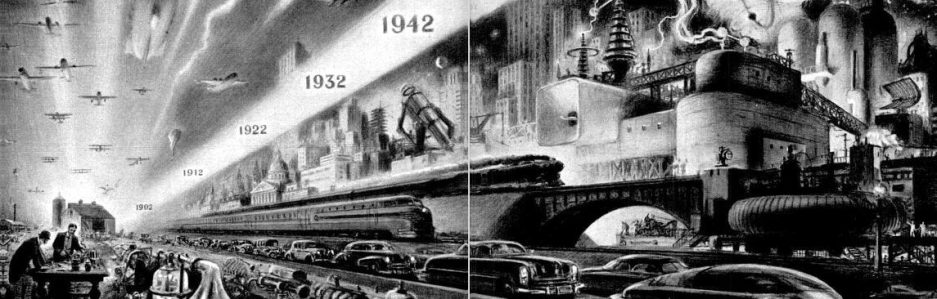
In 1968, the Foreign Policy Association published “Toward the Year 2018,” an edited volume of predictions about what technology would look like in fifty years. At the close of 2018, Jill Lepore has revisited those predictions in a short piece for the New Yorker.

Her general conclusion: “First, most of the machines that people expected would be invented have, in fact, been invented. Second, most of those machines have had consequences wildly different from those anticipated in 1968.”

Along the way, Lepore highlights some of the more interesting entries. For example, here’s her summary of what J. R. Pierce of Bell Labs had to say:

“The transmission of pictures and texts and the distant manipulation of computers and other machines will be added to the transmission of the human voice on a scale that will eventually approach the universality of telephony.” True! “What all this will do to the world I cannot guess,” Pierce admitted, with becoming modesty. “It seems bound to affect us all.”

Among the more prescient contributors, according to Lepore, was the M.I.T. political scientist Ithiel de Sola Pool, who believed that by 2018 “it will be cheaper to store information in a computer bank than on paper.” From this fact de Sola Pool further elaborated. In Lepore’s words,

“Tax returns, social security records, census forms, military records, perhaps a criminal record, hospital records, security clearance files, school transcripts . . . bank statements, credit ratings, job records,” and more would, by 2018, be stored on computers that could communicate with one another over a vast international network. You could find out anything about anyone, without ever leaving your desk. “By 2018 the researcher sitting at his console will be able to compile a cross-tabulation of consumer purchases (from store records) by people of low IQ (from school records) who have an unemployed member of the family (from social security records). That is, he will have the technological capability to do this. Will he have the legal right?”

“Pool declined to answer that question,” Lepore observed. “This is not the place to speculate how society will achieve a balance between its desire for knowledge and its desire for privacy,” he wrote.

Lepore doesn’t want to be too hard on those who hazard a guess at what the future will look like, but she finds in this refusal to think or accept responsibility the critical failure of all such visions of the future: “And that was the problem with 1968. People went ahead and built those things without worrying much about the consequences, because they figured that, by 2018, we’d have come up with all the answers.”

Lepore’s piece reminded me that at the conclusion of The Technological Society,  Jacques Ellul also commented critically on certain visions of the future from the 1960s. Writing about five years or so prior to the 1968 prognosticators, Ellul concluded a revised edition of The Technological Society by considering what some Russian and American scientists had, in 1960, predicted about technology in the year 2000.

“If we take a hard, unromantic look at the [predicted] golden age itself,” Ellul wrote, “we are struck with the incredible naiveté of these scientists.”

I wanted to pull some excerpts from the following, but found it hard to do without diminishing the force of Ellul’s prose. So here is a rather long passage for you to consider. I find that it holds up rather well and continues to resonate.

“They say, for example, that they will be able to shape and reshape at will human emotions, desires, and thoughts and arrive scientifically at certain efficient, pre-established collective decisions. They claim they will be in a position to develop certain collective desires, to constitute certain homogeneous social units out of aggregates of individuals, to forbid men to raise their children, and even to persuade them to renounce having any. At the same time, they speak of assuring the triumph of freedom and of the necessity of avoiding dictatorship at any price. They seem incapable of grasping the contradiction involved, or of understanding that what they are proposing, even after the intermediary period, is in fact the harshest of dictatorships. In comparison, Hitler’s was a trifling affair.

When our savants characterize their golden age in any but scientific terms, they emit a quantity of down-at-the-heel platitudes that would gladden the heart of the pettiest politician. Let’s take a few samples. ‘To render human nature nobler, more beautiful, and more harmonious.’ What on earth can this mean? What criteria, what content, do they propose? Not many, I fear, would be able to reply. ‘To assure the triumph of peace, liberty, and reason.’ Fine words with no substance behind them. ‘To eliminate cultural lag.’ What culture? And would the culture they have in mind be able to subsist in this harsh social organization? ‘To conquer outer space.’ For what purpose? The conquest of space seems to be an end in itself, which dispenses with any need for reflection.

We are forced to conclude that our scientists are incapable of any but the emptiest platitudes when they stray from their specialties. It makes one think back on the collection of mediocrities accumulated by Einstein when he spoke of God, the state, peace, and the meaning of life. It is clear that Einstein, extraordinary mathematical genius that he was, was no Pascal; he knew nothing of political or human reality, or, in fact, anything at all outside his mathematical reach. The banality of Einstein’s remarks in matters outside his specialty is as astonishing as his genius within it. It seems as though the specialized application of all one’s faculties in a particular area inhibits the consideration of things in general. Even J. Robert Oppenheimer, who seems receptive to a general culture, is not outside this judgment. His political and social declarations, for example, scarcely go beyond the level of those of the man in the street. And the opinions of the scientists quoted by tExpress are not even on the level of Einstein or Oppenheimer. Their pomposities, in fact, do not rise to the level of the average. They are vague generalities inherited from the nineteenth century, and the fact that they represent the furthest limits of thought of our scientific worthies must be symptomatic of arrested development or of a mental block. Particularly disquieting is the gap between the enormous power they wield and their critical ability, which must be estimated as null. To wield power well entails a certain faculty of criticism, discrimination, judgment, and option. It is impossible to have confidence in men who apparently lack these faculties. Yet it is apparently our fate to be facing a ‘golden age’ in the power of sorcerers who are totally blind to the meaning of the human adventure. When they speak of preserving the seed of outstanding men, whom, pray, do they mean to be the judges. It is clear, alas, that they propose to sit in judgment themselves. It is hardly likely that they will deem a Rimbaud or a Nietszche worthy of posterity. When they announce that they will conserve the genetic mutations which appear to them most favorable, and that they propose to modify the very germ cells in order to produce such and such traits; and when we consider the mediocrity of the scientists themselves outside the confines of their specialties, we can only shudder at the thought of what they will esteem most ‘favorable.'”

After all of this, Ellul adds, “None of our wise men ever pose the question of the end of all their marvels. The ‘wherefore’ is resolutely passed by.”

“But what good is it to pose questions of motives? of Why?” Ellul concludes. “All that must be the work of some miserable intellectual who balks at technical progress. The attitude of the scientists, at any rate, is clear. Technique exists because it is technique. The golden age will be because it will be. Any other answer is superfluous.”

In other words, Ellul already knew in 1964 what Lepore concludes at the end of 2018: “People went ahead and built those things without worrying much about the consequences.”


If you’ve appreciated what you’ve read, consider supporting or tipping the writer.