
Checking In and Looking Forward

In the past month, I’ve made exactly two new posts. A mere ten of any consequence since May. This is no way to run a blog, I realize. I’m sure you’ve not been losing any sleep over my relative silence, but I thought I’d check in just to let everyone know that I’m still alive and this site hasn’t gone dark.

The truth is that posting will probably remain light. The school year is back in full swing, and my teaching responsibilities keep me pretty busy. On top of that, I’m getting back to work on my doctoral program after a year’s respite. The next hoop I’ll be jumping through will be comprehensive exams, which I hope to knock out between this semester and next. Following that I’ll be entering the dread dissertation stage, which may or may not drag on indefinitely. Hopefully not. I’ll be focusing my research on what I’ve called, in a more popular vein on this site, a Borg Complex. Just in case you were wondering. It turns out to be a good time to be working on the Borg Complex. It’s on display quite a bit lately, especially in discussions about MOOCs and the future of education, robotics and automation, Google Glass, drones, and surveillance technology. For an example of the last of these, see my comment on this thread.

Given all of this, I’ve been less active online than I have been in the past. In fact, I began to wonder where those who participate more actively online find the time. I’ve not looked at the existing research on this, but I’m curious about the demographics of Twitter in particular. I tend to follow academics and folks who are in the tech writing business. Naturally, these folks tend to spend a lot of time sitting in front of a screen as part of their daily activities. It is their work in some regards to be active online. It’s easier for them to participate online regularly throughout the day. This was the case for me when I was a full time grad student for a semester or two and only working a minimal number of hours otherwise. It struck me, then, that Twitter, even if you work hard to avoid creating a filter bubble, is still a kind of socio-economic bubble by default, at least when it comes to those who participate actively since they will tend to be those whose work and family circumstances allow a certain degree of temporal freedom. I may be completely off about that, as I’m just extrapolating from my own experience. All I know is that my particular schedule leaves very little time for social media participation.

Time constraints alone, however, have not accounted entirely for my relative silence of late. You may remember a post from mid-July in which I laid out 11 practical steps I was taking to achieve a relatively healthy and productive relationship with “the Internet.” I’ve been fairly good about sticking to those guidelines and, as a kind of side effect, I’ve found myself a little less eager to write blog posts, post links on tumblr, or participate on Twitter.

In fact — and yes, this is strictly anecdotal and subjective — I have found that the better I stuck to these 11 guidelines that I set up for myself, the better I’ve felt generally. I found there to be a noticeable difference to the feel of a day in which I stuck to the guidelines, particularly after I’d done so for two or three days running, and the feel of a day in which, for whatever reason, I didn’t. And, in my estimation, the difference was a positive one as you may have already assumed.

One last consideration: I’ve also made a decision to focus what time I do have for writing on projects for other sites and journals.

All of this to say that, while I’m not abandoning this site, the posting will likely remain light. Of course, I’ve said that in the past only to then find myself suddenly posting more frequently. Who knows.

Whatever the case, thanks as always for dropping by. I hope all is well in your little corner of the world, wherever that happens to be.

Life: The First Person Video Game

Still from Kluwe's Youtube video
Still from Kluwe’s Youtube video

How will Google Glass transform professional football? Oakland Raiders punter Chris Kluwe is on the case. He is the NFL’s first Google Glass Explorer, a cadre of early adopters hand-picked by Google based on their response to the prompt “If I had Glass …”

Kluwe has had limited experience with Glass so far, mainly using Glass to record drills, but it’s been enough to give Kluwe a lot of ideas about how Glass could be deployed in the future. Alex Konrad of Forbes interviewed Kluwe and described part of what the punter has envisioned so far:

In Kluwe’s future NFL, players will wear clear visors that that can project to them the next play to run as they are getting back into position from the last one. Quarterbacks can get a flashing color when a receiver is very open or which area is about to become a good place to look. Running backs could be alerted that a new path to run has just opened up.

Here’s the striking thing about this entirely plausible development. For years, video games have been striving to capture the look and feel of the game as it’s played on the field. What Kluwe has described is a reversal of roles in which now the game as it is played on the field strives to capture the look and feel of playing a video game.

The closest analogy to the experience of the world through Google Glass may be the experience of playing a first-person video game.

This little insight carries wide-ranging implications that are not limited to the experience of professional athletes. A generation that has grown up playing first person shooters and role-playing video games is on the verge of receiving a tool that will make the experience of everyday life feel more like the experience of playing a game. This brings an entirely new meaning to gamification and it raises all sorts of intriguing, serious, and possibly disturbing possibilities.

As early as 1981, the philosopher Jean Baudrillard claimed that images and simulations, which had traditionally copied reality, were now beginning to precede and determine reality. Recalling a famous story by Jorge Louis Borges in which an empire commissions a map that is to be a faithful 1:1 representation of its territory, Baudrillard believed that now the map preceded the territory. Glass is poised create yet another realization of Baudrillard’s critique, except that now it is the game that will precede the real-world experience.

_________________________

UPDATE: Nick Carr adds the following observation in the comments below, “You might argue that this reversal is already well under way in warfare. Video war games originally sought to replicate the look and feel of actual warfare, but now, as more warfare becomes automated via drones, robots, etc., the military is borrowing its interface technologies from the gaming world. War is becoming more gamelike.”

11 Things I’m Trying To Do In Order To Achieve a Sane, Healthy, and Marginally Productive Relationship With the Internet

It’s fair to say that when I write about the Internet or digital devices, my tone tends toward the cautionary, and that’s probably understating the case. But, as my wife would be quick to confirm, I don’t always practice what I preach.

I wanted to do something about this, so I created a list of digital disciplines that I’ll be trying to stick to in a serious, but not quite puritanical fashion.

Of course, I don’t think these digital disciplines will be universally applicable. You may find them entirely implausible given your own circumstances, or you may find them altogether unnecessary. All I’m claiming for them is this: given my priorities and my circumstances, I’ve found it helpful to articulate and implement these disciplines in order to achieve what I would characterize as a healthy relationship to Internet culture.

[Aside: I’m using the awkward expression “Internet culture” as shorthand for the whole range of diverse artifacts and practices that accumulate around the Internet and the devices we use to access it. I realize that the very idea of “the Internet” is contested¹, but trying to delineate it here in a rigorous academic manner would be even more tedious than this aside.]

Before getting to the digital disciplines, though, let me first lay out some basic underlying assumptions. You’ll probably find some of these debatable, but at least you’ll know where I’m coming from.

  • Time is a limited resource, and I would rather treat it as a gift than as an enemy.
  • While I have no interest in denying the authenticity, much less the reality, of online experience, I do privilege face-to-face experience (or “fully embodied experience,” which is not to say that online experience is disembodied), all things being equal.
  • Relatedly, we are not less than our bodies; so how our bodies, not just our minds, interact with the Internet and Internet-enabled devices matters.
  • While it may be difficult to articulate a precise theoretical distinction between online and offline experience, the terms attempt to get at real distinctions with practical consequences.
  • Trying to “keep up” online is a joyless, Sisyphean undertaking that is best abandoned in principle.
  • “All of humanity’s problems stem from man’s inability to sit quietly in a room alone.” (Blaise Pascal)
  • I don’t go in for the whole trans-/post-human/cyborg thing. As Douglas Rushkoff recently put it, “I’m on team human here. Call that egotistical, but it’s the only team I know.”
  • “A life spent entirely in public, in the presence of others, becomes, as we would say, shallow.  While it retains visibility, it loses the quality of rising into sight from some darker ground which must remain hidden if it is not to lose its depth in a very real, non-subjective sense.” (Hannah Arendt)

Make of those what you will. Here, finally, is the list. Remember, I am the primary audience for this advice.

1. Don’t wake up with the Internet. Have breakfast, walk the dog, read a book, whatever … do something before getting online. Think of it as a way of preparing – physically, mentally, emotional, morally, etc. – for all that follows.

2. Don’t remain ambiently connected to your email account. Close the email tab/app. Check in two or three times a day for a fixed period of time. The same holds for FB, Twitter, etc.

3. Sit on a link for a few hours or even a day before sharing. If it’s not worth sharing then, it probably wasn’t worth sharing in the first place. Don’t add to the noise.

4. Don’t take meals with the Internet. Log off, leave devices behind, and enjoy your meal as an opportunity recoup, physically and mentally. If you’re inside all day, take your lunch outside. Enjoy the company of others, or take the chance to sit in silence for a few minutes.

5. Breathe. Seriously.

6. Do one thing – one whole, complete thing – at a time whenever it’s reasonable to do so. If writing an email, write it all at once. If reading an article, read it straight through. If a task can’t be completed in one sitting, at least work on it for a reasonable amount of time without interruption. Resist, in other words, the allure of the multitasking myth. It’s the siren song of our age, and it will shipwreck your mind.

7. Clear the RSS feed at the end of each day. If it didn’t get read, life will go on. This is a hard one for me; I want to read it all, stay on top of things, etc. If I don’t clear the feed, though, I end up with a pile of information that eventually snowballs to unmanageable proportions anyway. What’s more, deleting potentially interesting, unread items each day functions as a happy, cathartic gesture of liberation.

8. Turn off all notifications that threaten to interrupt or distract. Mentally, we tend to respond to these with Pavlovian alacrity. Emotionally, they are not unlike our own little versions of Gatsby’s green light. In either case, it’s a ruinous habit.²

9. Turn devices off when spending time with others. Also, shut the laptop when speaking to another person. This may seem quaint or reactionary or nostalgic or antiquated or judgmental or curmudgeonly. I see it as a way of remaining minimally civil and decent, whether or not I’m accorded the same civility and decency in return. If you must attend to a call or text, politely indicate as much and do so. Better that than surreptitiously attending to your device while still attempting to give off the impression of attentiveness. That’s a meaningless charade, and everyone involved knows it.

10. Log-off of social media sites after visiting them. The extra step to log-in makes it slightly less tempting to click over when a craving for distraction strikes. Don’t underestimate the effectiveness of these little digital speed-bumps.

11. Don’t go to bed with the Internet. Here’s why.

A few years ago, Umberto Eco said, “We like lists because we don’t want to die.” Perhaps that’s a bit too melodramatic for this particular list. Certainly, I’ve attached no death-defying hopes to it. But I do think following through on these digital disciplines will help me make better use of this life and take more pleasure in it.

If you’ve got your own similar list of digital disciplines, share them in the comments below. If they’re useful to you, chances are others would find them useful too.

_________________________________________________________________

¹See the comment thread on this post on Nick Carr’s blog.
²Self-plagiarism alert. I’ve used this language before, here and here.

Using, Rather Than Being Used by Our Devices

walden

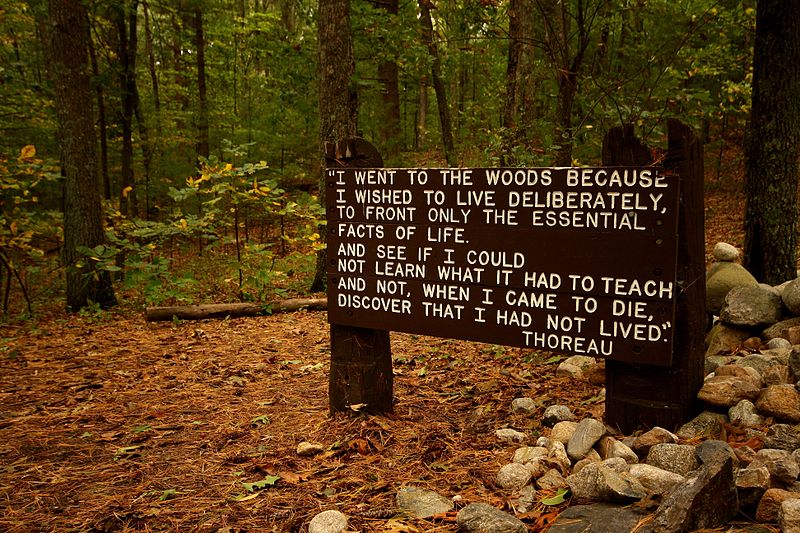
Long before the Internet and the smartphone, Henry David Thoreau – who, incidentally, was born this day, 1817 – decided to go off the grid. Granted, there was no “grid” at the time in the modern sense and he didn’t go very far in any case, but you get the point. Overwhelmed and not a little disgusted with the accoutrements of civilization, Thoreau set out to live a simple life in accord with nature.

In the first chapter of Walden, Thoreau explained:

The very simplicity and nakedness of man’s life in the primitive ages imply this advantage, at least, that they left him still but a sojourner in nature. When he was refreshed with food and sleep, he contemplated his journey again. He dwelt, as it were, in a tent in this world, and was either threading the valleys, or crossing the plains, or climbing the mountain-tops. But lo! men have become the tools of their tools.

Thoreau is the patron saint of all of those who have ever thought about quitting the Internet and lobbing Smartphones into a pond if only we could find one. This means most of us have probably lit a candle to Thoreau at some point in our relentlessly augmented lives.

Within the last few days, stories about the Walden-esque Camp Grounded, sponsored by a group called Digital Detox, have been popping up. Already, you’ve guessed that Camp Grounded was an opportunity to spend some time off the proverbial grid: no cellpones, no tablets, no computers, and no watches.

Writing about the event at Gigamon, Matthew Ingram offered what has by now become a predictable three-step response to these sorts of events or programs, or to most any critique of the Internet or digital devices.

Step 1: Illustrate how similar concerns have always existed. People have felt this way before, etc.*

Step 2: Deconstruct the line between offline and online activity. Online activities are no less “real” or “genuine” than offline activities …**

Step 3: Locate the “real” problem somewhere else altogether. It’s not the Internet, it’s _______________.***

Pivoting on the case of Paul Miller, a writer for Verge who spent a year sans Internet only to discover that there are also analog forms of wasting time, Ingram concluded,

Is it good to disconnect from time to time? Of course it is. And there’s no question that the pace of modern life has accelerated over the past decade, with so many sources of real-time activity that we feel compelled to participate in, either because our friends and family are there or because our jobs require it. But disconnecting from all of those things isn’t going to magically transform us into better people somehow — all it will do is reveal us as we really are.

But here’s the thing. While there are limits to the malleability of our character and personality, who “we really are” is a work in progress. We are now who we have been becoming. And who we are becoming is, in part, a product of habits and dispositions that arise out of our daily actions and practices, including our digitally mediated activities.

The problem with the three step strategy outlined above is that it doesn’t really erase the difference between online and offline experience. While it waves a rhetorical hand to that effect, it nevertheless retains the distinction but dismisses the significance of online experience and digital devices.

But online experience and digital devices, precisely because they are “real,” matter. Ingram is right to say that “disconnecting … isn’t going to magically transform us into better people somehow.” But for some people, under certain conditions, it may in fact be an important step in that direction.

Long before the Internet or even Walden, Aristotle taught that the mean between two excesses was the ideal to aim for. So, between the excesses of gluttony and ascetic deprivation, there was the ideal use of food for both pleasure and nutrition. This ideal use stood between two extremes, but it wasn’t simply a matter of splitting the difference. According to Aristotle, the mean was relative: it depended on each person’s particular circumstances.

But the point wasn’t simpy to hit some artificial middle ground for its own sake — it was to learn how to use things without being used by them. Or, as Thoreau put it, to learn how not to become the tool of our tools.

That’s what we’re looking for in our relationship to the Internet and our digital devices: the sense that we are using them toward good, healthy, and reasonable ends. Instead, many people feel as if they are being used by their devices. The solution is neither reactionary abstinence, nor thoughtless indulgence. What’s more, there’s no one answer for it that is universally applicable. But for some people at some times, taking extended of periods of time away from the Internet may be an important step toward using, rather than being used by it. The three-step rhetorical strategy used to dismiss those who raise questions about our digital practices won’t help at all.

_______________________________________

*Sometimes these historical analogies are misleading, sometimes they are illuminating. Never are they by themselves cause to dismiss present concerns. That would be sort of like saying that people have always been struck by diseases, so we shouldn’t really be too worried about it.
**A lot of pixels have already been spent on this one. E.g., here and here.
***I’ve actually written something similar, but the key is not to lose sight of how devices do play a role in the phenomenon.

Meta-Medium

As you know, I’ve been playing around with a new writing platform called Medium. A few days ago, I wrote up some thoughts on the platform in post titled, “Meta-Medium.” If you’re curious about the platform, give it a read. If you do, make sure to open up the notes by clicking on the small icon to the top right of each paragraph. Admittedly, I may have gotten a bit note-happy; I found it a very tempting feature. In any case, some important points are contained in them.